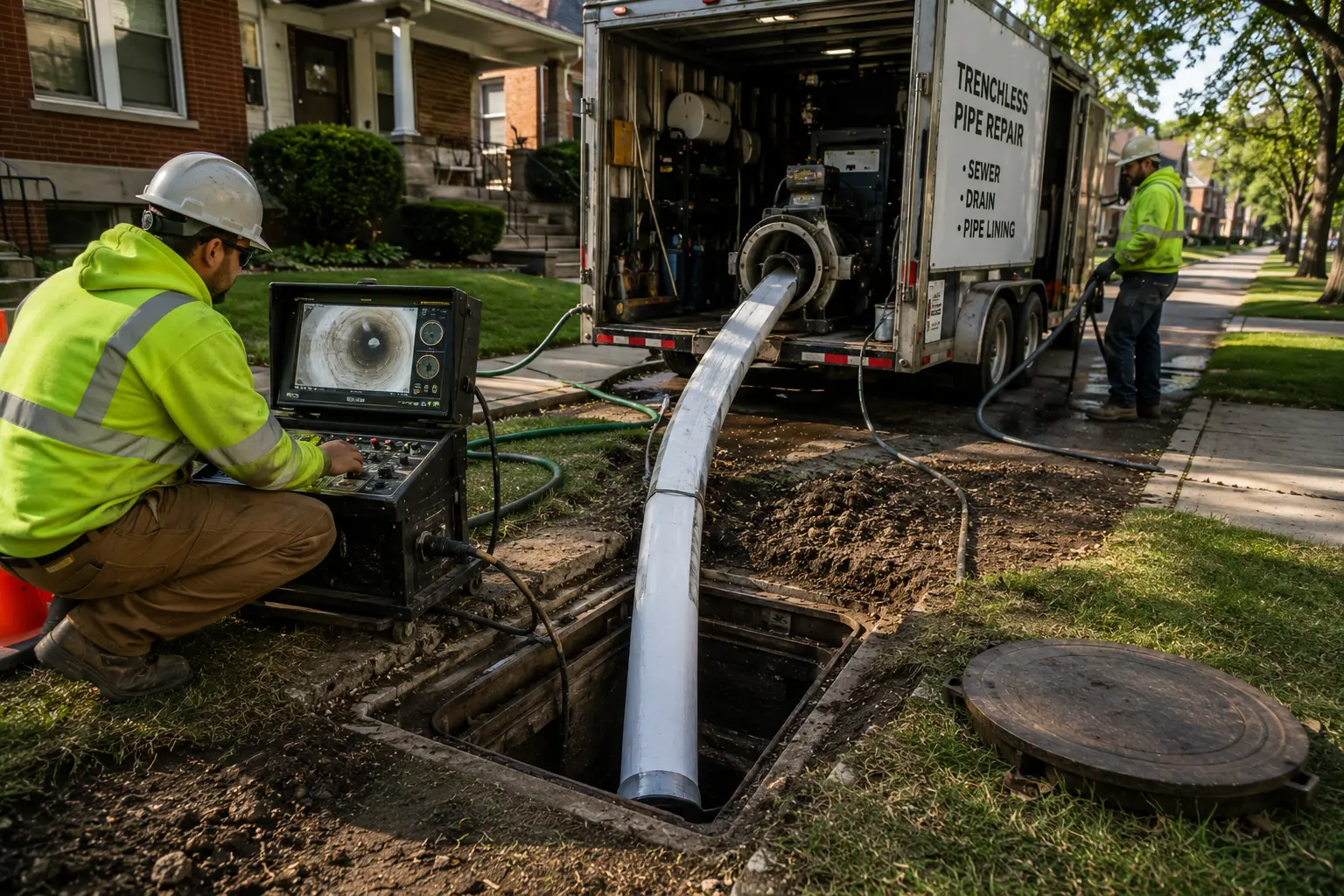
Trenchless sewer repair in Chicago is a less invasive way to repair or replace certain sewer lines without digging a full open trench across the property. Instead of exposing the entire pipe, trenchless methods use access points to rehabilitate the existing line or install a new pipe with reduced excavation.
For Chicago homeowners, this can be especially appealing when a sewer line runs beneath a driveway, sidewalk, patio, landscaped yard, finished basement area, or narrow urban lot. However, trenchless repair is not always the right solution. The condition of the existing pipe, the type of damage, access limitations, and local requirements all affect whether trenchless work is practical.
This guide explains how trenchless sewer repair works, when it makes sense, when it does not, how it compares with excavation, and what Chicago homeowners should consider before choosing a repair method. For more local sewer resources, visit the Chicago Neighborhood Sewer Guides.
Key Takeaways
- Trenchless sewer repair can reduce digging, surface damage, and restoration needs.
- The two most common trenchless approaches are pipe lining and pipe bursting.
- Trenchless methods are not suitable for every damaged sewer line.
- A sewer camera inspection is usually necessary before determining eligibility.
- Collapsed pipes, severe misalignment, and major belly sections may require excavation.
- Chicago properties with sidewalks, alleys, patios, mature landscaping, or limited access may benefit from trenchless options when conditions allow.
Is Trenchless Sewer Repair a Good Option in Chicago?
Trenchless sewer repair can be a good option for Chicago homes when the sewer line is damaged but still has enough structural integrity or access conditions to support lining or pipe bursting. It may help reduce excavation through yards, sidewalks, driveways, and tight urban spaces. However, it is not ideal for every sewer problem. A camera inspection is usually needed to confirm whether trenchless repair is appropriate.
What Is Trenchless Sewer Repair?
Trenchless sewer repair refers to methods that repair, rehabilitate, or replace underground sewer lines with limited digging. Instead of opening a long trench along the entire pipe path, the work is usually performed through existing cleanouts, small access pits, or targeted excavation points.
The goal is to restore sewer function while reducing disruption to the property surface.
Trenchless repair may be considered when a sewer line has:
- Cracks
- Root intrusion
- Joint separation
- Corrosion
- Limited structural damage
- Sections that need rehabilitation or replacement
It is one option within the broader category of Sewer Repair in Chicago, but it should be evaluated alongside traditional repair and replacement methods.
The Main Types of Trenchless Sewer Repair
Most residential trenchless sewer projects fall into two main categories: pipe lining and pipe bursting.
Pipe Lining
Pipe lining, often called cured-in-place pipe lining, involves inserting a resin-coated liner into the existing sewer pipe. Once positioned, the liner cures and forms a new interior pipe surface inside the old pipe.
Pipe lining may be used for:
- Cracked sewer pipes
- Minor root intrusion
- Small gaps or separations
- Aging pipes with manageable structural defects
- Reducing future root entry points
Because lining relies on the existing pipe as a host structure, the old pipe usually must be intact enough to support the liner.
Pipe Bursting
Pipe bursting involves pulling a new pipe through the path of the old sewer line while breaking the existing pipe apart. This method replaces the pipe rather than simply lining it.
Pipe bursting may be considered when:
- The existing pipe is too damaged for lining but still follows a usable path
- A full pipe replacement is needed
- Open trench excavation would cause significant disruption
- Access pits can be created at appropriate locations
Pipe bursting still requires excavation at entry and exit points, but it may avoid digging along the entire line.
Trenchless Repair vs. Traditional Excavation
Traditional sewer repair requires digging down to expose the damaged section of pipe. Trenchless methods reduce the amount of digging, but they do not eliminate all excavation in every case.
| Factor | Trenchless Sewer Repair | Traditional Excavation |
|---|---|---|
| Digging | Usually limited to access points | May require a full trench |
| Surface disruption | Often less disruptive | Can affect yards, sidewalks, driveways, and landscaping |
| Suitable for collapsed pipes | Sometimes limited | Often more practical |
| Pipe access | Requires usable access points | Direct access to damaged pipe |
| Diagnosis needed | Camera inspection is essential | Camera inspection is still helpful |
| Restoration needs | Usually reduced | Often greater |
When the pipe is too severely damaged for trenchless work, homeowners may need to consider Sewer Line Replacement in Chicago.
When Trenchless Sewer Repair Makes Sense
Trenchless repair can be a strong option when the sewer line problem is serious enough to require more than basic cleaning but not so severe that the pipe path is unusable.
Good Candidates for Trenchless Repair
- Cracked clay or cast iron sewer lines
- Recurring root intrusion through joints or cracks
- Pipe sections beneath hardscaping
- Lines running under landscaping the homeowner wants to preserve
- Properties with limited excavation access
- Homes where surface restoration would be expensive or disruptive
Situations Where Trenchless Repair May Help
Trenchless methods may be especially useful when a sewer line runs under a driveway, sidewalk, garage slab, patio, mature tree area, or narrow side yard. Avoiding full excavation can reduce restoration work and disruption to daily life.
Important: Trenchless repair should not be chosen only because it sounds less disruptive. The pipe condition must support the method. A camera inspection should guide the decision.
When Trenchless Repair May Not Be Appropriate
Trenchless methods have limits. Some sewer lines are too damaged, misaligned, or restricted to repair without excavation.
Trenchless Repair May Not Work When:
- The pipe has fully collapsed
- The sewer line has severe offsets
- A major belly prevents proper flow
- The pipe has lost its original shape
- There is no suitable access point
- The line needs a grade correction
- The existing path cannot support lining or bursting
In these cases, traditional excavation may provide better access and a more reliable correction.
Chicago-Specific Considerations for Trenchless Sewer Repair
Chicago homes often present conditions that make trenchless repair appealing, but also more complex to evaluate.
Older Clay and Cast Iron Pipes
Many Chicago sewer lines were installed decades ago. Clay tile pipes are vulnerable to root intrusion and joint separation, while cast iron pipes can corrode and scale internally over time.
Mature Tree Roots
Tree-lined streets are common throughout Chicago. Roots can enter small defects and continue growing inside sewer lines. Lining may help seal root entry points when the pipe remains structurally suitable.
Sidewalks, Parkways, and Alleys
Many sewer lines pass near or beneath public or shared surfaces. Depending on the location and scope of work, permits, inspections, or coordination may be required.
Narrow Urban Lots
Dense lots can limit equipment access. Trenchless methods may reduce disruption, but contractors still need workable access points for equipment and materials.
Basements and Building Layout
Some Chicago homes have sewer access through basements, cleanouts, or exterior points. The available access can influence which trenchless methods are realistic.
Sewer conditions also vary by area. Homeowners comparing local conditions may find it useful to review Sewer Repair on Chicago’s North Side, Sewer Repair on Chicago’s South Side, and Sewer Repair on Chicago’s West Side.
How Contractors Decide Whether Trenchless Repair Is Possible
A trenchless recommendation should be based on inspection evidence, not assumptions. Homeowners should expect the evaluation to include several important details.
Camera Inspection
The inspection should show the pipe condition, damage type, and whether the line is open enough for equipment.
Pipe Material
Clay, cast iron, PVC, and other materials may respond differently to lining or bursting methods.
Pipe Diameter and Length
The sewer line must be compatible with the trenchless equipment and materials being used.
Access Points
Cleanouts, basement access, yard access, and excavation points all affect feasibility.
Pipe Grade
If the sewer line does not slope correctly, lining may not solve the underlying drainage issue.
Structural Condition
The existing pipe must either be strong enough to host a liner or suitable for replacement through pipe bursting.
Cost Factors for Trenchless Sewer Repair
Trenchless repair is not automatically cheaper or more expensive than excavation. The total cost depends on the repair method, pipe condition, access, restoration needs, and project complexity.
| Cost Factor | How It Affects the Project |
|---|---|
| Repair method | Lining and pipe bursting involve different labor, equipment, and material requirements. |
| Pipe length | Longer repair sections generally require more material and time. |
| Access conditions | Limited access may increase setup complexity or require targeted excavation. |
| Pipe condition | Severe damage may require additional cleaning, preparation, or excavation. |
| Surface restoration | Trenchless methods may reduce restoration, but access pits or interior work may still require repairs. |
| Permits and inspections | Some work may require approvals depending on project scope and location. |
Homeowners should compare the total project impact, not just the quoted repair price. A method that reduces driveway, sidewalk, or landscaping restoration may offer value even if the sewer work itself is not the lowest-cost option.
Trenchless Repair in Emergency Situations
Trenchless repair may be possible during urgent sewer problems, but emergencies can limit the options available. If sewage is backing up into the home or the line is completely blocked, the immediate priority is usually restoring safe drainage and determining the cause.
In some emergencies, cleaning or temporary flow restoration may happen before a long-term repair decision is made. If the inspection shows the pipe is still structurally suitable, trenchless repair may be considered. If the line is collapsed, excavation or replacement may be necessary.
Homeowners dealing with active sewage backup or complete drainage failure should review Emergency Sewer Repair in Chicago for urgent decision steps.
Questions to Ask Before Choosing Trenchless Repair
Trenchless repair can be a strong solution, but homeowners should understand exactly why it is being recommended.
- What did the camera inspection show?
- Is the pipe cracked, collapsed, offset, corroded, or root-damaged?
- Which trenchless method is being recommended?
- Why is this method better than excavation for this property?
- Will the repair correct the cause of the problem or only the symptom?
- Are any access pits required?
- What areas of the property will still be disturbed?
- Does the sewer line have proper slope?
- What restoration work is included?
- What documentation will be provided after the repair?
Common Mistakes Homeowners Make
Assuming Trenchless Means No Digging at All
Most trenchless projects still require access points. The difference is that they usually avoid a full trench along the entire sewer line.
Choosing Trenchless Without Confirming Pipe Condition
A camera inspection should confirm whether the line is suitable for lining or bursting.
Ignoring Pipe Grade Problems
If the sewer line has a major belly or slope issue, lining may not solve drainage problems.
Comparing Prices Without Comparing Restoration
Excavation may appear less expensive until driveway, sidewalk, landscaping, or interior restoration costs are considered.
Using Trenchless Repair for the Wrong Problem
Trenchless methods are useful in the right conditions, but they cannot fix every sewer defect.
Frequently Asked Questions
Is trenchless sewer repair available for older Chicago homes?
Often, yes. Many older homes may be candidates for trenchless repair if the sewer line is still structurally suitable. Clay and cast iron pipes may sometimes be lined or replaced through pipe bursting, depending on their condition.
Does trenchless sewer repair require digging?
Usually some digging is still required for access points, but trenchless methods often avoid digging a full trench across the property.
Can trenchless repair fix tree root problems?
It can help in some cases. Pipe lining may seal cracks and joints where roots entered, while pipe bursting can replace the damaged pipe. However, the correct approach depends on the severity of root damage and pipe condition.
Is trenchless repair cheaper than traditional excavation?
Not always. Trenchless repair may reduce restoration costs and property disruption, but the sewer repair itself can still involve specialized equipment and materials. Homeowners should compare the total project scope.
Can a collapsed sewer line be repaired trenchlessly?
Sometimes, but not always. A fully collapsed pipe may prevent lining equipment or bursting equipment from passing through the line. Excavation may be necessary in severe cases.
Will homeowners insurance cover trenchless sewer repair?
Coverage depends on the policy and the cause of the sewer damage. Some homeowners may have sewer backup or service line coverage, but age-related deterioration and maintenance issues may be excluded.
How do I know whether trenchless repair or replacement is better?
A sewer camera inspection should show the extent of damage, pipe material, and structural condition. If the problem is localized or suitable for rehabilitation, trenchless repair may work. If damage is widespread or the line has failed structurally, replacement may be more appropriate.
Conclusion
Trenchless sewer repair in Chicago can be a practical option for homeowners who need to repair or replace a damaged sewer line while reducing excavation and surface disruption. It can be especially valuable when sewer lines run beneath driveways, sidewalks, landscaping, patios, or tight urban spaces.
However, trenchless methods are not automatically the best choice for every sewer problem. The decision should be based on camera inspection findings, pipe condition, access options, slope, repair goals, and total project impact. When used in the right situation, trenchless repair can offer a less disruptive path to restoring sewer function.