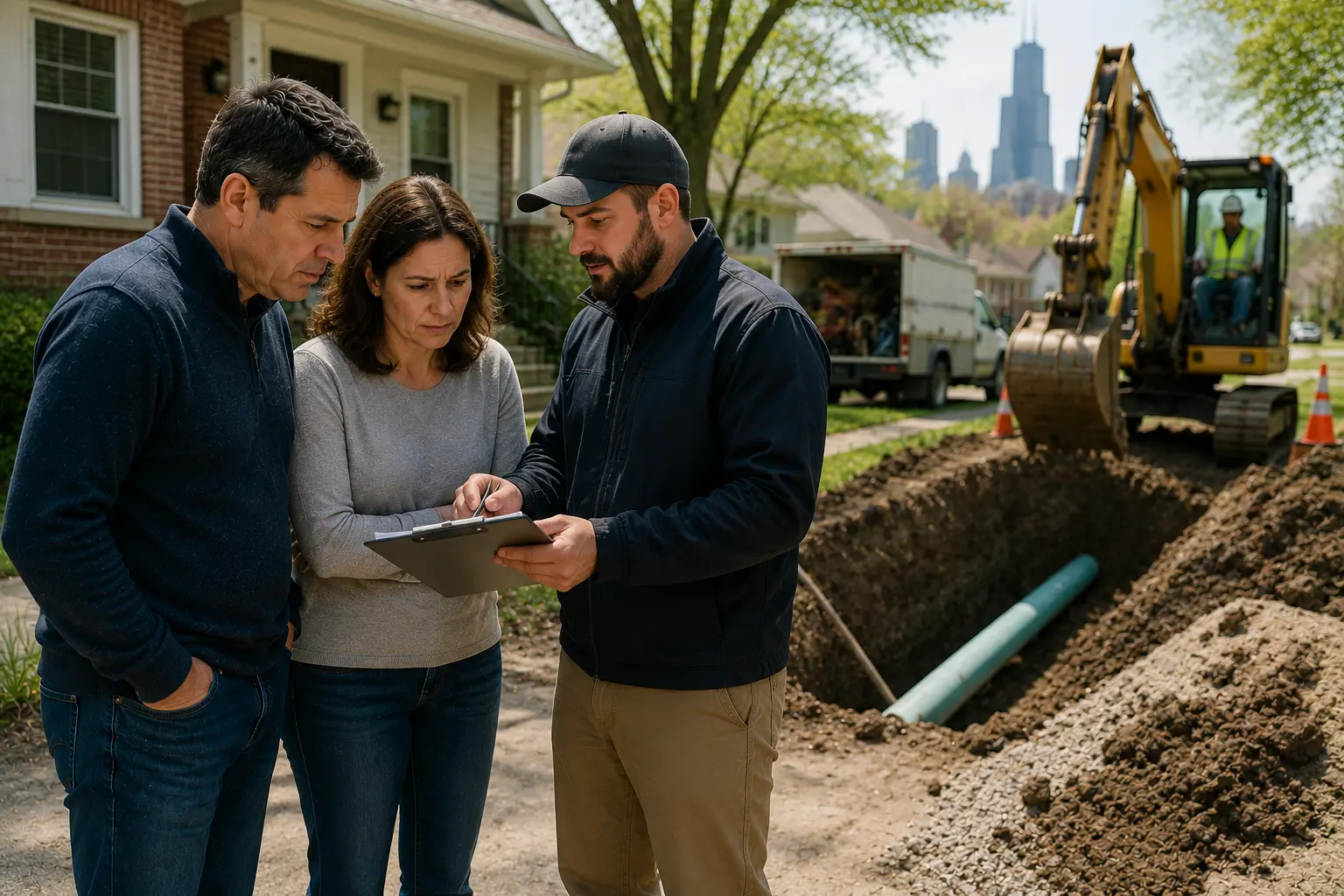
Sewer replacement can be a sudden and stressful expense for Chicago homeowners, especially when the problem involves a main line backup, collapsed pipe, repeated root intrusion, or a failed sewer lateral. Because the work is often urgent and expensive, many homeowners need to understand financing options before they can make a practical decision.
Sewer replacement financing may include savings, home equity options, personal loans, contractor financing, credit cards, insurance coverage, service line protection, local assistance programs, or a combination of several sources. The right choice depends on the urgency of the repair, the total project cost, credit profile, home equity, insurance situation, and how quickly the work must be completed.
This guide explains the most common sewer replacement financing options for Chicago homeowners, the tradeoffs to consider, and how to avoid rushing into a payment plan before understanding the full repair scope.
Key Takeaways
- Sewer replacement financing should be based on the full project scope, not only the first quote received.
- Options may include savings, personal loans, home equity financing, contractor financing, credit cards, insurance, or service line coverage.
- Emergency sewer work can limit decision time, so it helps to understand financing options before a full backup occurs.
- Insurance may help only in specific situations and often depends on policy language, endorsements, and the cause of damage.
- Chicago sewer replacement quotes can vary widely because of excavation, depth, permits, restoration, and pipe condition.
- Homeowners should compare interest rates, repayment terms, fees, exclusions, and whether the financing covers cleanup, repair, and restoration.
What Are the Main Sewer Replacement Financing Options for Chicago Homeowners?
Chicago homeowners may pay for sewer replacement with savings, a personal loan, home equity loan, home equity line of credit, contractor financing, credit card, insurance coverage, service line coverage, or a mix of several options. The best choice depends on how urgent the work is, how much the project costs, whether the homeowner has equity, and whether insurance or service line coverage applies.
For urgent sewer problems, homeowners may need fast access to funds. For planned sewer replacement, there may be more time to compare loan terms, get multiple estimates, check insurance, and avoid high-interest financing. The most important step is to understand the repair scope before committing to a payment plan.
For broader sewer pricing context, see the main Chicago sewer replacement cost guide.
Main Financing Options for Sewer Replacement
Cash or Emergency Savings
Using savings is the simplest option if funds are available. It avoids interest, loan applications, credit checks, and monthly payments. For homeowners with a strong emergency fund, paying directly may be the least complicated choice.
The downside is that sewer replacement can drain savings quickly. Homeowners should consider whether using cash leaves enough money for other urgent needs, especially if the sewer issue also involves basement cleanup, water damage, or temporary housing disruption.
Personal Loan
A personal loan may provide a fixed repayment schedule without using the home as collateral. This can be helpful when the sewer replacement is urgent and the homeowner needs a predictable monthly payment.
Personal loan terms vary based on credit, income, lender requirements, loan amount, and interest rate. Homeowners should compare the annual percentage rate, fees, repayment term, monthly payment, and whether there are penalties for early payoff.
Home Equity Loan
A home equity loan allows a homeowner to borrow against equity in the property. It may offer a fixed rate and fixed monthly payments, depending on the lender and loan terms. This can be useful for larger sewer replacement projects where the homeowner wants predictable repayment.
The tradeoff is that the home is used as collateral. Approval may take longer than a personal loan or credit card, which may not work well for an active sewer emergency.
Home Equity Line of Credit
A home equity line of credit, often called a HELOC, may provide flexible access to funds. Homeowners can draw what they need for sewer replacement, cleanup, restoration, or related repairs, depending on the line terms.
A HELOC may be useful when the final cost is uncertain, but rates can be variable, and repayment terms can change over time. Homeowners should understand the draw period, repayment period, rate structure, and fees before relying on this option.
Contractor Financing
Some sewer contractors offer financing through third-party lenders. This can be convenient because the financing is tied directly to the project. It may be useful when the homeowner needs fast approval or does not want to search lenders separately.
Convenience does not automatically mean the best terms. Homeowners should compare contractor financing against personal loans, home equity options, credit union loans, and other available sources.
Credit Cards
A credit card may be useful for inspection fees, deposits, small repairs, or short-term bridge payments. It may also be convenient during an emergency.
However, credit cards can become expensive if the balance is carried at a high interest rate. Homeowners should be cautious about putting a major sewer replacement on a card unless they have a clear payoff plan or a promotional rate they fully understand.
Common Sewer Financing Options Compared
| Financing Option | Potential Advantage | Potential Tradeoff |
|---|---|---|
| Savings | No interest or loan approval needed. | Can drain emergency funds quickly. |
| Personal loan | Fixed payments may be available without home collateral. | Rates depend on credit and lender terms. |
| Home equity loan | May work for larger projects with predictable payments. | Uses the home as collateral and may take longer to approve. |
| HELOC | Flexible funding when final costs are uncertain. | Rates may be variable and repayment terms can change. |
| Contractor financing | Convenient and may be fast during urgent projects. | Terms should be compared carefully against other options. |
| Credit card | Fast and useful for smaller or temporary costs. | Can be expensive if the balance is carried. |
| Insurance or service line coverage | May reduce out-of-pocket cost if coverage applies. | Coverage depends on policy language, cause of damage, and exclusions. |
Chicago-Specific Considerations
Older Sewer Lines
Many Chicago homes have older sewer lines made from clay, cast iron, or mixed materials from previous repairs. Older lines may be more vulnerable to cracks, joint separation, corrosion, root intrusion, and collapse.
Because older sewer problems can be structural, homeowners should avoid financing a major project until the cause and location of the failure are clearly explained. A camera inspection can help confirm whether repair, trenchless work, pipe bursting, or full replacement is being recommended for the right reason.
Basement Backups and Cleanup Costs
Chicago homes commonly have basements, and sewer problems often show up through floor drain backups, laundry tubs, lower-level bathrooms, or utility areas. If sewage enters the basement, the total financial impact may include both sewer work and cleanup.
Financing decisions should account for cleanup, damaged contents, drying, sanitation, and restoration if those costs are not covered by insurance.
Excavation, Sidewalks, Alleys, and Parkways
Chicago sewer replacement can involve narrow lots, sidewalks, alleys, parkways, concrete surfaces, and tight access. These conditions can make quotes vary significantly because one project may require more excavation and restoration than another.
Before financing the job, homeowners should confirm whether the estimate includes excavation, permits, backfill, concrete replacement, sidewalk repair, landscaping, or other restoration.
Emergency Timing
If sewage is actively backing up, homeowners may not have the luxury of waiting weeks for financing approval. Emergency timing can make contractor financing, credit cards, or short-term funding more tempting.
That does not mean every emergency requires immediate full replacement. In some cases, emergency cleaning may restore flow temporarily while the homeowner gets inspection results and compares long-term options.
Insurance and Service Line Coverage
Some homeowners may have sewer backup coverage, water backup coverage, or service line coverage. These are not the same thing, and each policy may treat cleanup, excavation, pipe replacement, and interior damage differently.
Homeowners should ask the insurer what is covered, what is excluded, what documentation is needed, and whether work must be approved before it begins.
Financing Repair vs Replacement
Financing can make a large sewer project possible, but it can also make it easier to approve more work than needed. The repair-versus-replacement decision should still be based on evidence.
A small repair may be the better financial decision when the problem is isolated. Replacement may be more practical when the line has multiple defects, recurring roots, collapse, or repeated backups.
| Situation | Repair Financing May Make Sense | Replacement Financing May Make Sense |
|---|---|---|
| One isolated defect | A smaller loan or cash payment may address the problem. | May not be necessary if the rest of the line is sound. |
| Recurring root intrusion | Temporary cleaning may buy time. | Replacement may reduce repeated emergency costs if pipe failure is widespread. |
| Collapsed pipe | Repair may be limited if the pipe has failed structurally. | Replacement may be needed to restore reliable flow. |
| Several previous repairs | Another small repair may only delay the issue. | A larger financed project may be more practical long term. |
| Emergency backup | Short-term funding may cover cleaning and inspection. | Longer-term financing may be needed if replacement is confirmed. |
Important Homeowner Note
Financing should follow diagnosis. Before borrowing for replacement, ask what the camera inspection showed, where the defect is located, and whether a smaller repair would reasonably solve the problem.
How to Compare Financing Offers
Not all financing offers are equal. A low monthly payment can look attractive, but the total cost may be higher if the term is long, the rate is high, or fees are added.
Before choosing a financing option, compare:
- Annual percentage rate
- Monthly payment
- Total repayment cost
- Loan term
- Origination or processing fees
- Prepayment penalties
- Deferred interest terms
- Whether approval is guaranteed or conditional
- Whether the loan is secured by the home
- How quickly funds are available
- Whether the financing covers cleanup, permits, and restoration
If the project cost is difficult to manage, it may also help to read how to pay for sewer line replacement without draining your savings.
Common Mistakes and Warning Signs
Mistake: Financing Before Understanding the Scope
Homeowners should understand what work is being financed. A quote should explain the pipe problem, repair method, footage, depth, permits, excavation, and restoration.
Mistake: Comparing Monthly Payments Only
A lower monthly payment may come with a longer term or higher total cost. Compare the total repayment amount, not just what fits into the monthly budget.
Mistake: Assuming Insurance Will Reimburse Everything
Insurance coverage depends on the policy and cause of damage. Some policies exclude wear and tear, root intrusion, deterioration, or underground service line issues unless specific coverage exists.
Mistake: Ignoring Cleanup and Restoration Costs
Sewer replacement financing may not cover basement cleanup, damaged contents, concrete replacement, or landscaping unless those items are included in the loan amount or estimate.
Mistake: Rushing Into Full Replacement During an Emergency
Emergency backups are stressful, but cleaning and inspection may sometimes provide enough time to compare replacement quotes and financing options. If the issue is urgent, review emergency sewer repair cost in Chicago to understand how after-hours pricing can affect the first bill.
Warning Signs That Financing May Need Careful Review
- The quote is vague or does not explain what is included
- The financing offer focuses only on low monthly payments
- Restoration, permits, or cleanup are excluded
- The contractor recommends replacement without inspection evidence
- The loan has deferred interest terms that are unclear
- The homeowner is being pressured to decide immediately
- Insurance coverage has not been confirmed
- Multiple quotes are thousands of dollars apart with no clear explanation
Decision Point
If the sewer line is actively backing up, immediate action may be necessary. But if the home can be stabilized first, homeowners may have more time to compare estimates, insurance options, and financing terms before approving a major replacement.
What Should Be Included Before Financing Sewer Replacement?
Before financing a sewer replacement project, homeowners should make sure the estimate and diagnosis are clear. Borrowing money for an unclear scope can create problems if the final cost changes later.
Before signing a financing agreement, ask whether the sewer estimate includes:
- Camera inspection findings
- The section of sewer line being repaired or replaced
- The approximate footage and depth
- The repair or replacement method
- Pipe material being installed
- Permit and inspection responsibility
- Excavation, backfill, and compaction
- Concrete, driveway, sidewalk, lawn, or basement slab restoration
- Cleanup and debris removal
- Conditions that could increase the final cost
- Whether emergency work and permanent work are separate charges
- Whether insurance or service line coverage may apply
If the estimates are far apart, review why sewer replacement quotes in Chicago can vary by thousands before choosing the lowest or easiest financing option.
FAQ About Sewer Replacement Financing Options
Can sewer replacement be financed?
Yes. Homeowners may use personal loans, home equity loans, HELOCs, contractor financing, credit cards, savings, insurance proceeds, or a combination of options. The right choice depends on project cost, urgency, credit, equity, and coverage.
Is contractor financing a good option?
It can be convenient, especially during urgent sewer work, but homeowners should compare the interest rate, repayment term, fees, and total cost against other financing sources before choosing it.
Will homeowners insurance pay for sewer replacement?
Coverage depends on the policy, cause of damage, and whether the homeowner has sewer backup or service line coverage. Many policies exclude wear and tear, deterioration, and root intrusion unless specific coverage applies.
Should I finance repair or full replacement?
That depends on the pipe condition. Repair may make sense for one isolated defect. Replacement may be more practical if the line has collapse, multiple cracks, recurring root intrusion, poor slope, or repeated backups.
Can trenchless sewer replacement be financed?
Often, yes, if the contractor or lender offers financing for the project. Homeowners should still confirm whether the trenchless method is suitable and whether the financing covers access pits, cleanup, permits, and restoration.
What should I do if sewer replacement is an emergency?
First, focus on stabilizing the backup and understanding the cause. If possible, separate emergency cleaning from permanent replacement decisions. Then compare financing terms, insurance coverage, and the written repair scope.
What Chicago-specific issues can affect how much I need to finance?
Older pipe, basements, tree roots, narrow lots, sidewalks, alleys, parkways, deep sewer laterals, concrete restoration, permits, and cleanup after backups can all increase the total amount needed.
Conclusion
Sewer replacement financing options for Chicago homeowners include savings, personal loans, home equity products, contractor financing, credit cards, insurance, service line coverage, and combinations of these sources. The best option depends on urgency, project scope, repayment terms, and whether coverage applies.
The most important step is to avoid financing an unclear project. Homeowners should understand the camera inspection findings, repair method, excavation needs, permits, restoration, and possible exclusions before agreeing to a major payment plan.
For Chicago homeowners, sewer financing is not only about finding money quickly. It is about choosing a payment option that fits the actual sewer problem, protects the household budget, and avoids turning a rushed repair into a long-term financial burden.