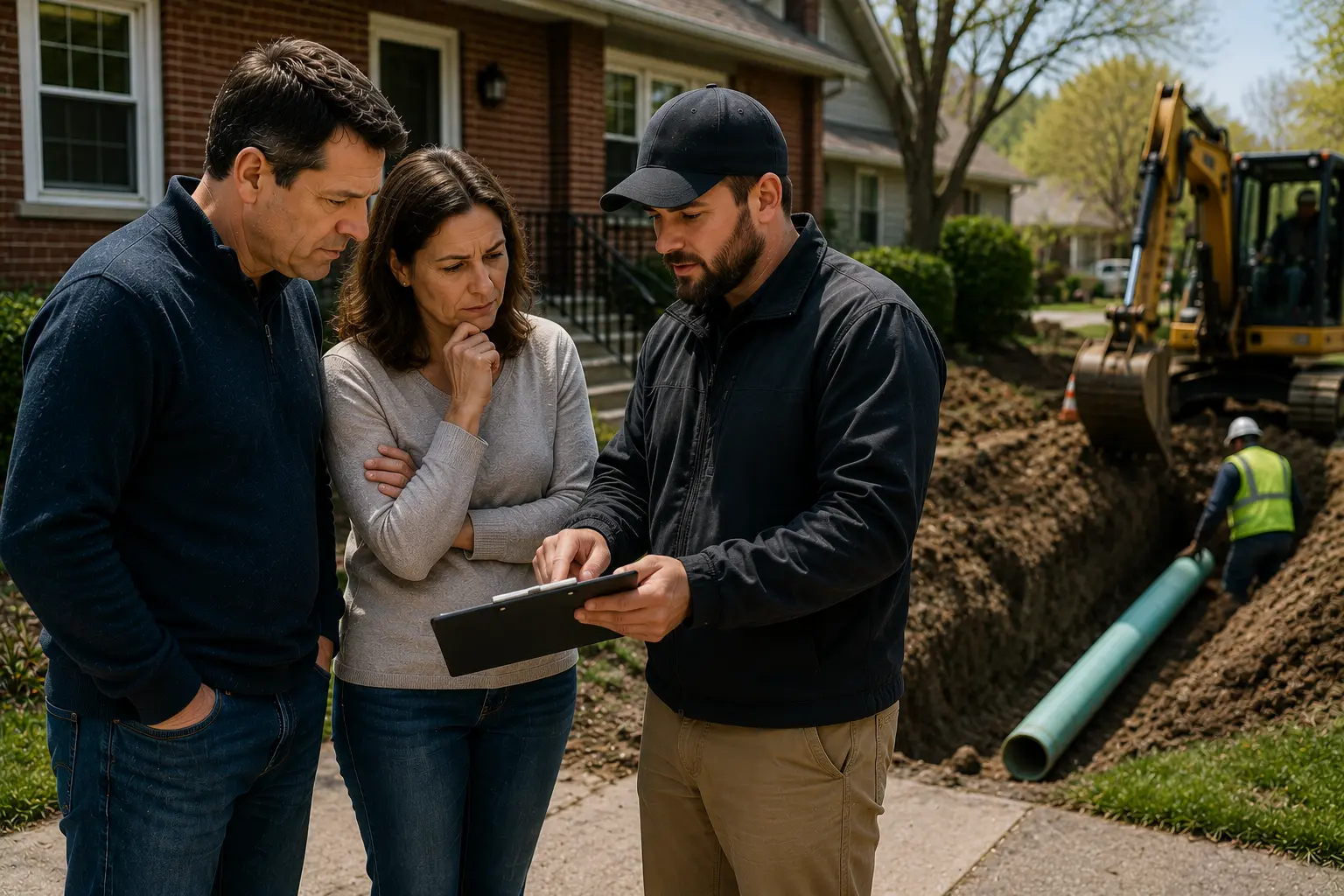
Sewer line replacement can be one of the most difficult home expenses to plan for because it often happens suddenly. A homeowner may go from dealing with slow drains or a basement backup to facing a major repair decision in a matter of days. When the cost is more than expected, the immediate question becomes how to pay for the work without draining emergency savings completely.
The best way to pay for sewer line replacement depends on the urgency of the problem, the total project cost, available savings, insurance coverage, credit options, home equity, and whether the work can be planned or must happen immediately. Some homeowners use one payment source, while others combine savings, financing, insurance proceeds, or staged repairs when appropriate.
This guide explains practical payment options for Chicago homeowners, how to compare them, and how to avoid committing to a large sewer expense before understanding the full repair scope.
Key Takeaways
- Paying for sewer line replacement without draining savings usually requires comparing several options, not relying on the first payment method offered.
- Common options include emergency savings, personal loans, home equity financing, contractor financing, credit cards, insurance, service line coverage, or a combination of sources.
- Chicago sewer replacement costs can vary because of depth, excavation, pipe condition, permits, sidewalks, basements, alleys, tree roots, and restoration work.
- Homeowners should understand the sewer diagnosis and written scope before financing a major replacement.
- Emergency sewer problems may require fast action, but cleaning or temporary stabilization may sometimes create time to compare permanent repair options.
- The goal is not only to afford the repair, but to avoid a payment plan that creates long-term financial strain.
How Can Chicago Homeowners Pay for Sewer Line Replacement Without Draining Savings?
Chicago homeowners may pay for sewer line replacement by combining available savings with financing, insurance, service line coverage, personal loans, home equity options, contractor financing, or short-term credit. The best option depends on how urgent the sewer problem is, whether the full replacement is confirmed, and what repayment terms are affordable.
If the sewer line is actively backing up, the first priority may be stopping the immediate problem. If the line can be stabilized temporarily, homeowners may have more time to compare estimates, check insurance, review financing terms, and avoid using every dollar in savings at once.
For broader sewer pricing context, see the main Chicago sewer replacement cost guide.
Main Ways to Pay for Sewer Line Replacement
Use Part of Your Emergency Savings
Using savings can be the simplest way to pay because there are no loan applications, interest charges, credit checks, or monthly payments. If the cost is manageable and still leaves a safe financial cushion, savings may be the cleanest option.
The risk is using too much cash at once. Sewer work can be followed by cleanup, restoration, landscaping, concrete repair, or other household expenses. Before emptying savings, homeowners should consider what other costs may still be coming.
Split the Cost Between Savings and Financing
Many homeowners choose a blended approach. They use some savings to reduce the amount borrowed, then finance the rest. This can lower monthly payments while preserving part of the emergency fund.
This approach may be useful when the sewer replacement is necessary but the homeowner does not want to drain all available cash. It also gives some flexibility if final costs change because of excavation, restoration, or unexpected pipe conditions.
Personal Loan
A personal loan may provide a fixed payment schedule without using the home as collateral. It can be useful for homeowners who need funds quickly and want predictable repayment.
The cost depends on credit, income, lender terms, fees, interest rate, and loan length. A longer loan may reduce the monthly payment but increase the total amount paid over time.
Home Equity Loan
A home equity loan may make sense for larger sewer replacement projects if the homeowner has enough equity and time to go through approval. It may offer predictable payments and a fixed repayment structure, depending on the lender.
The main tradeoff is that the home is used as collateral. It may also take longer to approve than other options, which may not work well during an active sewer emergency.
Home Equity Line of Credit
A home equity line of credit, or HELOC, may offer flexible access to funds. This can be helpful when the final sewer cost is not fully known or when the homeowner may also need to pay for cleanup, restoration, or related repairs.
However, HELOC rates may be variable, and repayment terms can change. Homeowners should understand the draw period, repayment period, fees, and rate structure before relying on this option.
Contractor Financing
Some sewer contractors offer financing through third-party lenders. This can be convenient, especially when the work is urgent and the homeowner wants a fast application process.
Convenience should not replace comparison. Homeowners should review the interest rate, repayment term, fees, deferred interest rules, and total repayment amount. Contractor financing can be useful, but it is still a loan that should be compared against other options.
Credit Cards
Credit cards may be practical for inspection fees, emergency cleaning, deposits, or a smaller repair. They may also serve as a temporary bridge if the homeowner expects reimbursement or another funding source soon.
For a major sewer replacement, credit cards can become expensive if the balance is carried at a high interest rate. A promotional rate may help only if the balance can realistically be paid before the promotion ends.
Payment Options Compared
| Payment Option | Potential Benefit | Potential Risk |
|---|---|---|
| Savings | No interest, no approval process, and no monthly payment. | Can leave the household with too little cash for other emergencies. |
| Savings plus financing | Reduces the loan amount while preserving some cash. | Still creates monthly payments and requires careful budgeting. |
| Personal loan | May offer fixed payments without home collateral. | Rates and fees depend on credit and lender terms. |
| Home equity loan | May work for larger projects with predictable repayment. | Uses the home as collateral and may take longer to close. |
| HELOC | Flexible funding for uncertain final costs. | Rates may be variable and repayment terms can change. |
| Contractor financing | Convenient and sometimes fast during urgent sewer work. | Terms may not be the best available option. |
| Credit card | Quick access for smaller or short-term costs. | High interest can make major repairs much more expensive. |
Chicago-Specific Considerations Before Choosing a Payment Option
Older Sewer Lines Can Make the Scope Bigger
Many Chicago homes have older clay pipe, cast iron sections, or mixed-material sewer lines from previous repairs. Older materials can develop cracks, root intrusion, separated joints, corrosion, or collapse.
If the pipe has widespread deterioration, a small repair may not be enough. Before deciding how much to borrow or spend, homeowners should understand whether the recommendation is for cleaning, spot repair, trenchless replacement, excavation, or full replacement.
Basement Backups Can Add Cleanup Costs
In Chicago homes with basements, sewer problems often appear through floor drains, laundry areas, lower-level bathrooms, or utility sinks. If sewage enters the basement, the total cost may include cleanup, drying, sanitizing, damaged belongings, and restoration.
A payment plan that covers only the sewer pipe work may not cover the full financial impact of the event.
Excavation and Restoration Can Change the Total
Chicago sewer work may involve narrow side yards, sidewalks, alleys, parkways, driveways, concrete slabs, and mature trees. These conditions can make excavation and restoration more expensive.
Before committing savings or financing, ask whether the estimate includes concrete replacement, lawn repair, sidewalk restoration, backfill, permits, and cleanup.
Emergency Timing Can Lead to Rushed Decisions
When sewage is backing up, homeowners may feel pressure to approve the fastest available solution. Sometimes that is necessary. But in some cases, emergency cleaning can restore flow temporarily while the homeowner gets a camera inspection and compares long-term options.
If the situation is urgent, review emergency sewer repair cost in Chicago to understand how after-hours and same-day pricing may affect the first bill.
Insurance May Help, But Only in Specific Situations
Homeowners insurance may or may not help with sewer-related costs. Coverage depends on the policy, cause of damage, endorsements, exclusions, and whether the claim involves sewer backup, service line damage, interior water damage, or wear and tear.
Homeowners should not assume coverage. Ask the insurer what is covered, what is excluded, what documentation is needed, and whether work must be approved before it begins.
Repair vs Replacement: Do Not Finance More Work Than Needed
Before using savings or financing, homeowners should understand whether replacement is truly necessary. A sewer camera inspection can help show whether the problem is isolated or widespread.
Repair may be enough when one section is damaged and the rest of the pipe is stable. Replacement may make more sense when the line has multiple defects, recurring root intrusion, collapse, poor slope, or repeated backups.
| Situation | Lower-Cost Approach May Work When | Larger Replacement May Be More Practical When |
|---|---|---|
| Single blockage | The line clears and inspection shows no structural failure. | Backups keep returning after cleaning. |
| One damaged section | The defect is isolated and easy to locate. | Several sections show cracking or separation. |
| Tree roots | Roots enter through one repairable joint. | Roots enter through multiple failed pipe sections. |
| Collapsed pipe | Temporary stabilization may buy time. | Replacement is needed to restore reliable flow. |
| Emergency backup | Cleaning and inspection can separate urgent from permanent work. | The pipe is structurally failing and cannot be relied on. |
Important Homeowner Note
The payment decision should follow the diagnosis. Before draining savings or signing financing documents, ask what the camera inspection showed, why replacement is being recommended, and whether a smaller repair is realistic.
How to Protect Your Savings During a Sewer Replacement
The goal is not to avoid spending money at all. The goal is to avoid using every available dollar before the full scope is clear.
Homeowners can protect savings by taking a structured approach:
- Get a clear diagnosis before approving permanent replacement.
- Ask whether the immediate problem can be stabilized first.
- Compare more than one estimate when time allows.
- Separate emergency service, permanent repair, cleanup, and restoration costs.
- Check insurance and service line coverage before assuming nothing applies.
- Ask whether the estimate includes permits, excavation, backfill, and restoration.
- Use only part of savings if financing the remaining balance is affordable.
- Compare total repayment cost, not just monthly payment.
- Avoid deferred-interest financing unless the payoff plan is realistic.
- Keep some cash available for unrelated emergencies.
If you want a deeper breakdown of funding choices, review sewer replacement financing options for Chicago homeowners.
What Should Be Clear Before You Pay or Finance the Work?
A major sewer estimate should explain the problem and the proposed solution. If the scope is vague, it becomes harder to know whether the payment decision is reasonable.
Before paying or financing sewer replacement, ask whether the estimate includes:
- Camera inspection findings
- The location of the damaged section
- The amount of pipe being repaired or replaced
- The assumed depth of the sewer line
- The repair or replacement method
- Pipe material being installed
- Permit and inspection responsibilities
- Excavation, backfill, and compaction
- Concrete, sidewalk, driveway, lawn, or basement slab restoration
- Cleanup and debris removal
- What is excluded from the price
- What conditions could increase the final cost
If two quotes are far apart, do not assume the cheaper one is automatically better or the higher one is automatically unreasonable. Read why sewer replacement quotes in Chicago can vary by thousands to understand how scope differences affect pricing.
Common Mistakes and Warning Signs
Mistake: Using All Available Cash Immediately
Paying cash avoids interest, but emptying savings can leave the household exposed if cleanup, restoration, or another emergency follows.
Mistake: Choosing the Lowest Monthly Payment Only
A low monthly payment can hide a longer repayment term, higher total cost, or deferred interest. Compare the full repayment amount before choosing.
Mistake: Assuming Insurance Will Cover the Work
Insurance may help in some situations, but many policies exclude wear and tear, age-related deterioration, long-term root intrusion, or underground service line issues unless specific coverage applies.
Mistake: Financing Before Comparing the Scope
If the estimate does not explain excavation, restoration, permits, depth, and pipe footage, homeowners may finance a project without understanding what is included.
Mistake: Treating Emergency Cleaning and Replacement as One Decision
Emergency cleaning may be needed immediately. Full replacement may require more evidence. When possible, separate the urgent service call from the permanent repair decision.
Warning Signs That the Payment Decision Needs Extra Caution
- The contractor recommends replacement without showing inspection findings
- The quote does not explain what restoration is included
- The financing terms focus only on the monthly payment
- There are unclear fees, penalties, or deferred-interest terms
- The homeowner is pressured to decide before reviewing options
- Insurance has not been contacted after a backup or damage event
- The project cost changes significantly without a clear explanation
- The estimate excludes cleanup, permits, or concrete repair
Decision Point
If the sewer line is actively backing up, immediate action may be necessary. Once the home is stabilized, slow down long enough to confirm the diagnosis, compare payment options, and avoid draining every available dollar unnecessarily.
FAQ About Paying for Sewer Line Replacement
What is the best way to pay for sewer line replacement?
The best option depends on urgency, available savings, credit, home equity, insurance coverage, and total project cost. Some homeowners use savings, while others combine savings with a loan, contractor financing, insurance proceeds, or home equity financing.
Should I use emergency savings for sewer replacement?
Using savings can avoid interest, but draining the entire emergency fund can create risk. Many homeowners prefer using part of savings and financing the rest if the monthly payment is manageable.
Can sewer line replacement be financed?
Yes. Financing options may include personal loans, contractor financing, home equity loans, HELOCs, credit cards, or other lender products. Homeowners should compare rates, fees, repayment terms, and total cost.
Will homeowners insurance pay for sewer line replacement?
Coverage depends on the policy and cause of damage. Many policies exclude wear and tear, deterioration, and root intrusion unless specific service line or sewer backup coverage applies. Homeowners should confirm coverage directly with their insurer.
Can I wait to replace the sewer line if I cannot afford it?
That depends on the severity of the problem. If sewage is actively backing up or the pipe has collapsed, waiting may cause more damage. If the line can be temporarily cleared, there may be time to compare estimates and financing options.
Can trenchless sewer replacement reduce the amount I need to pay?
Sometimes. Trenchless methods may reduce excavation and restoration costs when the pipe is a good candidate. However, trenchless work is not always cheaper and may not work for collapse, severe bellies, or poor slope.
What Chicago-specific costs should I plan for?
Chicago homeowners should ask about excavation, permits, sidewalk or driveway restoration, basement cleanup, tree roots, older pipe materials, narrow lot access, and concrete repair. These can affect the total amount needed.
Conclusion
Paying for sewer line replacement without draining savings starts with understanding the full scope. Homeowners should know what failed, why replacement is being recommended, what the estimate includes, and whether insurance, financing, or a smaller repair option may apply.
Cash may be the simplest option, but it is not always the safest if it empties the emergency fund. Personal loans, home equity options, contractor financing, credit cards, insurance, and blended payment strategies may all have a place depending on the situation.
For Chicago homeowners, the smartest payment decision is the one that solves the sewer problem while protecting the household budget. Confirm the diagnosis, compare the scope, review financing terms carefully, and avoid using every dollar of savings before the full cost is clear.