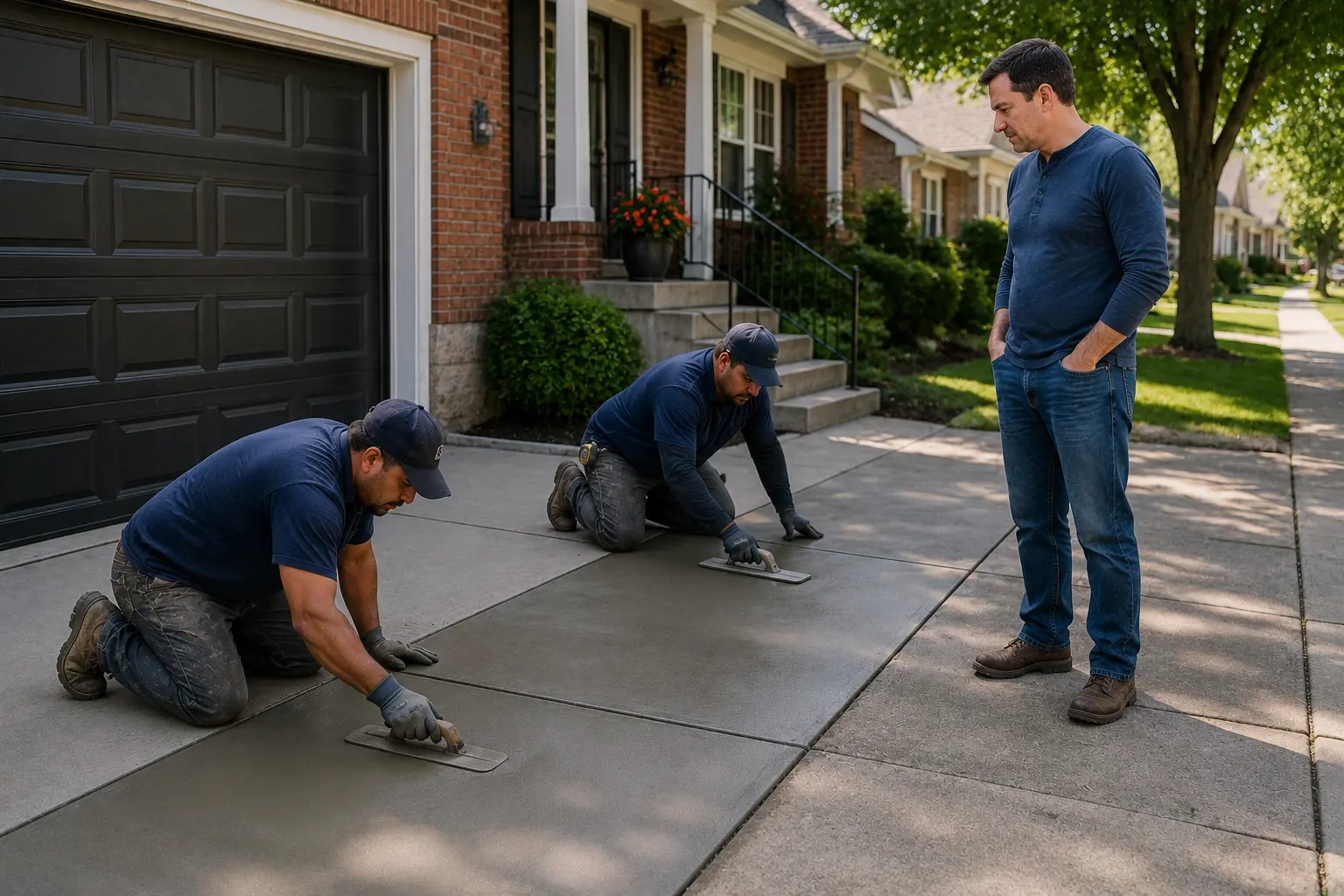
Driveway damage is one of the most frustrating issues homeowners may face after sewer line replacement. Even when the underground repair solves the sewer problem, excavation can leave behind cut concrete, patched asphalt, uneven surfaces, or temporary fill where a driveway used to be smooth and finished.
Driveway repair after sewer replacement depends on the type of driveway, the location of the sewer line, how much surface had to be removed, and whether the contractor is responsible for permanent restoration or only temporary patching. In Chicago, weather, permitting, freeze-thaw cycles, and dense property layouts can all affect how and when driveway restoration is completed.
This guide explains what homeowners should expect, what repair options are available, which costs and risks matter, and when driveway damage may require closer attention after sewer work. For broader post-project guidance, visit the Post-Repair Concerns hub.
Key Takeaways
- Driveway repair may be needed when sewer excavation crosses concrete, asphalt, pavers, or garage access areas.
- Temporary patches are common immediately after sewer replacement, especially when weather delays permanent restoration.
- Concrete and asphalt driveways are repaired differently and may age differently after patching.
- Soil settlement beneath the repaired area can cause cracking, sinking, or uneven pavement later.
- Homeowners should clarify restoration responsibilities before sewer work begins whenever possible.
- Chicago freeze-thaw cycles can make proper base preparation especially important.
What Happens to a Driveway After Sewer Replacement?
After sewer replacement, a damaged driveway may be temporarily patched, permanently repaired, or partially replaced depending on the excavation area and the restoration agreement. If the sewer trench crossed the driveway, the surface usually needs new base material, compaction, and replacement concrete, asphalt, or pavers. Full restoration may happen immediately or later, especially if weather conditions make permanent repair impractical.
Why Sewer Replacement Can Damage a Driveway
Many residential sewer lines run from the front of the home toward the street or alley. Depending on the property layout, that route may pass under or near a driveway. When traditional excavation is required, contractors may need to cut through the driveway surface to access the buried sewer pipe.
Driveway damage may occur because of:
- Concrete saw cutting
- Asphalt removal
- Excavation equipment crossing the surface
- Trench digging beneath the driveway
- Soil removal and backfilling
- Heavy equipment staging
- Temporary patching after the pipe is installed
The damage is often unavoidable if the sewer line is directly beneath the driveway and trenchless repair is not appropriate for the pipe condition. Homeowners who want a broader overview of what may happen after the underground work is complete can review What to Expect After Sewer Line Replacement.
Temporary Patch vs. Permanent Driveway Repair
Not every driveway repair completed right after sewer replacement is meant to be permanent. In many cases, the first goal is to make the area safe, passable, and protected until final restoration can be completed.
| Repair Type | Purpose | Common Limitations |
|---|---|---|
| Temporary gravel fill | Stabilizes the trench area and allows limited access | May shift, rut, or wash out |
| Temporary asphalt patch | Creates a smoother driving surface until final repair | May not match existing driveway or last long-term |
| Concrete patch | Replaces a cut section of concrete driveway | May show visible seams or color differences |
| Full panel replacement | Restores a larger concrete section more cleanly | Costs more and may require more curing time |
| Asphalt resurfacing | Improves appearance and smoothness after trench repair | May not solve base settlement if preparation was poor |
Homeowners should ask whether the surface being installed is a final repair or only a temporary patch. This distinction matters for cost, expectations, and future maintenance.
Concrete Driveway Repair After Sewer Work
Concrete driveways are common in Chicago-area residential properties. When sewer excavation cuts through concrete, the damaged section usually cannot be restored invisibly. Even a well-done repair may leave visible saw-cut lines or color differences between old and new concrete.
Common Concrete Repair Approaches
- Patch the trench area: The removed section is replaced with new concrete only where excavation occurred.
- Replace full panels: Entire driveway squares or sections are replaced to reduce awkward patch lines.
- Replace a larger driveway section: This may be considered when the driveway is already cracked, uneven, or aging.
Replacing full panels often looks cleaner than patching a narrow trench, but it usually costs more. The right choice depends on the driveway condition, budget, and how noticeable the repair area will be.
Homeowner note: New concrete often looks lighter than older concrete at first. Color differences may become less noticeable over time, but a perfect match should not be assumed.
Asphalt Driveway Repair After Sewer Replacement
Asphalt driveways are usually easier to patch than concrete, but they can still develop visible repair seams, low spots, or cracking if the base below the asphalt settles.
Asphalt repair may involve:
- Compacting the trench backfill
- Adding stone base material
- Installing a temporary cold patch
- Applying hot-mix asphalt when conditions allow
- Resurfacing a larger area for a smoother finish
In colder months, permanent asphalt repair may not be available immediately. A temporary patch may be used until weather and asphalt plant availability allow proper restoration.
Paver and Decorative Driveways
Paver driveways, brick driveways, and decorative surfaces require a different approach. In some cases, pavers can be removed before excavation and reinstalled afterward. However, breakage, base disturbance, and uneven settling can still occur.
Important considerations include:
- Whether existing pavers can be reused
- Whether matching replacement pavers are available
- How the base layer will be rebuilt
- Whether the restored area will settle differently
- How edge restraints and drainage will be handled
Decorative driveways can be more expensive to restore because the repair must address both structural support and appearance.
Base Preparation Matters More Than the Surface
A driveway repair can look acceptable on the day it is finished but fail later if the base underneath was not properly restored. Sewer excavation disturbs the soil beneath the driveway. If the trench is not compacted correctly, the driveway surface may sink, crack, or separate over time.
Good driveway restoration usually depends on:
- Proper trench backfill
- Layered compaction
- Appropriate stone base material
- Correct surface thickness
- Drainage away from the repaired area
- Enough time for concrete curing when applicable
Base failure is one reason homeowners should monitor the driveway after the project is finished, especially during the first year.
How Long Before You Can Use the Driveway?
Driveway use depends on the repair material. Gravel or temporary asphalt may allow faster access, while concrete often requires curing time before vehicles should be parked on it.
| Surface Type | Typical Access Consideration | Key Risk |
|---|---|---|
| Gravel fill | May allow limited access quickly | Rutting or shifting |
| Temporary asphalt patch | Often usable sooner than concrete | Soft spots or unevenness |
| New concrete | May require curing before vehicle traffic | Cracking, marking, or surface damage |
| Pavers | Depends on base compaction and installation | Uneven settling |
Homeowners should follow the repair contractor’s instructions before driving or parking on the restored area.
Chicago-Specific Considerations
Freeze-Thaw Cycles
Chicago winters can be hard on repaired driveway sections. Water that enters seams or cracks can freeze, expand, and worsen surface damage. Proper sealing, drainage, and base preparation can reduce the risk of premature deterioration.
Winter and Early Spring Repairs
If sewer replacement happens during cold weather, permanent concrete or asphalt restoration may be delayed. Temporary patches are common when conditions are not suitable for final work.
Small Urban Lots
Chicago properties often have limited access, narrow driveways, alleys, detached garages, and compact front yards. These conditions can make excavation and restoration more difficult.
Public Way and Permit Issues
If sewer work affects the driveway apron, parkway, sidewalk, or public right-of-way, additional municipal requirements may apply. Homeowners should confirm whether inspections and restoration approvals are complete. For more detail, see Sewer Replacement Final Inspection: What to Expect.
Who Is Responsible for Driveway Restoration?
Responsibility depends on the contract, the type of work performed, and whether the driveway was damaged as part of the agreed excavation area. Some sewer contractors include basic restoration. Others include only backfill and temporary patching, leaving permanent driveway repair to a concrete, asphalt, or hardscape contractor.
Before work begins, homeowners should clarify:
- Whether driveway repair is included in the sewer replacement estimate
- Whether the repair is temporary or permanent
- What material will be used
- Whether concrete panels or only the trench area will be replaced
- Who handles permits or inspections if needed
- Whether restoration work has a separate warranty
After work is complete, documentation matters. Homeowners should keep contracts, invoices, photos, permits, and inspection records. For a complete recordkeeping checklist, see What Documents Should You Keep After Sewer Replacement?.
Cost Factors in Driveway Repair After Sewer Replacement
Driveway repair costs vary because the scope can range from a small patch to replacement of a larger section. Homeowners should be cautious with any exact pricing claim that does not account for site conditions.
Major cost factors include:
- Driveway material
- Size of the excavated area
- Depth and width of the trench
- Condition of the existing driveway
- Whether full panels or only patches are replaced
- Need for base reconstruction
- Permit or inspection requirements
- Seasonal timing
- Disposal of removed material
- Access limitations for equipment
In some cases, homeowners choose to replace a larger driveway section because the existing driveway is already cracked or uneven. That can increase the upfront cost but may produce a cleaner and more durable result.
Insurance and Driveway Damage
Homeowners sometimes wonder whether insurance will pay for driveway restoration after sewer replacement. The answer depends on the policy, the cause of the sewer problem, and the specific coverage endorsements in place.
Standard homeowner policies may not cover all sewer line or service line issues. Some policies offer optional service line coverage or sewer backup endorsements, but those coverages vary. Even when underground repairs are covered, landscaping or driveway restoration may have separate limits or exclusions.
Practical step: If insurance may be involved, document the driveway condition before and after excavation. Keep photos, estimates, contractor notes, and all claim communications.
Related Repairs After Sewer Replacement
Driveway repair is often only one part of property restoration after a major sewer project. The same excavation may also affect the yard, landscaping, sidewalks, or cleanup process.
Helpful related resources include:
Warning Signs After Driveway Repair
Some settling and cosmetic differences may be expected, but certain problems should be monitored closely.
Watch for:
- Rapid sinking over the sewer trench
- Large cracks forming soon after repair
- Water pooling near the driveway or foundation
- Edges separating from the existing surface
- Loose pavers or uneven hardscape sections
- Soft asphalt patches that do not stabilize
- Trip hazards near the driveway apron or sidewalk
If driveway problems appear alongside sewer odors, slow drains, or recurring backups, the issue may not be limited to the surface. Homeowners may also want to review Drain Problems After Sewer Replacement: Common Causes.
Common Mistakes Homeowners Make
- Assuming driveway restoration is automatically included. Some contracts only include temporary patching.
- Not asking about curing time. Driving on new concrete too soon can damage the repair.
- Ignoring base preparation. A smooth surface will not last if the trench below was poorly compacted.
- Expecting a perfect color match. New concrete and asphalt rarely match older surfaces exactly.
- Failing to photograph damage. Photos are useful for contractors, insurance, and future resale documentation.
- Overlooking drainage. Water that pools near the repaired area can shorten the life of the driveway repair.
Frequently Asked Questions
Will my driveway look the same after sewer replacement?
Not always. Even a good repair may leave visible seams, color differences, or texture changes. Replacing full sections rather than narrow trench patches can sometimes create a cleaner appearance.
Is a temporary driveway patch normal after sewer work?
Yes. Temporary patches are common when permanent restoration cannot be completed immediately due to weather, scheduling, inspections, or soil settlement concerns.
How long should I wait before parking on repaired concrete?
Follow the contractor’s instructions. Concrete typically needs curing time before it can safely handle vehicle weight, and using it too soon can cause surface damage or cracking.
Can sewer excavation cause driveway sinking later?
Yes. If backfilled soil beneath the driveway settles, the repaired area can sink or crack. Proper compaction and base preparation reduce this risk.
Does insurance cover driveway repair after sewer replacement?
It depends on the policy and cause of damage. Service line coverage, sewer backup endorsements, and property restoration limits vary, so homeowners should review their policy and speak with their insurer when a claim may apply.
Should I replace the whole driveway instead of patching the sewer trench?
That depends on the age and condition of the existing driveway. If the driveway was already cracked or failing, replacing a larger section may produce a better long-term result than patching only the trench.
What documents should I keep after driveway restoration?
Keep the sewer replacement contract, driveway repair invoice, permit records, inspection approvals, photos, warranty information, and insurance claim records if applicable.
Conclusion
Driveway repair after sewer replacement is not just a cosmetic issue. The quality of the backfill, base preparation, drainage, and surface restoration can affect how well the driveway holds up over time. A temporary patch may be acceptable in the short term, but homeowners should understand when permanent repair is needed and what responsibilities are included in the project agreement.
For Chicago homeowners, seasonal timing and freeze-thaw cycles make proper restoration especially important. By asking the right questions, keeping documentation, monitoring for settlement, and addressing drainage concerns early, homeowners can reduce the risk of long-term driveway problems after sewer work.