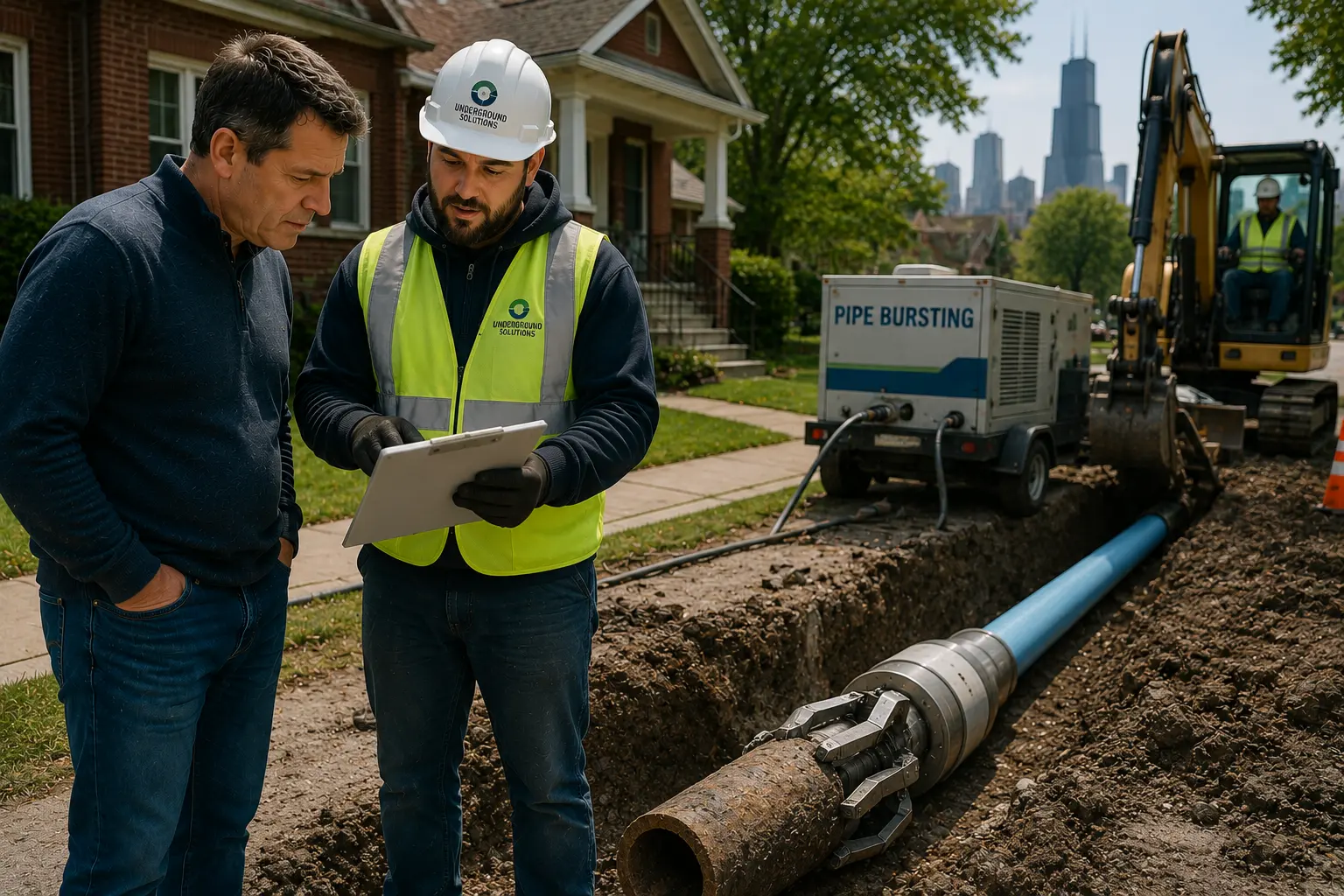
Sewer pipe bursting can be a practical option for some Chicago homeowners with older sewer lines because it may replace a damaged pipe without digging an open trench along the entire run. Instead of removing every section of the old pipe through excavation, pipe bursting breaks the existing pipe apart while pulling a new pipe into place along the same path.
The cost of sewer pipe bursting in Chicago depends on the length of pipe being replaced, the condition of the existing sewer line, access pit requirements, pipe depth, soil conditions, utility conflicts, inspection findings, permit needs, and surface restoration. It may reduce digging compared with traditional excavation, but it is not a no-dig solution and it is not appropriate for every damaged line.
For older Chicago sewer lines, pipe bursting may be worth considering when the pipe is deteriorated but the route is still suitable for replacement through the existing path. This guide explains what drives the cost, when pipe bursting makes sense, and what homeowners should ask before approving the work.
Key Takeaways
- Sewer pipe bursting cost in Chicago depends on pipe length, depth, access, soil conditions, existing pipe condition, permits, and restoration.
- Pipe bursting is a trenchless replacement method, but it still usually requires access pits or excavation at specific points.
- Older clay sewer lines may be candidates for pipe bursting in some cases, but severe alignment, slope, or collapse issues can limit the option.
- A sewer camera inspection and locating work are important before deciding whether pipe bursting is realistic.
- Pipe bursting may reduce disruption to yards, sidewalks, driveways, or landscaping compared with full trench excavation.
- Homeowners should compare the full finished project cost, not just the pipe bursting price.
How Much Does Sewer Pipe Bursting Cost in Chicago?
Sewer pipe bursting in Chicago is usually priced based on the total project scope rather than a simple flat number. The final cost depends on how much pipe is being replaced, how deep the line is, whether access pits are easy to create, whether the existing pipe path is suitable, and how much restoration is needed afterward.
Pipe bursting may be more cost-effective when traditional excavation would require opening a long trench through a yard, driveway, sidewalk, patio, basement slab, or landscaped area. However, if the sewer line has major slope problems, severe offsets, collapsed sections that block the path, or nearby utility conflicts, pipe bursting may not be the right method.
For broader sewer pricing context, see the main Chicago sewer replacement cost guide.
Main Cost Sections for Sewer Pipe Bursting
Length of Pipe Being Replaced
The length of sewer line being replaced is one of the main cost factors. A longer pipe bursting project usually requires more new pipe, more equipment time, more preparation, and more careful pulling or bursting work.
However, short projects can still carry significant fixed costs. A contractor may need to inspect the pipe, locate the line, create access pits, set up equipment, manage the bursting process, connect the new pipe, test the line, backfill, and restore disturbed areas. Because of those fixed costs, a short pipe bursting job may have a higher effective cost per foot than homeowners expect.
Access Pits and Entry Points
Pipe bursting usually reduces digging, but it does not eliminate digging completely. The project typically requires a starting access point and an ending access point. These may be located near the home, near an existing cleanout, or near the connection point depending on the layout.
If access pits can be placed in open soil, the job may be more straightforward. If they must be created through concrete, a driveway, basement slab, sidewalk, or tight side yard, the cost can increase.
Pipe Depth
Depth affects the cost of access pit excavation and connection work. A deeper sewer line requires more digging, more soil removal, more trench safety planning, and more backfill. Even though pipe bursting avoids a full-length trench, the access pits still need to reach the pipe safely.
In Chicago, sewer depth can vary based on the age of the home, basement layout, lot grade, and where the private line connects to the larger sewer system.
Existing Pipe Condition
Pipe bursting is often considered for older clay, cast iron, or deteriorated sewer lines, but the existing path still matters. The bursting head must be able to follow the pipe route and pull the new pipe into place.
Major offsets, severe bellies, extreme collapse, poor slope, or unusual bends can make pipe bursting more difficult or unsuitable. A camera inspection can help show whether the line is a reasonable candidate.
Soil and Utility Conditions
Soil conditions and nearby utilities can affect the difficulty and risk of pipe bursting. The process displaces the old pipe and surrounding soil as the new pipe is pulled through. If other utilities are close to the sewer line, the project may require extra locating, planning, or a different repair method.
Homeowners should ask whether utility locating is included and whether nearby gas, water, electric, or communication lines create any concerns.
Restoration After the Work
Pipe bursting may reduce restoration compared with open trenching, but access areas still need to be restored. Depending on the property, that may include soil backfill, lawn repair, concrete replacement, driveway patching, basement slab repair, sidewalk restoration, or cleanup.
A pipe bursting estimate should clearly explain what restoration is included and what remains the homeowner’s responsibility.
Sewer Pipe Bursting Cost Drivers
| Cost Driver | Why It Matters | What Homeowners Should Ask |
|---|---|---|
| Pipe length | Longer runs usually require more pipe, labor, setup time, and installation work. | How many feet are included in the estimate? |
| Access pits | Pipe bursting still requires entry and exit points. | Where will the access pits be located? |
| Pipe depth | Deeper lines make access pits more labor-intensive and may require added safety measures. | What depth is assumed in the quote? |
| Existing pipe condition | Severe collapse, offsets, or bellies can prevent pipe bursting from working properly. | What did the camera inspection show? |
| Surface material | Concrete, sidewalk, driveway, or basement slab access increases restoration needs. | Is restoration included? |
| Utility conflicts | Nearby utilities may increase planning, risk, and labor. | Has utility locating been completed? |
| Permit requirements | Some work may require permits or inspections. | Who handles permit and inspection responsibilities? |
Chicago-Specific Considerations
Older Clay Sewer Lines
Many older Chicago homes may have clay sewer lines. Clay pipe can crack, separate at joints, allow roots to enter, or deteriorate after decades underground. Pipe bursting is sometimes considered because it can replace the old pipe while reducing the amount of open trench excavation.
However, older clay lines are not automatically good candidates. If the line has collapsed badly, shifted significantly, or lost slope, the pipe path may not be suitable for bursting.
Cast Iron and Mixed-Material Lines
Some Chicago homes may have cast iron sections or mixed pipe materials from previous repairs. These transitions can affect how a bursting project is planned. Mixed materials may also create areas where the line changes shape, depth, or alignment.
A camera inspection can help identify these transitions before a contractor recommends pipe bursting.
Basements and Deep Laterals
Chicago homes with basements may have deeper sewer laterals than homeowners expect. Deeper lines can increase the cost of access pits, especially near the foundation or where the line exits the home.
If work must begin from inside or near a basement area, homeowners should ask whether any interior access, dust control, slab cutting, or interior restoration is required.
Tree Roots and Parkway Trees
Mature trees are common in Chicago neighborhoods, parkways, and older lots. Roots often enter sewer lines through cracks or separated joints. Pipe bursting may be considered when the line has recurring root problems and replacement is more practical than repeated cleaning.
If the pipe is root-damaged in multiple places but still follows a usable path, pipe bursting may be one possible option. If roots are associated with collapse or severe displacement, excavation may still be necessary.
Sidewalks, Alleys, Driveways, and Tight Lots
Pipe bursting may be especially attractive where open trenching would disturb sidewalks, driveways, patios, landscaping, alleys, or narrow side yards. Reducing the amount of surface disturbance can affect the total value of the project.
Still, tight Chicago lots can make equipment staging and access pit placement more difficult. The written estimate should explain where work areas will be located and what surfaces will be disturbed.
Pipe Bursting vs Excavation and Pipe Lining
Pipe bursting is one trenchless replacement method, but it is not the only option. Homeowners may also hear about traditional excavation, spot repair, pipe lining, or full open-trench replacement. Each option solves a different type of sewer problem.
Pipe lining rehabilitates the inside of an existing pipe. Pipe bursting replaces the old pipe by breaking it apart and pulling in new pipe. Excavation exposes the pipe directly so it can be removed and replaced. The best option depends on the condition of the sewer line, not just the desire to avoid digging.
| Option | When It May Make Sense | Potential Limitation |
|---|---|---|
| Pipe bursting | Older pipe needs replacement and the existing path is suitable. | May not work for severe bellies, major offsets, or utility conflicts. |
| Pipe lining | The existing pipe is damaged but still structurally suitable. | Does not correct major slope problems or collapse. |
| Spot excavation | One isolated defect needs direct access. | May not solve deterioration elsewhere in the line. |
| Full excavation | The line is collapsed, misaligned, or unsuitable for trenchless replacement. | Can involve more digging and restoration. |
Important Homeowner Note
Pipe bursting should be chosen because the sewer line is a good candidate, not simply because it sounds less disruptive. Camera inspection, locating, pipe alignment, slope, and utility proximity all matter.
Repair vs Replacement Considerations
Pipe bursting is usually a replacement method, not a minor repair. It may make sense when the line has enough deterioration that replacing a longer section is more practical than continuing with spot repairs or repeated cleanings.
Pipe Bursting May Make Sense When
- The existing sewer line is old, deteriorated, or repeatedly failing.
- Roots keep returning after cleaning because the pipe has cracks or open joints.
- The pipe path is still usable for pulling in new pipe.
- Traditional excavation would disturb concrete, driveways, landscaping, or sidewalks.
- Access pits can be created in practical locations.
- The camera inspection does not show severe slope or alignment problems that would prevent bursting.
Pipe Bursting May Not Make Sense When
- The pipe has a severe belly that holds standing water.
- The line has major offsets or unusual bends.
- The pipe has collapsed in a way that blocks the path.
- Nearby utilities make displacement risky.
- The damaged section is small and can be repaired more simply.
- Open excavation is needed to correct slope, depth, or connection problems.
If the issue has already caused flooding or a sewage backup inside the home, repair cost may not be the only expense. Review sewer backup cleanup cost in Chicago to understand related cleanup concerns.
What Should Be Included in a Pipe Bursting Estimate?
A pipe bursting estimate should explain the method clearly enough that homeowners understand what is being replaced, where work will happen, and what is included after the new pipe is installed.
Before approving pipe bursting, ask whether the estimate includes:
- The camera inspection findings supporting pipe bursting
- The section and footage being replaced
- The existing pipe material and condition
- The new pipe material being installed
- Access pit locations
- Any interior access or basement work
- Utility locating and conflict review
- Permit and inspection responsibilities
- Excavation, backfill, and compaction for access pits
- Concrete, driveway, sidewalk, lawn, or basement slab restoration
- Cleanup and debris removal
- Post-installation camera verification
- Conditions that could require excavation instead
If the project is being discussed after an urgent backup, it may also help to review emergency sewer repair cost in Chicago so you can separate immediate response costs from long-term replacement costs.
Common Mistakes and Warning Signs
Mistake: Assuming Pipe Bursting Means No Digging
Pipe bursting usually requires less digging than open trench replacement, but it still requires access points. Those access pits may involve excavation, backfill, and restoration.
Mistake: Choosing Pipe Bursting Without Camera Evidence
A camera inspection should support the recommendation. Without inspection evidence, homeowners may not know whether the pipe has bellies, collapse, major offsets, or other conditions that make pipe bursting unsuitable.
Mistake: Comparing Quotes Without Restoration Details
One quote may include restoration of access pits, concrete, or lawn areas while another may not. Homeowners should compare the finished project, not only the installation method.
Mistake: Ignoring Utility Conflicts
Because pipe bursting displaces old pipe and soil, nearby utilities should be located and considered. Utility conflicts can affect whether pipe bursting is safe or practical.
Mistake: Waiting Through Repeated Backups
Repeated cleaning may seem less expensive than replacement, but recurring roots, backups, and sewer emergencies can add up. If the line is failing structurally, replacement may eventually become more practical.
Warning Signs That May Lead to Pipe Bursting Evaluation
- Repeated root intrusion through older clay pipe
- Recurring sewer backups after cleaning
- Multiple cracks or separated joints on camera
- Old pipe running under concrete, driveway, sidewalk, or landscaping
- Several previous repairs on the same sewer line
- A damaged line that needs replacement but may not require full trenching
- Camera inspection showing deterioration without severe slope problems
- Emergency sewer calls becoming more frequent
Decision Point
Pipe bursting may be worth considering when an older sewer line needs replacement and the existing pipe path is suitable. If the line needs slope correction or has severe alignment problems, excavation may be more reliable.
FAQ About Sewer Pipe Bursting Cost in Chicago
Is sewer pipe bursting cheaper than excavation?
Sometimes, but not always. Pipe bursting may reduce restoration costs when open trenching would disturb concrete, landscaping, driveways, sidewalks, or basement areas. However, access pits, specialized equipment, permits, and preparation can still make it a significant project.
What affects sewer pipe bursting cost the most?
The biggest factors include pipe length, pipe depth, access pit locations, existing pipe condition, utility conflicts, surface restoration, permits, and whether the pipe path is suitable for bursting.
Is pipe bursting a trenchless sewer replacement method?
Yes. Pipe bursting is commonly considered trenchless because it avoids opening a full trench along the entire pipe. However, it still usually requires excavation at access points.
Can pipe bursting replace old clay sewer pipe?
It may be possible in some cases if the clay pipe route is suitable and the line does not have severe slope, alignment, or collapse issues. A sewer camera inspection and locating work are needed before making that decision.
Do I need a sewer camera inspection before pipe bursting?
Yes. A camera inspection helps identify cracks, roots, offsets, bellies, collapse, and pipe alignment issues. It helps determine whether pipe bursting is realistic or whether another repair method is more appropriate.
Will homeowners insurance cover sewer pipe bursting?
Coverage depends on the policy, the cause of the damage, and whether the homeowner has service line or sewer backup coverage. Many policies exclude wear and tear, age-related deterioration, and long-term root intrusion. Homeowners should confirm details directly with their insurer.
What Chicago-specific factors can affect pipe bursting?
Older clay pipe, cast iron transitions, basements, mature tree roots, sidewalks, alleys, driveways, parkways, tight lots, deep laterals, and nearby utilities can all affect whether pipe bursting is practical and how much it costs.
Conclusion
Sewer pipe bursting cost in Chicago depends on pipe length, depth, access, existing pipe condition, utility conflicts, permit needs, and restoration. It can be a useful option for older sewer lines when replacement is needed but full trench excavation would be especially disruptive.
However, pipe bursting is not right for every sewer problem. The existing pipe path must be suitable, and the method may not solve severe slope problems, major offsets, or certain collapsed sections. A sewer camera inspection and locating work should support the recommendation before homeowners approve the project.
For Chicago homeowners, the goal is to compare the total finished scope. Pipe bursting may reduce digging, but the estimate should clearly explain access pits, restoration, permits, inspection findings, and what conditions could require a different repair approach.