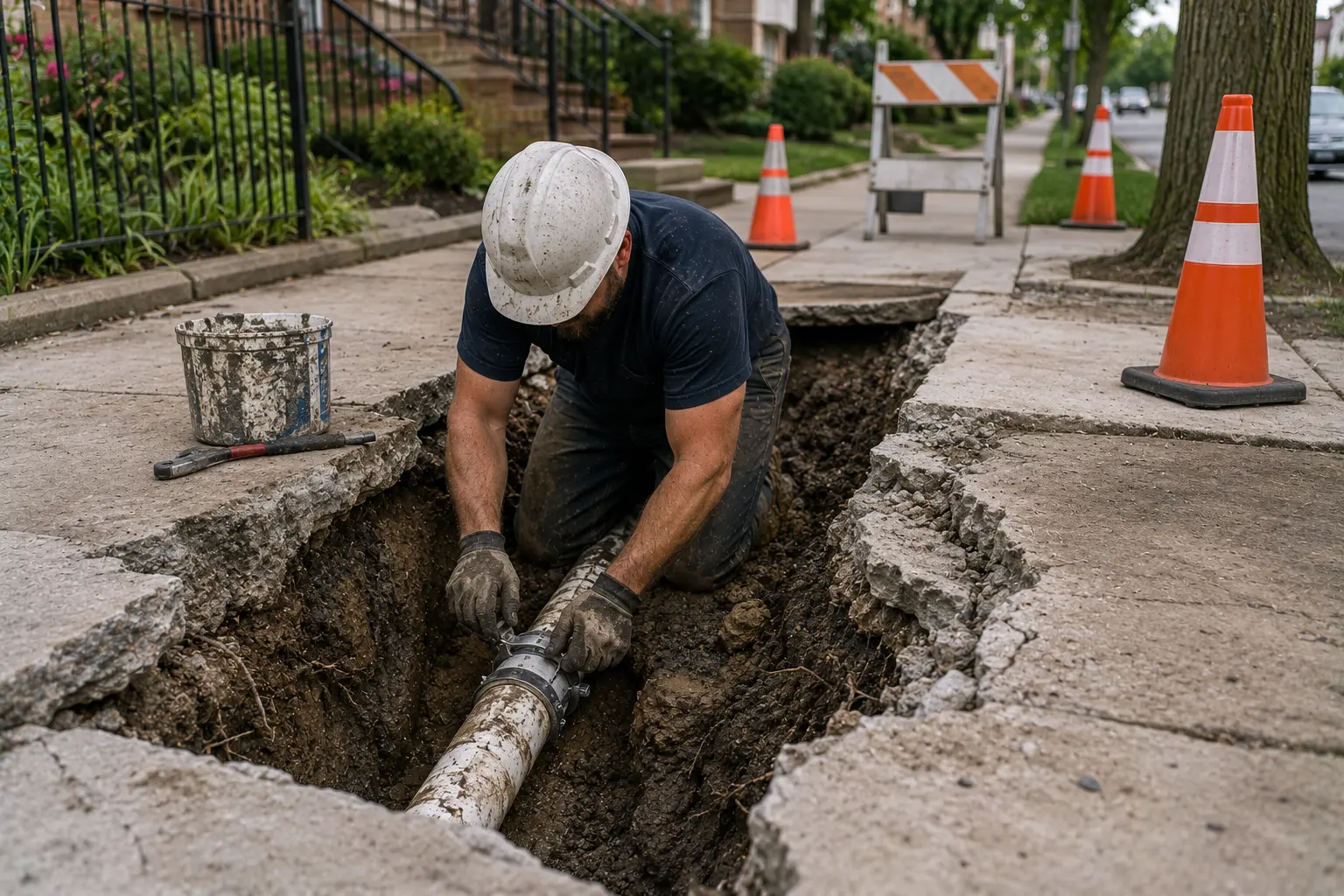
Sewer repair under a sidewalk can be more complicated than a repair in an open yard because the work may involve concrete removal, public access, permits, pedestrian safety, and restoration requirements in addition to the sewer repair itself. When the damaged pipe runs beneath a sidewalk, homeowners need to understand both the plumbing issue and the surface disruption that may come with fixing it.
For Chicago homeowners, this situation is common because many older sewer lines run through tight urban lots, parkways, driveways, and public-facing concrete areas before reaching the municipal sewer connection. Aging clay or cast iron pipe, tree roots, soil movement, and freeze-thaw cycles can all contribute to sewer problems beneath sidewalks.
The right repair method depends on the condition of the pipe, the location of the defect, the depth of the line, and whether trenchless repair can avoid opening the sidewalk. For a broader overview of available methods, visit the Sewer Repair Methods hub.
Key Takeaways
- Sewer repair under a sidewalk may involve both pipe repair and concrete restoration.
- A camera inspection and pipe locating are usually needed before deciding where to dig.
- Trenchless methods may reduce sidewalk disruption when the pipe is a good candidate.
- Traditional excavation may be required for collapsed, sagging, severely offset, or crushed pipe.
- Chicago sidewalk and parkway work may involve additional planning, permits, or coordination.
- Homeowners should ask whether estimates include sidewalk removal, replacement, permits, and inspections.
Can a Sewer Line Under a Sidewalk Be Repaired Without Breaking Concrete?
Sometimes. If the sewer pipe is stable enough, trenchless options such as pipe lining may repair cracks, leaks, or root entry points without removing large sections of sidewalk. Pipe bursting may also be possible for some replacement projects if the pipe path and access points are suitable.
If the sewer line has collapsed, shifted badly, developed a major belly, or needs slope correction, the sidewalk may need to be cut and removed so the pipe can be accessed directly.
Why Sidewalk Sewer Repairs Require Extra Planning
A sewer repair beneath a sidewalk affects more than the underground pipe. The work may also impact pedestrian access, concrete panels, parkway areas, nearby trees, utilities, and property boundaries.
Unlike a repair in a private backyard, sidewalk work may be visible to neighbors and passersby. Depending on the location, temporary barriers, safe walkways, or municipal coordination may be needed.
Homeowners should not assume that the sewer repair estimate automatically includes all sidewalk-related restoration. Concrete cutting, removal, replacement, inspection, and public-area requirements may be separate line items.
Common Sewer Problems Beneath Sidewalks
Sewer lines beneath sidewalks can fail for many of the same reasons as sewer lines in yards or driveways. The difference is that the location can make the repair more disruptive and potentially more regulated.
Common problems include:
- Tree roots entering clay pipe joints
- Cracked clay sewer pipe
- Corroded cast iron pipe
- Offset pipe joints
- Separated pipe sections
- Collapsed or crushed pipe
- Pipe bellies that hold wastewater
- Improper slope near the sidewalk or parkway
- Previous repairs that have shifted or failed
Older pipe materials are a major factor in many Chicago sewer repair decisions. Homeowners dealing with aging materials may want to review Clay Sewer Pipe Replacement: What to Expect and Cast Iron Sewer Pipe Repair Options.
How Sidewalk Sewer Problems Are Diagnosed
Sewer Camera Inspection
A sewer camera inspection helps identify the type and severity of the problem. The footage may show roots, cracks, offsets, standing water, corrosion, collapsed sections, or a blockage beneath or near the sidewalk.
Pipe Locating
After the defect is seen on camera, locating equipment can help estimate where the damaged section sits under the concrete. This helps limit unnecessary sidewalk removal.
Depth and Access Review
The depth of the sewer line affects the difficulty of excavation. A deeper pipe beneath a sidewalk may require more planning, larger excavation, and more careful backfill.
Repair Method Comparison
After diagnosis, homeowners should compare cleaning, spot repair, pipe lining, pipe bursting, traditional excavation, or full replacement depending on the pipe condition.
Repair Options for Sewer Lines Under Sidewalks
Sewer Cleaning or Rodding
If the problem is a blockage and the pipe is still structurally sound, cleaning may restore flow without opening the sidewalk. Rodding or hydro jetting may clear roots, grease, sludge, or debris, but these methods do not repair damaged pipe.
For homeowners trying to understand the difference between clearing and repairing, see Sewer Rodding vs Sewer Repair: What’s the Difference?.
Pipe Lining
Pipe lining may be an option when the pipe under the sidewalk is cracked or leaking but still structurally stable. This trenchless method creates a new interior surface inside the existing pipe and may avoid removing concrete.
Pipe lining is not appropriate for every defect. A collapsed, severely offset, crushed, or sagging pipe may still require excavation. Learn more in Pipe Lining for Sewer Repair: How It Works.
Spot Repair
A spot repair may be practical when one specific section beneath the sidewalk is damaged. This often involves cutting and removing a targeted sidewalk panel, excavating to the pipe, completing the repair, backfilling, and replacing the concrete.
For isolated damage, Spot Repair for Sewer Lines: When Is It Enough? can help homeowners understand when a limited repair may be sufficient.
Pipe Bursting
Pipe bursting may be considered when the sewer line needs replacement but a full trench through the sidewalk would be highly disruptive. This trenchless replacement method breaks apart the old pipe while pulling a new pipe into place.
Pipe bursting still requires access pits and is not suitable for every pipe path. More detail is available in Pipe Bursting for Sewer Replacement Explained.
Traditional Excavation
Traditional excavation may be required when the pipe must be physically exposed. This is often necessary for collapsed pipe, severe offsets, bellies, crushed pipe, or grade correction.
Homeowners can compare what excavation involves in Traditional Sewer Line Excavation: What Homeowners Should Expect.
Trenchless Repair vs Sidewalk Excavation
| Factor | Trenchless Repair | Sidewalk Excavation |
|---|---|---|
| Concrete Disruption | May reduce or avoid sidewalk removal | Usually requires cutting and replacing concrete |
| Best For | Stable pipes with cracks, leaks, or qualifying replacement paths | Collapsed, sagging, crushed, or severely misaligned pipe |
| Access Needs | Requires usable cleanouts or access points | Allows direct access from above |
| Restoration | Often limited to access points | May require sidewalk panel replacement and backfill |
| Limitations | Not suitable for every defect | More disruptive but adaptable to severe damage |
For a broader explanation of limited-excavation approaches, see Trenchless Sewer Repair in Chicago Explained.
Cost Factors for Sewer Repair Under a Sidewalk
The cost of sewer repair under a sidewalk depends on the sewer work, the concrete work, and any requirements related to public access or restoration.
Important cost factors include:
- Depth of the sewer line
- Length of pipe being repaired or replaced
- Type and condition of the existing pipe
- Whether trenchless repair is possible
- Amount of sidewalk that must be removed
- Concrete replacement requirements
- Soil conditions and backfill needs
- Nearby tree roots or utilities
- Permit and inspection requirements
- Pedestrian safety and temporary access needs
- Whether work extends into a parkway or public right-of-way
Homeowners should ask whether the estimate includes concrete restoration and whether any municipal requirements could affect scheduling or cost.
Chicago-Specific Considerations
Public Sidewalk and Parkway Issues
In Chicago, sewer work near sidewalks, parkways, or public areas may involve additional coordination. Homeowners should ask whether permits, inspections, barricades, or sidewalk restoration standards apply to the specific location.
Mature Trees and Root Intrusion
Tree roots are a common concern in older neighborhoods. Roots may enter clay sewer lines through joints and cracks near sidewalks or parkways. Cutting roots may restore flow temporarily, but the entry point may need repair.
Freeze-Thaw and Concrete Restoration
Chicago weather can make proper backfill and concrete restoration especially important. Poor compaction beneath a sidewalk can contribute to settling, cracking, or uneven panels over time.
Older Sewer Materials
Many homes may have clay, cast iron, PVC, or mixed pipe materials. Material transitions beneath sidewalks can become weak points if older repairs were not properly aligned or supported.
Nearby Driveways and Property Access
Some sidewalk repairs are close to driveway aprons, alleys, fences, or front walks. If the sewer issue extends beyond the sidewalk, homeowners may need to consider a larger access and restoration plan.
If the work also affects a driveway, see Sewer Repair Under a Driveway: Methods and Challenges.
What to Expect During Sidewalk Sewer Repair
Although each project is different, many sidewalk sewer repairs follow a general process.
- Sewer camera inspection and diagnosis
- Locating the damaged pipe section
- Reviewing trenchless and excavation options
- Utility marking before digging
- Permit coordination if required
- Pedestrian safety planning if the sidewalk is affected
- Concrete cutting or access preparation
- Pipe repair, lining, bursting, or replacement
- Inspection or testing
- Backfill and compaction
- Sidewalk restoration
Homeowners should ask whether the sidewalk can be used during the project and how long the repaired area may need before normal access resumes.
Repair, Partial Replacement, or Full Replacement?
A sidewalk location does not automatically mean the entire sewer line must be replaced. The decision depends on the inspection findings and the condition of the pipe beyond the sidewalk section.
A small defect may qualify for spot repair. A stable but cracked pipe may qualify for pipe lining. A failing line with multiple defects may require partial or full replacement.
Homeowners weighing a larger project can review Full Sewer Line Replacement: What Homeowners Should Know.
Insurance Considerations
Homeowners insurance coverage for sewer repair under a sidewalk depends on the policy, cause of damage, and any added service line coverage. Sewer backup cleanup coverage is not the same as coverage for underground pipe repair or sidewalk restoration.
Homeowners should review:
- Service line coverage
- Sewer backup endorsements
- Exclusions for wear and tear
- Exclusions for roots or age-related deterioration
- Coverage for excavation and concrete restoration
- Documentation needed for claims
It is important to ask whether coverage applies to the damaged pipe, the sidewalk restoration, or only damage caused by a backup inside the home.
Common Mistakes Homeowners Make
- Approving concrete removal before confirming the pipe location
- Skipping a sewer camera inspection
- Assuming trenchless repair works for every sidewalk sewer issue
- Not asking whether sidewalk restoration is included
- Ignoring public access, permits, or inspection requirements
- Comparing estimates without understanding concrete replacement details
- Assuming repeated rodding will solve a broken pipe
- Assuming homeowners insurance automatically covers pipe and sidewalk repairs
The most important mistake is focusing only on avoiding concrete removal. The repair method should be chosen based on pipe condition, long-term reliability, and total project scope.
Questions to Ask Before Approving Sidewalk Sewer Repair
- What did the camera inspection show?
- Where exactly is the damaged pipe located?
- Is the problem isolated or widespread?
- Can pipe lining avoid sidewalk removal?
- Is pipe bursting possible?
- Will excavation be required?
- How much sidewalk will be affected?
- Are permits or inspections required?
- Does the estimate include sidewalk restoration?
- How will pedestrian access be handled?
- How will the excavation be backfilled and compacted?
- What conditions could increase the final cost?
Frequently Asked Questions
Can sewer repair under a sidewalk be done without digging?
Sometimes. Pipe lining or pipe bursting may reduce or avoid sidewalk removal if the pipe condition and access points allow it. Severe collapse, bellies, or offsets may still require excavation.
Who is responsible for sidewalk restoration after sewer repair?
Responsibility can depend on the property, location, contractor agreement, and local requirements. Homeowners should confirm in writing whether sidewalk replacement is included in the estimate.
How do contractors know where to cut the sidewalk?
A sewer camera inspection and locating equipment are typically used to estimate the damaged pipe’s position before concrete is opened.
Is pipe lining a good option under a sidewalk?
It can be a good option when the pipe is cracked or leaking but still structurally stable. It is usually not appropriate for collapsed, crushed, severely offset, or badly sagging pipe.
Will homeowners insurance cover sewer repair under a sidewalk?
Coverage depends on the policy and cause of damage. Many policies exclude wear and tear, root intrusion, and age-related deterioration unless specific service line coverage applies.
Can tree roots cause sewer damage under sidewalks?
Yes. Roots can enter sewer pipes through cracks, joints, or separations, especially in older clay sewer lines near mature trees and parkways.
Should I replace the whole sewer line if one section under the sidewalk is damaged?
Not always. If the damage is isolated, a spot repair may be enough. If the inspection shows widespread deterioration or repeated failures, partial or full replacement may be more practical.
Conclusion
Sewer repair under a sidewalk requires careful planning because the work may involve pipe repair, concrete restoration, public access, permits, inspections, and pedestrian safety. In some cases, trenchless methods can reduce surface disruption. In others, excavation is necessary to correct collapsed, sagging, offset, or severely damaged pipe.
For Chicago homeowners, the best decision starts with camera inspection, accurate locating, and a clear explanation of whether the problem is isolated or part of a larger sewer failure. A complete estimate should explain the repair method, sidewalk impact, restoration responsibilities, permit considerations, and likely service interruption.