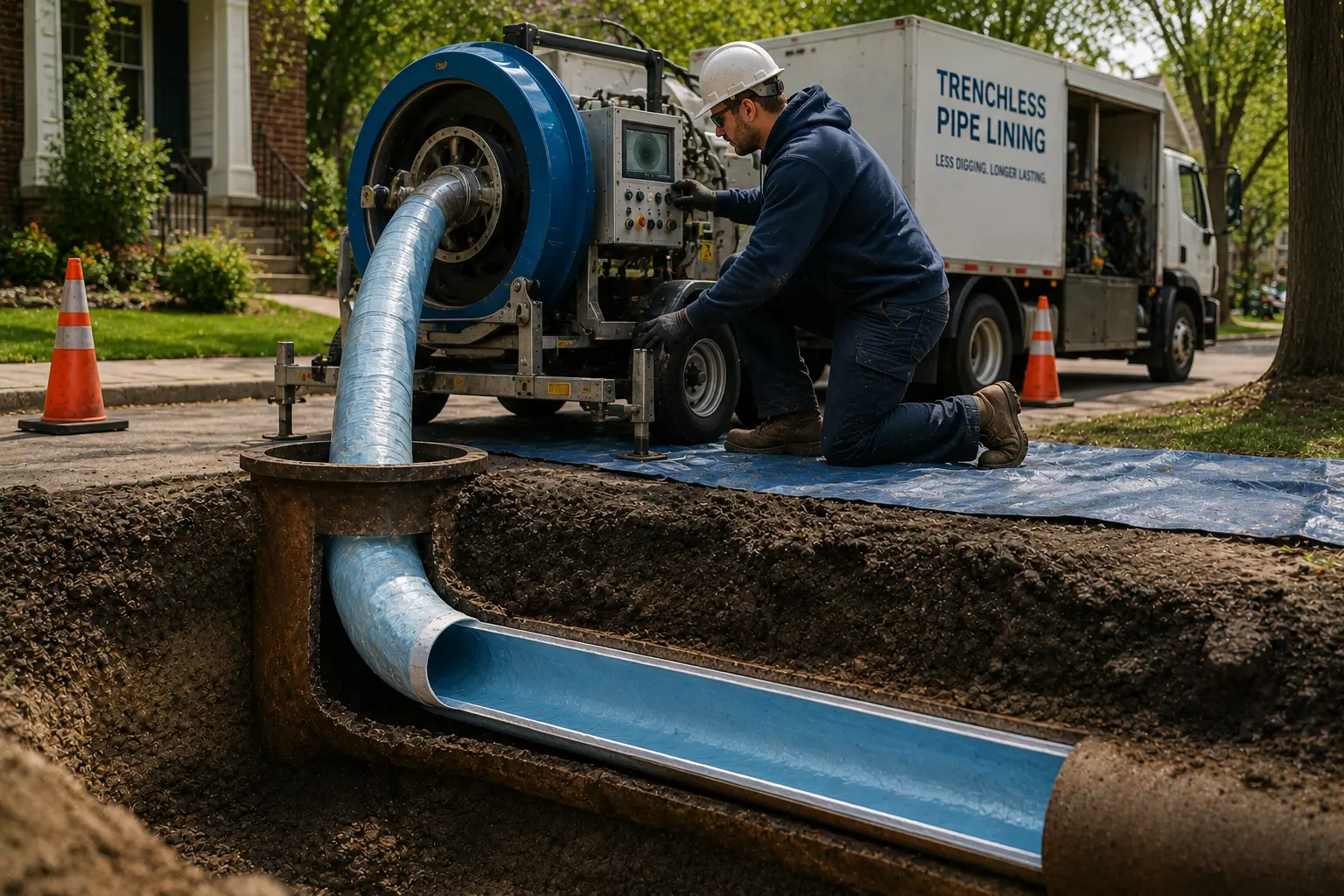
Pipe lining is a trenchless sewer repair method that creates a new pipe inside an existing damaged sewer line. Instead of digging up the entire pipe, a flexible liner is inserted into the old sewer line, positioned against the interior walls, and cured until it hardens into a smooth, durable inner layer.
For Chicago homeowners, pipe lining can be an attractive option when a sewer line has cracks, small leaks, root intrusion, or worn joints but has not fully collapsed. It may reduce excavation, protect finished surfaces, and help avoid major disruption to yards, sidewalks, driveways, patios, or landscaping.
However, pipe lining is not right for every sewer problem. The existing pipe must be stable enough to support the liner, and certain defects may require excavation or replacement instead. For a broader comparison of available solutions, visit the Sewer Repair Methods hub.
Key Takeaways
- Pipe lining repairs a sewer line by forming a new pipe inside the existing pipe.
- It is commonly used for cracks, leaks, minor joint problems, and root intrusion.
- Pipe lining is considered a trenchless repair method because it usually requires limited excavation.
- The existing sewer pipe must be structurally stable enough to hold the liner.
- A camera inspection and cleaning process are usually needed before lining can begin.
- Pipe lining may reduce restoration costs when sewer lines run under concrete, landscaping, sidewalks, or driveways.
How Pipe Lining Works in Simple Terms
Pipe lining works by inserting a resin-coated liner into an existing sewer pipe and curing it until it hardens. Once cured, the liner creates a new interior pipe surface that can seal cracks, cover small gaps, reduce leaks, and block future root entry points.
The method is often used when the pipe is damaged but still has enough structural shape to guide and support the liner. If the sewer line is collapsed, badly sagging, severely offset, or full of major defects, another repair or replacement method may be needed.
What Is Pipe Lining for Sewer Repair?
Pipe lining is a sewer rehabilitation method rather than a traditional pipe replacement method. The original pipe usually remains underground, while the new liner becomes the functional interior surface of the sewer line.
In many residential sewer projects, pipe lining is used to address problems such as cracks, open joints, small missing sections, minor infiltration, and tree root entry points. Because the repair is completed from inside the existing pipe, it can reduce the need for large trenches.
Pipe lining is often discussed alongside other trenchless methods. Homeowners who want a broader overview of limited-excavation options can review Trenchless Sewer Repair in Chicago Explained.
The Basic Pipe Lining Process
Although equipment and materials may vary by contractor and project, most pipe lining jobs follow a similar general process.
1. Sewer Camera Inspection
The process usually begins with a sewer camera inspection. The camera helps identify the location, condition, and severity of defects inside the pipe.
The inspection helps determine whether pipe lining is appropriate or whether the line needs cleaning, spot repair, excavation, or replacement first.
2. Sewer Line Cleaning
Before a liner can be installed, the pipe must be cleaned. Roots, grease, scale, debris, and buildup can prevent the liner from bonding properly or forming a smooth interior surface.
Cleaning may involve mechanical cutting, rodding, or hydro jetting depending on the condition of the line. If the issue is mainly blockage rather than structural damage, homeowners may want to compare Hydro Jetting vs Sewer Line Replacement.
3. Liner Preparation
A flexible liner is prepared with the appropriate resin or repair material. The liner must be sized to match the length and diameter of the pipe section being repaired.
4. Liner Insertion
The liner is inserted into the sewer pipe through an access point. Depending on the system used, it may be pulled or inverted into place.
5. Curing
Once positioned, the liner is cured so it hardens into a solid inner pipe. Curing methods vary, but the goal is the same: to create a strong, continuous surface inside the existing sewer line.
6. Final Inspection
After curing, the line is inspected again to confirm the liner is properly installed, open, and functioning as intended.
Problems Pipe Lining Can Often Address
Pipe lining is most useful when the sewer pipe has damage that can be sealed or reinforced from the inside.
Pipe lining may be considered for:
- Cracked sewer pipes
- Minor leaks
- Root intrusion through joints or cracks
- Small gaps or open joints
- Moderate interior wear
- Older pipes that are still structurally stable
- Sections beneath concrete or landscaping where excavation would be disruptive
For short, isolated defects, a localized repair may be enough. Homeowners can compare that option in Spot Repair for Sewer Lines: When Is It Enough?.
When Pipe Lining May Not Be the Right Option
Pipe lining has important limitations. It works best when the existing pipe still provides a usable path and basic structure.
Pipe lining may not be appropriate when:
- The sewer pipe has fully collapsed
- The pipe has a severe belly or sag
- Pipe sections are badly offset
- The pipe is crushed or severely misshapen
- The line has major slope problems
- There is not enough access for equipment
- The pipe diameter or layout creates installation challenges
In these situations, excavation or replacement may be necessary. For comparison, see Traditional Sewer Line Excavation: What Homeowners Should Expect.
Pipe Lining vs Pipe Bursting
Pipe lining and pipe bursting are both commonly grouped under trenchless sewer methods, but they solve different problems.
| Factor | Pipe Lining | Pipe Bursting |
|---|---|---|
| Primary Purpose | Repairs the inside of an existing pipe | Replaces the old pipe with a new pipe |
| Existing Pipe | Usually remains in place | Is broken apart during installation |
| Best For | Cracks, leaks, roots, and stable damaged pipe | More extensive pipe deterioration or replacement needs |
| Excavation | Limited access points | Limited access points, but may need pulling pits |
| Structural Requirements | Old pipe must generally hold shape | Old pipe must allow bursting equipment to pass |
| Result | New interior liner | New pipe installed in place of the old one |
If the pipe needs full replacement rather than interior rehabilitation, homeowners may want to review Pipe Bursting for Sewer Replacement Explained.
Pipe Lining vs Full Sewer Line Replacement
Pipe lining can extend the useful life of a damaged sewer line, but it is not the same as replacing the entire pipe. Replacement may be more appropriate when the sewer line is failing throughout or has repeated defects in multiple areas.
Pipe lining may make sense when the pipe has limited defects and remains structurally usable. Replacement may make more sense when the line is old, unstable, severely damaged, or repeatedly failing.
For homeowners trying to decide between these options, Sewer Line Repair vs Replacement: Which Option Makes Sense? provides a practical decision framework.
Cost Factors for Pipe Lining
Pipe lining costs vary because every sewer line has different access, material, and condition issues. Homeowners should be cautious of any estimate that sounds too simple before an inspection is completed.
Major cost factors include:
- Length of pipe being lined
- Pipe diameter
- Depth and accessibility of the sewer line
- Condition of the existing pipe
- Amount of cleaning required before lining
- Number of access points needed
- Whether a cleanout must be installed
- Permit or inspection requirements
- Whether any spot excavation is needed before lining
Pipe lining may reduce restoration expenses if it avoids cutting through concrete, digging across a yard, or disturbing finished surfaces. However, the specialized materials and equipment can still make the project a significant investment.
Chicago-Specific Considerations
Older Clay and Cast Iron Pipes
Many Chicago homes have older clay or cast iron sewer lines. Pipe lining may be an option for these materials when the pipe is still stable enough to support a liner.
Clay pipes often develop cracks or joint gaps where roots can enter. Cast iron pipes may experience interior scaling, corrosion, and roughness as they age. Homeowners evaluating older materials can learn more from Clay Sewer Pipe Replacement: What to Expect and Cast Iron Sewer Pipe Repair Options.
Driveways, Sidewalks, and Concrete Surfaces
One reason Chicago homeowners consider pipe lining is to avoid unnecessary excavation under concrete or public-facing surfaces. If the sewer line runs under a driveway, sidewalk, patio, or walkway, trenchless repair may reduce disruption.
That said, some excavation may still be required for access, cleanout installation, or isolated defects that cannot be lined properly.
Dense Lots and Limited Access
Chicago lots can be tight, especially where homes, garages, fences, and alleys limit equipment access. Pipe lining may be useful when a full trench would be difficult, expensive, or highly disruptive.
Permits and Inspection Requirements
Depending on the scope of the work and location of the pipe, permits or inspections may be required. Homeowners should ask whether the estimate includes any required permitting, inspection coordination, and final documentation.
When a Cleanout Matters
A sewer cleanout provides access to the sewer line for inspection, cleaning, and certain repair methods. If a home does not have a usable cleanout, one may need to be installed before pipe lining can proceed efficiently.
Cleanout access can affect both the feasibility and cost of trenchless work. For more context, see Sewer Cleanout Installation: Purpose, Cost, and Benefits.
Questions Homeowners Should Ask Before Choosing Pipe Lining
Before approving pipe lining, homeowners should understand why it is being recommended and what conditions were found during inspection.
- What defects did the camera inspection show?
- Is the pipe structurally stable enough for lining?
- How much of the line will be lined?
- Will the pipe need rodding, cutting, or hydro jetting first?
- Are there any collapsed, sagging, or severely offset sections?
- Will any excavation still be required?
- Does the estimate include permits, cleaning, access work, and final inspection?
- How will branch connections or tie-ins be handled?
- What restoration, if any, is included?
Common Mistakes Homeowners Make
- Assuming pipe lining works for every damaged sewer line
- Skipping a camera inspection before agreeing to repair work
- Failing to ask whether the pipe is collapsed or sagging
- Comparing lining costs without considering excavation restoration costs
- Assuming pipe lining is the same as full pipe replacement
- Ignoring repeated backups after previous cleaning or rodding
- Not asking whether a cleanout is required
The best sewer repair decision starts with the condition of the pipe, not the appeal of a specific method. Pipe lining can be a strong option when the pipe qualifies, but it should not be forced onto a sewer line that needs structural correction or replacement.
Frequently Asked Questions
Is pipe lining considered trenchless sewer repair?
Yes. Pipe lining is generally considered a trenchless sewer repair method because it repairs the pipe from the inside and usually requires much less digging than traditional excavation.
Can pipe lining fix tree root intrusion?
Pipe lining can help address root intrusion when roots are entering through cracks or joints that can be sealed by the liner. The pipe usually must be cleaned first so roots and debris are removed before installation.
Can pipe lining be used if the sewer pipe is collapsed?
Usually no. A fully collapsed pipe typically does not provide the shape or pathway needed for liner installation. Excavation or replacement may be required in that situation.
Does pipe lining reduce the inside diameter of the sewer pipe?
Pipe lining adds a new layer inside the existing pipe, so it may slightly reduce the interior diameter. However, the smoother interior surface can still support proper flow when installed correctly and when the pipe is suitable for lining.
Is pipe lining cheaper than replacing a sewer line?
It depends on the project. Pipe lining may reduce excavation and restoration costs, but the specialized materials and equipment can still be expensive. The total cost depends on pipe length, condition, access, cleaning, and local project requirements.
Will homeowners insurance cover pipe lining?
Coverage depends on the policy and cause of the sewer problem. Many policies exclude deterioration, wear and tear, or root-related issues unless a specific endorsement applies. Homeowners should review their policy before assuming coverage.
How do I know if my Chicago home is a good candidate for pipe lining?
A sewer camera inspection is the usual starting point. The inspection should show whether the pipe is cracked but stable, whether it has roots or leaks, and whether there are collapses, severe offsets, or bellies that would make lining unsuitable.
Conclusion
Pipe lining can be a practical sewer repair option for Chicago homeowners who want to address cracks, leaks, root intrusion, or aging pipe interiors without digging up the entire line. When the existing sewer pipe is stable enough to support a liner, this trenchless method can reduce disruption and protect finished surfaces around the property.
Still, pipe lining is not a cure-all. Collapsed pipes, severe sags, major offsets, and widespread structural failure may require excavation, pipe bursting, or full replacement. The right decision depends on a careful inspection, a clear explanation of the pipe condition, and a realistic comparison of repair and replacement options.