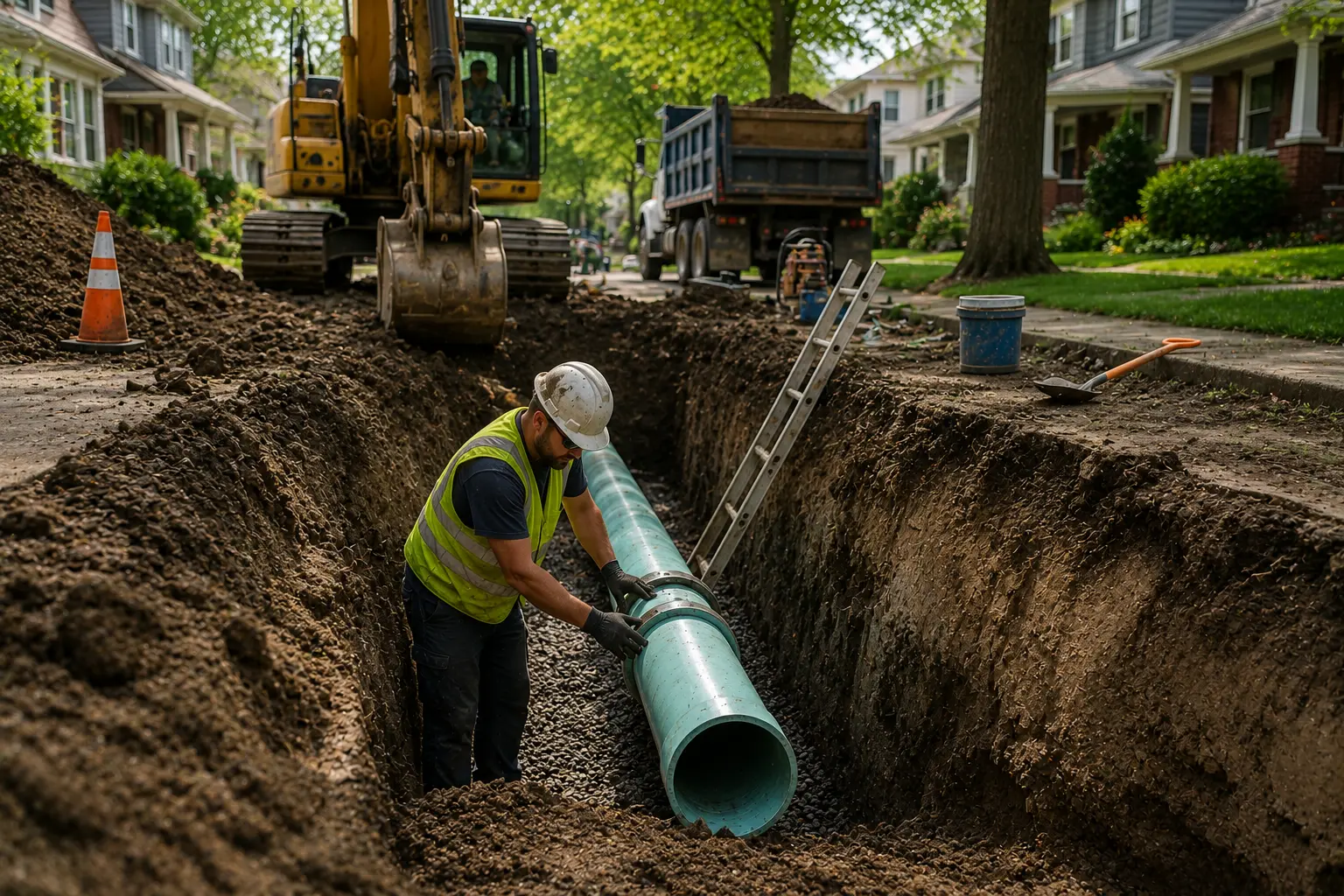
Traditional sewer line excavation is the process of digging down to expose a damaged sewer pipe so it can be repaired or replaced directly. While trenchless methods receive a lot of attention, excavation remains one of the most common and reliable ways to address serious sewer line problems, especially when the pipe is collapsed, severely misaligned, badly deteriorated, or difficult to access from inside the line.
For Chicago homeowners, excavation can feel intimidating because it may involve digging through a yard, driveway, sidewalk, parkway, basement floor, or other finished surface. Understanding what the process involves can make the project less confusing and help homeowners ask better questions before work begins.
This article explains when traditional excavation is used, what the process typically looks like, what affects cost and timing, and how it compares with less invasive repair methods. For a broader look at available options, visit the Sewer Repair Methods hub.
Key Takeaways
- Traditional sewer excavation involves digging to physically expose the damaged pipe.
- It is often used when trenchless methods are not practical or when the pipe is severely damaged.
- Excavation may affect yards, driveways, sidewalks, landscaping, patios, or basement slabs.
- A camera inspection and utility marking process usually occur before digging begins.
- Costs depend heavily on pipe depth, access, surface restoration, permits, and project complexity.
- Although excavation is more disruptive, it gives contractors direct access to the problem area.
What Should Homeowners Expect During Sewer Excavation?
Homeowners should expect a sewer camera inspection, utility marking, digging, pipe repair or replacement, inspection, backfilling, and surface restoration. The project may involve heavy equipment, temporary disruption to the yard or hardscape, and limited use of plumbing fixtures while the sewer line is being repaired.
Traditional excavation is more invasive than trenchless sewer repair, but it may be the most dependable option when the pipe is collapsed, badly offset, severely deteriorated, or located in a section where lining or bursting cannot solve the problem.
What Is Traditional Sewer Line Excavation?
Traditional sewer line excavation means digging a trench or access pit to reach the sewer pipe directly. Once the pipe is exposed, the damaged section can be removed, repaired, replaced, or reconnected.
The excavation may be small and localized if the damage is limited to one area. In more serious cases, the excavation may extend across a larger portion of the property to replace a longer section of sewer line.
Unlike trenchless approaches, which work primarily inside the existing pipe, excavation gives workers physical access to the pipe and surrounding soil conditions. That direct access can be important when the pipe has collapsed, shifted, sagged, or separated in a way that cannot be corrected from inside the line.
When Traditional Excavation Is Usually Needed
Excavation is not automatically required for every sewer problem. However, certain conditions often make it the more practical or necessary option.
Traditional excavation may be needed when:
- The sewer pipe has fully or partially collapsed
- A pipe belly has created a low spot that holds waste and water
- Pipe sections are severely offset or disconnected
- The existing pipe cannot support a liner
- Tree roots have caused major structural damage
- The sewer line is too damaged for rodding or hydro jetting to provide a lasting fix
- The pipe runs beneath an area where access points are limited
- A section of pipe must be physically removed and replaced
If the damage is limited, a smaller repair may be enough. Homeowners comparing a localized fix with a larger project may want to review Spot Repair for Sewer Lines: When Is It Enough?.
The Typical Sewer Excavation Process
1. Sewer Camera Inspection
Most excavation decisions begin with a sewer camera inspection. The camera helps identify where the problem is located, how severe it is, and whether excavation is truly needed.
The inspection may reveal cracks, root intrusion, collapsed sections, sagging pipe, offset joints, or failed pipe materials. It also helps determine whether a trenchless option might still be possible.
2. Locating the Problem Area
Once the issue is identified, the contractor may use locating equipment to mark the approximate position and depth of the damaged pipe. This is important because digging in the wrong location can increase cost, delay the project, and create unnecessary property damage.
3. Utility Marking
Before excavation, underground utilities should be marked. Gas, electric, water, communication lines, and other buried utilities may be present near the sewer line. This step helps reduce safety risks during digging.
4. Excavation
The digging phase may involve hand digging, compact equipment, or larger excavation equipment depending on the depth and access conditions. In tight Chicago lots, equipment access can be one of the biggest challenges.
5. Pipe Repair or Replacement
After the pipe is exposed, the damaged portion is removed or repaired. The replacement material may vary depending on the existing system, code requirements, and the scope of the project.
6. Inspection and Testing
Before the area is backfilled, the repaired or replaced section may need to be inspected. The line may also be tested to confirm proper flow and connection.
7. Backfill and Restoration
After repair work is complete, the excavation is filled back in. Surface restoration may involve replacing soil, grass, concrete, asphalt, pavers, or other materials affected by the project.
Traditional Excavation vs Trenchless Sewer Repair
Traditional excavation and trenchless repair solve some of the same sewer problems, but they do so in very different ways.
| Factor | Traditional Excavation | Trenchless Sewer Repair |
|---|---|---|
| Access Method | Pipe is exposed by digging | Pipe is accessed through limited entry points |
| Surface Disruption | Often higher | Usually lower |
| Best For | Collapsed, sagging, severely damaged, or misaligned pipe | Structurally stable pipes or replacement routes that qualify |
| Inspection Access | Direct visual and physical access | Camera-based evaluation and internal work |
| Restoration Needs | Can be significant | Often reduced |
| Limitations | More disruptive and may require more restoration | Not suitable for every pipe condition |
Homeowners interested in less invasive options can compare this approach with Trenchless Sewer Repair in Chicago Explained.
Why Excavation Is Sometimes the Better Choice
Excavation is often viewed as the more disruptive option, but it also has important advantages. When the pipe is badly damaged, direct access can provide the clearest path to a durable repair.
Excavation may be the better choice when the goal is to:
- Correct a severe pipe belly or sag
- Remove a collapsed section
- Replace a badly offset pipe connection
- Fix a section that cannot be lined
- Address surrounding soil or bedding problems
- Install new pipe with proper slope and alignment
In these situations, trying to force a trenchless solution may create future problems if the underlying pipe alignment or structure is not corrected.
Cost Factors Homeowners Should Understand
Traditional sewer excavation costs can vary widely because the amount of work depends on far more than the damaged pipe itself.
Important cost factors include:
- Depth of the sewer line
- Length of pipe being repaired or replaced
- Soil conditions
- Access for equipment
- Whether concrete, asphalt, or pavers must be removed
- Whether the sewer line runs under a driveway, sidewalk, garage, or basement slab
- Permit and inspection requirements
- Restoration after the repair
- Emergency timing or after-hours work
Homeowners should ask whether estimates include restoration or only the sewer repair itself. A lower repair estimate may not be the lowest total cost if concrete, landscaping, or hardscape replacement is billed separately.
Chicago-Specific Considerations
Older Pipe Materials
Many Chicago homes have older clay or cast iron sewer lines. These materials can fail in different ways. Clay pipes may crack, separate at joints, or allow root intrusion. Cast iron pipes may corrode, scale, or weaken over time.
For material-specific information, see Clay Sewer Pipe Replacement: What to Expect and Cast Iron Sewer Pipe Repair Options.
Dense Lots and Limited Access
Chicago properties may have narrow side yards, detached garages, rear alleys, neighboring structures, fences, and limited equipment access. These site conditions can affect how excavation is planned and how much restoration is needed afterward.
Concrete, Sidewalks, and Parkways
Excavation in Chicago may involve concrete sidewalks, public parkways, driveways, patios, or slabs. Work in or near public areas may require additional planning, permits, or coordination.
If the problem area is beneath concrete, homeowners may find Sewer Repair Under a Sidewalk: What Homeowners Need to Know and Sewer Repair Under a Driveway: Methods and Challenges helpful.
Winter and Weather Conditions
Cold weather, frozen ground, snow, and freeze-thaw cycles can complicate excavation and restoration. Even when sewer repairs must proceed quickly, final surface restoration may be affected by seasonal conditions.
How Long Does Sewer Excavation Take?
The timeline depends on the scope and complexity of the project. A smaller spot repair may move faster than a full sewer line replacement, but even a limited excavation can be delayed by depth, utility conflicts, inspection timing, weather, or difficult access.
Typical stages include:
- Inspection and diagnosis
- Estimate and repair planning
- Utility marking
- Permit coordination if required
- Excavation
- Pipe repair or replacement
- Inspection or testing
- Backfill
- Surface restoration
Homeowners should clarify whether the quoted project timeline includes final restoration or only the sewer repair portion.
Repair, Partial Replacement, or Full Replacement?
Excavation does not always mean the entire sewer line must be replaced. In some cases, only a damaged section is excavated and repaired. In others, the condition of the pipe may justify replacing a longer run.
The decision depends on:
- How much of the line is damaged
- The age of the pipe
- The number of defects found during inspection
- Whether previous repairs have failed
- The risk of future problems
- The cost difference between partial and full replacement
For homeowners deciding between a smaller repair and a larger project, Sewer Line Repair vs Replacement: Which Option Makes Sense? provides a helpful comparison.
When Full Excavation Replacement May Be Necessary
A full sewer line replacement may be considered when the pipe has reached the end of its service life or when multiple defects are present throughout the line.
Replacement may make sense when:
- Multiple sections are cracked or failing
- The pipe has repeated root intrusion points
- Previous spot repairs have not solved the problem
- The line has significant slope or alignment issues
- The pipe material is deteriorating throughout
- The homeowner wants a more permanent solution instead of repeated repairs
For a more detailed overview, see Full Sewer Line Replacement: What Homeowners Should Know.
Common Mistakes Homeowners Make
- Assuming excavation is unnecessary before reviewing camera inspection results
- Choosing the lowest estimate without understanding restoration costs
- Ignoring permits, inspection requirements, or utility marking
- Delaying repairs when a sewer line is partially collapsed
- Assuming trenchless repair works for every pipe condition
- Failing to ask how much property disruption is expected
- Not clarifying who is responsible for concrete, grass, or landscape restoration
The most important mistake is making the decision based only on price. Sewer work should be evaluated by diagnosis, pipe condition, project scope, and long-term reliability.
Questions to Ask Before Approving Excavation
Before approving sewer excavation, homeowners should ask practical questions that clarify the scope of work and reduce surprises.
- What did the camera inspection show?
- Is excavation required, or are trenchless options possible?
- How much of the pipe will be exposed?
- Will this be a spot repair, partial replacement, or full replacement?
- What surfaces will be disturbed?
- Are permits or inspections needed?
- Does the estimate include backfill and surface restoration?
- How long will plumbing service be interrupted?
- What material will be used for the replacement section?
- What conditions could increase the final cost?
Frequently Asked Questions
Is traditional sewer excavation always worse than trenchless repair?
No. Excavation is more disruptive, but it can be the better option when the sewer line is collapsed, badly sagging, severely offset, or structurally unsuitable for trenchless methods.
Will my yard or driveway be completely torn up?
It depends on where the damaged pipe is located and how much pipe needs to be exposed. Some projects require only a limited access pit, while others involve a longer trench or removal of concrete surfaces.
Can excavation be used for a small sewer repair?
Yes. Excavation can be used for a localized spot repair when only one section of pipe is damaged and the rest of the line is in reasonable condition.
Does homeowners insurance cover sewer excavation?
Coverage depends on the policy and cause of damage. Many policies exclude wear and tear, deterioration, root intrusion, or underground service line failures unless specific endorsements apply.
How do I know if excavation is really necessary?
A sewer camera inspection is usually the most useful starting point. The footage should show whether the pipe is collapsed, severely offset, sagging, or otherwise unsuitable for less invasive repair methods.
Will I be able to use plumbing during the excavation?
Plumbing use may be limited or temporarily unavailable while the sewer line is open or disconnected. Homeowners should ask when service will be interrupted and when it is expected to resume.
Is excavation more expensive than trenchless repair?
Not always. Excavation may have higher restoration costs, but trenchless methods use specialized equipment and materials. The total cost depends on pipe condition, access, depth, length, and restoration requirements.
Conclusion
Traditional sewer line excavation is a direct and often highly effective way to repair or replace a damaged sewer line. While it can be more disruptive than trenchless methods, it remains necessary when pipes are collapsed, severely misaligned, badly deteriorated, or otherwise unsuitable for internal repair techniques.
For Chicago homeowners, the key is understanding why excavation is being recommended, what areas of the property will be affected, and whether the project involves a spot repair, partial replacement, or full sewer line replacement. A clear diagnosis and a detailed scope of work can help homeowners make a practical decision with fewer surprises.