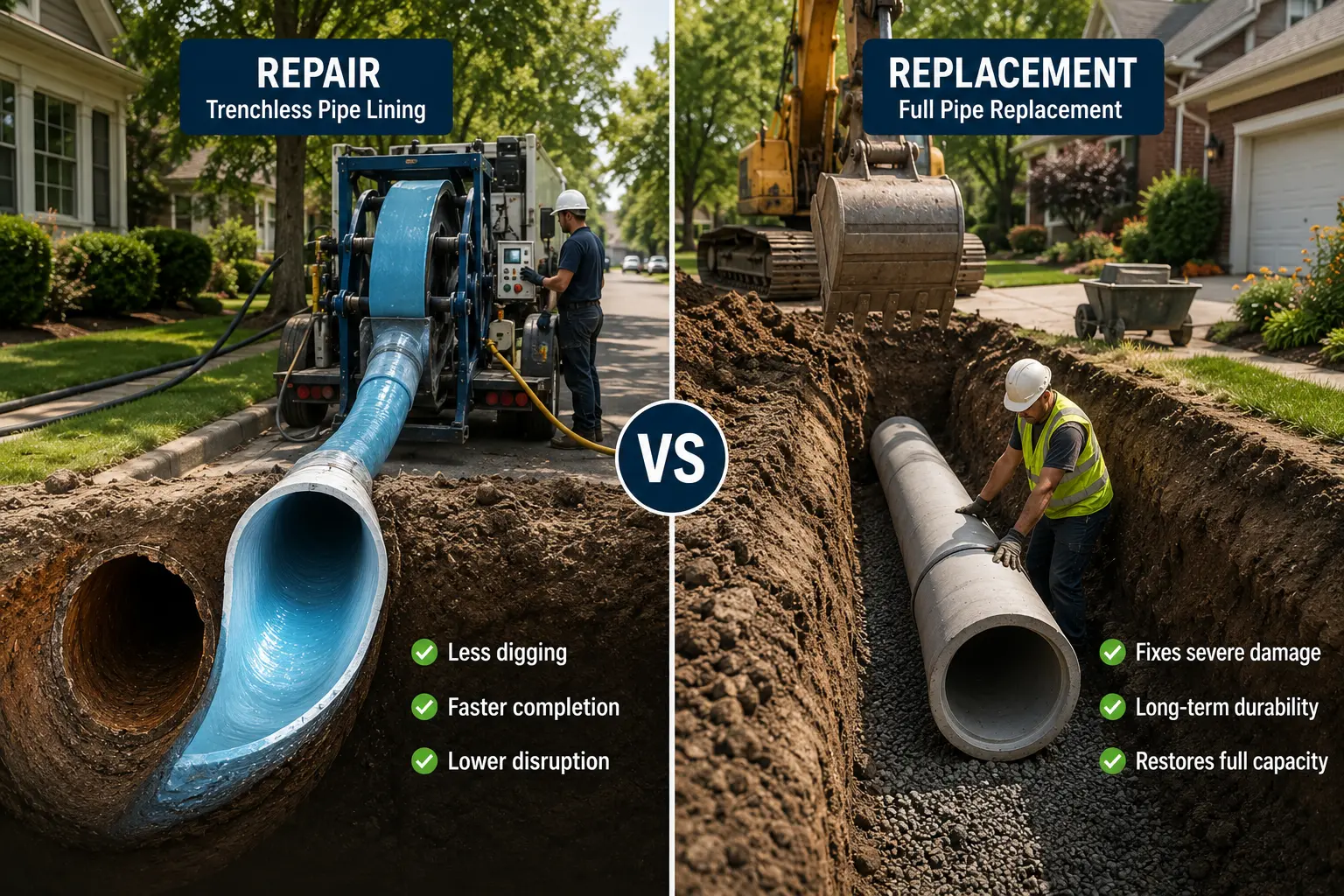
When a sewer line starts causing recurring problems, one of the biggest questions homeowners face is whether the pipe can be repaired or if full replacement is the better long-term solution. The answer depends on the age of the pipe, the extent of the damage, the location of the problem, and the overall condition of the sewer system.
In some cases, a targeted repair can restore proper function for years. In others, repairing a failing sewer line simply delays a larger and more expensive problem. Understanding the differences between sewer repair and sewer replacement can help Chicago homeowners make informed decisions and avoid spending money on solutions that do not address the underlying issue.
For a broader overview of available repair techniques and replacement methods, homeowners can explore the Sewer Repair Methods resource hub.
Key Takeaways
- Sewer repairs are often appropriate for isolated damage or limited problem areas.
- Full replacement is usually recommended when pipes have widespread deterioration.
- The age and material of the sewer line significantly affect the decision.
- Trenchless technologies may allow replacement with less disruption than traditional excavation.
- Multiple repairs over time can sometimes cost more than replacing the line once.
- A sewer camera inspection is typically necessary before choosing either option.
When Does Repair Make More Sense Than Replacement?
If the damage is isolated, the pipe is otherwise in good condition, and the sewer line has substantial remaining life, repair is often the most practical choice.
If the line has multiple failures, extensive root intrusion, structural collapse, severe corrosion, or widespread deterioration, replacement usually provides a more reliable long-term solution. The decision should be based on the overall condition of the pipe rather than the location of a single symptom.
Understanding the Difference Between Sewer Repair and Sewer Replacement
Although the terms are sometimes used interchangeably, sewer repair and sewer replacement involve very different approaches.
Sewer Repair
Sewer repair addresses a specific defect while preserving most of the existing pipe. Repairs may include:
- Spot repairs for isolated damage
- Pipe lining within damaged sections
- Joint repairs
- Root intrusion corrections
- Localized excavation and replacement
Homeowners interested in localized fixes can learn more about Spot Repair for Sewer Lines: When Is It Enough?.
Sewer Replacement
Sewer replacement involves removing or replacing significant portions of the sewer line. Depending on the project, this may include:
- Replacing the entire line from house to city connection
- Installing completely new piping materials
- Using trenchless replacement technologies
- Traditional excavation and reconstruction
For a deeper look at full-system replacement projects, see Full Sewer Line Replacement: What Homeowners Should Know.
Signs That a Sewer Repair May Be Sufficient
Repair is often the preferred option when the problem is limited and the remainder of the pipe remains structurally sound.
Repair may make sense when:
- The sewer line has a single crack or break
- Damage is confined to a short section
- The pipe material remains in generally good condition
- Tree root intrusion is limited
- A recent inspection shows no widespread deterioration
- Previous sewer performance has been reliable
In these situations, repairing the affected section can restore function without the expense and disruption of replacing the entire line.
Signs That Sewer Replacement May Be the Better Choice
Replacement becomes increasingly attractive when repairs would only address one symptom of a larger problem.
Common indicators that replacement should be considered include:
- Recurring backups despite multiple repairs
- Numerous cracks throughout the pipe
- Severe corrosion in cast iron systems
- Collapsing clay pipe sections
- Multiple root intrusion points
- Pipe bellies or significant settling
- Major offset joints
- Advanced age of the sewer system
When deterioration is widespread, replacing the entire line often provides better long-term value than repeatedly repairing individual failures.
Comparing Repair and Replacement
| Factor | Repair | Replacement |
|---|---|---|
| Project Scope | Localized correction | Partial or complete pipe renewal |
| Upfront Cost | Typically lower | Typically higher |
| Long-Term Reliability | Depends on overall pipe condition | Usually higher |
| Construction Time | Often shorter | May take longer |
| Future Maintenance | May still be needed | Often reduced |
| Suitable for Aging Pipes | Sometimes | Often preferred |
Cost Considerations
Cost is often the first factor homeowners consider, but it should not be the only factor.
A repair may cost significantly less today, but if the line continues failing, multiple repairs can eventually exceed the cost of replacement.
Factors affecting cost include:
- Depth of the sewer line
- Location of the damage
- Pipe material
- Accessibility of the work area
- Need for permits
- Restoration requirements
- Use of trenchless methods
Chicago properties often have mature landscaping, sidewalks, garages, and alley access considerations that can influence both repair and replacement costs.
How Pipe Material Influences the Decision
Clay Sewer Pipes
Many older Chicago homes still contain clay sewer lines. While clay can last for decades, it is vulnerable to root intrusion and cracking.
Homeowners with aging clay systems may want to review Clay Sewer Pipe Replacement: What to Expect when evaluating replacement options.
Cast Iron Sewer Pipes
Cast iron systems often experience corrosion as they age. While isolated repairs are possible, extensive rusting may indicate that replacement is becoming unavoidable.
Additional information is available in Cast Iron Sewer Pipe Repair Options.
PVC Sewer Pipes
Modern PVC systems generally resist corrosion and root intrusion better than older materials. When damage occurs, repairs are often more straightforward and replacement sections can be integrated easily.
Chicago-Specific Considerations
Chicago homeowners face several unique factors when evaluating sewer repair versus replacement.
Older Housing Stock
Many neighborhoods contain homes built decades before modern sewer materials became standard. Aging clay and cast iron systems frequently require more extensive evaluation.
Freeze-Thaw Cycles
Chicago’s climate can contribute to soil movement over time. Repeated freeze-thaw cycles may affect pipe alignment, joints, and surrounding soil conditions.
Urban Property Constraints
Tight lot lines, garages, sidewalks, alleys, and neighboring structures can make excavation more complicated than in suburban developments.
Permits and Inspections
Certain sewer projects may require permits, inspections, or coordination with municipal agencies depending on the location and scope of work.
Repair Methods That May Avoid Full Replacement
In some situations, modern repair techniques can extend the life of an existing sewer line without complete replacement.
- Pipe lining
- Spot repairs
- Localized excavation
- Joint repairs
- Root intrusion remediation
Homeowners evaluating minimally invasive options may benefit from reviewing Pipe Lining for Sewer Repair: How It Works and Trenchless Sewer Repair in Chicago Explained.
When Trenchless Replacement Becomes Attractive
Some homeowners assume replacement automatically means extensive excavation across the yard, driveway, or landscaping. Modern trenchless methods can sometimes reduce surface disruption while still providing an entirely new sewer line.
One of the most common approaches is pipe bursting, which replaces the old line while simultaneously installing new piping.
For more information, see Pipe Bursting for Sewer Replacement Explained.
Common Mistakes Homeowners Make
- Choosing repair solely because it costs less upfront
- Ignoring recurring sewer backups
- Skipping a camera inspection before making decisions
- Assuming all sewer problems require full replacement
- Delaying corrective action until a complete failure occurs
- Overlooking the age and overall condition of the pipe
- Failing to compare repair costs against long-term replacement value
Making decisions based on a complete assessment of the sewer system typically leads to better outcomes than focusing only on the immediate problem area.
Frequently Asked Questions
How can I tell if my sewer line needs repair or replacement?
A sewer camera inspection is usually the most reliable way to determine the extent of damage. The inspection can reveal whether the issue is isolated or part of a broader deterioration problem.
Is replacement always more expensive than repair?
Replacement generally has a higher initial cost, but repeated repairs can sometimes exceed the long-term cost of installing a new sewer line.
Can trenchless methods be used for both repair and replacement?
Yes. Technologies such as pipe lining are often used for repairs, while pipe bursting is commonly used for replacement projects.
Will homeowners insurance cover sewer line replacement?
Coverage varies by policy. Some policies exclude sewer line failures caused by wear and tear, while optional endorsements may provide limited underground utility coverage.
Are older Chicago homes more likely to need replacement?
Older homes frequently contain clay or cast iron sewer lines that may be approaching the end of their service life. However, age alone does not automatically mean replacement is necessary.
How long does a repaired sewer line typically last?
The lifespan depends on the repair method, pipe material, soil conditions, and the overall condition of the existing sewer system.
Can a sewer line pass inspection after a repair?
Yes. If the repair successfully addresses the defect and the remaining pipe is structurally sound, the line may continue performing reliably for years.
Conclusion
Choosing between sewer repair and sewer replacement is ultimately a question of long-term value, not just immediate cost. A targeted repair can be highly effective when damage is isolated and the rest of the sewer line remains in good condition. However, when pipes show widespread deterioration, recurring failures, or advanced age-related issues, replacement often becomes the more practical and durable solution.
For Chicago homeowners, understanding the condition of the entire sewer system—and not just the visible symptom—is the key to making the right decision.