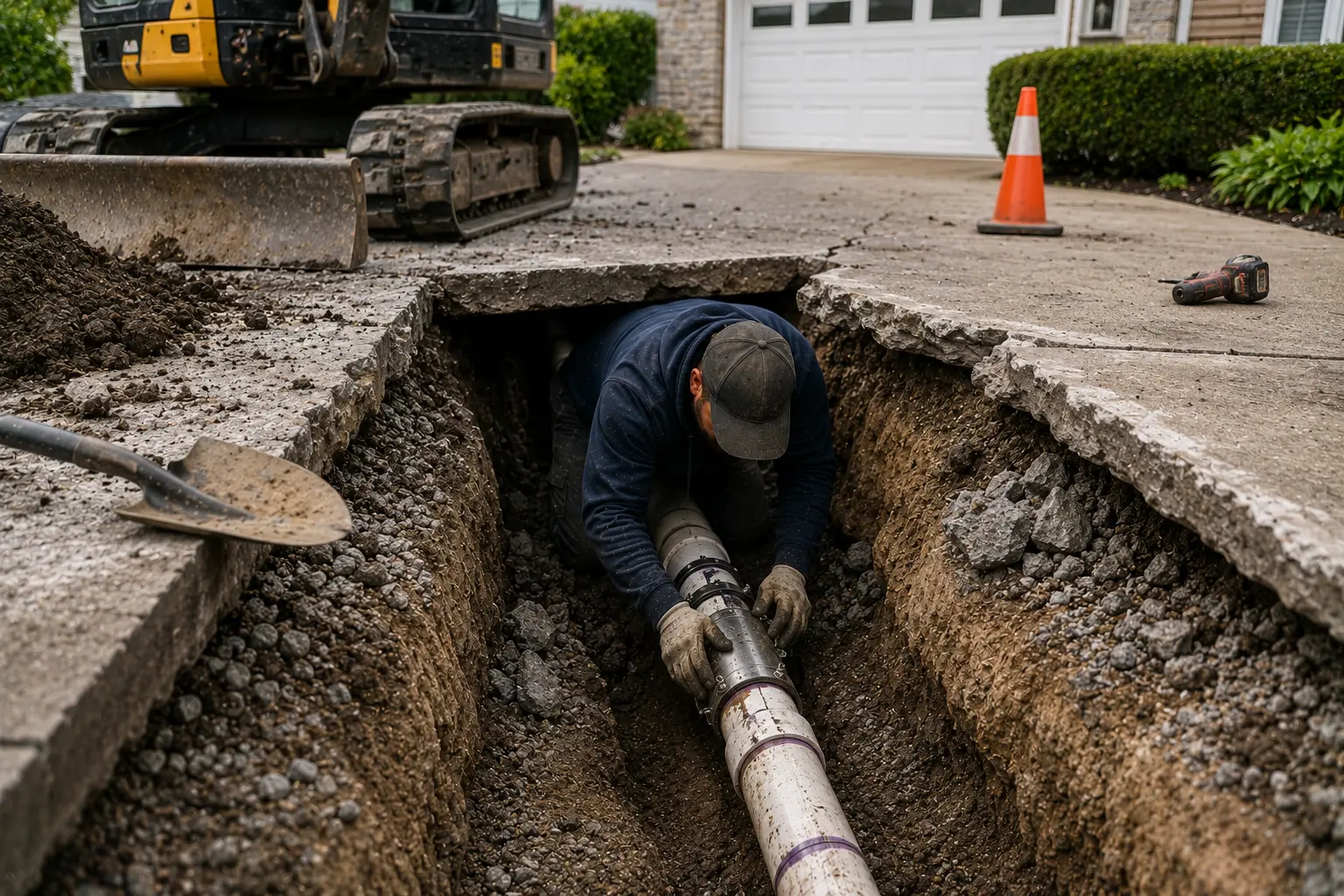
Sewer repair under a driveway can be more complicated than a sewer repair in an open yard. When the sewer line runs beneath concrete, asphalt, pavers, or a narrow driveway area, homeowners must consider not only the pipe repair itself but also access, excavation, surface removal, restoration, drainage, and whether trenchless methods may reduce disruption.
For Chicago homeowners, driveway sewer repairs can be especially challenging because many properties have older clay or cast iron sewer lines, limited side-yard access, detached garages, alleys, mature trees, and paved areas close to the home. A sewer problem under the driveway may require careful planning before any digging or concrete cutting begins.
The right method depends on the pipe condition, the location of the defect, the driveway material, the depth of the sewer line, and whether repair or replacement is the better long-term option. For a broader overview of available methods, visit the Sewer Repair Methods hub.
Key Takeaways
- Sewer repair under a driveway often involves both pipe work and surface restoration.
- Camera inspection and pipe locating are usually needed before cutting or excavating.
- Trenchless options may reduce driveway damage if the pipe is a suitable candidate.
- Traditional excavation may still be necessary for collapse, severe offsets, pipe bellies, or major structural defects.
- Costs depend on pipe depth, driveway material, access, repair method, permits, and restoration.
- Homeowners should clarify whether the estimate includes driveway replacement or only sewer repair.
Can a Sewer Line Under a Driveway Be Repaired Without Removing the Driveway?
Sometimes. If the sewer pipe is structurally stable and the damage can be addressed from inside the line, trenchless methods such as pipe lining may reduce or avoid driveway removal. Pipe bursting may also be possible for certain replacement projects if the existing pipe path and site access allow it.
However, if the sewer line is collapsed, severely offset, sagging, crushed, or needs grade correction, traditional excavation may be required. In those cases, part of the driveway may need to be cut, removed, and restored after the pipe work is complete.
Why Driveway Sewer Repairs Are More Complicated
A sewer line under a driveway is harder to reach than one under grass or landscaping. The repair may require cutting through concrete or asphalt, removing pavers, excavating below the surface, repairing the pipe, backfilling properly, and restoring the driveway so it remains usable.
The driveway surface also adds decisions that are separate from the sewer repair itself. Homeowners may need to ask whether the affected area can be patched, whether a larger section should be replaced for appearance, and whether drainage or settling could become a future issue.
Driveway repairs can also affect vehicle access, garage access, alley access, and parking during the project.
Common Sewer Problems Found Under Driveways
Sewer lines under driveways can experience many of the same problems as other underground sewer lines. The difference is that access and restoration may be more expensive or disruptive.
Common problems include:
- Cracked clay sewer pipe
- Corroded cast iron pipe
- Tree root intrusion
- Offset pipe joints
- Separated pipe sections
- Collapsed or crushed pipe
- Pipe bellies that hold wastewater
- Previous repairs that have shifted or failed
- Improper slope beneath the driveway
Older clay and cast iron systems are common concerns in Chicago homes. Homeowners dealing with aging materials may want to review Clay Sewer Pipe Replacement: What to Expect and Cast Iron Sewer Pipe Repair Options.
How Contractors Diagnose a Driveway Sewer Problem
Sewer Camera Inspection
A sewer camera inspection helps identify the type of defect, the condition of the pipe, and whether the damage appears isolated or widespread. This is usually the first step before deciding whether the driveway must be opened.
Pipe Locating
Once the defect is seen on camera, locating equipment may be used to estimate where the damaged section sits beneath the driveway. Accurate locating can help limit unnecessary concrete or asphalt removal.
Depth and Access Evaluation
The depth of the sewer line affects excavation difficulty, shoring needs, equipment access, and cost. A deeper pipe under a driveway can be more complex than a shallow pipe in open soil.
Repair Method Review
After the inspection, homeowners should compare the available options. A simple blockage, isolated crack, collapsed section, and widespread failing line all point to different solutions.
Repair Options for Sewer Lines Under Driveways
Sewer Cleaning or Rodding
If the issue is a clog and the pipe is still structurally sound, sewer rodding or hydro jetting may restore flow without digging. However, cleaning does not repair cracks, collapse, corrosion, or offset joints.
Homeowners trying to understand the difference between clearing a blockage and repairing pipe damage can read Sewer Rodding vs Sewer Repair: What’s the Difference?.
Pipe Lining
Pipe lining may be an option when the sewer pipe under the driveway is cracked, leaking, or affected by root entry points but still stable enough to support a liner. This trenchless method creates a new interior pipe surface and may reduce the need to remove driveway sections.
For more detail, see Pipe Lining for Sewer Repair: How It Works.
Spot Repair
A spot repair may be appropriate when one specific section beneath the driveway is damaged. This often involves cutting a targeted area of the driveway, exposing the pipe, repairing or replacing the damaged section, and restoring the surface afterward.
For isolated defects, Spot Repair for Sewer Lines: When Is It Enough? explains when a limited repair may be enough.
Pipe Bursting
Pipe bursting may be used when the sewer line needs replacement but the homeowner wants to avoid a full trench through the driveway. This method breaks apart the old pipe while pulling new pipe into place.
Pipe bursting still requires access pits, and it is not suitable for every pipe condition. Severe bellies, major offsets, blocked pipe paths, or nearby utility conflicts may make excavation necessary.
More information is available in Pipe Bursting for Sewer Replacement Explained.
Traditional Excavation
Traditional excavation may be required when the pipe must be physically exposed. This is often the case with collapsed pipe, crushed sections, major grade problems, severe offsets, or defects that cannot be repaired from inside the pipe.
Homeowners can learn what to expect from digging and restoration in Traditional Sewer Line Excavation: What Homeowners Should Expect.
Trenchless Repair vs Driveway Excavation
Trenchless methods are often attractive when a sewer line runs under a driveway, but they should only be used when the pipe condition is appropriate.
| Factor | Trenchless Repair | Driveway Excavation |
|---|---|---|
| Driveway Disruption | Often reduced | May require cutting or removing part of the driveway |
| Best For | Stable pipes, lining candidates, or replacement paths suitable for bursting | Collapsed, sagging, crushed, or severely misaligned pipe |
| Access Needs | Requires usable access points | Requires direct access from above |
| Restoration | May be limited to access areas | May involve concrete, asphalt, or paver restoration |
| Limitations | Not suitable for every defect | More disruptive but adaptable to severe pipe conditions |
For a broader overview of limited-excavation options, see Trenchless Sewer Repair in Chicago Explained.
Driveway Materials Affect the Repair Plan
The type of driveway surface can affect both access and restoration.
Concrete Driveways
Concrete may need to be saw-cut and removed in sections. After the pipe repair, the concrete may be patched or a larger panel may need replacement depending on the cut location and driveway condition.
Asphalt Driveways
Asphalt can sometimes be cut and patched more easily than concrete, but matching the surface and preventing settlement still matter.
Paver Driveways
Pavers may be removable and reusable in some situations, but the base must be properly restored to avoid uneven settling after the repair.
Shared or Narrow Driveways
In dense Chicago neighborhoods, narrow or shared driveways may create access limitations. Equipment staging, parking, and neighbor coordination may become part of the planning process.
Cost Factors for Sewer Repair Under a Driveway
Sewer repair under a driveway can vary widely because the total cost includes pipe work, access, and surface restoration.
Important cost factors include:
- Depth of the sewer line
- Length of pipe being repaired or replaced
- Driveway material
- Amount of concrete, asphalt, or paver removal
- Whether trenchless repair is possible
- Pipe material and condition
- Equipment access
- Permit and inspection requirements
- Backfill and compaction
- Driveway restoration
- Whether access to a garage or alley is affected
Homeowners should ask whether an estimate includes driveway restoration or only the sewer repair. These are often separate parts of the project.
Chicago-Specific Considerations
Older Sewer Materials
Chicago homes may have clay, cast iron, PVC, or mixed sewer materials from previous repairs. The material affects whether the line can be cleaned, lined, spot repaired, burst, or replaced.
Detached Garages and Alley Access
Many properties have detached garages, rear driveways, and alley access. Sewer repair under these areas may affect where equipment can be staged and whether vehicles can enter or exit during the project.
Freeze-Thaw and Surface Restoration
Chicago’s freeze-thaw cycles can make proper backfill and compaction important. Poor restoration beneath a driveway can contribute to settling, cracking, or uneven surfaces later.
Sidewalks and Public Areas
Some driveway sewer repairs may be close to sidewalks, aprons, parkways, or public right-of-way areas. Additional permitting or coordination may be required depending on the location.
If the sewer work extends near a sidewalk, homeowners may also find Sewer Repair Under a Sidewalk: What Homeowners Need to Know useful.
Limited Lot Space
Urban lots may not provide much room for excavation equipment, spoil piles, pipe staging, or access pits. This can influence both method selection and project timeline.
What to Expect During Driveway Sewer Repair
While each project is different, many driveway sewer repairs follow a general sequence.
- Camera inspection and diagnosis
- Locating the damaged pipe section
- Reviewing trenchless and excavation options
- Utility marking before digging
- Permit coordination if required
- Driveway cutting, removal, or access pit preparation if needed
- Pipe repair, lining, bursting, or replacement
- Inspection or testing
- Backfill and compaction
- Driveway surface restoration
Homeowners should ask how long vehicle access will be limited and whether the driveway can be used immediately after restoration or must cure or settle first.
Insurance Considerations
Homeowners insurance coverage for sewer repair under a driveway depends on the policy, the cause of the sewer damage, and any added endorsements. Coverage for sewer backup cleanup is not necessarily the same as coverage for underground pipe repair or driveway restoration.
Homeowners should review:
- Service line coverage
- Sewer backup endorsements
- Exclusions for wear and tear
- Exclusions for roots or age-related deterioration
- Coverage for excavation and restoration
- Deductibles and claim documentation requirements
Before assuming coverage, it is important to understand whether the policy covers the pipe, the driveway surface, cleanup, or only certain types of sudden damage.
Common Mistakes Homeowners Make
- Approving driveway removal before confirming the pipe location
- Skipping a sewer camera inspection
- Assuming trenchless repair works for every driveway sewer problem
- Not asking whether driveway restoration is included
- Comparing estimates without checking surface repair details
- Ignoring pipe bellies or slope problems shown on camera footage
- Failing to ask how long vehicle access will be blocked
- Assuming homeowners insurance automatically covers the pipe and driveway
The most important mistake is treating the driveway as the main issue while overlooking the condition of the sewer line itself. The best repair method should be chosen based on the pipe defect, not just the desire to avoid cutting the driveway.
Questions to Ask Before Approving Driveway Sewer Repair
- What did the camera inspection show?
- Where exactly is the damaged pipe located?
- Is the damage isolated or widespread?
- Can pipe lining avoid driveway removal?
- Is pipe bursting possible?
- Will traditional excavation be required?
- How much of the driveway will be affected?
- Does the estimate include driveway restoration?
- Will the repaired area match the existing surface?
- How long will vehicle access be unavailable?
- Are permits or inspections required?
- What conditions could increase the final cost?
Frequently Asked Questions
Can a sewer line under a driveway be repaired without digging up the driveway?
Sometimes. Pipe lining or pipe bursting may reduce driveway removal if the pipe is a suitable candidate and access points are available. Severe collapse, bellies, or offsets may still require excavation.
How do contractors know where to cut the driveway?
A sewer camera inspection and locating equipment are typically used to estimate the damaged section’s location before concrete, asphalt, or pavers are opened.
Is trenchless repair always better under a driveway?
No. Trenchless repair can reduce disruption, but it is only appropriate when the pipe condition allows it. Excavation may be better for collapsed, sagging, or severely misaligned pipe.
Will the driveway look the same after sewer repair?
That depends on the material, age, color, patch size, and restoration scope. Concrete and asphalt patches may be visible, while pavers may be easier to blend if they can be reused.
Does homeowners insurance cover sewer repair under a driveway?
Coverage depends on the policy and cause of damage. Many policies exclude wear and tear, root intrusion, deterioration, and underground service line failure unless special coverage applies.
How long will I lose access to my driveway?
The timeline depends on the repair method, excavation needs, inspection timing, and surface restoration. Concrete or asphalt work may require additional time before regular use resumes.
Should I repair one section or replace the whole line?
That depends on the inspection results. Isolated damage may qualify for spot repair, while widespread deterioration, repeated backups, or multiple defects may make replacement more practical.
Conclusion
Sewer repair under a driveway requires careful planning because the project involves both underground pipe work and surface restoration. Some problems can be handled with trenchless repair, pipe lining, or a targeted spot repair. Others require excavation to correct collapsed, sagging, offset, or severely damaged pipe.
For Chicago homeowners, the best decision starts with a camera inspection, accurate locating, and a clear explanation of whether the damage is isolated or widespread. A complete estimate should explain the repair method, affected driveway area, restoration responsibilities, permits, plumbing interruption, and any conditions that could change the project scope.