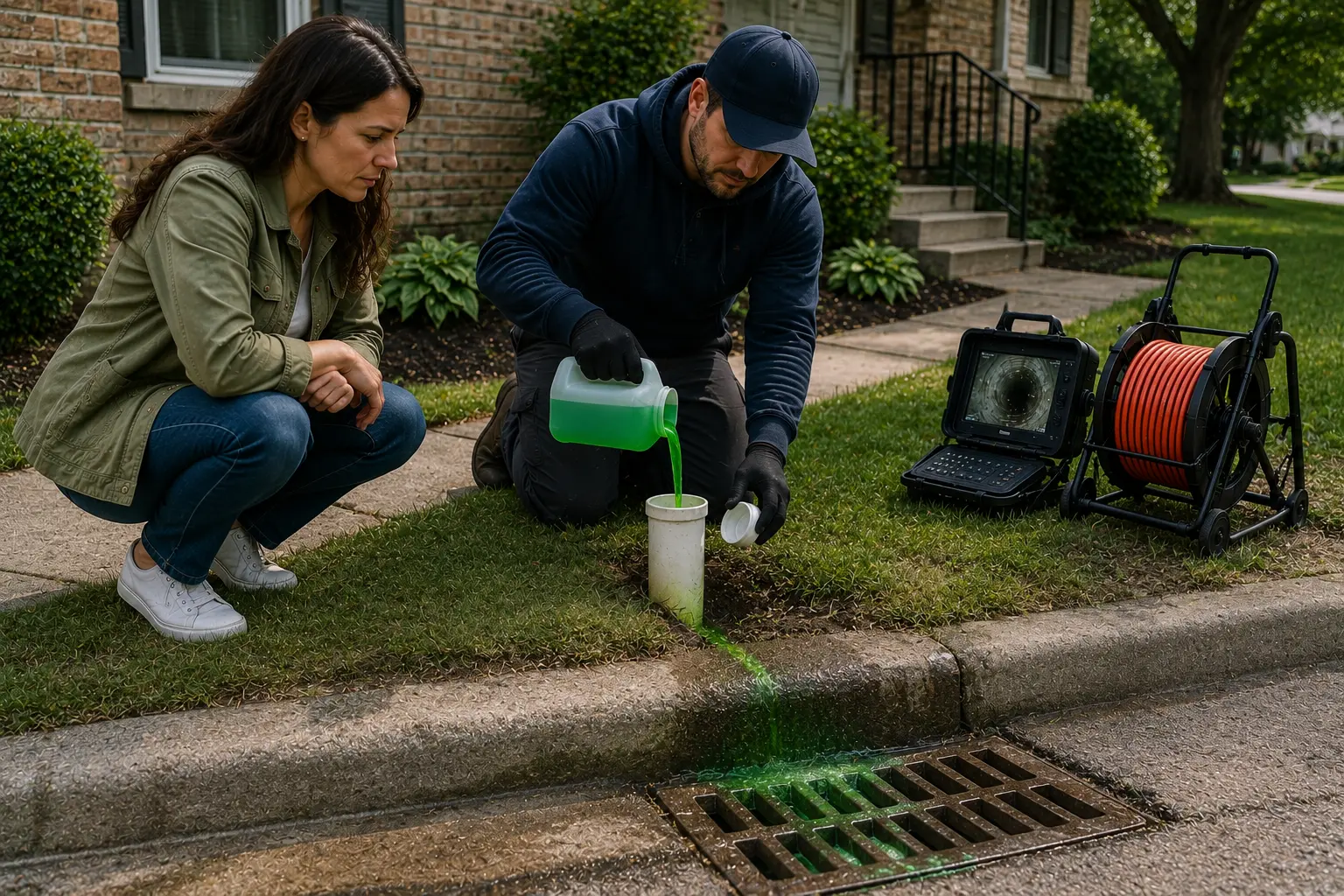
Sewer dye testing is a diagnostic method used to trace where water is flowing in a plumbing, sewer, or drainage system. Instead of using a camera to inspect the inside of a pipe or smoke to find air leaks, dye testing uses brightly colored test dye and water to help confirm whether a drain, fixture, downspout, leak, or suspected connection leads to a specific location.
For Chicago homeowners, sewer dye testing may be useful when the question is not simply “what does the pipe look like?” but “where is this water going?” It can help investigate suspected cross-connections, basement seepage, stormwater routing, improper drainage, leaks, and confusing sewer or drain pathways in older homes.
Dye testing is not the right tool for every sewer problem. It does not show the full interior condition of a pipe like a sewer camera inspection, and it does not locate sewer gas pathways the same way smoke testing can. But when used for the right problem, it can provide practical evidence that helps homeowners understand drainage behavior and decide what diagnostic step should come next.
For more homeowner-focused diagnostic resources, visit the Sewer Inspections & Diagnosis hub.
Key Takeaways
- Sewer dye testing uses colored dye and water to trace drainage paths or confirm where water is traveling.
- It is commonly used for suspected leaks, improper connections, stormwater routing questions, basement seepage, and drainage investigations.
- Dye testing is different from sewer camera inspection, smoke testing, and line locating.
- A dye test can help confirm a connection, but it usually does not show the full physical condition of the pipe.
- Chicago homes with older plumbing, basements, downspouts, additions, and mixed drainage systems may require dye testing in specific situations.
- Dye test results should be documented clearly, especially when they affect repair, insurance, real estate, or code-related decisions.
When Is Sewer Dye Testing Used?
Sewer dye testing is used when a homeowner or inspector needs to trace where water flows. It may be used to confirm whether a drain connects to a sewer line, whether a downspout or exterior drain is tied into a sanitary or combined sewer system, whether water is leaking into a basement, or whether a suspected drainage pathway leads to a specific outlet.
It is most helpful for connection and flow questions. If the goal is to evaluate cracks, roots, offsets, collapse, or pipe condition, a sewer camera inspection is usually more appropriate.
How Sewer Dye Testing Works
A dye test typically involves placing a visible, water-soluble dye into a fixture, drain, suspected leak point, downspout, exterior drain, or other part of the drainage system. Water is then run through the area so the dye travels with the flow.
The inspector then watches for the dye to appear at another location. This might be a cleanout, catch basin, floor drain, sewer access point, sump area, exterior discharge point, basement seepage area, or another suspected connection.
The basic steps often include:
- Identify the drain, fixture, or suspected source to be tested.
- Add test dye to the selected location.
- Run water to move the dye through the system.
- Observe likely exit points, connected drains, or problem areas.
- Document where the dye appears or does not appear.
- Use the result to decide whether additional inspection is needed.
The test may sound simple, but interpretation matters. Dye appearing in an unexpected place can be meaningful, while dye not appearing may mean the connection is absent, blocked, delayed, diluted, or not adequately observed.
What Sewer Dye Testing Can Help Confirm
Dye testing is useful because it can answer practical flow questions that are difficult to confirm by looking at fixtures or pipes from the surface.
| Question | How Dye Testing Helps | Why It Matters |
|---|---|---|
| Where does this drain go? | Dye is introduced into the drain and watched for downstream. | Helps confirm connections before repair or remodeling decisions. |
| Is a downspout connected to the sewer? | Dye is added to the downspout while downstream areas are observed. | May identify improper or outdated stormwater connections. |
| Is water entering the basement from a drain path? | Dye may help connect exterior water movement to interior seepage. | Helps separate plumbing issues from groundwater or foundation issues. |
| Does this fixture connect to the expected line? | Dye is introduced at the fixture and observed at the suspected line. | Useful in older homes with unclear plumbing history. |
| Is there an unknown cross-connection? | Dye may appear where it should not. | Can reveal improper routing or hidden drainage connections. |
| Is an abandoned line still active? | Dye movement may confirm whether the line carries water. | Important for renovations and repairs. |
Common Situations Where Dye Testing Is Used
Basement Water or Seepage Questions
When water appears in a basement, it is not always obvious whether it came from a plumbing line, foundation seepage, an exterior drain, a sewer issue, or stormwater. Dye testing may help determine whether water from a specific source is reaching the basement.
Downspout and Stormwater Routing
Some homes have downspouts, yard drains, or exterior drainage systems that connect in ways homeowners do not expect. Dye testing may help determine whether water is flowing to a sewer connection, storm drain, catch basin, sump system, or another discharge point.
Unknown Drain Connections
Older homes may have floor drains, laundry drains, utility sinks, or exterior drains with unclear routing. Dye testing can help confirm whether a drain connects to the expected sewer or drainage line.
Renovations and Additions
When homes have been modified over time, some plumbing connections may be hidden behind finishes or beneath slabs. Dye testing may help confirm how water moves through those systems.
Real Estate Due Diligence
During a home purchase, dye testing may be used when the buyer needs more information about drainage connections or suspected water movement. It is usually a targeted test rather than a standard inspection for every home.
For broader home purchase guidance, see Sewer Inspection Before Buying a House.
Dye Testing vs. Sewer Camera Inspection
Dye testing and camera inspection are often confused because both can be part of sewer diagnosis. However, they answer different questions.
A sewer camera inspection shows the interior of the sewer pipe. It can reveal roots, cracks, offsets, bellies, corrosion, collapse, blockages, and material changes. Dye testing shows where water travels, not necessarily what the inside of the pipe looks like.
| Method | Best Used For | Limitations |
|---|---|---|
| Dye testing | Tracing flow paths, confirming connections, investigating water movement | Does not show full pipe condition |
| Sewer camera inspection | Viewing the pipe interior and identifying structural or blockage issues | May not confirm every flow pathway or hidden connection |
| Smoke testing | Finding air leaks, odor pathways, venting defects, and openings | Does not trace water flow the same way dye does |
| Line locating | Finding pipe route, depth, and defect location | Does not by itself show flow behavior or pipe condition |
For camera-based diagnosis, see What Does a Sewer Camera Inspection Show?. For air and odor pathways, review Sewer Line Smoke Testing Explained.
Chicago-Specific Dye Testing Considerations
Chicago homes often have conditions that make drainage paths less obvious. Dye testing may be useful when older construction, basement plumbing, and stormwater management questions overlap.
Older Plumbing Layouts
Many Chicago properties have plumbing systems that were installed, modified, repaired, or expanded over many decades. Some lines may not be routed the way a homeowner expects.
Basements and Floor Drains
Basement floor drains, laundry areas, utility sinks, and lower-level bathrooms can create confusing water movement patterns. Dye testing may help identify whether a particular fixture or drain is connected to the suspected line.
Downspouts and Exterior Drainage
Older properties may have downspouts or exterior drains with outdated or unclear connections. Dye testing can help investigate where roof or yard water is actually going.
Combined Sewer Context
In parts of Chicago, stormwater and sanitary wastewater infrastructure may be closely related through combined sewer systems. That does not mean every private drainage connection is appropriate or functioning correctly. Dye testing may help clarify specific property-level flow questions.
Renovated or Flipped Homes
Cosmetic updates do not always mean plumbing and drainage systems were fully updated. Dye testing can be useful when a renovated home has unclear drainage routing or suspicious water movement.
Chicago homeowner tip: When water appears in a basement after rain, the source may not be obvious. Dye testing can help determine whether the issue is connected to a drain, downspout, sewer pathway, or exterior water movement—but it may need to be combined with other inspection methods.
What Dye Testing Cannot Prove by Itself
Dye testing is useful, but it has limits. Homeowners should avoid treating a dye test as a complete sewer evaluation.
Dye testing may not:
- Show the full condition of the pipe interior
- Identify tree roots inside the sewer line
- Reveal every crack, offset, or collapse
- Determine exact repair cost
- Locate the pipe route without additional equipment
- Confirm that an unseen line is structurally sound
- Identify sewer gas pathways as well as smoke testing
- Rule out delayed or intermittent drainage problems
If the concern involves recurring backups, pipe damage, or hidden defects, a camera inspection may be more useful. For timing guidance, see When Should You Get a Sewer Scope Inspection?.
How Dye Test Results Affect Decisions
A dye test result can influence the next step, but the meaning depends on what the test was designed to answer.
If Dye Appears Where Expected
This may confirm that a drain or fixture connects to the suspected line. That can be useful for mapping the system, planning repairs, or confirming routing.
If Dye Appears Somewhere Unexpected
This may indicate an improper connection, leak path, abandoned pipe, cracked drain, or drainage route that needs further evaluation.
If Dye Does Not Appear
This may mean the tested source is not connected to the observed area. It may also mean the dye was diluted, delayed, blocked, or not observed long enough. A negative result should be interpreted carefully.
If Dye Appears in a Basement or Yard
This may point to a drainage or sewer defect, but further diagnosis is usually needed to determine the location, severity, and repair approach.
If locating becomes necessary after dye testing, Sewer Line Locating Services: What to Expect can help explain the next step.
Cost Factors for Sewer Dye Testing
The cost of sewer dye testing can vary depending on the scope of the test, the number of suspected connections, the size of the property, and whether the test is performed alone or as part of a broader diagnostic visit.
Cost factors may include:
- Number of drains, fixtures, or exterior sources being tested
- Whether multiple dye colors or test points are needed
- Time required to observe downstream areas
- Access to cleanouts, floor drains, catch basins, or discharge points
- Whether camera inspection is also needed
- Whether smoke testing is also needed
- Whether line locating or mapping is required
- Whether written documentation, photos, or reports are provided
Homeowners should ask what the dye test is intended to prove before approving it. A focused test with a clear question is usually more useful than a vague “let’s see where it goes” approach.
Insurance and Documentation Considerations
Dye testing may become relevant when there is water damage, a suspected sewer backup, basement seepage, or a dispute over the source of water. In these situations, documentation is important.
Helpful documentation may include:
- Photos of where dye was introduced
- Photos or video of where dye appeared
- Time intervals between testing and dye appearance
- Notes on water flow conditions
- Weather conditions if rain-related seepage is involved
- Inspection reports or diagrams
- Any follow-up camera or locating results
Insurance coverage depends on the policy, cause of loss, exclusions, endorsements, and claim circumstances. Dye testing may help document a condition, but it does not guarantee coverage.
Common Mistakes Homeowners Make
Using Dye Testing When a Camera Inspection Is Needed
If the main concern is roots, cracks, collapse, offsets, or a recurring clog, dye testing alone is usually not enough. A camera inspection is better suited to pipe condition questions.
Assuming a Negative Test Rules Everything Out
If dye does not appear, it may mean there is no connection. It could also mean the test was not long enough, water flow was insufficient, or the dye traveled somewhere not being observed.
Testing Without a Clear Question
Dye testing works best when there is a specific hypothesis, such as “does this downspout connect to this drain?” or “is this exterior water reaching the basement?”
Failing to Document Results
Verbal results are less useful than photos, video, time notes, and written findings, especially for insurance, real estate, or repair decisions.
Confusing Dye Testing With Smoke Testing
Dye traces water movement. Smoke identifies air pathways and openings. The right test depends on the symptom.
Accepting Poorly Explained Findings
If the results are vague or do not answer the original question, the test may not be useful. Review Signs a Sewer Inspection Was Done Poorly for broader warning signs.
Frequently Asked Questions
What is sewer dye testing used for?
Sewer dye testing is used to trace water flow, confirm drainage connections, investigate suspected leaks, identify improper connections, and understand where water from a fixture, drain, downspout, or exterior source is traveling.
Is dye testing the same as a sewer camera inspection?
No. Dye testing traces water movement. A sewer camera inspection shows the inside of the pipe and can identify roots, cracks, offsets, blockages, bellies, corrosion, or collapse.
Can dye testing find a broken sewer pipe?
It may suggest a leak or unexpected pathway if dye appears where it should not, but it usually cannot fully evaluate the pipe condition. A camera inspection or locating may be needed.
Can dye testing help with basement water?
Yes, in some cases. Dye testing can help determine whether water from a drain, downspout, fixture, or exterior source is reaching a basement area. However, groundwater and foundation issues may require other evaluation.
Is sewer dye safe?
Dyes used for plumbing diagnostics are designed for tracing water flow, but homeowners should still ask what product is being used and where it will be introduced, especially around finished surfaces or sensitive areas.
How long does a dye test take?
Timing depends on the system being tested, water flow, distance, and observation points. Some results appear quickly, while others may require longer observation or repeated testing.
Will insurance cover sewer dye testing?
Coverage depends on the policy and claim circumstances. Dye testing may support documentation, but homeowners should not assume it will be reimbursed unless their insurer confirms coverage.
Can dye testing show if a downspout is connected to the sewer?
Yes, dye testing may help confirm whether water from a downspout appears in a sewer access point, drain, catch basin, or other observed location. The test should be planned carefully so the result is meaningful.
Conclusion
Sewer dye testing is a practical diagnostic tool for tracing water movement. It can help homeowners understand where drains, downspouts, fixtures, leaks, or suspected connections are sending water. This makes it useful for basement seepage investigations, unclear drainage routing, stormwater questions, and older plumbing systems with uncertain connections.
For Chicago homeowners, dye testing can be especially helpful because older homes often have basements, mixed plumbing histories, exterior drainage changes, and sewer routes that are not obvious from the surface. Still, dye testing is only one diagnostic method. Camera inspections, smoke testing, and line locating may be needed depending on the problem.
The best use of dye testing starts with a clear question, careful observation, and good documentation. When the results are interpreted properly, dye testing can help turn confusing water movement into a clearer repair or inspection decision.