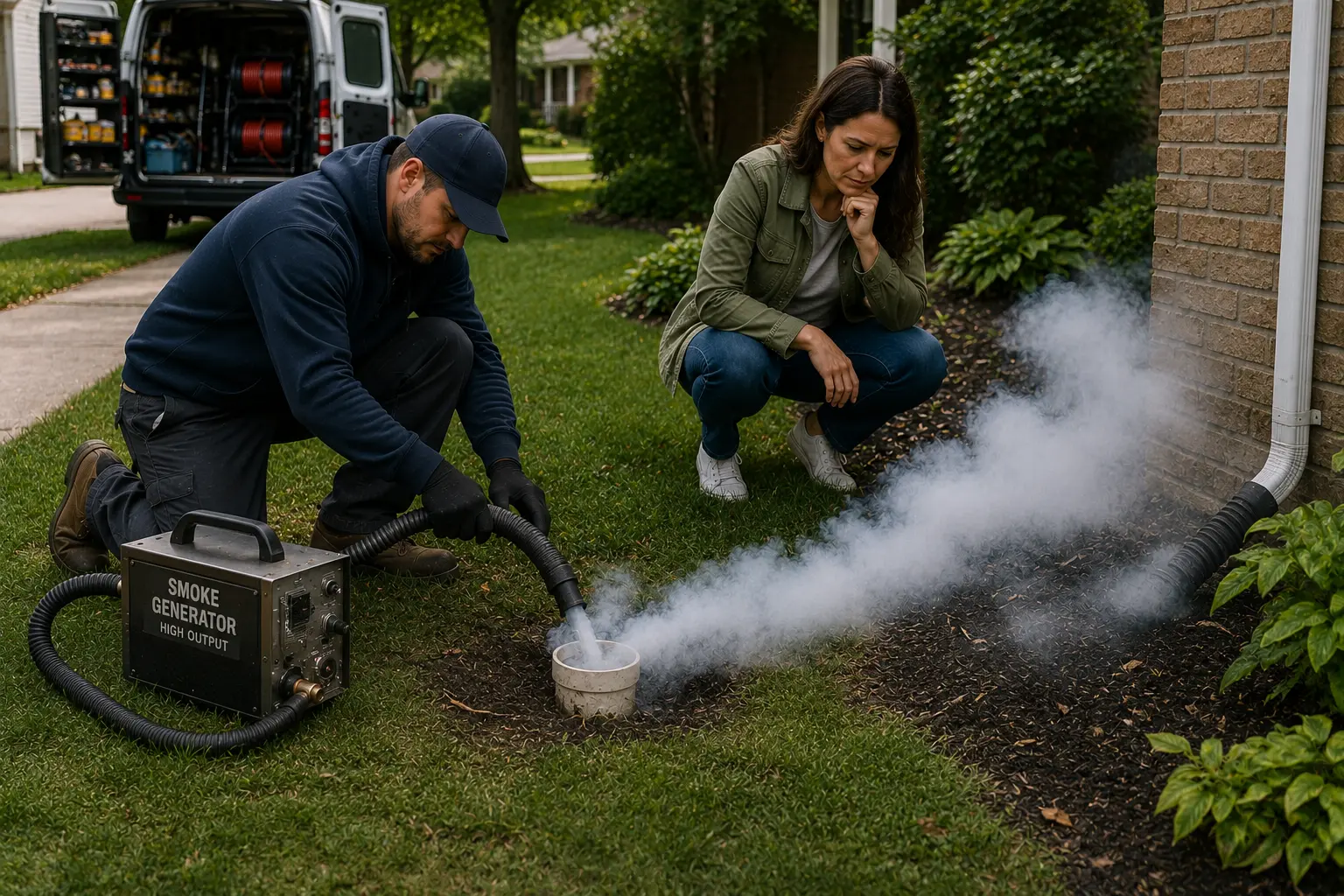
Sewer line smoke testing is a diagnostic method used to find certain leaks, improper connections, venting problems, and openings in a sewer or drainage system. Instead of looking inside the pipe with a camera, smoke testing introduces non-toxic test smoke into the system and watches where the smoke escapes.
For Chicago homeowners, smoke testing may be useful when sewer odors, suspected leaks, unexplained drainage issues, or improper connections are difficult to locate with a standard visual inspection alone. It is not the right test for every sewer problem, but when used in the correct situation, it can reveal defects that may otherwise remain hidden behind walls, beneath slabs, in yard areas, or around exterior openings.
Smoke testing is best understood as one tool within the broader sewer inspection process. It does not replace a camera inspection, but it can help answer different questions. For more homeowner-focused diagnostic resources, visit the Sewer Inspections & Diagnosis hub.
Key Takeaways
- Sewer smoke testing uses test smoke to identify openings, leaks, improper connections, and venting issues in a sewer or drainage system.
- It is different from a sewer camera inspection, which visually examines the inside of the pipe.
- Smoke testing may help investigate sewer gas odors, hidden leaks, disconnected pipes, faulty venting, or improper stormwater connections.
- The smoke should travel through the plumbing system and exit through proper vent openings, not through cracks, drains, walls, or yard defects.
- Chicago homes with older plumbing, basements, additions, and historic repairs may benefit from smoke testing in specific diagnostic situations.
- Smoke testing does not repair the problem and may need to be combined with camera inspection, dye testing, or line locating.
What Is Sewer Line Smoke Testing?
Sewer line smoke testing is a diagnostic process where visible test smoke is introduced into a sewer, drain, or vent system to see where it escapes. If smoke appears in unexpected locations, it may indicate a cracked pipe, faulty seal, dry trap, disconnected line, improper venting, or another opening in the system.
Homeowners usually consider smoke testing when sewer odors, suspected leaks, or improper connections cannot be easily confirmed with a standard inspection. It is especially useful for tracing air pathways and openings, while a sewer camera inspection is better for viewing the inside condition of the sewer pipe.
How Sewer Smoke Testing Works
During a smoke test, controlled test smoke is pushed into the sewer or drainage system using specialized equipment. The smoke follows the available pathways inside the system. In a properly sealed and vented system, smoke should generally exit through plumbing vents or designated openings.
If smoke appears somewhere unexpected, that location may indicate a problem.
Smoke may appear through:
- Cracks in sewer or drain piping
- Open or damaged cleanouts
- Faulty toilet seals
- Floor drains with dry traps
- Improperly abandoned pipes
- Disconnected vent lines
- Foundation cracks near sewer defects
- Yard areas above damaged underground pipe
- Improper stormwater or downspout connections
The test does not usually identify every detail of the defect by itself. Instead, it helps identify where further inspection may be needed.
What Sewer Smoke Testing Can Reveal
Smoke testing is most useful when the question involves an opening, leak path, connection, or venting issue. It can help identify problems that may not be obvious during a camera inspection or visual walkthrough.
| Possible Finding | What Smoke May Show | Why It Matters |
|---|---|---|
| Sewer gas pathway | Smoke enters living areas, basements, or walls | May explain odor complaints or unsafe gas pathways |
| Dry or faulty trap | Smoke exits from a floor drain or fixture | May allow sewer odors into the home |
| Broken underground pipe | Smoke emerges from soil or cracks outside | May indicate an opening in the sewer line |
| Open cleanout | Smoke exits from an uncapped or damaged cleanout | Can allow odors, pests, or debris into the system |
| Improper connection | Smoke appears at downspouts, drains, or unexpected fixtures | May indicate incorrect drainage routing |
| Vent defect | Smoke exits from walls, attic areas, or hidden openings | May indicate disconnected or damaged vent piping |
| Abandoned piping | Smoke appears from old pipe openings | Can reveal unfinished or poorly sealed prior work |
When Smoke Testing Makes Sense
Smoke testing is not the first step for every sewer issue. It is most useful when the problem involves air movement, odor, leaks, or unclear connections rather than a simple blockage.
Homeowners may consider smoke testing when:
- A sewer smell persists but no obvious source is visible
- Basement odors appear near floor drains or utility areas
- A camera inspection does not explain the odor issue
- There may be a cracked or disconnected vent line
- There are suspected illegal or improper drainage connections
- Water or odor appears after renovations or additions
- An old pipe may have been abandoned but not sealed
- The source of sewer gas is unclear
If the concern is recurring clogs or backups, a camera inspection may be the better starting point. See Sewer Camera Inspection in Chicago: What Homeowners Should Know for more context.
Smoke Testing vs. Sewer Camera Inspection
Smoke testing and camera inspection answer different questions. They are sometimes used together, but they are not interchangeable.
| Diagnostic Method | Best For | Limitations |
|---|---|---|
| Sewer camera inspection | Viewing the inside of the sewer line, identifying roots, cracks, blockages, offsets, bellies, and collapse | May not identify hidden air leaks, dry traps, or venting pathways outside the viewed pipe |
| Smoke testing | Finding openings, odor pathways, vent defects, improper connections, and possible leak points | Does not provide a full visual assessment of pipe interior condition |
| Dye testing | Tracing water movement or confirming certain drainage connections | Does not show full pipe condition and may not identify air leaks |
| Line locating | Identifying pipe route, defect location, and sometimes depth | Does not diagnose every pipe defect by itself |
For a detailed look at camera findings, see What Does a Sewer Camera Inspection Show?. For a related flow-tracing method, see Sewer Dye Testing: When Is It Used?.
Chicago-Specific Smoke Testing Considerations
Smoke testing can be especially relevant in Chicago because many homes have older plumbing systems, basements, floor drains, additions, and decades of prior repairs. These conditions can create hidden pathways for sewer odors or drainage problems.
Older Homes and Mixed Plumbing
Older Chicago homes may contain a mix of original piping, partial repairs, abandoned connections, and updated fixtures. Smoke testing can sometimes reveal openings left behind by old work or disconnected piping that is not visible from finished areas.
Basement Floor Drains
Basements are common in Chicago homes. Floor drains, laundry areas, utility sinks, and lower-level bathrooms can all be possible odor points if traps dry out, seals fail, or drainage connections are compromised.
Renovations and Additions
Homes that have been renovated over time may have hidden plumbing transitions. Smoke testing may help identify venting or drain issues caused by past modifications.
Dense Urban Lots
On narrow lots with gangways, patios, sidewalks, parkways, and garages, sewer and drainage routes may be less obvious. Smoke testing may help identify where unexpected connections or openings are located.
Odors After Heavy Rain
Some odor or drainage complaints may become more noticeable after rain or pressure changes in the sewer system. Smoke testing may help identify whether gases are entering through a private plumbing defect or another pathway.
Chicago homeowner tip: If sewer odors are strongest near a basement floor drain, laundry area, or older bathroom, the issue may involve traps, seals, venting, or hidden openings—not only the main sewer line.
What Homeowners Should Expect During a Smoke Test
The exact process depends on the property and the suspected issue, but smoke testing usually follows a structured diagnostic approach.
- The access point or test area is identified.
- Fixtures, drains, vents, and nearby areas may be reviewed before testing.
- Test smoke is introduced into the sewer, drain, or vent system.
- The property is observed for smoke escaping from unexpected locations.
- Problem areas are documented with notes, photos, or markings.
- Follow-up inspection or repair recommendations may be made based on findings.
Homeowners should ask what part of the system is being tested, what the smoke test can and cannot prove, and whether any additional diagnostic step will be needed afterward.
Safety and Practical Concerns
Smoke testing is commonly used as a diagnostic method, but homeowners should still understand the practical considerations. The test smoke is designed for this type of work, but it can be surprising if it appears indoors or near unexpected areas.
Before a smoke test, homeowners may need to consider:
- Whether anyone in the home has respiratory sensitivities
- Whether pets should be moved away from the test area
- Whether alarms may be triggered
- Whether windows or doors should remain closed during observation
- Whether traps should be filled before or after the test depending on the goal
- Whether neighbors may see smoke outside and need advance notice
Smoke appearing inside the home during the test is not the goal, but it may be the clue that identifies the defect. The key is documenting where and why it appears.
Cost Factors for Smoke Testing
The cost of smoke testing can vary depending on the property, access, test scope, and whether it is performed as a standalone service or part of a broader diagnostic visit. Homeowners should avoid assuming that all smoke tests include the same level of documentation or follow-up.
Cost factors may include:
- Size and layout of the property
- Number of drains, vents, or suspected problem areas
- Ease of access to cleanouts or test points
- Whether the issue is inside, outside, or both
- Whether camera inspection is also needed
- Whether line locating is required
- Whether written findings, photos, or diagrams are provided
- Whether the test is related to a real estate transaction, backup, or odor complaint
If the smoke test identifies an underground issue, additional locating may be needed before repair planning. See Sewer Line Locating Services: What to Expect.
How Smoke Testing Affects Repair Decisions
A smoke test can identify where smoke escapes, but the repair decision depends on what the escape point means. Some findings are minor and easy to correct. Others may point to hidden pipe damage or improper construction.
Simple Maintenance Issues
If smoke exits from a dry floor drain, the solution may involve restoring the trap seal or addressing why the trap dries out. This is very different from repairing a broken sewer line.
Fixture or Seal Problems
If smoke appears near a toilet base, fixture connection, or mechanical room, the issue may involve a failed seal or improper connection.
Hidden Vent or Drain Defects
Smoke appearing from walls, ceilings, or unfinished areas may indicate disconnected or damaged piping that requires further investigation.
Underground Sewer Defects
If smoke appears from soil, pavement cracks, or exterior defects, a camera inspection and locating may be needed to evaluate pipe condition and repair options.
When smoke testing is connected to a backup history, Sewer Inspection After a Sewer Backup can help homeowners understand how diagnostic findings affect next steps.
Common Mistakes Homeowners Make
Using Smoke Testing for the Wrong Problem
Smoke testing is useful for leaks, openings, odors, and connections. It is not usually the best first test for a simple clog or recurring main line backup.
Assuming Smoke Means a Major Sewer Failure
Smoke appearing in an unexpected place means there is an opening or pathway. The severity depends on where it appears and why.
Skipping Camera Inspection When Pipe Condition Matters
If the main question is whether the pipe has roots, cracks, offsets, or collapse, camera inspection is usually needed.
Ignoring Dry Traps
Sometimes sewer odor comes from a dry trap rather than a broken sewer line. Floor drains and rarely used fixtures should be considered.
Failing to Document Findings
Photos, notes, and clear location details can help homeowners understand what was found and compare repair opinions.
Accepting Vague Conclusions
A useful test should explain where smoke appeared, what that likely means, and what should be checked next. If testing seems poorly documented, review Signs a Sewer Inspection Was Done Poorly.
Frequently Asked Questions
What does sewer smoke testing find?
Sewer smoke testing can help find openings, leaks, dry traps, faulty seals, vent defects, improper connections, abandoned pipes, and possible pathways where sewer gas or drainage system air can escape.
Is sewer smoke testing the same as a camera inspection?
No. A camera inspection shows the inside of the pipe. Smoke testing shows where air or smoke escapes from the system. They answer different diagnostic questions and may be used together.
Is the smoke harmful?
Test smoke used for sewer diagnostics is designed for this type of work, but homeowners should still discuss respiratory concerns, pets, alarms, and indoor exposure before testing begins.
Why would smoke come out of a floor drain?
Smoke from a floor drain may indicate a dry trap, missing trap, faulty seal, or another opening that allows sewer gas to enter the home. The specific cause needs to be evaluated.
Can smoke testing find tree roots?
Smoke testing is not the best method for identifying tree roots inside a sewer pipe. A sewer camera inspection is generally better for root intrusion, cracks, blockages, and pipe condition.
Can smoke testing help with sewer smells in a basement?
Yes, it may help identify whether odors are entering through floor drains, faulty seals, vent defects, abandoned pipes, or hidden openings. Other diagnostic methods may still be needed.
Will insurance cover sewer smoke testing?
Coverage depends on the policy, the cause of the issue, and whether the testing is connected to a covered claim. Homeowners should review policy language and speak with their insurer before assuming coverage.
What happens if smoke appears outside in the yard?
Smoke appearing from soil, pavement cracks, or exterior openings may indicate a broken pipe, defective cleanout, abandoned connection, or other opening. Further inspection or locating may be needed.
Conclusion
Sewer line smoke testing is a practical diagnostic tool for finding openings, odor pathways, vent defects, improper connections, and certain hidden leaks in a sewer or drainage system. It is especially useful when a homeowner is dealing with sewer smells, unclear drainage connections, or suspected defects that are not easily confirmed with a visual inspection alone.
For Chicago homeowners, smoke testing can be helpful because older plumbing, basements, mixed repairs, additions, and dense urban layouts often create hidden sewer and drain pathways. Still, smoke testing is not a replacement for every other inspection method. Camera inspection, dye testing, and line locating may also be needed depending on the issue.
The best use of smoke testing is as part of a careful diagnostic process: identify where smoke appears, understand what that means, document the finding, and choose the next step based on evidence rather than assumption.