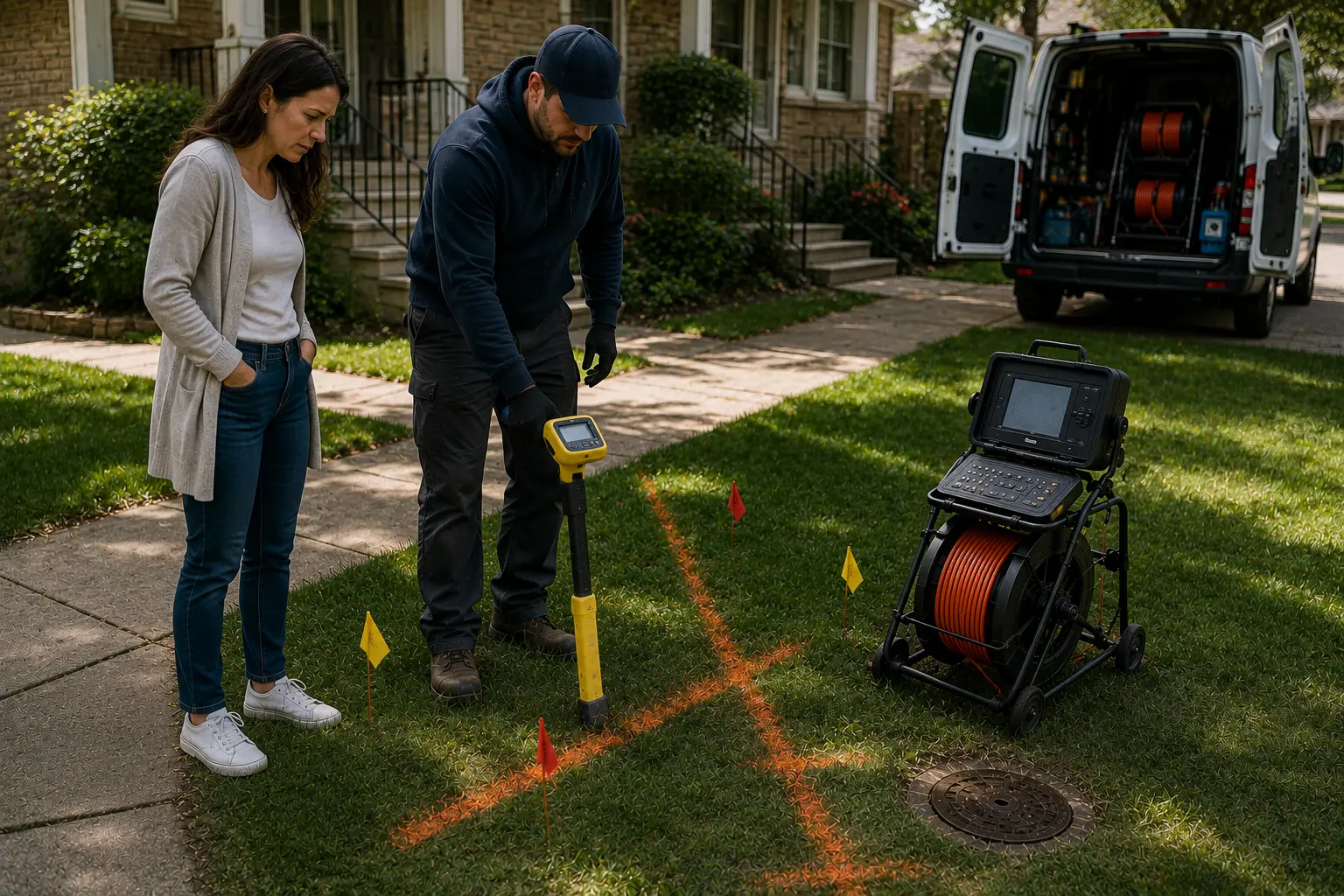
Sewer line locating services help homeowners identify where a sewer line runs underground, where a defect may be located, and sometimes how deep the pipe is buried. This information can be critical before excavation, repair planning, home improvements, landscaping, or interpreting a sewer camera inspection.
For Chicago homeowners, sewer locating can be especially useful because many properties have older sewer lines, basements, narrow gangways, garages, alleys, sidewalks, parkways, mature trees, and past repairs that may not be obvious from the surface. A sewer line may not run in a straight path, and the most expensive part of a repair can depend on what is above the problem area.
A sewer camera can show what is happening inside the pipe, but locating services help connect that video finding to a real-world location under the yard, driveway, sidewalk, or structure. Understanding what to expect can help homeowners ask better questions and avoid making decisions based on assumptions.
For more homeowner-focused sewer inspection guidance, visit the Sewer Inspections & Diagnosis hub.
Key Takeaways
- Sewer line locating helps identify the route, surface location, and sometimes depth of a buried sewer line.
- Locating is often used with a sewer camera inspection when a defect needs to be marked above ground.
- Chicago properties can have sewer lines that run toward streets, alleys, parkways, side yards, or less obvious connection points.
- Locating is useful before excavation, repair estimates, landscaping, construction, or buying an older home.
- A distance reading on a camera report is helpful, but it is not the same as a marked surface location.
- Homeowners should ask what was located, how it was marked, whether depth was estimated, and what limitations applied.
What Happens During Sewer Line Locating?
During sewer line locating, a technician typically sends a camera with a transmitter through the sewer line, then uses a receiver above ground to detect the camera head. This helps trace the pipe route and mark the approximate location of the sewer line or a specific defect.
Locating may also include depth estimates, distance measurements from the access point, surface markings, and notes about whether the pipe appears to run under yard, concrete, sidewalk, driveway, basement slab, or another area. The goal is to understand where the sewer line is, not just what the pipe looks like on camera.
What Are Sewer Line Locating Services?
Sewer line locating services are used to identify the underground path of a private sewer line or the location of a specific problem found during inspection. The service may be performed by itself or as part of a sewer camera inspection.
In many cases, locating is used after the camera finds something important inside the pipe, such as roots, a crack, a collapsed section, an offset joint, or standing water. Once the camera reaches that point, locating equipment helps identify where the camera is positioned underground.
For a broader explanation of the inspection process, see Sewer Camera Inspection in Chicago: What Homeowners Should Know.
Why Sewer Line Locating Matters
Knowing that a sewer line has a problem is only part of the decision. Homeowners also need to know where that problem is located.
Location can affect:
- Repair access
- Excavation difficulty
- Concrete removal
- Driveway or sidewalk restoration
- Landscaping disruption
- Basement slab work
- Permit and coordination needs
- Repair method options
- Overall cost and timing
A defect in open yard space may be handled very differently from a similar defect under a garage slab, front sidewalk, mature tree, or finished basement area.
When Homeowners Should Consider Sewer Locating
Sewer locating is not needed for every plumbing issue, but it can be very useful when location affects the next decision.
Common reasons to locate a sewer line include:
- A camera inspection found a defect that may require repair.
- The sewer line route is unknown.
- A homeowner is planning excavation or major landscaping.
- A driveway, patio, garage, fence, or addition is being planned.
- A buyer wants to understand sewer risk before closing.
- A sewer backup suggests a recurring underground problem.
- A contractor needs to compare repair options.
- The sewer line may run under hardscape or public-facing areas.
For homeowners trying to understand the route of the pipe, How to Find a Sewer Line Under Your Yard explains the clues and methods involved.
How Sewer Line Locating Usually Works
The exact process depends on the property and equipment used, but most sewer locating follows a basic sequence.
- A cleanout or other suitable access point is identified.
- A sewer camera is inserted into the pipe.
- The operator advances the camera through the line while watching the video.
- Distance measurements are noted from the access point.
- When the camera reaches a key location, the transmitter is detected above ground.
- The surface location is marked with paint, flags, stakes, or notes.
- Depth may be estimated if the equipment and site conditions allow.
- The homeowner receives an explanation of what was located and any limitations.
If the line is blocked, full locating may be limited. A severe obstruction can prevent the camera from reaching the intended area, which should be clearly documented.
What Locating Can Identify
Sewer locating can help answer several practical questions about the underground line.
| Locating Question | What the Service May Identify | Why It Matters |
|---|---|---|
| Where does the sewer line run? | The approximate route from the access point toward the connection. | Useful before digging, landscaping, or construction. |
| Where is the defect? | The surface location of roots, cracks, offsets, bellies, or collapse. | Helps plan targeted repair or further evaluation. |
| How deep is the pipe? | An estimated depth at specific points, when possible. | Depth affects excavation complexity and repair planning. |
| What is above the pipe? | Whether the defect is under yard, concrete, sidewalk, driveway, or structure. | Restoration and access can change the repair decision. |
| How far did the camera travel? | Distance from the access point to the located area. | Helps connect the report to the physical property. |
| Was the full line accessible? | Whether the camera could reach the target area or connection point. | Limitations affect confidence in the findings. |
Distance Measurements vs. Surface Locating
Homeowners often see distance numbers in a sewer scope report and assume they know where the defect is. That can be a mistake.
A report may say “roots at 42 feet” or “standing water begins at 55 feet.” That means the camera reached that point after traveling 42 or 55 feet from the access point. It does not automatically prove where the defect is under the yard.
To understand the real location, you need to know:
- Where the camera entered the line
- Which direction the camera traveled
- Whether the pipe runs straight or turns
- Whether the camera distance counter is accurate
- Whether electronic locating was performed
- Whether the surface location was marked
For help interpreting inspection documents, see How to Read a Sewer Scope Report.
Chicago-Specific Sewer Locating Considerations
Chicago properties can be challenging because sewer lines may be older, deeper, partially repaired, or routed through tight urban spaces. The route may not match what the homeowner expects.
Street, Alley, and Parkway Routing
Some sewer lines run toward the street, while others may route toward an alley or other connection point. The presence of a front sidewalk does not guarantee the entire line runs straight beneath the front yard.
Basements and Slab Areas
Many Chicago homes have basements with floor drains, laundry plumbing, and lower-level bathrooms. The sewer may exit below the basement floor, and some defects may be located under or near interior slab areas.
Narrow Side Yards and Gangways
Urban lot layouts can create access challenges. A sewer line may run near fences, stairs, neighboring structures, utility lines, or tight side passages.
Older Pipe Materials
Clay tile, cast iron, and mixed-material lines are common in older homes. Locating may help identify where older and newer sections transition after past repairs.
Concrete and Hardscape
Sidewalks, driveways, patios, garage slabs, and parkways can affect the practical difficulty of reaching a defect. Knowing the surface location helps prevent repair surprises.
Chicago homeowner tip: Do not assume the sewer line is shallow, straight, or entirely under open yard space. Locating helps confirm the route before repair decisions or digging begin.
How Locating Helps After a Sewer Camera Inspection
A camera inspection shows what is inside the sewer line. Locating helps determine where the important findings are underground.
This matters when the camera shows:
- Root intrusion
- Cracked pipe
- Collapsed sections
- Offset joints
- Pipe bellies
- Standing water
- Material transitions
- Blockages that stop the camera
For a full explanation of possible camera findings, see What Does a Sewer Camera Inspection Show?.
Once the defect is located, homeowners can better understand whether the next step is cleaning, monitoring, spot repair, additional testing, or a broader repair estimate.
How Locating Helps After a Sewer Backup
After a sewer backup, a homeowner may know that the line was blocked but not know where the underlying problem is. If the camera finds roots, a collapsed section, or a belly, locating can help connect that finding to a physical spot on the property.
This can help answer questions such as:
- Is the problem near the house or farther out?
- Is it under the yard, sidewalk, or driveway?
- Is it close to a large tree?
- Is it near a prior repair?
- Could a targeted repair reach the defect?
- Does the issue suggest a larger line replacement discussion?
If the locating follows a backup, see Sewer Inspection After a Sewer Backup for more context.
Cost Factors for Sewer Line Locating
The cost of sewer locating can vary because not every locating job involves the same scope. Some homeowners only need a rough route marked. Others need a specific defect located for repair planning.
Cost factors may include:
- Whether a camera inspection is included
- Whether there is an accessible cleanout
- How much of the line must be traced
- Whether the pipe is blocked or partially collapsed
- Whether depth estimates are needed
- Whether the line runs under concrete or structures
- Whether multiple defects must be marked
- Whether written documentation is provided
- Whether the service is part of an emergency or scheduled visit
Homeowners should ask what the service includes before comparing prices. A simple locate and a full camera inspection with marked defects, depth estimates, and documentation are not the same service.
Questions to Ask Before Hiring Sewer Locating Services
Before scheduling sewer locating, homeowners should clarify what will be done and what documentation they will receive.
- Will a sewer camera be used?
- Will the camera include a transmitter for above-ground locating?
- Will the sewer route be marked on the surface?
- Can specific defects be located?
- Will approximate depth be estimated?
- Will the full line be traced if accessible?
- What happens if the camera cannot pass a blockage?
- Will photos, video, or written notes be provided?
- Will the markings be suitable for repair estimates?
- Are utility markings or excavation services separate?
Clear answers help prevent misunderstandings, especially when repairs or construction decisions depend on the locate.
Limitations Homeowners Should Understand
Sewer locating is useful, but it is not perfect. Conditions on the property and inside the pipe can affect accuracy and completeness.
Possible limitations include:
- Blocked pipes may stop the camera before the target location.
- Deep lines may be harder to locate accurately.
- Metal, concrete, utilities, or site conditions may interfere with signals.
- Distance counters may not account for every bend or cable movement perfectly.
- Depth estimates may be approximate rather than exact.
- Surface markings can fade, be disturbed, or require confirmation before digging.
- Locating the pipe does not automatically diagnose every pipe defect.
Practical note: Sewer locating helps reduce uncertainty, but it should be combined with camera footage, repair evaluation, utility marking, and proper excavation planning when digging is involved.
Safety and Utility Marking Before Digging
Sewer locating does not replace proper utility marking. Before any excavation, homeowners should follow utility marking procedures and understand that private sewer locating and public utility marking may cover different things.
Underground areas may contain:
- Gas lines
- Electric lines
- Water lines
- Communication lines
- Drainage lines
- Private sewer laterals
- Irrigation or exterior drainage systems
Any digging should be approached carefully. Locating a sewer line for planning purposes is not the same as safely exposing it.
Related Diagnostic Tools
Sewer locating may be used alongside other diagnostic methods depending on the problem.
Sewer Camera Inspection
Best for viewing the pipe interior and identifying roots, cracks, offsets, bellies, corrosion, or collapse.
Smoke Testing
Useful for finding certain air leaks, odor pathways, improper connections, or venting issues. Learn more in Sewer Line Smoke Testing Explained.
Dye Testing
Useful for tracing water movement and confirming drainage connections. See Sewer Dye Testing: When Is It Used?.
Report Review
Useful when deciding whether a sewer scope report provides enough information for repairs, negotiations, or second opinions.
Common Mistakes Homeowners Make
Assuming a Camera Distance Equals a Dig Location
A distance reading is helpful, but surface locating is usually needed before relying on that number for repair planning.
Not Asking Whether Depth Was Estimated
Depth can affect excavation difficulty and cost. If depth matters, homeowners should ask whether it was measured or estimated.
Skipping Locating Before Major Repairs
Approving excavation without a clear defect location can lead to confusion, unnecessary digging, or unexpected restoration needs.
Assuming the Line Runs Straight
Sewer lines can turn, transition, or route toward alleys and side yards. Older properties may not follow obvious paths.
Confusing Sewer Locating With Utility Marking
Private sewer locating and public utility marking are related but not identical. Both may be needed before excavation.
Accepting Vague Markings
If the locate is not documented or explained, it may be difficult to use for repair estimates. Poor documentation is a broader warning sign discussed in Signs a Sewer Inspection Was Done Poorly.
Frequently Asked Questions
What is sewer line locating?
Sewer line locating is the process of identifying the underground route, surface location, and sometimes depth of a sewer line or specific defect. It is often performed with a sewer camera and electronic locating equipment.
Is sewer locating the same as a sewer camera inspection?
No. A camera inspection shows the inside of the pipe. Locating identifies where the camera or pipe is underground. The two services are often used together.
Can sewer locating show how deep the line is?
Sometimes. Some locating equipment can estimate depth at specific points, but depth readings may be approximate and affected by site conditions.
Should I locate my sewer line before landscaping?
Yes, it is often wise before major landscaping, tree planting, driveway work, patios, garages, fences, or additions. Knowing the sewer route can prevent future access problems and reduce the risk of damage.
Can sewer locating find a collapsed pipe?
Locating can help mark where the camera stops or where a collapse is visible, but the collapse itself is usually identified through camera inspection. If the camera cannot pass, the stopping point may be important evidence.
How accurate is sewer line locating?
Accuracy depends on equipment, depth, access, pipe conditions, signal interference, and operator skill. Locating is usually approximate and should be confirmed before excavation.
Will utility marking locate my private sewer line?
Public utility marking may not fully locate private sewer laterals. Homeowners may need separate sewer locating services to identify the private sewer line on their property.
Does insurance cover sewer locating?
Coverage depends on the policy, cause of loss, endorsements, and claim circumstances. Some diagnostic costs may be considered in certain claims, but homeowners should confirm with their insurer.
Conclusion
Sewer line locating services help homeowners understand where a sewer line runs and where important inspection findings are located underground. This information can be essential before repairs, excavation, landscaping, construction, home purchases, or decisions after a sewer backup.
For Chicago homeowners, locating is especially useful because sewer lines may run beneath basements, sidewalks, parkways, driveways, patios, garages, gangways, or mature landscaping. Older pipe materials and past repairs can make the route even less predictable.
A sewer camera may show the problem, but locating helps show where that problem exists on the property. The most useful sewer diagnosis often combines both: clear footage of the defect and a reliable understanding of its location, depth, access challenges, and repair implications.