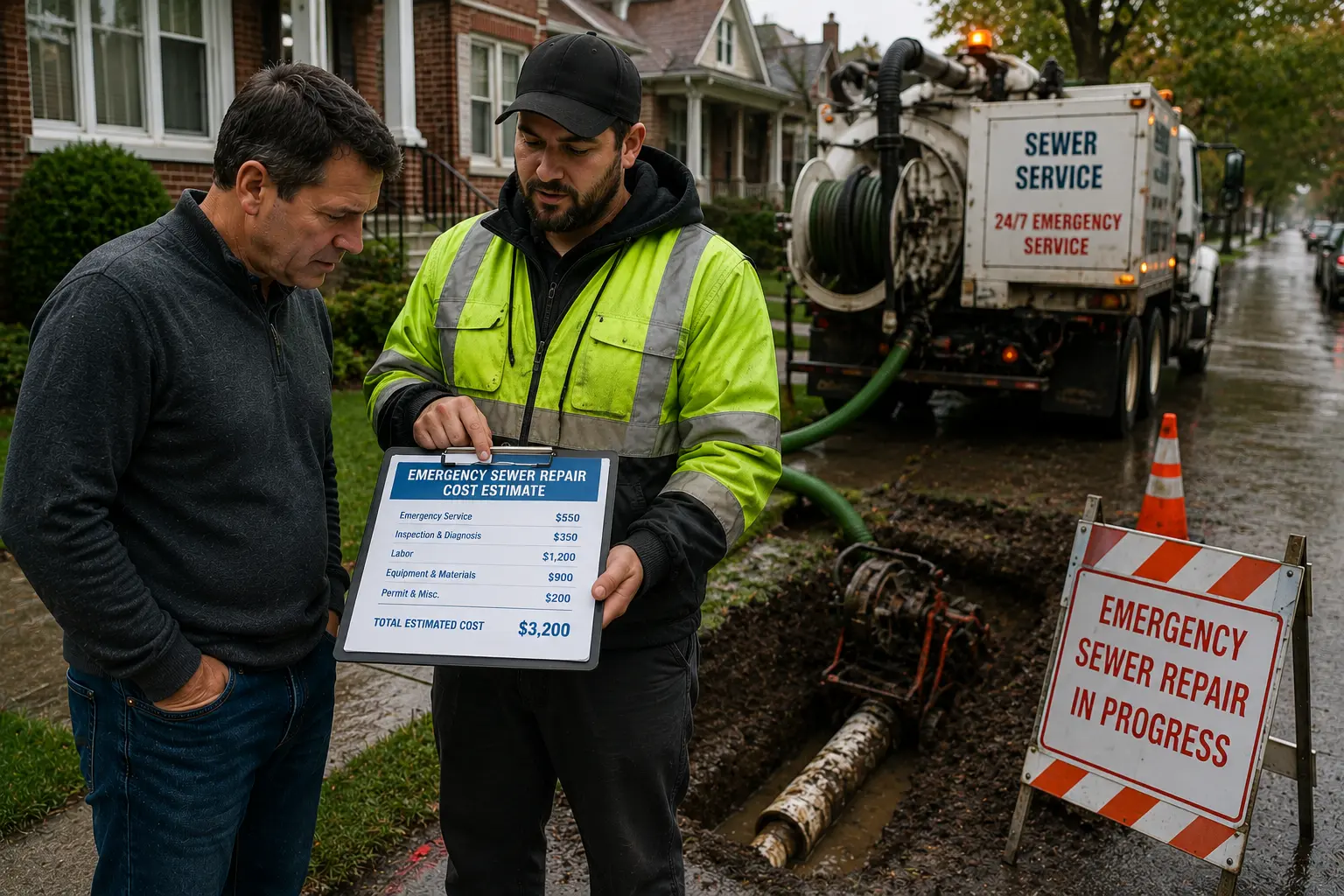
Emergency sewer repair in Chicago usually costs more than planned sewer work because the problem needs immediate attention, scheduling is tighter, and the contractor may need to respond after normal business hours. When sewage is backing up into a basement, multiple drains are clogged, or the main line is no longer carrying wastewater away from the home, homeowners often have less time to compare options carefully.
The cost of emergency sewer repair depends on the timing of the call, the severity of the backup, the cause of the problem, whether cleaning or excavation is needed, whether a camera inspection is performed, and whether the issue can be stabilized temporarily or requires same-day repair.
This guide explains what Chicago homeowners should expect with after-hours and same-day sewer pricing, what drives the cost higher, and how to avoid making a rushed decision that creates bigger problems later.
Key Takeaways
- Emergency sewer repair often costs more than scheduled repair because of urgency, after-hours labor, equipment availability, and limited scheduling flexibility.
- A same-day response may involve cleaning, rodding, hydro jetting, camera inspection, temporary stabilization, spot repair, or full replacement depending on the problem.
- Chicago homes with basements, older sewer lines, tree roots, clay pipe, narrow lots, sidewalks, alleys, and deep sewer laterals may face added complexity.
- A sewer camera inspection is important after the immediate backup is controlled because cleaning alone may not solve structural pipe damage.
- Insurance coverage depends on the policy, the cause of the damage, and whether the homeowner has sewer backup or service line coverage.
- Homeowners should ask what is included in the emergency price before approving major work.
How Much Does Emergency Sewer Repair Cost in Chicago?
Emergency sewer repair in Chicago is usually priced based on the immediate service needed, the time of day, the severity of the blockage or damage, the equipment required, and whether the work stays limited to cleaning or turns into repair or replacement. After-hours, weekend, holiday, or same-day service may cost more than a scheduled appointment.
The lowest emergency cost is usually associated with clearing a blockage or restoring temporary flow. Costs rise when the line needs camera inspection, heavy root removal, hydro jetting, excavation, trenchless repair, pipe bursting, or replacement. If the sewer line has collapsed or the backup involves a main line failure, the project may move beyond a simple emergency service call.
For broader context on sewer pricing, see the main Chicago sewer replacement cost guide.
Main Cost Sections for Emergency Sewer Repair
Timing of the Service Call
Timing is one of the most obvious emergency cost factors. A sewer problem during regular business hours may be easier to schedule than one that happens late at night, early in the morning, on a weekend, or during a holiday.
After-hours service may include higher labor rates, emergency dispatch fees, or minimum charges. Homeowners should ask whether the quoted amount covers only the initial visit or includes any cleaning, inspection, or repair work.
Severity of the Backup
A slow drain is different from sewage backing up through a basement floor drain. The more severe the backup, the more urgent the response becomes. Severe backups may require immediate cleaning, water-use restrictions, sanitation concerns, and faster decision-making.
If multiple drains are backing up at the same time, the issue may involve the main sewer line rather than one isolated fixture.
Cause of the Problem
The cause of the emergency has a major effect on cost. A soft blockage may be cleared with rodding or cleaning. Heavy roots may require more aggressive cleaning and follow-up inspection. A collapsed or broken pipe may require excavation, trenchless repair, or replacement.
Emergency service can often restore flow, but the underlying pipe condition determines whether the problem is truly fixed.
Equipment Required
Some emergencies require basic drain cleaning equipment. Others may require hydro jetting, camera inspection, locating equipment, excavation machinery, pumps, or specialized trenchless tools.
More equipment usually means more cost. It may also mean the problem is more serious than a simple clog.
Camera Inspection
A sewer camera inspection may not always happen before the line is cleared because severe blockages can prevent visibility. However, once flow is restored, a camera inspection can help identify roots, cracks, offsets, standing water, collapsed pipe, or other structural issues.
For more detail on inspection pricing and when it is worth doing, read How Much Does a Sewer Camera Inspection Cost in Chicago?.
Temporary Fix vs Permanent Repair
In an emergency, the first goal is often to restore flow and stop active backup. That may not be the same as permanently repairing the sewer line. A temporary cleaning may buy time, but if the pipe is damaged, roots are entering, or the line has collapsed, additional repair may still be needed.
Homeowners should ask whether the emergency work is intended to solve the problem permanently or only stabilize the situation.
Emergency Sewer Repair Cost Drivers
| Cost Driver | Why It Matters | Question to Ask |
|---|---|---|
| After-hours timing | Nights, weekends, and holidays may involve higher dispatch or labor charges. | Is this priced as after-hours or emergency service? |
| Backup severity | Active sewage backup requires faster response and may involve cleanup concerns. | Is this a main line issue or an isolated fixture clog? |
| Root intrusion | Heavy roots can require more aggressive cleaning and follow-up repair. | Were roots found, and where are they entering? |
| Camera inspection | Inspection helps identify whether cleaning solved the problem or only restored flow. | Is camera inspection included after the line is cleared? |
| Excavation | Digging can dramatically increase cost, especially under concrete or deep soil. | Will excavation be required, and what restoration is included? |
| Trenchless repair | May reduce surface disruption but requires suitable pipe conditions. | Is the pipe a candidate for trenchless repair? |
| Financing need | Emergency work can create sudden expense and limited decision time. | Are there payment or financing options available? |
Chicago-Specific Considerations
Basement Backups
Many Chicago homes have basements, which means sewer problems often show up through floor drains, laundry tubs, lower-level bathrooms, or utility sinks. A basement backup can feel urgent because wastewater may enter finished or storage areas quickly.
If the backup involves multiple basement fixtures or the floor drain, homeowners should consider the possibility of a main line blockage rather than a single drain problem.
Older Sewer Lines
Chicago homes may have older clay pipe, cast iron sections, or mixed pipe materials from previous repairs. Older clay pipe can crack, separate at joints, or allow roots to enter. Cast iron can corrode or scale internally.
Older pipe does not automatically require replacement, but recurring emergencies may suggest that the line is deteriorating rather than simply clogging.
Tree Roots
Mature trees are common throughout Chicago neighborhoods, parkways, and older lots. Roots often enter sewer lines through cracks, loose joints, or separated pipe sections. Emergency rodding may clear the roots temporarily, but it does not repair the opening where roots entered.
If roots are found repeatedly, homeowners should ask whether a repair, lining, pipe bursting, or replacement option should be evaluated.
Sidewalks, Alleys, and Tight Urban Lots
Chicago properties can make emergency sewer work more complicated. Narrow side yards, garages, fences, sidewalks, alleys, porches, and parkway areas may affect access and excavation planning.
If emergency repair turns into excavation, homeowners should ask who is responsible for permits, restoration, and any public-facing surfaces that may be disturbed.
Heavy Rain and Sewer Stress
Heavy rain can reveal sewer weaknesses, especially if a line already has roots, cracks, poor slope, or partial blockage. A rain-related backup may be temporary, but repeated backups during storms deserve closer inspection.
Emergency Cleaning vs Repair vs Replacement
Emergency sewer work often begins with restoring flow. That may involve rodding, cabling, or hydro jetting. Once the immediate blockage is cleared, the next question is whether the pipe needs further repair.
Cleaning is not the same as repair. It removes an obstruction but does not fix broken pipe, separated joints, major root entry points, sagging sections, or collapse.
| Option | When It May Make Sense | Potential Limitation |
|---|---|---|
| Emergency cleaning | The line is blocked but structurally usable. | May only provide temporary relief if the pipe is damaged. |
| Camera inspection | Flow has been restored and the pipe condition needs confirmation. | May not be possible until the blockage is cleared. |
| Spot repair | One isolated defect is causing the emergency. | May not solve widespread deterioration. |
| Pipe bursting | The line needs replacement and conditions are suitable for trenchless work. | May not work for every pipe layout or damage type. |
| Excavation replacement | The line is collapsed, severely damaged, or not suitable for trenchless repair. | Can disturb concrete, yard areas, sidewalks, or driveways. |
If pipe bursting is being discussed as an alternative to open trenching, read Sewer Pipe Bursting Cost in Chicago for Older Sewer Lines.
Repair vs Replacement Considerations
The decision between repair and replacement is more difficult during an emergency because homeowners are under pressure to stop the backup quickly. The best approach is to separate the immediate response from the long-term decision whenever possible.
Emergency Repair May Be Enough When
- The blockage is cleared and the camera inspection shows no major structural failure.
- The damage is isolated to one small section.
- The pipe is otherwise stable and properly sloped.
- Roots are limited to one clear entry point.
- The backup does not keep returning after cleaning.
Replacement May Need to Be Considered When
- The pipe has collapsed or is severely cracked.
- The sewer line has multiple offsets or separated joints.
- Roots keep returning after repeated emergency cleanings.
- The line has standing water from a belly or slope issue.
- Backups are becoming more frequent or more severe.
- The cost of repeated emergency calls is approaching the cost of larger repair work.
Important Homeowner Note
An emergency visit may solve the immediate backup without solving the long-term sewer problem. If the same line has backed up before, ask for inspection evidence before deciding whether another cleaning is enough.
How to Review an Emergency Sewer Estimate
Emergency conditions can make it harder to slow down and compare details, but homeowners should still ask basic questions before approving expensive work.
A clear emergency estimate should explain:
- Whether the price is for dispatch only or includes service
- Whether after-hours or emergency fees apply
- What cleaning method will be used
- Whether camera inspection is included
- What was found in the line
- Whether the work is temporary or permanent
- Whether excavation or trenchless repair is being recommended
- Whether permits may be required
- What restoration is included
- What conditions could change the price
- Whether payment or financing options are available
If the emergency repair becomes a larger replacement project, it may help to review sewer replacement financing options for Chicago homeowners.
Common Mistakes and Warning Signs
Mistake: Assuming the First Emergency Fix Solves Everything
Clearing the line may restore flow, but it may not repair cracks, roots, offsets, or collapse. A follow-up camera inspection can help confirm whether the line is stable.
Mistake: Approving Major Work Without Understanding the Evidence
Emergency conditions are stressful, but homeowners should still ask what the camera showed, where the damage is located, and why the proposed repair is necessary.
Mistake: Comparing Emergency Pricing to Scheduled Pricing
After-hours or same-day pricing may be higher than planned work. That does not automatically mean the price is unreasonable, but homeowners should understand what emergency charges apply.
Mistake: Ignoring Cleanup and Safety
Sewage backups can create sanitation concerns. Sewer repair pricing may not include water cleanup, disinfecting, damaged material removal, or restoration inside the home.
Mistake: Waiting Through Repeated Warning Signs
Repeated clogs, basement backups, and root problems often become more expensive when ignored. Addressing the issue before the next emergency may provide more time to compare estimates.
Warning Signs That Require Prompt Attention
- Sewage backing up through a basement floor drain
- Multiple toilets, tubs, or sinks backing up at the same time
- Strong sewage odors inside the home
- Gurgling drains throughout the house
- Water backing up when the washing machine drains
- Recurring clogs shortly after rodding
- Tree roots repeatedly removed from the line
- Camera inspection showing collapse, standing water, cracks, or offsets
Decision Point
If sewage is actively backing up into the home, stop using water where possible and treat the situation as urgent. Once the immediate backup is controlled, focus on identifying why it happened so the same emergency does not keep repeating.
FAQ About Emergency Sewer Repair Cost in Chicago
Why does emergency sewer repair cost more?
Emergency sewer repair may cost more because it involves urgent scheduling, after-hours labor, faster dispatch, equipment availability, and limited time to plan the work. Weekend, night, or holiday calls may also include additional charges.
Is same-day sewer repair always necessary?
Not always. Same-day service may be necessary if sewage is actively backing up, multiple drains are affected, or the home cannot use plumbing safely. If the issue is slow drainage without active backup, scheduled inspection may be possible.
Do I need a camera inspection during an emergency?
A camera inspection is often helpful, but it may need to happen after the blockage is cleared. Inspection can show whether the problem was a temporary clog or a structural issue such as roots, cracks, offsets, collapse, or standing water.
Can trenchless repair be used for emergency sewer problems?
Sometimes. Trenchless repair or pipe bursting may be an option if the pipe condition, access points, and layout are suitable. If the pipe is severely collapsed, badly bellied, or misaligned, excavation may still be necessary.
Will homeowners insurance cover emergency sewer repair?
Coverage depends on the policy, the cause of the problem, and whether the homeowner has sewer backup or service line coverage. Many policies exclude wear and tear, deterioration, and long-term root intrusion. Homeowners should confirm details directly with their insurer.
What Chicago-specific issues can make emergency sewer repair more expensive?
Older pipe materials, deep sewer laterals, basement backups, narrow lots, sidewalks, alleys, mature tree roots, concrete surfaces, parkways, and permit requirements can all increase complexity and cost.
What should I ask before approving emergency sewer work?
Ask whether the price includes dispatch, cleaning, inspection, after-hours fees, camera work, permits, excavation, restoration, and cleanup. Also ask whether the repair is temporary or intended to solve the underlying problem permanently.
Conclusion
Emergency sewer repair cost in Chicago depends on timing, severity, equipment, inspection needs, pipe condition, access, and whether the issue can be solved with cleaning or requires repair or replacement. After-hours and same-day service may cost more, but the larger risk is approving expensive work without understanding the cause of the problem.
The best approach is to stabilize the emergency first, then confirm the pipe condition with inspection evidence. If the sewer line is structurally sound, cleaning may be enough. If the line has recurring roots, collapse, offsets, or severe damage, a larger repair or replacement decision may be necessary.
For Chicago homeowners, the goal is to solve the immediate backup without losing sight of the long-term issue. A clear estimate, camera findings, and a realistic explanation of what is included can help prevent the same emergency from happening again.