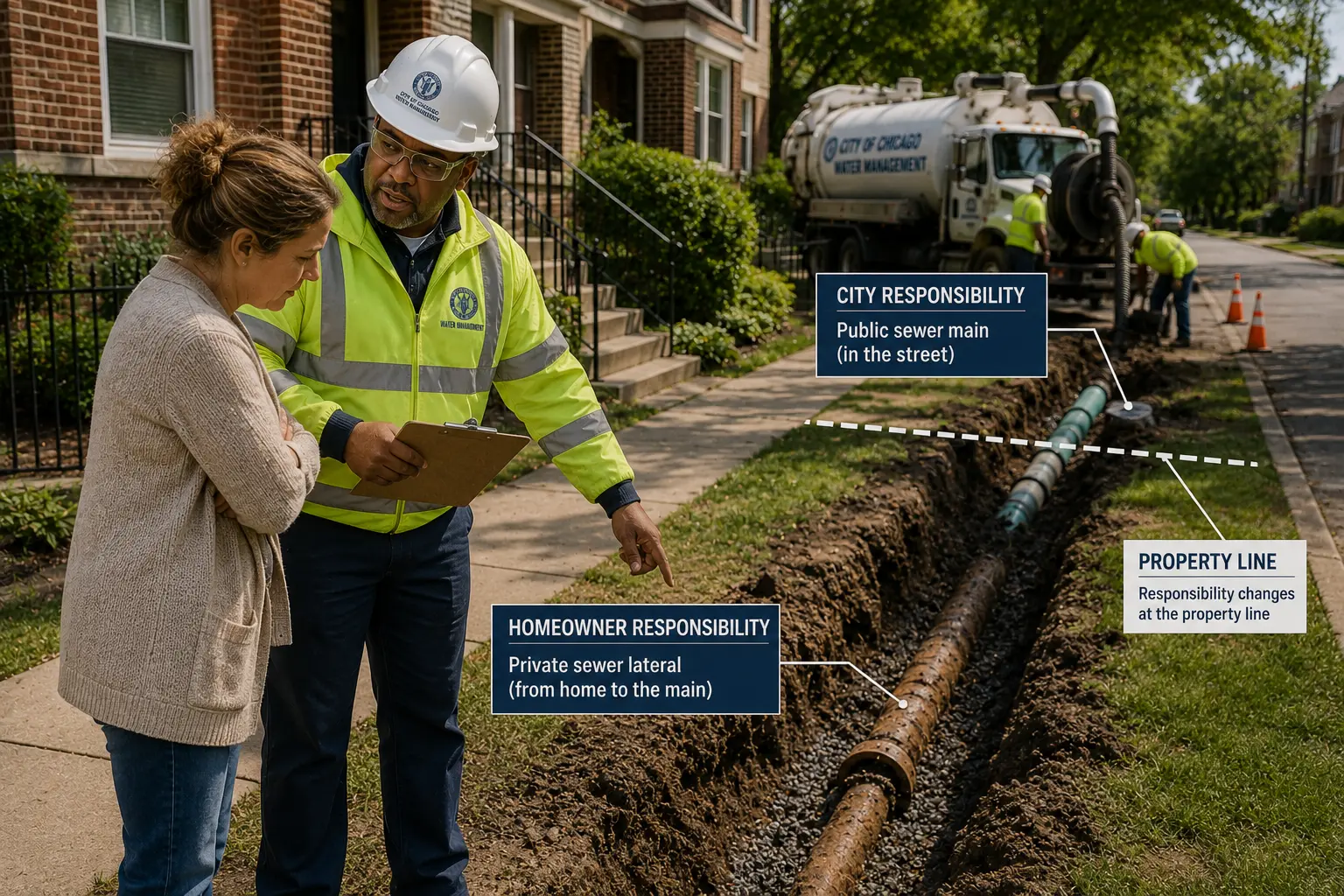
When a sewer line backs up, cracks, collapses, or needs replacement, one of the first questions Chicago homeowners ask is who is responsible for fixing it. The answer depends on where the problem is located, what part of the sewer system is affected, and whether the issue involves a private sewer lateral, public sewer main, public right-of-way, or a qualifying city program.
In general, homeowners are usually responsible for the private sewer line that serves their property, while the city is generally responsible for public sewer mains. However, Chicago sewer responsibility can become more complicated near sidewalks, parkways, streets, alleys, easements, and city connection points. Understanding those boundaries can help homeowners avoid unnecessary repairs, delays, and disputes.
Key Takeaways
- Homeowners are commonly responsible for the private sewer line serving their property.
- The city is generally responsible for public sewer mains and public sewer infrastructure.
- Responsibility depends heavily on the exact location of the defect.
- Sewer problems under sidewalks, streets, alleys, or parkways may require additional review.
- Chicago’s Private Drain Program may apply in certain qualifying public-way situations.
- Camera inspections and line locating are often needed before responsibility can be determined.
- Permit, inspection, and licensed contractor requirements may still apply even when responsibility is unclear.
Who Usually Pays for Sewer Line Problems in Chicago?
In most cases, the homeowner is responsible for the private sewer line that carries wastewater from the home toward the city sewer system. The City of Chicago is generally responsible for public sewer mains. The difficult part is determining exactly where the private line ends, where the public system begins, and whether a defect under the public way qualifies for special city review.
A sewer backup inside the home does not automatically mean the city is responsible. Many backups are caused by clogs, roots, cracks, offsets, pipe bellies, or collapsed sections within the private sewer lateral.
At the same time, homeowners should not assume every sewer problem is private. If the issue involves the public sewer main, multiple affected properties, public drainage, or a defect under the public way, city involvement may be appropriate.
For broader context on local rules, permits, inspections, and city-related sewer issues, see Chicago Permits, Codes & Local Rules.
Private Sewer Line vs. City Sewer Main
The most important distinction is between the private sewer line and the city sewer main.
The private sewer line, often called a private lateral, carries wastewater from an individual building toward the public sewer system. The city sewer main serves the broader municipal system and receives wastewater from multiple properties.
| Part of System | Typical Responsibility | Common Issues |
|---|---|---|
| Interior plumbing drains | Homeowner | Clogs, fixture backups, basement drain issues, failed indoor piping |
| Private sewer lateral | Homeowner | Roots, cracks, offsets, collapse, pipe bellies, blockages |
| Private drain under public way | Depends on eligibility and location | Broken sections that may require city review |
| City sewer main | City | Main blockages, public system defects, area drainage problems |
| Catch basins and street drainage | Often city-related | Street flooding, blocked drains, public drainage complaints |
For a closer comparison, homeowners can review City Sewer Main vs Private Sewer Line: Who Pays?.
Why Sewer Responsibility Gets Confusing in Chicago
Chicago has older housing stock, dense neighborhoods, public alleys, parkways, sidewalks, and sewer lines that may cross areas not fully visible to the homeowner. A sewer line may begin inside the home, run beneath the yard, pass below a sidewalk or parkway, and eventually connect to the city sewer main under a street or alley.
That path creates several points of confusion:
- The backup may appear inside the home even if the problem is outside.
- The damaged pipe may be private even if it is located near public property.
- A public-way defect may need city review before responsibility is clear.
- The city sewer main may be separate from the homeowner’s private lateral.
- Older repairs may not match current records or assumptions.
Because of this, responsibility is usually determined by evidence, not guesswork.
How Homeowners Can Determine Responsibility
Determining responsibility usually starts with diagnosis. A plumber or sewer contractor may need to rod the line, run a camera inspection, locate the pipe path, and identify the exact defect.
Useful evidence may include:
- Sewer camera footage
- Distance measurements from the cleanout or access point
- Line locating results
- Photos of visible damage or flooding
- Contractor written findings
- 311 service request records
- Inspection notes from city representatives
- Whether neighboring properties are also affected
If a contractor says the problem is near a sidewalk, parkway, alley, street, or city connection, homeowners should ask for clear documentation before authorizing major excavation.
When the Homeowner Is Usually Responsible
Homeowners are commonly responsible for problems within the private sewer line serving their property. This can include the pipe beneath the home, yard, gangway, driveway, or other private areas.
Typical homeowner-responsibility issues include:
- Tree roots entering a private sewer lateral
- Cracked or separated clay pipe
- Collapsed private sewer sections
- Pipe bellies or improper slope
- Offset joints
- Clogs caused by grease, wipes, or debris
- Private cleanout installation or repair
- Replacement of aging private sewer lines
Even when the city is not responsible for the repair itself, homeowners may still need permits and inspections for major sewer work. Related permit details are covered in Chicago Sewer Repair Permits: What Homeowners Need to Know.
When the City May Be Responsible
The City of Chicago may be involved when the issue appears connected to public sewer infrastructure, city sewer mains, public drainage, catch basins, or qualifying public-way defects.
City involvement may be more likely when:
- Multiple nearby homes are backing up at the same time.
- There is standing water or flooding in the street.
- A catch basin appears blocked or not draining.
- Sewer odors are coming from public areas.
- A contractor identifies a defect near the public sewer main.
- The damaged section may be under the public way.
For issues involving city review, public drainage, or possible Water Department involvement, see Common Chicago Water Department Sewer Issues.
How Chicago’s Private Drain Program Fits In
Some sewer responsibility questions involve a private drain that may be broken under the public way. This is where Chicago’s Private Drain Program may become relevant.
The program does not cover every sewer backup or every private lateral issue. It may apply only when a qualifying private drain defect is located under the public way and the city determines the issue meets program requirements.
Homeowners should not assume eligibility based on symptoms alone. A sewer backup, root problem, or camera obstruction does not automatically mean the program applies.
Before making major repair decisions near the public way, homeowners should review Understanding Chicago’s Private Drain Program.
Sidewalks, Streets, Alleys, and Public Right-of-Way
Responsibility becomes more complicated when sewer work affects sidewalks, parkways, streets, or alleys. These areas may involve public property, public access, restoration standards, and additional permits.
A homeowner may still be responsible for the private sewer line, but the location of the work can trigger city requirements.
| Location | Why It Matters |
|---|---|
| Sidewalk | Excavation may require public-way coordination and restoration. |
| Parkway | May involve city review, utilities, trees, and surface restoration. |
| Street | May require traffic control, permits, and city coordination. |
| Alley | May affect access, pavement restoration, and public drainage. |
| City sewer connection | Responsibility depends on the exact defect and connection details. |
For these situations, see Sewer Repair Near Sidewalks in Chicago and Sewer Repair Near Streets and Alleys in Chicago.
Chicago-Specific Considerations
Older Sewer Materials
Many Chicago homes still have older sewer materials such as clay or cast iron. These pipes can crack, separate, settle, or allow root intrusion over time. Age alone does not make the city responsible if the damaged section is part of the private lateral.
Shared or Unusual Drainage Layouts
Some older properties may have unusual drainage configurations, shared lines, or unclear access points. This can complicate responsibility, especially in dense neighborhoods or multi-unit buildings.
Easements
A sewer line may cross an area subject to an easement. Easements can affect access rights, repair planning, and responsibility questions. Homeowners dealing with these issues should review Understanding Sewer Line Easements in Chicago.
Two-Flats and Multi-Unit Homes
Two-flats and multi-unit homes may have more complex sewer responsibility questions because multiple occupants or owners can be affected. Repair decisions may require more documentation, coordination, and care than a single-family home.
Cost Factors When Responsibility Is Unclear
When homeowners are unsure who is responsible, costs can add up quickly. The goal is to spend enough to diagnose the problem properly without rushing into unnecessary excavation.
| Cost Factor | Why It Matters |
|---|---|
| Rodding | May clear the line temporarily and help identify whether the problem is recurring. |
| Camera inspection | Helps document the location and type of defect. |
| Line locating | Helps determine whether the problem is on private property or under the public way. |
| Permit fees | May apply if repair or replacement work is needed. |
| Excavation | Usually one of the largest costs and should be based on clear diagnosis. |
| Restoration | May include yard, sidewalk, street, alley, or pavement repair. |
| Emergency cleanup | May be needed after sewage enters a basement or living space. |
Insurance may help with some resulting damage depending on the policy, but homeowners should not assume it will cover the sewer line itself. Service line coverage, sewer backup endorsements, exclusions, and cause of loss all matter.
Common Mistakes Homeowners Make
Assuming the City Is Responsible for Anything Outside the House
The private sewer lateral can extend outside the house and still remain the homeowner’s responsibility.
Authorizing Excavation Without Locating the Defect
Digging before the defect is clearly located can lead to unnecessary costs or disputes over responsibility.
Not Calling 311 When Public Infrastructure May Be Involved
If street flooding, public sewer odors, blocked catch basins, or multiple affected homes are involved, creating a city record can be useful.
Ignoring Permit Requirements
Even if the repair is the homeowner’s responsibility, permits and inspections may be required for major sewer work.
Failing to Keep Documentation
Camera videos, invoices, inspection notes, permit records, and 311 request numbers can be important for insurance, resale, and future repairs.
Warning Signs That Responsibility Needs Closer Review
Homeowners should slow down and gather documentation when:
- The contractor says the problem is near the sidewalk, street, alley, or city connection.
- Several nearby homes have backups at the same time.
- Street flooding or catch basin problems are present.
- The same backup happens repeatedly after rodding.
- Camera footage shows a break beyond the private yard area.
- The property has a shared sewer line or easement issue.
- The repair estimate includes public-way excavation.
These signs do not prove city responsibility, but they do mean the homeowner should verify location, documentation, and permit requirements before approving costly work.
Frequently Asked Questions
Is the homeowner responsible for the sewer line from the house to the street?
Often, yes. The private sewer lateral serving the property is commonly the homeowner’s responsibility, even when it extends outside the house. Exact responsibility depends on the location and nature of the defect.
Is the city responsible if my basement backs up?
Not automatically. Many basement backups are caused by private sewer line issues. City responsibility is more likely if the problem involves the public sewer main, public drainage, or multiple affected properties.
What if the sewer problem is under the sidewalk?
A problem under or near the sidewalk may require closer review. The homeowner may still be responsible for the private line, but public-way rules, permits, restoration, or the Private Drain Program may apply.
Should I call 311 for a sewer backup?
Calling 311 can be helpful if public infrastructure may be involved, multiple homes are affected, or the issue needs a city record. A private sewer inspection may still be needed.
Can insurance cover sewer line repairs?
It depends on the policy. Sewer backup coverage may help with resulting interior damage, while service line coverage may be needed for underground pipe repair. Exclusions and limits are important.
How do I prove whether the problem is private or public?
Camera inspection, line locating, contractor notes, city inspection records, and 311 service request documentation can help establish where the problem is located.
Do I need a licensed plumber for sewer responsibility issues?
For diagnosis, permitted work, replacement, or major repair, a properly qualified professional is strongly recommended and may be required depending on the work.
Conclusion
In Chicago, sewer line responsibility depends primarily on location and system ownership. Homeowners are commonly responsible for private sewer laterals, while the city is generally responsible for public sewer mains and public sewer infrastructure.
The complicated cases occur near sidewalks, streets, alleys, public-way areas, easements, and city connection points. Before approving major repairs, homeowners should document the issue, locate the defect, understand whether city review is needed, and confirm permit requirements. That approach can help avoid unnecessary costs and make responsibility easier to determine.