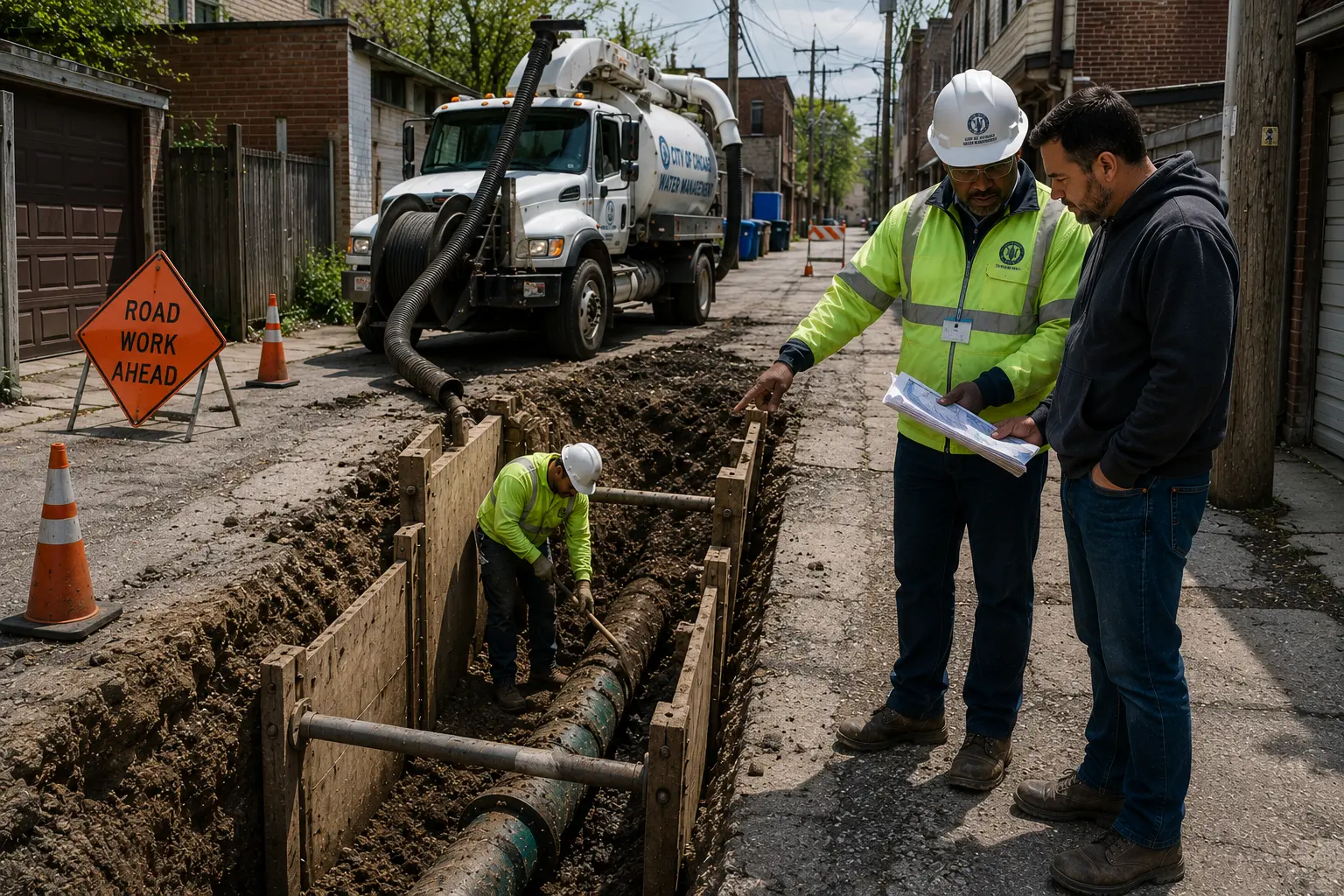
Sewer repair near streets and alleys in Chicago can be more complex than a typical private-yard repair. The damaged pipe may still be part of the homeowner’s private sewer line, but the location of the work can involve public right-of-way rules, city coordination, permits, inspections, access restrictions, pavement restoration, and questions about who should pay.
For homeowners, the main point is this: a sewer problem near a street or alley should be located and documented before major work begins. The repair may be private, city-related, or subject to additional review depending on whether the issue involves the private lateral, public sewer main, public drainage, or a qualifying defect under the public way.
Key Takeaways
- Sewer repairs near streets and alleys in Chicago often require more planning than repairs fully on private property.
- The exact location of the defect helps determine responsibility, permits, inspections, and restoration requirements.
- The homeowner may still be responsible for a private sewer line even when the repair is near a public street or alley.
- Public sewer main issues, public drainage problems, or defects under the public way may require city review.
- Permits and inspections are commonly needed for sewer excavation, replacement, or major repair near streets and alleys.
- Pavement, alley, sidewalk, curb, or street restoration can add cost and complexity.
- Camera inspection, line locating, and written documentation are important before approving expensive excavation.
Why Sewer Repairs Near Streets and Alleys Are Different
Sewer repair near a Chicago street or alley may involve public right-of-way rules, permits, inspections, restoration requirements, and city coordination. Even when the damaged pipe is part of a private sewer lateral, work near public pavement, alleys, streets, or the city sewer connection can trigger additional requirements that affect cost, timing, and responsibility.
Many Chicago properties drain toward sewer mains located under streets or alleys. Depending on the neighborhood and property layout, the private sewer line may run from the building toward a front street, rear alley, parkway, or public sewer connection.
That means a sewer defect may be physically close to city infrastructure without automatically becoming the city’s responsibility. The location, pipe ownership, connection point, and type of defect all matter.
For broader context on local sewer rules, permits, inspections, and public-way issues, see Chicago Permits, Codes & Local Rules.
Is the Homeowner Responsible for Sewer Work Near a Street or Alley?
Often, yes. Homeowners are commonly responsible for the private sewer lateral serving their property, even when that line runs toward a street or alley. The city is generally responsible for public sewer mains and public sewer infrastructure.
The challenge is that the private line and city system meet somewhere. A problem near that transition can be difficult to evaluate without proper inspection and locating.
| Location or Issue | Typical Responsibility Question |
|---|---|
| Pipe under private yard or gangway | Often treated as homeowner responsibility. |
| Pipe approaching a street or alley | May still be private, but location needs documentation. |
| Defect under public right-of-way | May require city review, permits, or program eligibility checks. |
| Connection to city sewer main | Responsibility depends on the exact defect and connection details. |
| Public sewer main blockage | Generally a city infrastructure issue. |
| Street or alley drainage problem | May involve catch basins, public drainage, or city maintenance. |
Homeowners trying to understand this boundary should review Who Is Responsible for Sewer Lines in Chicago? and City Sewer Main vs Private Sewer Line: Who Pays?.
How Contractors Locate a Street or Alley Sewer Defect
Before approving excavation near a street or alley, homeowners should ask how the contractor determined the defect location. Guessing is risky because public-way work can be expensive and disruptive.
A proper diagnosis may include:
- Sewer rodding to clear or attempt to clear the line
- Camera inspection to identify the defect
- Distance measurements from the access point
- Electronic locating to trace the sewer line path
- Surface marking of the suspected defect location
- Review of whether the problem is structural or maintenance-related
- Documentation showing whether the defect is on private property, under public way, or near the city connection
Homeowner decision point: If the contractor says the sewer problem is “near the alley” or “near the street,” ask for the exact location, camera evidence, and line locating results before approving excavation.
Permits for Sewer Repair Near Streets and Alleys
Sewer repair near streets and alleys often requires permits because the work may involve excavation, pipe replacement, public right-of-way impacts, traffic or access concerns, and regulated sewer connections.
Permits help ensure the work is performed legally, safely, and in compliance with local requirements. They also create an inspection and documentation process that can matter later for insurance, resale, and future repairs.
Important permit questions include:
- Does this repair require a sewer or plumbing permit?
- Does excavation in or near the street or alley require additional approval?
- Who will obtain the permit?
- Are permit fees included in the estimate?
- Will the contractor coordinate inspections?
- Who is responsible for pavement, alley, sidewalk, curb, or parkway restoration?
- Will public access be affected during the work?
For a broader explanation, homeowners can read Chicago Sewer Repair Permits: What Homeowners Need to Know.
Inspection Requirements Near Streets and Alleys
When sewer repair work is permitted, inspections may be required before the pipe is covered and before the project is finalized. This is especially important when work affects a street, alley, or public-way area.
Inspection requirements may involve reviewing:
- Pipe materials
- Pipe slope and alignment
- Connection points
- Cleanout installation if included
- Excavation and bedding conditions
- Backfill and compaction
- Compliance with the permitted scope of work
- Surface restoration requirements
Inspections can affect project timing. If the contractor covers the work before a required inspection, the area may need to be reopened, which can increase cost and delay completion.
For more detail, see Sewer Repair Inspection Requirements in Chicago.
How Chicago’s Private Drain Program May Apply
Chicago’s Private Drain Program may become relevant when a qualifying private drain is broken under the public way. Since streets and alleys are public-way areas, homeowners should understand this program before paying for major excavation near those locations.
The program does not apply to every backup, clog, root intrusion, or damaged sewer line. Eligibility depends on the property, defect, location, documentation, and city determination.
If a camera inspection shows a break, collapse, or separation under a street, alley, parkway, or other public-way area, homeowners should ask whether city review is appropriate before the repair proceeds as a normal private job.
For more detail, see Understanding Chicago’s Private Drain Program.
Street Repairs vs. Alley Repairs
Street and alley sewer repairs share many issues, but they are not identical. The project location can affect access, restoration, scheduling, and disruption.
| Repair Location | Common Project Concerns |
|---|---|
| Front street | Traffic control, pavement cutting, curb or parkway impacts, public access, utility conflicts. |
| Rear alley | Garage access, trash pickup routes, alley pavement, drainage, neighbor access, tight equipment space. |
| Parkway near street | Tree roots, utility lines, landscaping, sidewalk proximity, public-way restoration. |
| Near city sewer connection | Responsibility questions, inspection requirements, connection standards, possible city review. |
Because alleys are common in Chicago, homeowners should be especially careful about access planning. A repair that blocks a rear alley can affect multiple properties, garages, service vehicles, and neighbors.
Cost Factors for Sewer Repair Near Streets and Alleys
Sewer repairs near streets and alleys can cost more than repairs fully on private property because the work may involve public pavement, deeper excavation, access limitations, permits, inspections, and restoration.
| Cost Factor | How It Can Affect the Project |
|---|---|
| Camera inspection and locating | Helps verify the defect location before costly excavation. |
| Excavation depth | Deeper lines require more labor, equipment, and safety measures. |
| Pavement cutting | Street or alley surfaces may need to be cut and removed. |
| Traffic or access control | May be needed if work affects vehicles, pedestrians, garages, or service routes. |
| Permit requirements | Adds administrative cost and may affect scheduling. |
| Inspection timing | Required inspections can influence when work can be covered and completed. |
| Surface restoration | May include asphalt, concrete, alley pavement, curb, sidewalk, or parkway repair. |
| Repair scope | A spot repair may cost less than partial or full sewer replacement. |
When comparing estimates, homeowners should ask whether restoration, permits, inspections, access control, and public-way coordination are included. A lower bid may not cover all required work.
Repair Options Near Streets and Alleys
Spot Repair
A spot repair targets a specific defect. It may make sense when the rest of the line is structurally sound and the problem is clearly isolated.
Partial Replacement
Partial replacement may be appropriate when several pipe sections near the street or alley are deteriorated, separated, or damaged.
Full Sewer Line Replacement
Full replacement may be considered when the sewer line has repeated failures, widespread structural damage, or old pipe that is likely to keep causing problems. Homeowners should understand permit requirements before authorizing a replacement. See Chicago Sewer Replacement Permit Requirements.
Trenchless Repair or Replacement
Trenchless methods may reduce excavation in some situations, but they are not always suitable. Severe collapse, poor alignment, inaccessible connection points, or code requirements can limit whether trenchless work is practical.
Practical tradeoff: A smaller repair may reduce immediate cost and disruption, but it may not solve recurring failures in an older line. A larger repair can be more expensive upfront but may reduce repeat excavation near public areas.
Chicago-Specific Considerations
Older Sewer Laterals
Many Chicago homes have older sewer laterals that may run toward streets or alleys. Aging clay, cast iron, or previously repaired pipe can complicate repair planning.
Alleys and Shared Access
Alley work can affect neighbors, garages, trash pickup, delivery access, and emergency access. Homeowners should ask contractors how the work area will be secured and how long access may be limited.
Public Drainage Concerns
Street or alley drainage issues may involve catch basins, grading, stormwater flow, or public sewer capacity. If the issue appears city-related, homeowners may need to create a 311 record or seek Water Department review.
Related city concerns are covered in Common Chicago Water Department Sewer Issues.
Two-Flats and Multi-Unit Homes
Multi-unit buildings may require more coordination because several households can be affected by one sewer outage. Repair planning should account for tenant communication, access, timing, and temporary service disruption.
Common Mistakes Homeowners Make
Assuming a Street or Alley Location Means the City Pays
A private sewer lateral can extend toward a street or alley while still raising private responsibility issues. City payment depends on the exact defect and infrastructure involved.
Approving Excavation Without Documentation
Street and alley work can be expensive. Homeowners should ask for camera footage, locating results, and written findings before moving forward.
Ignoring Access and Neighbor Impacts
Alley work can affect other properties. Contractors should explain how access, barriers, cleanup, and timing will be managed.
Overlooking Restoration Costs
Pavement restoration can be a meaningful cost. Homeowners should confirm who is responsible for restoring concrete, asphalt, alley pavement, curb areas, or parkways.
Skipping Permit and Inspection Questions
Permitted work requires proper coordination. Homeowners should verify that permits and inspections are included where required.
Warning Signs That a Street or Alley Repair Needs Extra Review
Slow down and gather more information if:
- The defect appears under a street, alley, or parkway.
- The camera stops near the public sewer connection.
- Multiple nearby properties are affected.
- Street or alley flooding is also present.
- The estimate includes pavement cutting or public-way restoration.
- The contractor is unsure whether city review is needed.
- The same backup returns after repeated rodding.
- The project may block alley access for neighbors.
These signs do not automatically determine responsibility, but they do mean the homeowner should confirm location, permit requirements, city involvement, and restoration obligations before work begins.
Frequently Asked Questions
Who pays for sewer repair under a Chicago alley?
Responsibility depends on whether the defect is part of the private sewer lateral, a public sewer main, or a qualifying issue under the public way. Homeowners should confirm the defect location before assuming who pays.
Do I need a permit for sewer repair near a street or alley?
Often, yes. Sewer excavation, replacement, major repairs, public-way impacts, and work near city connections may require permits and inspections.
Can the city repair my sewer line if it is under the street?
Possibly, but not automatically. The city generally handles public sewer infrastructure, while private drain issues under the public way may require eligibility review.
What documentation should I ask the contractor for?
Ask for camera footage, distance measurements, line locating results, written findings, permit details, inspection plans, and restoration responsibilities.
Will homeowners insurance cover sewer repair near a street or alley?
Coverage depends on the policy. Sewer backup coverage may apply to resulting interior damage, while service line coverage may be needed for underground pipe repair. Pavement or restoration coverage can vary.
What if the repair blocks my alley?
The contractor should explain access impacts, expected timing, safety barriers, cleanup, and whether neighbors or city coordination may be affected.
Should I call 311 for a street or alley sewer issue?
If public drainage, street flooding, a suspected public sewer main issue, or a public-way defect may be involved, calling 311 can help create a city record. A private sewer inspection may still be needed.
Conclusion
Sewer repair near streets and alleys in Chicago requires careful diagnosis before anyone can confidently determine cost, responsibility, permits, or timing. The repair may involve a private sewer lateral, public sewer infrastructure, public-way rules, or a qualifying issue that needs city review.
Before approving major street or alley sewer work, homeowners should ask for camera evidence, line locating, written findings, permit details, inspection plans, and restoration responsibilities. Careful documentation can help prevent unnecessary costs, delayed repairs, and disputes over who should pay.