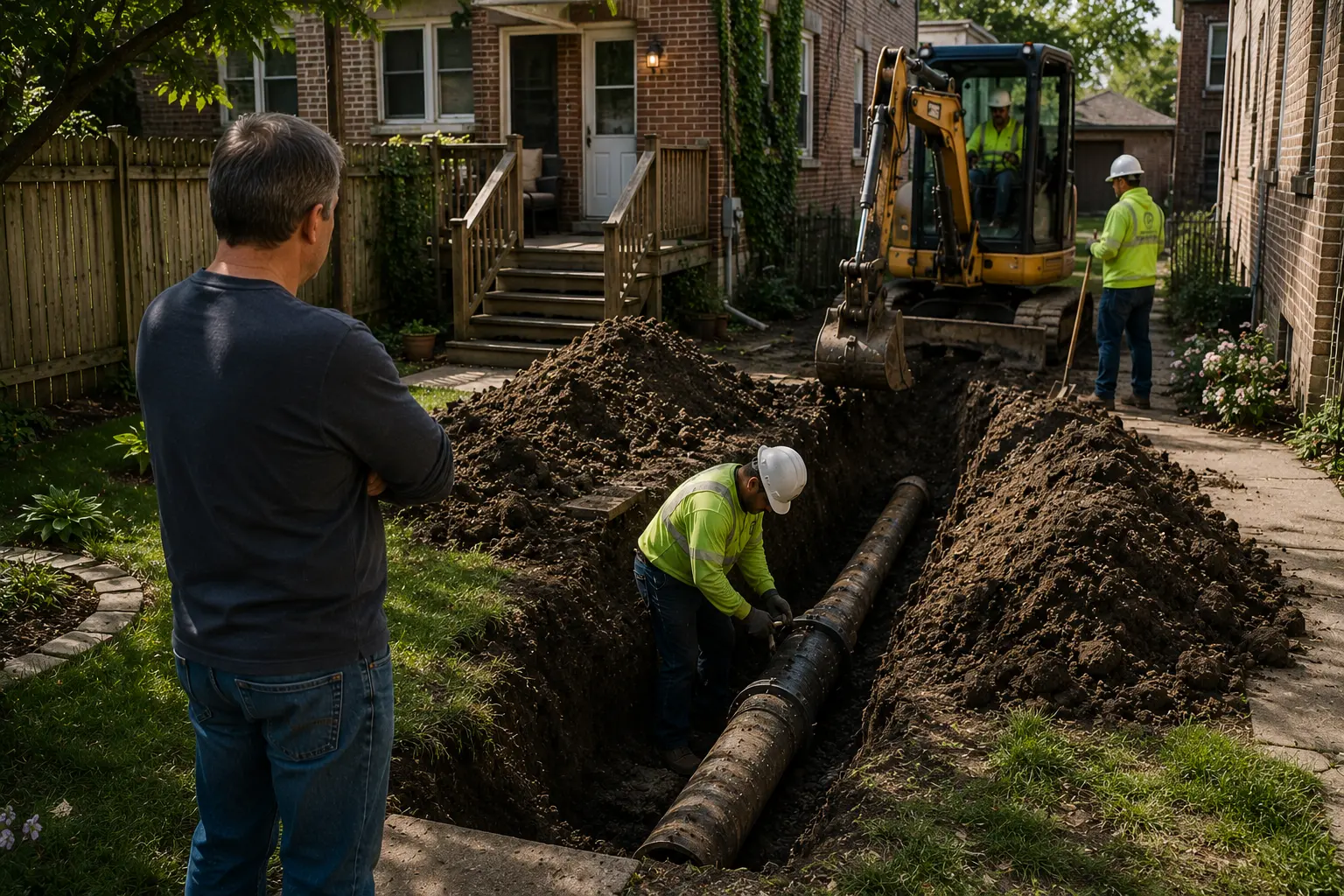
Sewer line easements can create confusion for Chicago homeowners because the pipe serving a property may not always run in the most obvious place. A sewer line may cross a side yard, rear yard, shared gangway, neighboring parcel, alley area, or other access route before reaching the public sewer system. When that happens, repair decisions can involve more than just hiring a contractor.
The key point is that an easement can affect access, responsibility, repair planning, permits, restoration, and disputes with neighbors. It does not automatically mean the city pays for the repair, and it does not automatically mean the homeowner can dig wherever needed without review. Homeowners should confirm the location of the sewer line, the terms of any easement, and applicable permit requirements before approving major work.
Key Takeaways
- A sewer line easement is a legal right allowing sewer access or sewer infrastructure to cross property that may not belong entirely to the user of the line.
- Easements can affect where contractors may dig, who must be notified, and how restoration is handled.
- A sewer line crossing an easement may still be the homeowner’s responsibility if it serves the private property.
- Responsibility depends on pipe ownership, property records, defect location, and the specific easement language.
- Permits and inspections may still be required for sewer work involving an easement.
- Shared sewer lines, two-flats, multi-unit properties, and alley-adjacent homes can raise additional complications.
- Homeowners should keep records of surveys, title documents, camera inspections, permits, and contractor findings.
What Is a Sewer Line Easement?
A sewer line easement is a legal right that allows a sewer line, sewer access, or sewer-related work to exist on or cross a property area. In Chicago, easements can matter when a private sewer line crosses a neighboring property, shared area, gangway, alley-adjacent area, or other location where access and ownership are not straightforward.
For homeowners, the practical question is not just whether a sewer line exists. The question is whether the homeowner has the legal right to access, repair, replace, or maintain the line in that location.
Easements can appear in title records, plats, surveys, recorded agreements, condo documents, development records, or utility-related documents. They may be clearly written, poorly understood, or discovered only after a sewer problem appears.
For broader context on sewer permits, code requirements, public-way issues, and homeowner responsibilities, see Chicago Permits, Codes & Local Rules.
Why Sewer Easements Matter During Repairs
A sewer easement can affect repair planning because it may limit where contractors can work, how access is obtained, who must be notified, and who is responsible for restoring disturbed areas.
Without understanding the easement, homeowners may run into delays, neighbor disputes, permit problems, or unexpected restoration costs.
A sewer easement may affect:
- Where excavation can occur
- Whether a neighbor must allow access
- Who pays for repair or restoration
- Whether the sewer line can be relocated
- Whether permits or inspections are required
- Whether shared use or maintenance obligations exist
- Whether a future home sale raises questions about the sewer line
Because sewer lines are buried, homeowners may not realize an easement exists until a camera inspection, survey, title review, or repair estimate reveals the issue.
Common Sewer Easement Situations in Chicago
Chicago properties can have dense lot layouts, older buildings, gangways, rear alleys, two-flats, coach houses, shared access areas, and older sewer configurations. These conditions can make easement questions more common than homeowners expect.
| Situation | Why It Matters |
|---|---|
| Private sewer line crosses a neighboring property | Access rights and repair responsibility may depend on recorded easement language. |
| Shared sewer line serves more than one property | Maintenance and repair costs may need to be divided or clarified. |
| Sewer line runs through a gangway or side yard | Access may be tight and may involve neighboring structures or fences. |
| Line runs toward a rear alley | Public-way rules, alley access, and restoration may become important. |
| Two-flat or multi-unit property | Multiple owners, tenants, or occupants may be affected by repair decisions. |
| Older undocumented sewer layout | Records may be incomplete, requiring camera inspection, locating, and title review. |
Does an Easement Mean the City Pays?
No. An easement does not automatically make the sewer line a city responsibility.
A private sewer line can cross an easement and still remain privately owned or privately maintained. The city is generally responsible for public sewer mains and public sewer infrastructure, while homeowners are commonly responsible for private sewer laterals serving their properties.
The difficult cases occur when a private drain runs under a public way, connects near city infrastructure, or serves multiple properties. In those situations, responsibility depends on the facts, not just the presence of an easement.
For more detail on responsibility boundaries, review Who Is Responsible for Sewer Lines in Chicago? and City Sewer Main vs Private Sewer Line: Who Pays?.
How to Find Out Whether a Sewer Easement Exists
Homeowners may need to combine several sources to understand whether a sewer easement exists and what it allows.
Useful sources may include:
- Property survey documents
- Title insurance records
- Recorded easement agreements
- Closing documents from the home purchase
- Condo or association documents, if applicable
- Plat maps or subdivision records
- Contractor sewer camera and locating results
- Prior repair records from previous owners
Practical homeowner step: If a sewer defect appears to cross a property boundary or shared access area, gather title documents, survey records, and camera inspection results before authorizing excavation.
A contractor can help locate the sewer line physically, but a contractor usually cannot interpret legal easement rights the way a title company, attorney, or survey professional can.
Permits and Inspections for Sewer Work Involving Easements
An easement does not remove permit requirements. If sewer work involves excavation, replacement, new connections, major repair, or work near public areas, permits and inspections may still be required.
Permit questions homeowners should ask include:
- Does the repair require a sewer or plumbing permit?
- Does the work cross a property line or shared access area?
- Does the easement allow access for excavation or replacement?
- Will a neighbor or association need notice?
- Who will schedule inspections?
- Who is responsible for restoring the affected area?
- Will the completed work be documented for future property records?
For general permit requirements, see Chicago Sewer Repair Permits: What Homeowners Need to Know. For inspection issues, see Sewer Repair Inspection Requirements in Chicago.
Access Problems During Easement Sewer Repairs
Access is often the biggest practical issue with sewer easements. Even if the homeowner has some right to maintain or repair a sewer line, the work may require entry onto a neighbor’s property, removal of fencing, protection of landscaping, or coordination around structures.
Common access complications include:
- Fences, garages, decks, or patios over the sewer path
- Tight gangways with limited equipment access
- Landscaping or concrete installed above the line
- Neighbor disagreement over excavation
- Unclear responsibility for restoration
- Shared use of the sewer line by multiple properties
- Emergency repairs that require fast coordination
When access is uncertain, homeowners should avoid making assumptions. The easement language, property records, and local requirements should be reviewed before work begins whenever possible.
Shared Sewer Lines and Multi-Unit Properties
Some sewer easement issues involve shared sewer lines. A shared line may serve more than one property, more than one building, or multiple units within a larger property arrangement.
Shared sewer issues can raise difficult questions:
- Who pays for diagnosis?
- Who pays for repair?
- Who authorizes excavation?
- Who restores the affected area?
- What happens if one owner refuses access?
- How are future maintenance costs divided?
These situations are especially important for two-flats, multi-unit homes, condominium buildings, and properties with older drainage layouts. Homeowners can explore related issues in Sewer Repair for Two-Flats and Multi-Unit Homes.
Easements Near Streets, Alleys, and Sidewalks
Some easement-related sewer work overlaps with public-way concerns. A sewer line may cross private property, then continue toward a sidewalk, street, alley, or city sewer main. In those cases, the project may involve both easement access and public-way rules.
This can affect:
- Permit requirements
- Public access
- Traffic or alley access
- Sidewalk or pavement restoration
- Responsibility for surface repairs
- Possible city review
If the sewer problem is near a sidewalk, street, or alley, homeowners may need to look beyond the easement itself. Related guidance is available in Sewer Repair Near Sidewalks in Chicago and Sewer Repair Near Streets and Alleys in Chicago.
Cost Factors for Sewer Easement Repairs
Sewer work involving an easement can cost more than a straightforward private-yard repair because access, documentation, coordination, and restoration may be more complex. Exact costs vary widely based on location, depth, pipe condition, repair method, legal documentation, and whether multiple parties are involved.
| Cost Factor | How It Can Affect the Project |
|---|---|
| Camera inspection and locating | Helps confirm where the sewer line runs and where the defect is located. |
| Survey or title review | May be needed to confirm easement rights and property boundaries. |
| Neighbor coordination | Can affect timing, access, and restoration expectations. |
| Excavation access | Tight spaces or blocked access can increase labor and equipment needs. |
| Permit requirements | May add fees and inspection steps. |
| Surface restoration | May include concrete, fencing, landscaping, pavement, or shared areas. |
| Shared line disputes | Can delay repair decisions or require legal review. |
Homeowners comparing estimates should ask whether the quote includes easement-related access work, restoration, permits, inspections, and any special coordination required with neighboring properties.
Insurance and Sewer Easements
Insurance coverage for sewer line repairs involving easements depends on the policy, the cause of damage, the type of coverage purchased, and the location of the damaged pipe.
Homeowners should not assume a standard policy covers underground sewer line repair. Sewer backup coverage may help with resulting interior damage, while service line coverage may be needed for the pipe itself. Easement-related restoration, neighbor property damage, or access disputes may involve additional coverage questions.
Before filing or relying on a claim, review:
- Sewer backup endorsement limits
- Service line coverage
- Exclusions for wear, roots, deterioration, or earth movement
- Coverage for excavation and restoration
- Liability issues if neighboring property is affected
- Deductibles and claim limits
Common Mistakes Homeowners Make
Assuming the Easement Solves the Responsibility Question
An easement may provide access rights, but it does not automatically determine who pays for the sewer repair.
Digging Before Reviewing Property Records
If the sewer line crosses a boundary or shared area, records should be reviewed before excavation begins whenever possible.
Ignoring Neighbor Communication
Even when access rights exist, poor communication can create delays, conflict, and restoration disputes.
Skipping Permit Questions
Sewer work involving an easement may still require permits and inspections, especially if excavation or replacement is involved.
Failing to Document the Repair
Future buyers, insurers, contractors, or neighbors may need proof of what was repaired, where it occurred, and whether approvals were obtained.
Warning Signs That an Easement Issue May Be Involved
Homeowners should investigate easement questions when:
- The sewer line appears to cross a neighbor’s property.
- The pipe runs through a shared gangway, rear yard, or common area.
- A contractor cannot access the defect without entering another property.
- The sewer serves multiple buildings or units.
- Property records mention drainage, utility, or sewer easements.
- The repair affects a shared driveway, alley-adjacent area, or common courtyard.
- A neighbor disputes access or restoration responsibility.
These signs do not mean the repair cannot move forward. They mean the homeowner should gather records and clarify rights before the project becomes more expensive or contentious.
Frequently Asked Questions
What is a sewer easement?
A sewer easement is a legal right that allows a sewer line, sewer access, or sewer-related maintenance to exist on or cross a property area. The exact rights depend on the easement language and property records.
Does a sewer easement mean my neighbor must let workers dig?
Possibly, but it depends on the easement terms. Some easements allow reasonable access for maintenance and repair, while others may be limited or unclear. Property records should be reviewed before assuming access rights.
Who pays if my sewer line crosses a neighbor’s property?
Payment depends on ownership, maintenance obligations, easement language, and whether the line is private, shared, or public. A private line crossing an easement may still be the homeowner’s responsibility.
Do sewer easement repairs require permits?
They may. Excavation, replacement, major sewer repair, and work near public areas can require permits and inspections even when an easement exists.
Can I move a sewer line out of an easement?
Sometimes, but relocation may require permits, engineering review, contractor evaluation, and possibly agreement from affected parties. Relocation can be expensive and may not always be practical.
Will insurance cover sewer repair in an easement?
Coverage depends on the policy. Service line coverage may be needed for underground pipe repair, while sewer backup coverage may apply only to resulting interior damage. Easement-related restoration or liability questions may require policy review.
Should I get legal advice for a sewer easement dispute?
If access, payment responsibility, neighbor rights, or recorded easement terms are disputed, legal advice may be helpful. Contractors can identify pipe conditions, but they usually cannot resolve property-rights disputes.
Conclusion
Sewer line easements in Chicago can affect repair access, responsibility, permits, restoration, neighbor communication, and long-term property records. An easement may give a homeowner the right to maintain a sewer line in a certain location, but it does not automatically answer every question about cost or authority.
Before approving major sewer work involving a shared area, neighboring property, public-way location, or unclear sewer path, homeowners should gather surveys, title records, camera inspection results, contractor findings, permit information, and restoration plans. Clear documentation can help prevent delays, disputes, and costly misunderstandings.