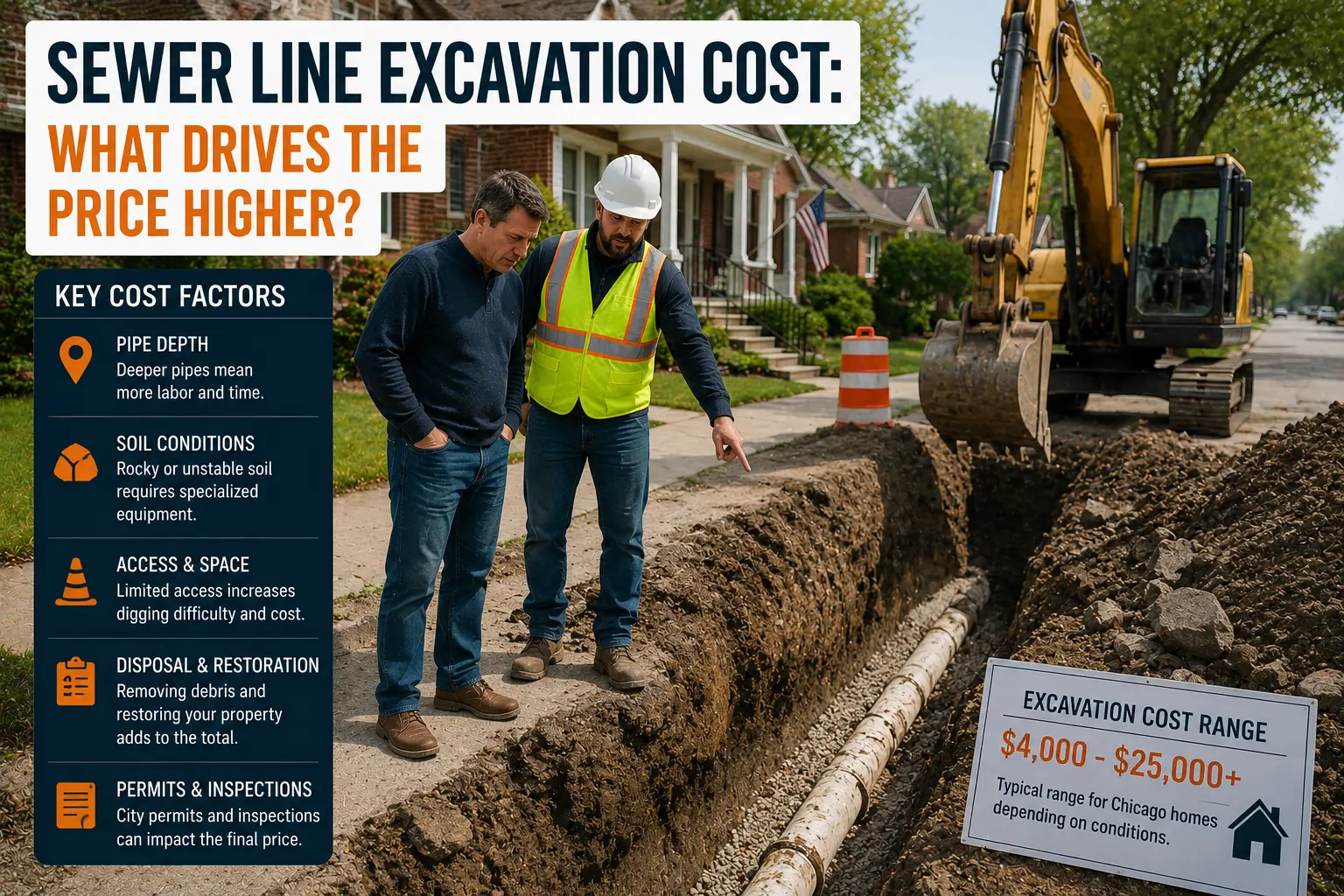
Sewer line excavation is often one of the biggest reasons sewer repair or replacement becomes expensive. The pipe itself matters, but the real cost is frequently driven by how difficult it is to reach the pipe, remove damaged sections, work safely in the trench, and restore the property afterward.
For Chicago homeowners, excavation cost can rise quickly when the sewer line is deep, located under concrete, blocked by tight access, near a foundation, under a sidewalk, or affected by older pipe materials and tree roots. A short excavation in a difficult location may cost more than a longer excavation through open yard space.
This guide explains what drives sewer line excavation cost higher, how excavation affects repair and replacement decisions, and what homeowners should ask before approving a sewer estimate.
Key Takeaways
- Sewer line excavation cost is driven by depth, access, soil conditions, pipe location, labor, equipment, permits, and restoration.
- Chicago properties may involve older sewer lines, basements, narrow lots, sidewalks, alleys, parkways, concrete surfaces, and mature tree roots.
- A small sewer repair can still be expensive if the excavation is deep, tight, or under hard surfaces.
- Trenchless options may reduce excavation in some cases, but they are not suitable for every damaged sewer line.
- A sewer camera inspection and locating work can help determine where excavation is needed before digging begins.
- Homeowners should compare the full written scope, not just the excavation price or pipe replacement cost.
How Much Does Sewer Line Excavation Cost in Chicago?
Sewer line excavation cost in Chicago depends on how deep the sewer line is, where it is located, what surface must be opened, how much pipe needs to be exposed, whether permits are required, and how much restoration is included after the work is complete.
Excavation is usually less costly when the pipe is shallow, easy to access, and located under open soil. The price can rise when the line is deep, under concrete, near a foundation, below a basement slab, beneath a sidewalk or driveway, or in a narrow side yard where equipment access is limited.
For a broader view of how excavation fits into overall sewer pricing, see the main Chicago sewer replacement cost guide.
Main Cost Sections for Sewer Line Excavation
Depth of the Sewer Line
Depth is one of the most important excavation cost factors. A shallow sewer line is easier to uncover, repair, replace, and backfill. A deeper sewer line requires more digging, more labor, more soil removal, and more trench safety planning.
Deeper excavation may also require wider work areas, shoring, careful backfilling, and additional time to reach the damaged section safely. In Chicago, sewer depth can vary based on the home’s age, basement layout, lot elevation, and connection point.
Access to the Work Area
Access can dramatically change the cost of excavation. If equipment can reach the dig area easily, the work may be more efficient. If the sewer line runs through a narrow gangway, behind a fence, near a garage, under a porch, or beside a neighboring structure, the job can require more hand digging and careful staging.
Many Chicago lots are tight, which means contractors may have limited room for equipment, materials, spoil piles, and worker access. Limited access can turn a simple sewer repair into a more labor-intensive project.
Surface Above the Sewer Line
The surface above the pipe matters. Digging through grass or open soil is usually simpler than cutting concrete, removing pavers, opening a driveway, breaking a basement slab, or working under a sidewalk.
Hard surfaces may need to be cut, removed, hauled away, and replaced. If restoration is not included in the original estimate, the true finished cost can be higher than the excavation price suggests.
Length of Excavation
The amount of pipe that must be exposed affects the cost. A small spot repair may require one excavation pit. A larger replacement may require a longer trench or multiple access points.
However, a longer excavation is not always more expensive on a per-foot basis. Some costs are fixed, such as equipment setup, locating, permits, and mobilization. A short but deep excavation under concrete can be more costly than a longer excavation through accessible soil.
Pipe Condition and Damage Type
The reason for excavation also matters. A clean break in one accessible section may be simpler than a collapsed pipe, severe offset, heavy root intrusion, or multiple failed sections. If the existing sewer line is unstable, work may take longer and require more care.
A sewer camera inspection can help identify whether excavation is needed for one isolated defect or whether the line has broader deterioration.
Backfill, Compaction, and Cleanup
Excavation cost does not end when the pipe is repaired. The trench must be backfilled properly, and the area may need compaction, grading, cleanup, and restoration. Poor backfill can lead to settling, sunken soil, damaged surfaces, or future drainage problems.
Homeowners should ask whether backfill, compaction, debris removal, and surface restoration are included in the estimate.
Common Sewer Excavation Cost Drivers
| Cost Driver | Why It Raises Cost | What Homeowners Should Ask |
|---|---|---|
| Deep sewer line | Requires more digging, soil removal, labor, and trench safety planning. | What depth is assumed in the estimate? |
| Concrete or pavement | Must be cut, removed, disposed of, and possibly replaced. | Is concrete restoration included? |
| Narrow access | Limits equipment use and may require more hand digging. | Will access limitations change the final price? |
| Basement slab work | Interior excavation can involve cutting flooring, dust control, and slab repair. | Will interior restoration be included? |
| Tree roots | Roots may indicate damaged pipe and complicate excavation. | Where are roots entering the line? |
| Public-facing areas | Sidewalks, parkways, or alleys may involve permits and restoration requirements. | Who handles permits and inspections? |
| Collapsed pipe | May require direct excavation and careful replacement. | Has the failed section been located on camera? |
Chicago-Specific Considerations
Older Homes and Older Sewer Materials
Many Chicago homes have older sewer lines made from clay, cast iron, or a mix of materials from previous repairs. Older clay pipe can crack, separate at joints, or allow roots to enter. Cast iron can corrode or scale internally.
When older pipe is excavated, contractors may also discover previous repairs, material transitions, or sections that are in worse condition than expected. These discoveries can affect the final scope.
Basements and Deep Sewer Laterals
Because many Chicago homes have basements, sewer lines may run deeper than homeowners expect. A deeper lateral can increase excavation difficulty, especially near the foundation or where the line exits the home.
If the problem appears under a basement slab, the project may involve interior cutting, dust control, debris removal, and slab restoration in addition to pipe repair.
Sidewalks, Alleys, Parkways, and Tight Lots
Chicago properties often include narrow side yards, alleys, sidewalks, parkway areas, detached garages, fences, porches, and limited equipment access. These conditions can make excavation more complicated than a simple open-yard dig.
If the sewer line runs near public-facing areas, homeowners should ask whether permits, inspections, pedestrian access, or restoration requirements are part of the project.
Mature Trees and Root Intrusion
Mature trees are common across Chicago neighborhoods and parkways. Roots can enter sewer lines through cracks, open joints, or separated pipe sections. When roots are found repeatedly, excavation may be recommended to repair the damaged section where roots are entering.
Cleaning may remove roots temporarily, but it does not repair the pipe opening. A camera inspection can help determine whether excavation is needed or whether another method may work.
Weather and Soil Conditions
Weather can affect excavation. Frozen ground, heavy rain, saturated soil, and winter conditions may make digging slower or more complicated. Poor soil conditions can also affect trench stability and backfill requirements.
Excavation vs Trenchless Sewer Repair
Excavation is not the only way to repair or replace some sewer lines. Trenchless methods may reduce digging by using access points instead of opening the entire line. These methods can be useful when the damaged pipe runs under concrete, landscaping, sidewalks, or other expensive-to-restore areas.
However, trenchless repair is not always possible. If the pipe has collapsed, lost slope, developed a severe belly, or shifted significantly, direct excavation may be required to correct the underlying problem.
| Option | Potential Advantage | Potential Limitation |
|---|---|---|
| Traditional excavation | Allows direct access to remove, repair, or replace the damaged pipe. | Can disturb yards, sidewalks, driveways, basements, or landscaping. |
| Trenchless repair | May reduce digging and surface restoration. | Requires suitable pipe condition and access points. |
| Spot excavation | Can address one clearly located defect. | May not solve deterioration elsewhere in the line. |
| Full excavation replacement | Can address widespread pipe failure directly. | Usually more disruptive and higher cost than a small repair. |
Important Homeowner Note
Excavation is not automatically bad, and trenchless repair is not automatically better. The right option depends on the pipe condition, slope, access, damage location, and long-term reliability.
Repair vs Replacement Considerations
Excavation cost can change the repair-versus-replacement decision. If the ground must be opened anyway, homeowners may need to consider whether it makes sense to repair only one section or replace a larger portion of aging pipe.
Repair May Make Sense When
- The damaged section is isolated and clearly located.
- The rest of the sewer line appears structurally sound on camera.
- The excavation area is limited and does not require major restoration.
- The pipe has proper slope outside the damaged area.
- The homeowner wants to avoid replacing usable pipe.
Replacement May Make Sense When
- The line has several cracks, offsets, or separated joints.
- Roots keep returning after repeated cleaning.
- The pipe has collapsed or has major slope problems.
- The excavation area is already significant and the remaining pipe is deteriorated.
- The cost of repeated digging would likely exceed a larger replacement.
- Several previous repairs have already been made on the same line.
If estimates differ significantly, the reason may be different assumptions about excavation depth, restoration, pipe length, or permits. For more context, read why sewer replacement quotes in Chicago can vary by thousands.
What Should Be Included in a Sewer Excavation Estimate?
A sewer excavation estimate should clearly explain what will be opened, how deep the work is expected to be, and what happens after the pipe repair is complete. Vague excavation pricing can lead to confusion once the project begins.
Before approving excavation, ask whether the estimate includes:
- The reason excavation is being recommended
- The inspection findings supporting the recommendation
- The approximate location of the damaged pipe
- The assumed depth of the sewer line
- The length or size of the excavation area
- Utility locating requirements
- Permit and inspection responsibility
- Soil removal and disposal
- Pipe material and replacement details
- Backfill and compaction
- Concrete, sidewalk, driveway, lawn, or basement slab restoration
- Cleanup and debris removal
- Conditions that could increase the final cost
If the cost is difficult to absorb at once, it may help to review how to pay for sewer line replacement without draining your savings and compare available options before making a rushed decision.
Common Mistakes and Warning Signs
Mistake: Looking Only at the Pipe Repair Price
The pipe repair may be only one part of the job. Excavation, backfill, concrete cutting, restoration, permits, and cleanup can all affect the final cost.
Mistake: Not Asking What Restoration Includes
A quote may include backfill but not lawn repair, concrete replacement, driveway patching, or basement slab restoration. Homeowners should ask exactly what the property will look like when the work is finished.
Mistake: Approving Digging Without Location Evidence
Before excavation begins, the problem area should usually be identified through camera inspection and locating when possible. Digging without clear location information can increase risk and cost.
Mistake: Choosing the Smallest Repair When the Line Is Failing
If excavation is already expensive and the surrounding pipe is deteriorated, a very small repair may only postpone the next problem. Homeowners should consider the condition of the full inspected section.
Mistake: Waiting Until the Problem Becomes an Emergency
Emergency excavation can be more stressful because homeowners have less time to compare scopes, financing, and restoration details. If warning signs are recurring, planned evaluation is usually better than waiting for a full backup.
Warning Signs That May Lead to Excavation
- Camera inspection showing collapsed pipe
- Major offsets or separated joints
- Standing water from a belly or slope problem
- Recurring tree root intrusion through broken pipe
- Multiple whole-house backups
- Basement floor drain backups
- Wet, sunken, or unusually soft areas in the yard
- Several failed repairs in the same sewer line
Decision Point
Excavation is often most justified when the sewer problem is structural and cannot be solved reliably with cleaning or lining. The decision should be based on inspection evidence, not guesswork.
FAQ About Sewer Line Excavation Cost
Why is sewer line excavation so expensive?
Excavation can be expensive because it involves labor, equipment, digging, soil removal, trench safety, pipe access, backfill, compaction, permits, and surface restoration. The deeper or harder-to-access the sewer line is, the more complicated the work becomes.
Does excavation cost depend on the length of pipe being replaced?
Yes, but length is only one factor. Depth, access, concrete, restoration, soil conditions, and permit requirements can have just as much impact. A short excavation under concrete can cost more than a longer dig through open soil.
Can trenchless sewer repair avoid excavation?
Sometimes. Trenchless methods may reduce digging when the pipe condition and access points are suitable. However, excavation may still be required for collapsed pipe, severe bellies, bad slope, major offsets, or access pit creation.
Do I need a sewer camera inspection before excavation?
In most cases, yes. A camera inspection and locating work can help identify where the pipe is damaged and whether excavation is necessary. This can reduce guesswork before digging begins.
Will homeowners insurance cover sewer excavation?
Coverage depends on the policy and the cause of damage. Many policies exclude wear and tear, age-related pipe deterioration, and long-term root intrusion. Some homeowners may have service line or sewer backup coverage, but details should be confirmed directly with the insurer.
What Chicago-specific factors increase excavation cost?
Older pipe materials, deep sewer laterals, basements, narrow lots, sidewalks, alleys, parkways, concrete surfaces, mature tree roots, and permit requirements can all make excavation more complicated.
What should I ask before approving sewer excavation?
Ask why excavation is needed, what the camera inspection showed, where the damage is located, how deep the pipe is, what restoration is included, who handles permits, and what conditions could increase the final cost.
Conclusion
Sewer line excavation cost is driven by much more than the act of digging. Depth, access, pipe condition, surface material, permits, labor, equipment, backfill, and restoration all affect the final price.
For Chicago homeowners, excavation can become especially complex because of older sewer materials, basements, narrow lots, sidewalks, alleys, parkways, concrete surfaces, and mature tree roots. A detailed estimate should explain why excavation is needed and what is included from opening the ground through final restoration.
The best decision starts with evidence. A sewer camera inspection, locating information, and a clear written scope can help homeowners understand whether excavation is necessary, whether repair or replacement makes more sense, and how to compare estimates fairly.