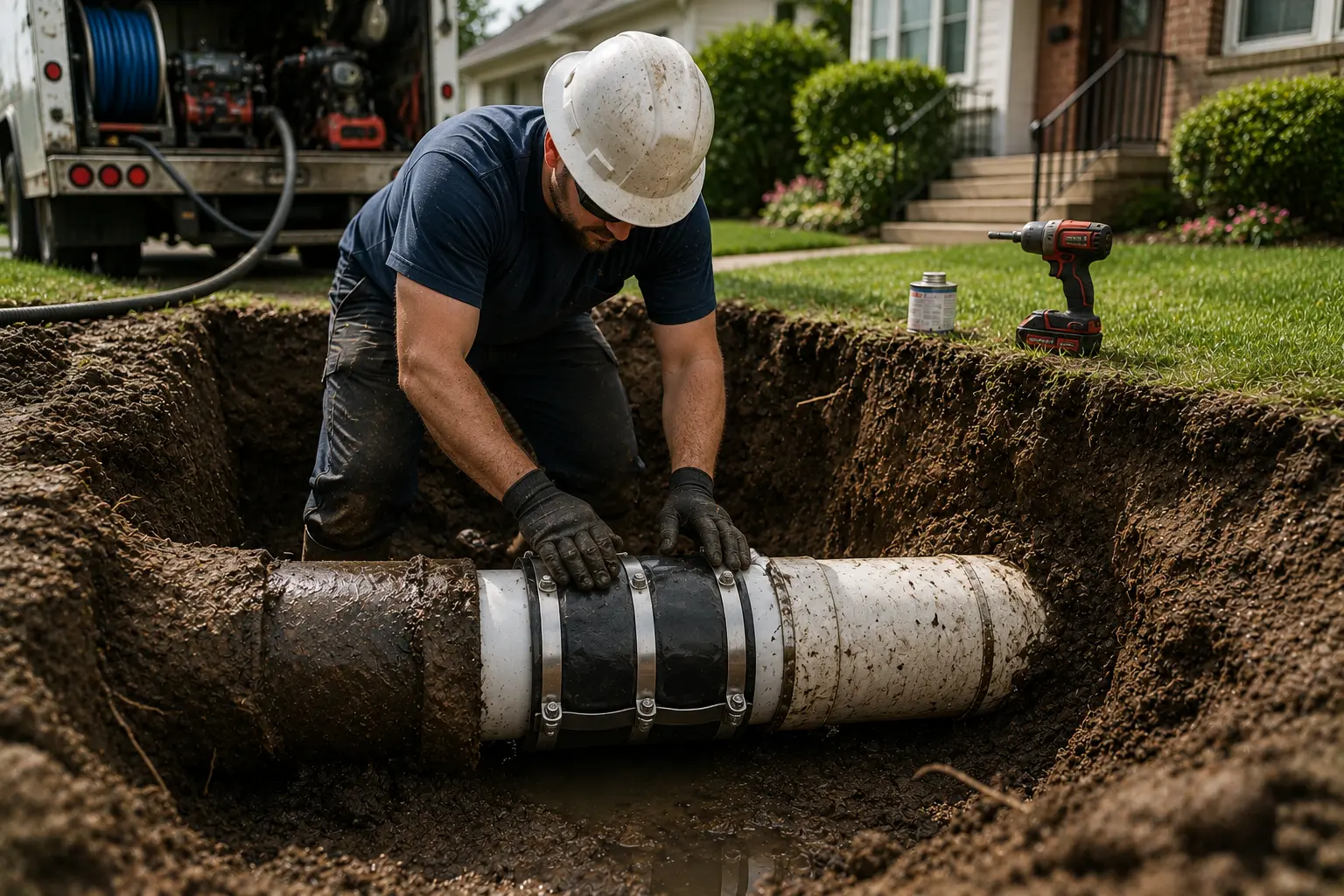
A spot repair is a targeted sewer line repair that fixes one damaged section instead of replacing the entire pipe. It can be a practical option when a camera inspection shows a single crack, break, offset, root entry point, or failed joint while the rest of the sewer line remains in usable condition.
For Chicago homeowners, spot repair can be appealing because it may cost less than full replacement and may limit excavation to one area. However, it is not always the best long-term decision. If the pipe has widespread deterioration, repeated failures, major root intrusion, or multiple weak points, repairing only one spot may delay a larger replacement project.
This article explains when spot repair is enough, when it is not, what homeowners should ask before approving the work, and how to compare spot repair with other sewer repair methods. For a broader overview of available options, visit the Sewer Repair Methods hub.
Key Takeaways
- Spot repair fixes one localized section of a sewer line.
- It may be enough when the rest of the pipe is structurally sound.
- A sewer camera inspection is usually needed before deciding whether a spot repair is appropriate.
- Spot repair is not ideal when the pipe has multiple defects or widespread deterioration.
- Chicago homes with older clay or cast iron sewer lines may need a broader repair strategy.
- The lowest upfront repair cost is not always the best long-term value.
When Is a Sewer Spot Repair Enough?
A sewer spot repair may be enough when the damage is limited to one clearly identified area and the rest of the sewer line appears stable, properly sloped, and free of major defects. Common examples include one cracked section, one root entry point, one broken joint, or one small area damaged by settling or age.
Spot repair is usually not enough when the sewer line has multiple cracks, repeated root intrusion, severe corrosion, major pipe bellies, collapse, or age-related deterioration throughout the line. In those situations, partial or full replacement may be more practical.
What Is a Spot Repair for a Sewer Line?
A spot repair is a localized sewer repair focused on one specific defect. Instead of replacing the entire sewer line, the damaged section is accessed, removed, repaired, reinforced, or replaced while the rest of the pipe remains in place.
Spot repairs may be performed through traditional excavation or, in some cases, with trenchless repair methods. The exact approach depends on the pipe material, damage location, pipe depth, access, and condition of the surrounding line.
Spot repair is different from full sewer line replacement. It is meant to solve a limited problem, not renew an entire aging sewer system.
Common Problems That May Qualify for Spot Repair
Spot repair can be useful when the defect is specific, visible on inspection, and unlikely to represent a broader system failure.
Spot repair may be considered for:
- One cracked pipe section
- A single broken joint
- Localized tree root intrusion
- A small offset between pipe sections
- One damaged clay pipe segment
- A short section of collapsed or crushed pipe
- Damage caused by soil movement in one area
- A limited defect beneath a yard, driveway, or sidewalk
If the problem is limited and the remaining line looks healthy, a spot repair may avoid unnecessary full replacement.
When Spot Repair Is Usually Not Enough
Spot repair becomes less attractive when the sewer line shows signs of broader failure. Repairing one area does not help much if several other sections are close to failing.
Spot repair may not be enough when:
- There are multiple cracks or breaks along the line
- Roots are entering at several locations
- The pipe has widespread corrosion or scaling
- Clay pipe joints are separating in many areas
- The line has a major belly or sag
- The pipe has repeated backups after previous cleaning
- The sewer line is nearing the end of its useful life
- Previous spot repairs have already been made
In these cases, homeowners may need to compare localized repair with larger repair or replacement options. For a broader decision framework, see Sewer Line Repair vs Replacement: Which Option Makes Sense?.
How Contractors Identify Whether a Spot Repair Makes Sense
A spot repair decision should be based on more than the location of a clog. A proper evaluation usually includes inspection, diagnosis, and consideration of the entire sewer line.
Sewer Camera Inspection
A sewer camera inspection helps locate the defect and evaluate the condition of the pipe before and after the damaged section. The inspection should show whether the issue is isolated or part of a larger pattern.
Pipe Location and Depth
The depth and location of the damaged section affect how difficult the repair will be. A defect under grass is usually easier to access than one under concrete, a driveway, a sidewalk, or a slab.
Pipe Material
Clay, cast iron, and PVC pipes behave differently. A small defect in newer PVC may be a better spot repair candidate than a single visible defect in a severely deteriorated cast iron line.
History of Backups
If this is the first major issue, spot repair may be reasonable. If the line has backed up repeatedly, the visible defect may be only one part of a larger sewer problem.
Spot Repair vs Full Sewer Line Replacement
The main advantage of spot repair is that it targets only the damaged section. The main risk is that the rest of the line may fail later if the pipe is already aging or deteriorating.
| Factor | Spot Repair | Full Sewer Line Replacement |
|---|---|---|
| Scope | Repairs one localized section | Replaces most or all of the sewer line |
| Upfront Cost | Usually lower | Usually higher |
| Disruption | Often limited to one area | May affect a larger portion of the property |
| Best For | Isolated damage in an otherwise sound pipe | Widespread deterioration or repeated failures |
| Long-Term Reliability | Depends on remaining pipe condition | Usually stronger when the entire line is failing |
| Risk | Other sections may fail later | Higher initial cost and larger project scope |
For homeowners considering a larger project, Full Sewer Line Replacement: What Homeowners Should Know explains when replacement may be the more durable option.
Spot Repair vs Pipe Lining
Spot repair and pipe lining can both address limited sewer defects, but they do so differently.
A spot repair typically focuses on physically correcting a damaged section. Pipe lining creates a new interior surface inside the existing pipe. Lining may be useful when the pipe has cracks, leaks, or root entry points but is still structurally stable enough to support a liner.
Spot repair may be more appropriate when the damaged section needs to be removed or when the pipe has a specific defect that cannot be corrected by lining alone.
For more on lining, see Pipe Lining for Sewer Repair: How It Works.
Spot Repair vs Traditional Excavation
Spot repair often uses excavation, but it does not always require a long trench. In many cases, excavation is limited to the area directly above the defect.
Traditional excavation may still be necessary when the damaged section must be physically exposed, removed, and replaced. This is especially true for collapsed sections, severe offsets, or defects that trenchless methods cannot address.
Homeowners concerned about digging can review Traditional Sewer Line Excavation: What Homeowners Should Expect to understand what the process may involve.
Cost Factors for Sewer Spot Repair
Spot repair is often less expensive than full replacement, but costs can vary widely depending on the location and complexity of the defect.
Important cost factors include:
- Depth of the sewer line
- Location of the damaged section
- Length of pipe being repaired
- Pipe material
- Access for equipment
- Whether excavation is required
- Whether concrete, asphalt, or pavers must be removed
- Permit and inspection requirements
- Restoration after the repair
- Whether additional defects are found during work
A spot repair under a landscaped yard may be very different from a spot repair under a driveway, sidewalk, garage, or concrete slab. Homeowners should ask whether the estimate includes surface restoration or only the pipe repair itself.
Chicago-Specific Considerations
Older Clay Pipe
Many Chicago homes still have older clay sewer lines. Clay pipe can crack, shift, and separate at joints. A spot repair may be useful when one section is damaged, but multiple failing joints may indicate that replacement deserves consideration.
For more detail, see Clay Sewer Pipe Replacement: What to Expect.
Cast Iron Deterioration
Cast iron sewer lines may corrode from the inside over time. If one area is damaged but the rest of the pipe is solid, a localized repair may be possible. If the pipe is deteriorating throughout, spot repair may only postpone a larger project.
Homeowners with older cast iron systems can review Cast Iron Sewer Pipe Repair Options.
Driveways, Sidewalks, and Concrete
In Chicago, sewer lines often pass beneath concrete surfaces. A spot repair under a sidewalk, driveway, patio, or slab can involve restoration costs beyond the pipe work itself.
When the damaged section is below paved areas, homeowners may find Sewer Repair Under a Driveway: Methods and Challenges and Sewer Repair Under a Sidewalk: What Homeowners Need to Know helpful.
Tree Roots in Mature Neighborhoods
Mature trees are common in many Chicago neighborhoods. If roots are entering through one damaged joint, spot repair may solve the entry point. If roots are present throughout the line, a broader strategy may be needed.
Warning Signs That Spot Repair May Not Be Enough
Some symptoms suggest that a single repair may not fully address the sewer problem.
Be cautious if you notice:
- Backups returning shortly after cleaning
- Several defects visible on camera footage
- Standing water in the pipe
- Multiple areas of root intrusion
- Repeated sewer odors or slow drains throughout the home
- Prior repairs in the same sewer line
- Pipe material that appears brittle, corroded, or deteriorated
These signs do not automatically mean full replacement is required, but they do suggest that homeowners should look beyond the single damaged area.
Questions to Ask Before Approving a Spot Repair
Before approving a spot repair, homeowners should ask questions that clarify whether the repair is truly limited or whether more problems are likely.
- What exactly did the sewer camera inspection show?
- Is the damage limited to one section?
- What is the condition of the pipe before and after the damaged area?
- Are there signs of roots, corrosion, sagging, or offset joints elsewhere?
- Will excavation be required?
- What surfaces will be disturbed?
- Does the estimate include backfill and restoration?
- Are permits or inspections needed?
- What pipe material will be used for the repaired section?
- Would pipe lining, pipe bursting, or full replacement be more appropriate?
Common Mistakes Homeowners Make
- Choosing spot repair only because it costs less upfront
- Failing to inspect the entire sewer line before approving work
- Ignoring repeated backups after previous repairs
- Assuming one visible defect is the only problem
- Not asking whether restoration is included in the estimate
- Repairing one section of a pipe that is failing throughout
- Overlooking trenchless options when excavation would be disruptive
- Assuming homeowners insurance will automatically cover the repair
The most important mistake is treating a spot repair as a long-term solution without confirming the overall condition of the sewer line.
Frequently Asked Questions
What is a sewer spot repair?
A sewer spot repair fixes one specific damaged section of a sewer line rather than replacing the entire pipe. It is often used when the rest of the sewer line appears to be in reasonable condition.
Is spot repair cheaper than full sewer replacement?
Spot repair is usually less expensive upfront because it has a smaller scope. However, if the rest of the pipe is deteriorating, repeated spot repairs can become more expensive over time.
Can a spot repair fix tree root intrusion?
Yes, if roots are entering through one damaged joint or crack. If roots are entering at multiple points, a broader repair or replacement plan may be needed.
Does spot repair require excavation?
Often, yes. Many spot repairs involve digging down to the damaged section. However, some localized repairs may be possible with trenchless methods depending on the pipe condition and location.
How do I know if spot repair is enough?
A sewer camera inspection is the best starting point. Spot repair may be enough if the damage is isolated and the rest of the line is structurally sound.
Will homeowners insurance cover a sewer spot repair?
Coverage depends on the policy and cause of the damage. Many policies exclude wear and tear, deterioration, root intrusion, or underground service line failures unless specific coverage has been added.
Can spot repair be done under a driveway or sidewalk?
Yes, but the project may involve cutting, removing, and restoring concrete or other paved surfaces. Trenchless alternatives may also be considered depending on the pipe condition.
Conclusion
A spot repair can be a sensible sewer solution when the damage is isolated and the rest of the pipe remains in good condition. It may reduce cost, limit disruption, and solve a specific problem without replacing the entire sewer line.
However, spot repair is not always enough. If a sewer line has multiple defects, recurring backups, extensive root intrusion, corrosion, sagging, or widespread age-related deterioration, a larger repair or replacement may provide better long-term value. The decision should be based on inspection results, pipe condition, access, cost, and the likelihood of future failures.