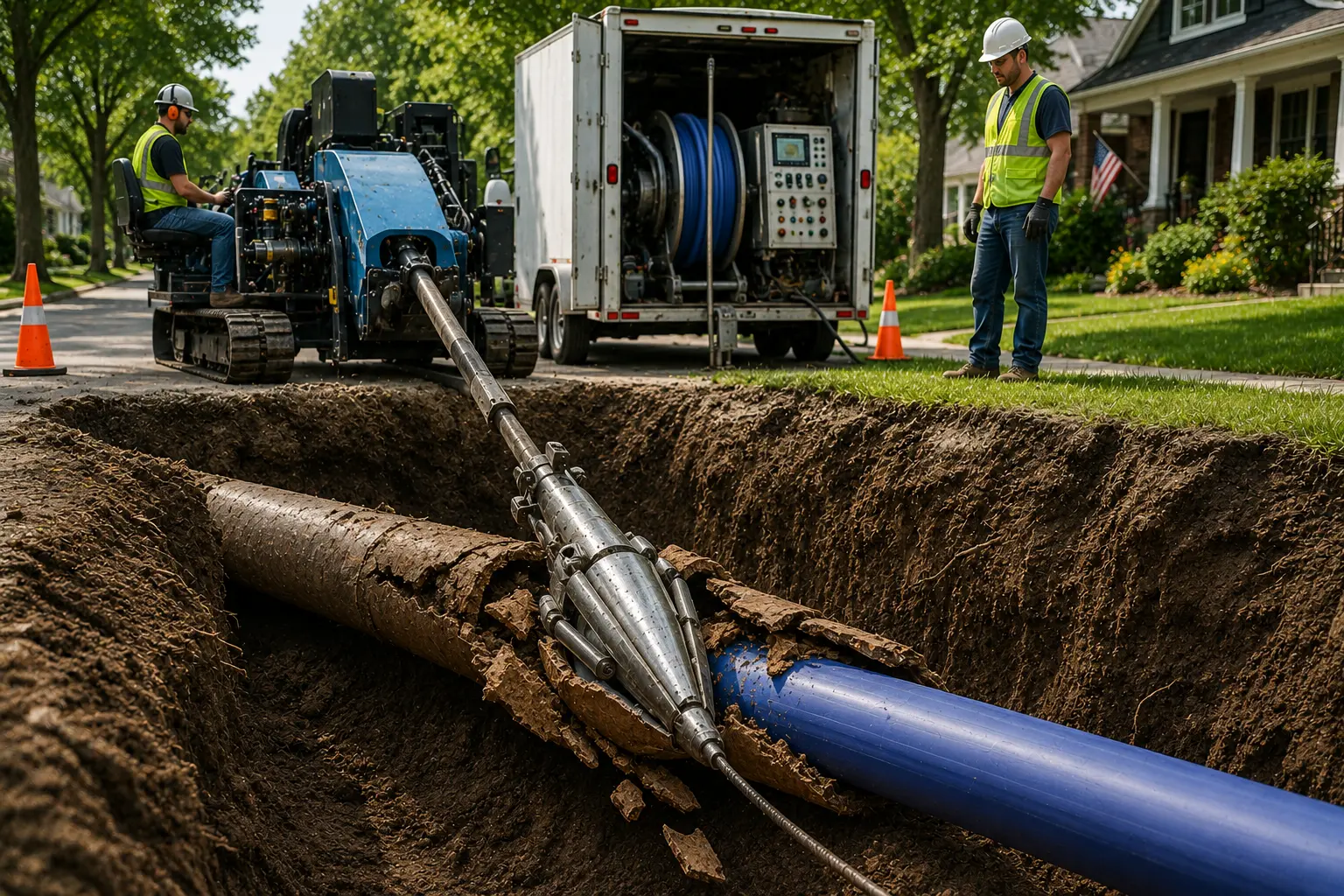
Pipe bursting is a trenchless sewer replacement method that installs a new sewer pipe while breaking apart the old pipe underground. Instead of digging a long trench across the property, contractors use access points to pull new pipe into place along the same general path as the existing sewer line.
For Chicago homeowners, pipe bursting can be appealing when a sewer line needs more than a repair but the property owner wants to avoid full traditional excavation if possible. It may reduce disruption to yards, driveways, sidewalks, landscaping, patios, and other finished surfaces.
Pipe bursting is not the same as pipe lining. Lining repairs the inside of an existing pipe, while bursting replaces the pipe itself. The right choice depends on the condition of the sewer line, the pipe material, the layout, and whether the old line can safely be used as the path for the new one. For a broader overview of repair and replacement options, visit the Sewer Repair Methods hub.
Key Takeaways
- Pipe bursting is a trenchless replacement method, not just a sewer repair.
- The old pipe is fractured or displaced while a new pipe is pulled into place.
- It can reduce excavation compared with traditional sewer line replacement.
- Pipe bursting is often considered when the existing sewer line is too damaged for lining.
- A camera inspection and site evaluation are usually needed before determining whether pipe bursting is feasible.
- It may not work for every pipe layout, soil condition, pipe material, or degree of damage.
When Does Pipe Bursting Make Sense?
Pipe bursting may make sense when a sewer line needs full replacement but the property conditions make open trench excavation especially disruptive. It is commonly considered when the existing pipe is cracked, deteriorated, root-damaged, or no longer reliable, but the pipe path can still support the bursting process.
It may not be the right choice when the sewer line has severe alignment problems, major bellies, complicated connections, nearby utilities, or access limitations that prevent equipment from being used safely and effectively.
What Is Pipe Bursting?
Pipe bursting is a trenchless sewer replacement technique that uses the existing sewer line as a guide path for the new pipe. A bursting head is pulled through the old line. As it moves forward, it breaks apart or displaces the existing pipe while pulling new piping into place behind it.
The result is a new sewer line installed underground with much less surface excavation than a traditional trench. While access pits are still needed, the entire route generally does not need to be dug open.
This method is often discussed as part of trenchless sewer work. Homeowners who want a broader comparison of limited-excavation methods can review Trenchless Sewer Repair in Chicago Explained.
How the Pipe Bursting Process Works
Although the details vary by property and contractor, most pipe bursting projects follow a general sequence.
1. Sewer Camera Inspection
The process usually begins with a sewer camera inspection. The inspection helps identify pipe defects, locate damaged sections, evaluate the path of the line, and determine whether the existing pipe can be used for bursting.
The inspection may reveal cracks, root intrusion, pipe separation, corrosion, clay pipe failure, or other problems that help explain why replacement is being considered.
2. Site Evaluation
Before pipe bursting is selected, the property must be evaluated for access. Contractors need enough room for equipment, access pits, pulling equipment, and new pipe staging.
In Chicago, this step can be especially important because many properties have tight side yards, detached garages, paved surfaces, alleys, mature trees, fences, and neighboring structures close to the sewer line.
3. Access Pit Excavation
Pipe bursting is trenchless, but it is not excavation-free. Access pits are usually dug at strategic points, often near the beginning and end of the replacement section.
These access points allow the new pipe to be inserted and the bursting equipment to be connected.
4. Pulling the New Pipe Into Place
A cable or rod system is used to pull the bursting head through the old sewer line. As the bursting head moves forward, it fractures or pushes aside the old pipe while pulling the new pipe behind it.
The new pipe is installed along the same general path as the old pipe.
5. Connections and Final Inspection
After the new pipe is installed, connections are made at the home and downstream sewer connection. A final inspection may be performed to confirm proper installation, flow, and alignment.
Pipe Bursting vs Pipe Lining
Pipe bursting and pipe lining are both trenchless methods, but they are used for different situations.
| Factor | Pipe Bursting | Pipe Lining |
|---|---|---|
| Primary Purpose | Replaces the existing sewer pipe | Repairs the inside of the existing pipe |
| Old Pipe | Broken apart or displaced | Left in place as the host pipe |
| Best For | More extensive deterioration or replacement needs | Cracks, leaks, roots, and stable damaged pipe |
| Excavation | Limited access pits | Limited access points |
| Pipe Structure Needed | Old pipe must provide a usable path | Old pipe must generally hold its shape |
| Final Result | New sewer pipe | New interior pipe surface |
When the existing pipe is stable but damaged, lining may be enough. For more detail on that method, see Pipe Lining for Sewer Repair: How It Works.
Pipe Bursting vs Traditional Excavation
The main appeal of pipe bursting is that it may replace a failing sewer line without digging a full trench. However, traditional excavation is still necessary in some situations.
| Factor | Pipe Bursting | Traditional Excavation |
|---|---|---|
| Surface Disruption | Usually reduced | Often significant |
| Access Needs | Requires entry and exit pits | Requires open access to the pipe |
| Best For | Replacement along an existing usable pipe path | Collapsed, sagging, severely misaligned, or complex repairs |
| Restoration | Often less extensive | May involve yard, concrete, driveway, or sidewalk restoration |
| Direct Pipe Access | Limited | Full direct access |
| Limitations | Not suitable for every layout or pipe condition | More disruptive but highly adaptable |
For situations where trenchless replacement is not feasible, homeowners can compare expectations in Traditional Sewer Line Excavation: What Homeowners Should Expect.
When Pipe Bursting May Be a Good Fit
Pipe bursting may be appropriate when the sewer line needs replacement and the existing route can support the process.
Pipe bursting may be considered when:
- The existing pipe is badly cracked or deteriorated
- Tree roots have damaged multiple sections
- The sewer line has repeated failures
- The pipe is too damaged for lining but not too distorted for bursting
- The homeowner wants to reduce excavation across finished surfaces
- The sewer line runs beneath landscaping, driveways, or sidewalks
- A full replacement is needed along the existing path
Homeowners deciding whether replacement is necessary may find Sewer Line Repair vs Replacement: Which Option Makes Sense? helpful.
When Pipe Bursting May Not Work
Pipe bursting is powerful, but it is not suitable for every sewer line.
It may not be appropriate when:
- The existing pipe path is severely misaligned
- The sewer line has a major belly or sag
- The pipe is fully collapsed in a way that blocks equipment
- There are complicated bends or transitions
- Nearby utilities create safety concerns
- The line has unusual connections that cannot be managed from access points
- There is not enough space for equipment or pipe staging
When the pipe has slope or alignment problems, traditional excavation may be needed because the pipe path itself must be corrected, not simply replaced along the same route.
Cost Factors for Pipe Bursting
Pipe bursting costs depend on the complexity of the replacement, the length of pipe, and the property conditions. It is not always less expensive than excavation, but it may reduce restoration costs when it avoids tearing through finished surfaces.
Key cost factors include:
- Length of sewer line being replaced
- Depth of the pipe
- Pipe diameter
- Number and size of access pits required
- Soil conditions
- Pipe material being replaced
- Distance from the home to the sewer connection
- Driveway, sidewalk, patio, or landscaping obstacles
- Permit and inspection requirements
- Temporary plumbing disruption
- Restoration after access pits are backfilled
Homeowners should ask whether estimates include access pit restoration, cleanup, permits, inspections, and any concrete or landscape work affected by the project.
Chicago-Specific Considerations
Older Clay and Cast Iron Sewer Lines
Many Chicago homes still rely on older clay or cast iron sewer pipes. Clay lines can crack, separate at joints, and allow root intrusion. Cast iron lines can corrode, scale, and weaken over time.
Pipe bursting may be considered when these older materials are too deteriorated for lining and replacement is the more practical long-term option. For material-specific context, see Clay Sewer Pipe Replacement: What to Expect and Cast Iron Sewer Pipe Repair Options.
Driveways, Sidewalks, and Hardscaping
In Chicago, sewer lines may run under concrete driveways, sidewalks, patios, garages, or parkways. Pipe bursting can be appealing when it reduces the amount of concrete that must be removed.
When sewer work involves paved surfaces, homeowners may also want to review Sewer Repair Under a Driveway: Methods and Challenges and Sewer Repair Under a Sidewalk: What Homeowners Need to Know.
Tight Urban Lots
Pipe bursting still requires room for access pits and equipment. Narrow side yards, fences, garages, alleys, and neighboring structures can affect whether the method is feasible.
Permits and Inspections
Sewer replacement work may require permits, inspections, and compliance with local requirements. Homeowners should ask who is responsible for securing permits and coordinating inspections before work begins.
How Pipe Bursting Affects the Home During Work
During pipe bursting, plumbing service may be interrupted while the sewer line is disconnected or being replaced. Homeowners should ask how long toilets, sinks, showers, and laundry should be avoided.
Other temporary impacts may include:
- Noise from equipment
- Access pits in the yard or paved areas
- Temporary equipment staging
- Limited access to part of the property
- Inspection scheduling
- Backfill and restoration work after pipe installation
Although pipe bursting usually reduces surface disruption compared with a full trench, homeowners should still expect an active construction project.
Pipe Bursting and Cleanout Access
Access is an important part of any trenchless sewer project. A properly located cleanout can help with inspection, maintenance, and certain repair steps.
If the property does not have a usable sewer cleanout, one may need to be installed as part of the project. For more context, see Sewer Cleanout Installation: Purpose, Cost, and Benefits.
Common Mistakes Homeowners Make
- Assuming pipe bursting is completely dig-free
- Confusing pipe bursting with pipe lining
- Approving replacement without seeing inspection findings
- Ignoring alignment, slope, or belly problems that may require excavation
- Comparing estimates without asking what restoration is included
- Assuming trenchless replacement is always cheaper
- Not asking how long plumbing service will be unavailable
- Failing to clarify permit and inspection responsibilities
The most important step is matching the method to the pipe condition. Pipe bursting can be an effective replacement option, but it should be chosen because the line is a suitable candidate, not simply because it sounds less disruptive.
Questions to Ask Before Choosing Pipe Bursting
Before approving pipe bursting, homeowners should ask clear questions about the condition of the pipe and the scope of the project.
- What did the sewer camera inspection show?
- Why is pipe bursting being recommended instead of pipe lining?
- Is the existing pipe path suitable for bursting?
- Are there any severe bellies, offsets, or collapsed sections?
- Where will access pits be located?
- What property surfaces will be disturbed?
- How long will plumbing service be interrupted?
- What pipe material will be installed?
- Are permits and inspections included?
- What restoration is included in the estimate?
Frequently Asked Questions
Is pipe bursting a repair or replacement?
Pipe bursting is generally considered a sewer replacement method. It breaks apart or displaces the old pipe while pulling a new pipe into place.
Does pipe bursting require digging?
Yes, but usually much less than traditional excavation. Access pits are typically needed at key points, but the entire sewer line route may not need to be opened.
Can pipe bursting replace clay sewer pipe?
Often, yes. Clay sewer lines are commonly considered for pipe bursting when they are deteriorated, root-damaged, or failing, as long as the pipe path and site conditions are suitable.
Can pipe bursting fix a sewer line belly?
Not always. If the sewer line has a major belly or slope problem, simply pulling a new pipe through the old path may not correct the underlying grade issue. Excavation may be required to reset the pipe at the proper slope.
Is pipe bursting cheaper than traditional excavation?
It depends. Pipe bursting may reduce surface restoration costs, but it uses specialized equipment and still requires access pits. The total cost depends on pipe length, depth, access, restoration, and local project requirements.
Will homeowners insurance cover pipe bursting?
Coverage depends on the policy and cause of the sewer failure. Many policies exclude deterioration, age-related failure, and root intrusion unless the homeowner has added specific service line or sewer-related coverage.
How do I know whether pipe bursting is right for my Chicago home?
A sewer camera inspection and site evaluation are usually needed. The pipe must have a usable path, the access points must be workable, and the damage must be appropriate for trenchless replacement rather than lining or excavation.
Conclusion
Pipe bursting can be a practical sewer replacement option for Chicago homeowners who need a new sewer line but want to reduce the disruption of traditional trench excavation. It is especially useful when the existing line is deteriorated, root-damaged, or failing, yet still provides a usable path for trenchless replacement.
However, pipe bursting is not the right answer for every sewer problem. Severe pipe bellies, collapsed sections, complicated layouts, nearby utilities, or access limitations may require traditional excavation or another method. The best decision starts with a clear inspection, a realistic explanation of the pipe condition, and a comparison of repair and replacement options.