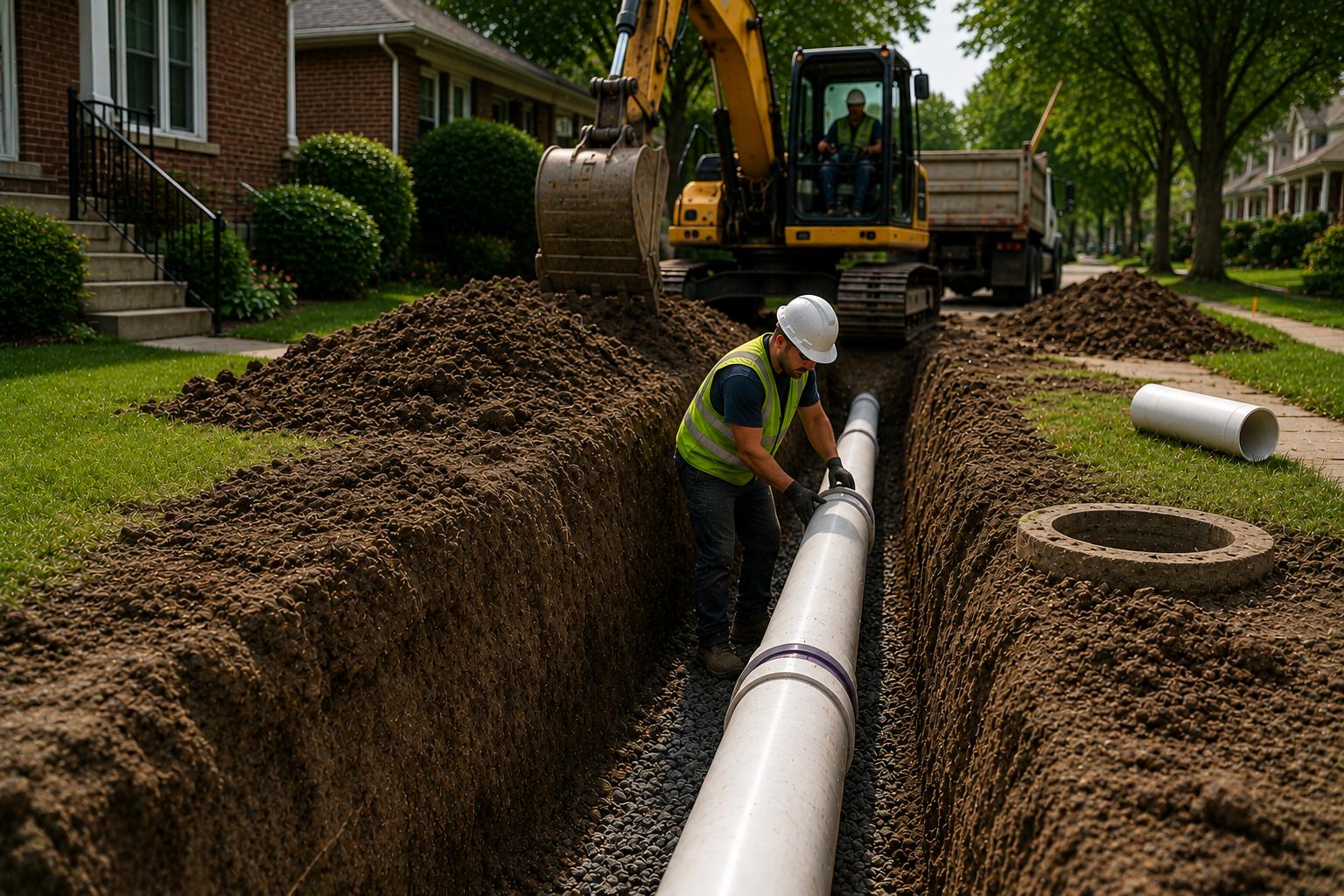
Full sewer line replacement is the process of replacing most or all of a failing sewer line instead of repairing one isolated section. It is usually considered when the existing pipe has widespread damage, repeated failures, severe root intrusion, major corrosion, collapse, or age-related deterioration that makes smaller repairs less reliable.
For Chicago homeowners, full replacement can feel like a major and stressful project. Sewer lines may run under yards, driveways, sidewalks, patios, garages, parkways, or basement slabs. The work may involve excavation, trenchless methods, permits, inspections, temporary plumbing disruption, and restoration afterward.
Full replacement is not always necessary, but when a sewer line is failing throughout, it can provide a more practical long-term solution than repeated cleaning or spot repairs. For a broader overview of available repair and replacement methods, visit the Sewer Repair Methods hub.
Key Takeaways
- Full sewer line replacement is usually considered when the entire line or most of the line is no longer reliable.
- Replacement may be needed for collapsed pipe, severe root intrusion, widespread cracks, major corrosion, or repeated sewer backups.
- Chicago homes with older clay or cast iron sewer lines may be more likely to face replacement decisions.
- Replacement can be done through traditional excavation or certain trenchless methods, depending on pipe condition and site access.
- A sewer camera inspection is usually essential before deciding between repair and replacement.
- The total cost depends on pipe depth, length, access, method, permits, inspections, and surface restoration.
When Does Full Sewer Line Replacement Make Sense?
Full sewer line replacement makes sense when the pipe has widespread structural problems rather than one isolated defect. If a camera inspection shows multiple breaks, repeated root entry points, major corrosion, collapsing sections, severe offsets, or a line that has failed repeatedly after cleaning or repairs, replacement may be the most practical long-term option.
Repair may still be enough when damage is limited to one short section and the rest of the pipe remains sound. The decision should be based on the condition of the entire sewer line, not just the most visible problem.
What Is Full Sewer Line Replacement?
Full sewer line replacement means replacing the main sewer pipe that carries wastewater away from the home. Depending on the property, this may include the line from the house to the city connection, or a substantial portion of that route.
Replacement may be completed by digging a trench to expose the pipe or by using trenchless methods that reduce excavation. The goal is to remove, bypass, or replace a failing sewer line with a new pipe system that restores reliable flow.
Full replacement is different from a spot repair. A spot repair targets one damaged section, while full replacement addresses the broader condition of the line.
Signs Full Replacement May Be Needed
Most homeowners begin considering replacement after repeated sewer problems or after a camera inspection shows serious pipe deterioration.
Full sewer line replacement may be considered when:
- Sewer backups keep returning after cleaning or rodding
- The pipe has multiple cracks, breaks, or separations
- Tree roots are entering through several locations
- The line has collapsed or is partially collapsed
- There are major offsets between pipe sections
- The pipe has severe corrosion or scaling
- The sewer line has a significant belly or sag
- Previous repairs have not solved the problem
- The pipe material is deteriorating throughout the line
Homeowners who are unsure whether repair or replacement is more appropriate can review Sewer Line Repair vs Replacement: Which Option Makes Sense?.
When Full Replacement May Be More Than Necessary
Not every sewer problem requires full replacement. If damage is isolated, replacing the whole line may be more work than the situation requires.
Full replacement may not be necessary when:
- Only one short section is cracked or broken
- The rest of the pipe is structurally sound
- The issue is caused by a removable blockage
- Tree roots are limited to one joint or small area
- A localized repair would restore proper function
- Pipe lining can rehabilitate the existing pipe
For isolated damage, Spot Repair for Sewer Lines: When Is It Enough? may be a better comparison point.
How Homeowners Usually Get to a Replacement Decision
Full replacement is rarely the first decision made from symptoms alone. It usually follows a series of observations, inspections, and failed short-term fixes.
Recurring Backups
One sewer backup may be caused by a clog. Repeated backups, especially after rodding or hydro jetting, suggest that the sewer line may have a structural problem.
Camera Inspection Findings
A sewer camera inspection can show whether the problem is isolated or widespread. The footage may reveal broken clay sections, cast iron corrosion, pipe bellies, root intrusion, or collapsed pipe.
Repair History
If the line has already been cleaned, patched, or repaired multiple times, full replacement may become more practical than continuing to address failures one at a time.
Pipe Age and Material
Older sewer materials can influence the decision. A newer pipe with one damaged area may be a repair candidate. An older line with several defects may be closer to replacement.
Full Replacement Methods
There is more than one way to replace a sewer line. The right method depends on the condition of the pipe, the route of the line, property access, and whether trenchless technology is feasible.
Traditional Excavation
Traditional excavation involves digging to expose the sewer pipe directly. This method may be necessary when the pipe is collapsed, badly sagging, severely misaligned, or inaccessible by trenchless equipment.
Homeowners can learn what to expect from digging, access, and restoration in Traditional Sewer Line Excavation: What Homeowners Should Expect.
Pipe Bursting
Pipe bursting is a trenchless replacement method that breaks apart the old pipe while pulling a new pipe into place. It may reduce surface disruption compared with digging a full trench.
For more detail, see Pipe Bursting for Sewer Replacement Explained.
Combination Approach
Some projects may use a combination of methods. For example, limited excavation may be needed at access points, while the main replacement is completed using trenchless equipment.
Full Replacement vs Pipe Lining
Pipe lining and full replacement are often compared because both can address aging or damaged sewer lines. However, they are not the same.
Pipe lining creates a new interior surface inside the existing pipe. It can work well when the pipe is cracked or leaking but still structurally stable. Full replacement is more appropriate when the existing pipe cannot reliably support rehabilitation or when defects are too severe.
| Factor | Pipe Lining | Full Sewer Replacement |
|---|---|---|
| Primary Purpose | Rehabilitates the existing pipe interior | Replaces the failing pipe |
| Best For | Stable pipes with cracks, leaks, or root entry points | Collapsed, severely deteriorated, or repeatedly failing pipes |
| Existing Pipe | Remains in place | Replaced, bypassed, or broken apart depending on method |
| Excavation | Usually limited | Varies by method and property conditions |
| Limitations | Not ideal for collapse, major sagging, or severe offsets | Larger project scope and potentially more disruption |
For more about lining, see Pipe Lining for Sewer Repair: How It Works.
Cost Factors for Full Sewer Line Replacement
Full sewer line replacement can vary significantly in cost because each property has different access, depth, surface, and pipe conditions. Exact pricing should be based on inspection and a written scope of work.
Important cost factors include:
- Length of the sewer line being replaced
- Depth of the pipe
- Pipe material and diameter
- Replacement method used
- Soil conditions
- Access for equipment
- Whether the line runs under concrete, asphalt, landscaping, or structures
- Permit and inspection requirements
- Need for a cleanout
- Temporary plumbing accommodations
- Restoration after the work is complete
Homeowners should ask whether a quote includes only the pipe replacement or also includes backfill, concrete replacement, landscaping, permit fees, inspections, and cleanup.
Chicago-Specific Considerations
Older Housing and Sewer Materials
Many Chicago homes were built before modern plastic sewer materials became standard. Older clay and cast iron lines can fail due to age, roots, corrosion, soil movement, or joint separation.
Homeowners evaluating material-specific issues can review Clay Sewer Pipe Replacement: What to Expect and Cast Iron Sewer Pipe Repair Options.
Concrete and Hardscape Obstacles
Chicago sewer lines may run under sidewalks, driveways, patios, garage slabs, or parkways. These surfaces can affect replacement planning, method selection, and total project cost.
When the sewer line runs beneath paved areas, related guidance is available in Sewer Repair Under a Driveway: Methods and Challenges and Sewer Repair Under a Sidewalk: What Homeowners Need to Know.
Limited Lot Access
Narrow side yards, detached garages, alleys, fences, and neighboring structures can limit equipment access. This may influence whether trenchless replacement, traditional excavation, or a combination approach is possible.
Permits and Inspections
Full sewer replacement may require permits, inspections, and compliance with local requirements. Homeowners should clarify who handles permitting and whether inspection scheduling is included in the project scope.
Seasonal Weather
Chicago weather can affect excavation, restoration, and timing. Frozen ground, snow, rain, and freeze-thaw cycles may complicate outdoor work or delay final surface restoration.
How Long Does Full Sewer Replacement Take?
The timeline depends on the method, pipe depth, access, inspections, weather, and restoration requirements. A straightforward replacement may move more quickly than a complex project involving deep excavation, concrete removal, tight access, or public right-of-way coordination.
Typical project stages include:
- Camera inspection and diagnosis
- Method selection and written estimate
- Utility marking
- Permit coordination if required
- Excavation or trenchless access setup
- Pipe replacement
- Connection and testing
- Inspection
- Backfill
- Surface restoration
Homeowners should ask how long plumbing service will be unavailable and whether final restoration is included in the estimated timeline.
Insurance and Sewer Line Replacement
Homeowners insurance coverage for sewer line replacement depends on the policy and the cause of the damage. Many standard policies exclude deterioration, wear and tear, age-related failure, root intrusion, and underground service line problems unless special coverage has been added.
Before assuming a claim will be covered, homeowners should review:
- Whether the policy includes service line coverage
- Whether sewer backups are covered separately from pipe replacement
- Whether root intrusion is excluded
- Whether wear and tear or age-related failure is excluded
- Documentation requirements for claims
- Whether excavation and restoration are covered
It is important to distinguish between cleanup after a sewer backup and replacement of the sewer pipe itself. Those may be treated differently by an insurance policy.
Common Mistakes Homeowners Make
- Approving full replacement without seeing inspection findings
- Choosing repeated cleaning when the pipe is structurally failing
- Comparing estimates without checking what restoration is included
- Assuming trenchless replacement works for every sewer line
- Ignoring permits, inspections, or utility marking
- Replacing a full line when a spot repair would have been enough
- Choosing the lowest bid without understanding the scope
- Assuming homeowners insurance will automatically cover replacement
The best decision comes from understanding the condition of the entire sewer line, the available methods, and the total project scope.
Questions to Ask Before Full Sewer Line Replacement
Before approving a major sewer replacement project, homeowners should ask specific questions that reduce confusion and help compare options.
- What did the camera inspection show?
- Is the damage isolated or widespread?
- Are spot repair or pipe lining realistic options?
- Is trenchless replacement possible?
- What pipe material will be installed?
- Where will excavation or access pits be located?
- What surfaces will be disturbed?
- Does the estimate include permits and inspections?
- Does the estimate include backfill and surface restoration?
- How long will plumbing service be interrupted?
- What conditions could increase the final cost?
Frequently Asked Questions
How do I know if I need full sewer line replacement?
A sewer camera inspection is usually the best starting point. Full replacement may be needed when the line has widespread cracks, collapse, repeated root intrusion, severe corrosion, multiple failures, or recurring backups after cleaning and repairs.
Is full replacement always better than spot repair?
No. Spot repair may be enough when one section is damaged and the rest of the pipe is sound. Full replacement is usually considered when the entire line or most of the line is unreliable.
Can full sewer replacement be done without digging up the whole yard?
Sometimes. Trenchless methods such as pipe bursting may reduce excavation when the pipe path and site conditions qualify. However, some situations still require traditional excavation.
Will homeowners insurance cover full sewer line replacement?
Coverage depends on the policy and the cause of failure. Many policies exclude deterioration, root intrusion, and wear and tear unless special service line coverage has been added.
Can an old clay sewer line be replaced with PVC?
In many replacement projects, older clay pipe may be replaced with modern approved materials such as PVC, depending on local code requirements and project conditions.
How long will I be without plumbing during replacement?
Plumbing service may be interrupted during portions of the project while the line is disconnected or replaced. Homeowners should ask for a realistic service interruption estimate before work begins.
Is pipe lining the same as full sewer replacement?
No. Pipe lining creates a new interior surface inside the existing pipe. Full replacement installs a new sewer line or replaces the failing pipe more directly.
Conclusion
Full sewer line replacement is a major project, but it may be the most practical solution when a sewer line is failing throughout rather than in one isolated location. Repeated backups, widespread root intrusion, collapsed pipe, severe corrosion, and multiple failed sections are all signs that replacement may deserve serious consideration.
For Chicago homeowners, the right decision depends on inspection results, pipe material, property layout, repair history, access, restoration needs, and long-term reliability. A clear diagnosis can help determine whether a smaller repair is enough or whether full replacement is the better investment.