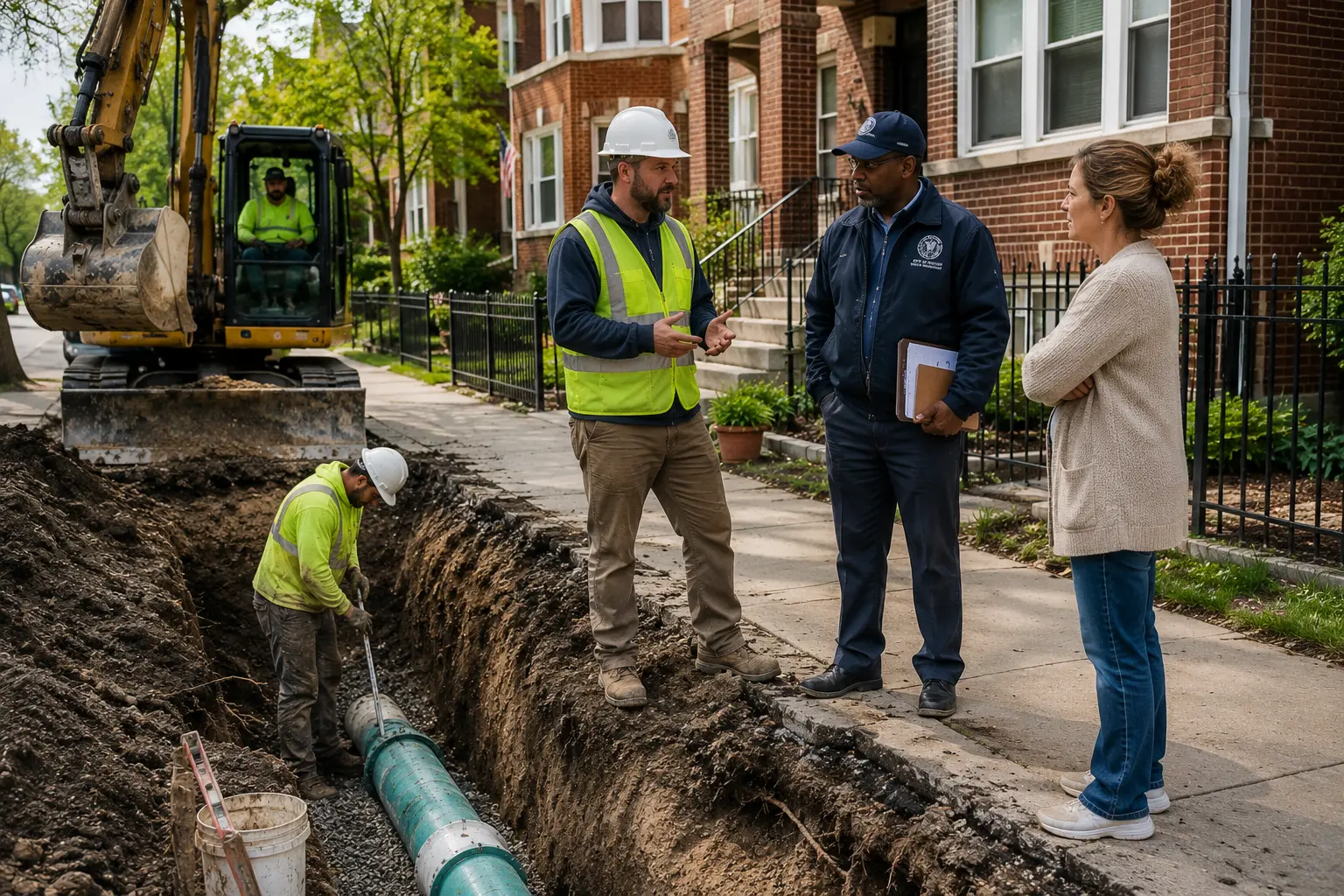
Chicago’s Private Drain Program can be confusing because it sits between private homeowner responsibility and city sewer infrastructure. Many homeowners first hear about it after a sewer backup, repeated rodding, a camera inspection, or a contractor saying the problem may be under the public way.
The most important thing to understand is that the program may help when a qualifying private residential sewer drain is broken under the public way, generally beyond the homeowner’s private property area. It does not automatically cover every sewer backup, clog, root problem, or sewer repair. Eligibility depends on the property, the defect, the location of the problem, and the city’s review process.
Key Takeaways
- Chicago’s Private Drain Program may apply when a qualifying private sewer drain is broken under the public way.
- The program is generally aimed at private residences with limited unit counts, not commercial or large multi-unit properties.
- Homeowners usually need to hire a licensed sewer contractor to rod, camera, locate, and document the problem.
- The city typically reviews the issue before deciding whether the repair qualifies.
- The program does not usually cover every blockage, backup, tree-root issue, or problem located on private property.
- Even if the city may handle a qualifying repair, the homeowner can still have upfront costs for inspection, rodding, video work, and contractor coordination.
- Understanding responsibility before paying for major work can prevent expensive mistakes.
What the Private Drain Program May Cover
Chicago’s Private Drain Program may help repair certain broken private sewer drains located under the public way. In practical terms, that usually means the damaged section is not simply inside the home, under the yard, or on private property. The issue must generally be documented and reviewed before the city determines whether it qualifies.
This program matters because many Chicago sewer laterals pass from private property toward the public sewer main through areas such as the sidewalk, parkway, street, or alley. When the failure is located in that public-way area, the repair can become more complicated than a normal private-property sewer repair.
For homeowners trying to understand how the program fits into broader local rules, Chicago Permits, Codes & Local Rules provides helpful context on permits, inspections, public-way issues, and contractor requirements.
What Is a Private Drain in Chicago?
A private drain is generally the sewer line that carries wastewater away from a private building toward the city sewer system. For a homeowner, this is often the line serving the house before it connects to the municipal sewer main.
The confusing part is that a private drain may pass through different areas before it reaches the city sewer main. Some of those areas are on private property, while others may be within the public way.
That distinction matters because responsibility may change depending on where the problem is located.
| Location of Problem | Why It Matters |
|---|---|
| Inside the house | Usually treated as a private plumbing issue. |
| Under private yard or property | Often the homeowner’s responsibility. |
| Near the sidewalk or parkway | May require closer review to determine public-way involvement. |
| Under a street or alley | May involve city infrastructure, permits, and additional approvals. |
| At the city sewer main | Responsibility depends on the exact defect and connection point. |
For a deeper explanation of responsibility, see Who Is Responsible for Sewer Lines in Chicago?.
Who May Qualify for the Private Drain Program?
Eligibility depends on the city review process, but the program is generally associated with private residential properties rather than commercial properties or large apartment buildings.
Common eligibility factors may include:
- The property is located within the City of Chicago.
- The building is a qualifying residential property.
- The sewer defect is located under the public way.
- The problem is a broken or defective drain, not just routine clogging.
- A licensed contractor documents the condition properly.
- A city sewer inspector reviews the issue.
Important homeowner note: Do not assume eligibility based only on a backup or a contractor’s first opinion. The city typically needs to confirm the location and nature of the defect before the repair is treated as a qualifying Private Drain Program issue.
What the Program Usually Does Not Cover
The Private Drain Program is not a general sewer maintenance program for every homeowner problem.
Issues that may not qualify include:
- Clogs that can be cleared by normal rodding
- Tree-root intrusion without a qualifying broken section
- Problems located entirely on private property
- Indoor plumbing issues
- Basement drain problems unrelated to the exterior sewer lateral
- Non-qualifying commercial or larger multi-unit properties
- Repairs completed before city review without proper documentation
This is why it is risky to authorize expensive excavation before confirming the location and responsibility for the defect. Homeowners should compare the situation carefully against the distinction explained in City Sewer Main vs Private Sewer Line: Who Pays?.
How the Private Drain Program Process Typically Works
The exact process can vary based on the property and the condition found, but the homeowner path often follows a general sequence.
- A sewer problem appears. This may include backups, slow drainage, repeated clogs, or evidence of a broken sewer line.
- The homeowner hires a qualified sewer contractor. The contractor may rod the line, perform a camera inspection, and identify where the problem appears to be located.
- The contractor documents the defect. Proper video, locating, and measurement may be needed to show whether the problem is under the public way.
- A city review is scheduled. A city sewer inspector may need to observe or review the findings.
- The city determines eligibility. If the defect qualifies, the city may handle the eligible repair.
- Repair work is completed. Depending on eligibility, repair responsibility may fall to the city or the homeowner.
- Restoration and documentation follow. The homeowner should keep records of all inspections, findings, invoices, and approvals.
Because contractor involvement is usually necessary early in the process, it is important to understand Licensed Plumber Requirements for Sewer Work in Chicago before hiring someone to investigate a possible program-related issue.
Costs Homeowners Should Expect
Even when a repair ultimately qualifies for city involvement, homeowners may still face upfront costs.
Those costs may include rodding, camera inspection, locating, documentation, permit-related coordination, contractor time, and meeting with an inspector. Exact costs vary by contractor, property access, line condition, and the complexity of the investigation.
| Possible Cost | Why It May Be Needed |
|---|---|
| Sewer rodding | Clears or attempts to clear the line and helps determine whether a blockage or defect exists. |
| Camera inspection | Documents pipe condition and helps locate breaks, separations, roots, or collapse points. |
| Line locating | Helps determine whether the defect is on private property or under the public way. |
| Contractor coordination | Covers time spent preparing for city review or meeting with an inspector. |
| Private-property repair | May be required if the problem is found outside the program’s covered area. |
The main tradeoff is that paying for proper documentation may help identify whether the city should be involved. But if the problem is found on private property or does not qualify, the homeowner may still be responsible for repair costs.
Chicago-Specific Considerations
Public Way Location Matters
In Chicago, the location of the defect is often the most important factor. A broken pipe under a private front yard may be treated differently from a broken section under a sidewalk, parkway, street, or alley.
Homeowners dealing with sidewalk-area issues should review Sewer Repair Near Sidewalks in Chicago. If the problem may extend toward an alley or street, Sewer Repair Near Streets and Alleys in Chicago may be more relevant.
Older Sewer Lines Can Make Diagnosis Harder
Many Chicago homes have older sewer materials, unusual connection points, or previous repairs that complicate diagnosis. A camera inspection may show roots or obstruction, but the key question is whether there is a qualifying structural defect in the right location.
Multi-Unit Properties Need Extra Caution
Two-flats and small residential buildings may raise different questions than single-family homes. Larger properties may not qualify in the same way. Owners should confirm eligibility before assuming the program applies.
City Review Can Affect Timing
The Private Drain Program is not always instant. If city review is required, scheduling, inspection availability, documentation quality, and the nature of the defect can all affect timing. During an active backup, homeowners may still need temporary mitigation while the process plays out.
Private Drain Program vs. Normal Sewer Repair
The difference between a normal sewer repair and a potential Private Drain Program issue usually comes down to location, eligibility, and responsibility.
| Issue | Normal Private Sewer Repair | Potential Private Drain Program Case |
|---|---|---|
| Location | Usually on private property | May be under the public way |
| Who investigates | Homeowner’s contractor | Homeowner’s contractor plus city review |
| Who pays for investigation | Usually homeowner | Usually homeowner upfront |
| Who pays for repair | Often homeowner | May involve city repair if eligible |
| Timing | Based on contractor availability | May depend on city inspection and approval |
Common Mistakes Homeowners Make
Assuming Every Sewer Backup Qualifies
A backup alone does not prove that the Private Drain Program applies. The issue may be a clog, interior plumbing problem, or private-property failure.
Excavating Before Responsibility Is Clear
Starting major work too early can make it harder to determine whether the city should have reviewed the problem first.
Hiring a Contractor Without Asking About the Program
Not every contractor handles Private Drain Program documentation the same way. Homeowners should ask about experience with city inspection coordination.
Ignoring Unit Count or Property Type
Eligibility may depend on property type. Multi-unit, mixed-use, and commercial properties should be reviewed carefully before assuming coverage.
Failing to Keep Records
Homeowners should keep camera footage, inspection notes, contractor invoices, city documentation, and any final repair information.
Warning Signs That the Program May Be Worth Asking About
The Private Drain Program may be worth discussing with a qualified contractor when certain patterns appear.
Potential signs include:
- Repeated sewer backups after rodding
- Camera evidence of a structural pipe defect
- A suspected break near or beyond the sidewalk
- Problems near the parkway, street, or alley
- Roots entering through a separated or broken pipe section
- Difficulty rodding past a consistent point near the public way
- Standing water or obstruction that suggests collapse or separation
These signs do not guarantee eligibility. They simply indicate that the location and nature of the defect should be investigated carefully before major repair decisions are made.
Frequently Asked Questions
Does Chicago’s Private Drain Program cover all sewer repairs?
No. The program generally applies only to certain qualifying private drain defects located under the public way. Many sewer issues remain the homeowner’s responsibility.
Do I have to pay for the inspection or camera work?
Homeowners commonly pay for the initial contractor work needed to inspect, rod, camera, and document the sewer line. If the defect qualifies, the repair responsibility may change, but the upfront investigation is often still a homeowner expense.
What if the problem is under my yard?
If the defect is located on private property, it may not qualify for the Private Drain Program. The homeowner may be responsible for repair costs, permits, restoration, and contractor coordination.
Does tree-root intrusion qualify?
Tree roots alone may not be enough. The issue usually needs to involve a qualifying defect, such as a broken or separated pipe section in the covered location. A contractor and city review may be needed to determine eligibility.
Can I use the program for a two-flat?
Some smaller residential properties may be considered differently than large multi-unit or commercial properties. Owners of two-flats and multi-unit buildings should confirm eligibility before assuming the program applies.
Will homeowner’s insurance cover costs related to the Private Drain Program?
Insurance depends on the policy, cause of damage, and type of claim. Some policies may cover resulting damage from a backup but not the sewer line repair itself. Homeowners should review sewer backup endorsements, service line coverage, and exclusions carefully.
Should I call 311 about a possible Private Drain Program issue?
311 may be useful for reporting sewer-related concerns or asking about city processes, but homeowners often still need a qualified contractor to investigate and document the private drain condition.
Conclusion
Chicago’s Private Drain Program can be valuable for homeowners when a qualifying private sewer drain is broken under the public way. However, it is not a blanket solution for every sewer backup or damaged pipe.
The most important steps are identifying the location of the problem, documenting the defect properly, confirming eligibility, and avoiding major repair decisions before responsibility is clear. Homeowners who understand the process are better prepared to ask the right questions, manage costs, and avoid paying for work that may require city review.