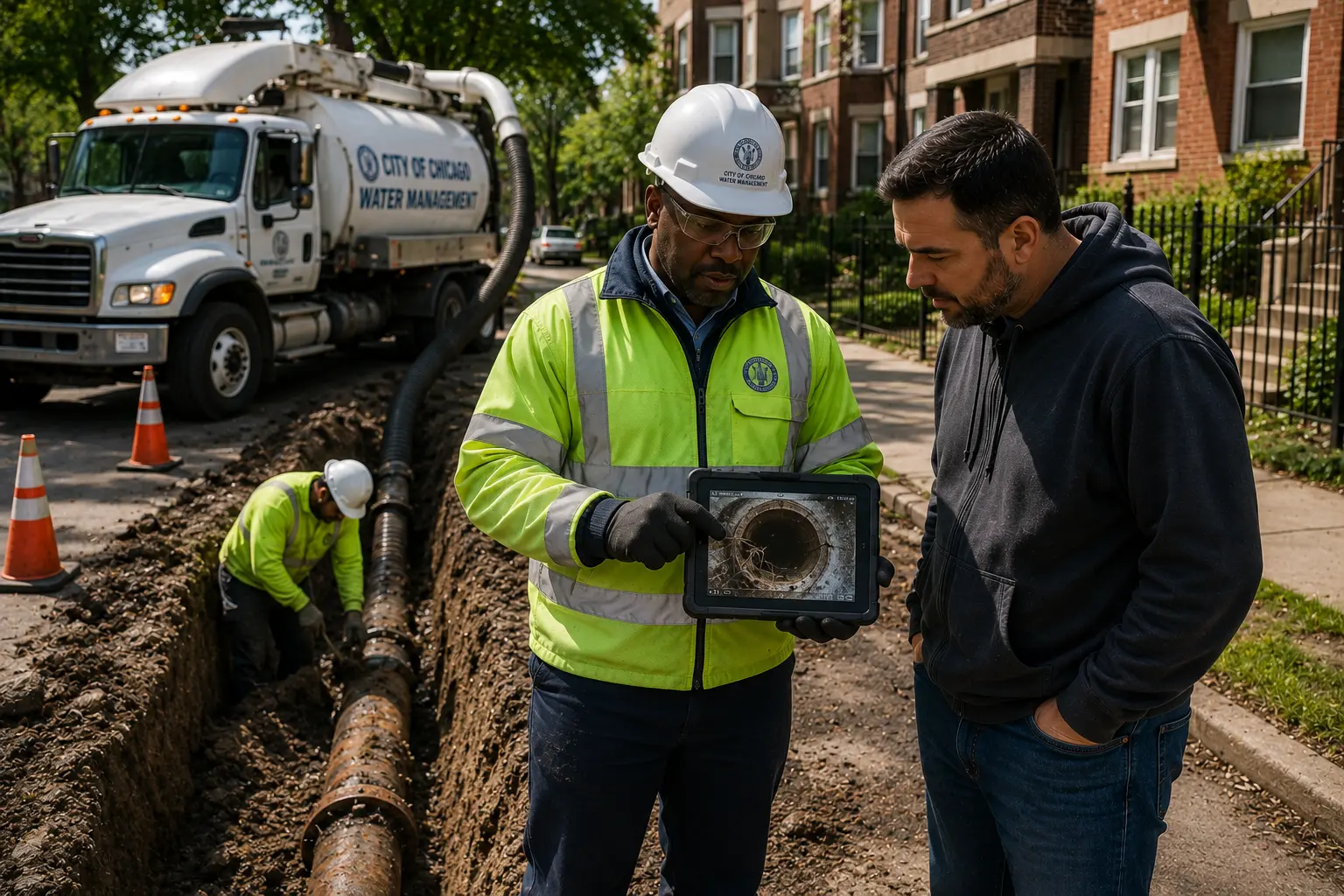
Chicago homeowners often do not know when a sewer issue is a private plumbing problem, a city sewer concern, or something that should be reported through the Chicago Water Department or 311. That confusion is understandable because sewer symptoms inside the home can sometimes be caused by private lateral problems, public sewer main issues, heavy rain, blocked catch basins, or defects near the city connection.
The key point is this: the Chicago Water Department generally becomes relevant when the issue may involve public sewer infrastructure, the city sewer main, public right-of-way drainage, or a problem that needs city review. Many sewer backups and private line failures remain the homeowner’s responsibility, but knowing when to contact the city can prevent wasted time, unnecessary repair costs, and missed documentation.
Key Takeaways
- Not every sewer backup is a Chicago Water Department issue.
- Public sewer mains, catch basins, street drainage, and certain public-way sewer problems may require city involvement.
- Private sewer laterals serving individual homes are often the homeowner’s responsibility.
- Repeated backups should be documented with dates, photos, invoices, and camera inspection findings.
- 311 complaints can create a record but do not automatically mean the city will perform repairs.
- Licensed sewer contractors are often needed to identify whether the problem is private or public.
- Problems near sidewalks, alleys, streets, or public sewer connections may involve permits, inspections, and city coordination.
When a Sewer Problem May Involve the Chicago Water Department
The Chicago Water Department may need to be involved when a sewer issue appears connected to public infrastructure, the city sewer main, street drainage, catch basins, or a defect under the public way. However, backups caused by a clogged or damaged private sewer line are usually handled by the homeowner and a qualified sewer contractor.
This distinction matters because homeowners can lose valuable time if they assume the city is responsible for a private lateral problem. On the other hand, paying for private work before determining whether a city sewer main or public-way issue is involved can also be costly.
For a broader overview of local rules, homeowner responsibilities, and sewer-related city processes, see Chicago Permits, Codes & Local Rules.
Common Chicago Water Department Sewer Issues Homeowners Encounter
Several sewer and drainage problems may bring the Chicago Water Department, 311, or other city departments into the conversation.
| Issue | Why It Matters |
|---|---|
| Public sewer main blockage | May affect multiple properties or cause widespread drainage problems. |
| Street flooding near drains | May involve catch basins, public drainage, or stormwater capacity. |
| Repeated backups during rain | Could involve private backflow risk, overloaded sewers, or area drainage limitations. |
| Defect near the city connection | Responsibility may depend on the exact location and cause of the issue. |
| Broken private drain under public way | May need review under Chicago’s Private Drain Program. |
| Sewer odors from public areas | Could indicate a drainage, catch basin, or sewer maintenance issue. |
Each situation requires careful diagnosis. A symptom inside the home does not automatically prove whether the cause is private or public.
Private Sewer Line vs. City Sewer Main Problems
The most important question in many Chicago sewer disputes is where the problem is located.
A private sewer line, often called a private lateral, usually carries wastewater from the home toward the city sewer main. The city sewer main serves the broader public system and carries wastewater from multiple properties.
Homeowners are commonly responsible for private sewer line problems, while the city is generally responsible for public sewer main issues. But the boundary can become complicated near the connection point, under public sidewalks, or beneath streets and alleys.
For a more detailed explanation, review City Sewer Main vs Private Sewer Line: Who Pays? and Who Is Responsible for Sewer Lines in Chicago?.
Basement Sewer Backups and City Involvement
Basement sewer backups are one of the most common reasons homeowners contact the city. The challenge is that the cause can vary widely.
A backup may be caused by:
- A clog in the private sewer lateral
- Tree roots in an older sewer pipe
- A collapsed or broken private line
- Improper slope or pipe belly
- A blocked or overwhelmed public sewer main
- Heavy rain entering a combined sewer system
- A missing, failed, or inadequate backflow prevention setup
If several nearby homes experience backups at the same time, a public sewer issue may be more likely. If only one property is affected repeatedly, the private line should be investigated carefully.
Homeowners planning to report a backup should read Chicago 311 Sewer Backup Complaints: What to Expect so they understand what a complaint may and may not accomplish.
Street Flooding, Catch Basins, and Public Drainage
Chicago homeowners may also encounter sewer-related issues outside the home, especially during heavy rain. Street flooding, standing water near curbs, slow-draining catch basins, or water collecting in alleys can point toward public drainage concerns.
These problems may involve:
- Debris blocking catch basin grates
- Sediment inside catch basins
- Public sewer capacity during storms
- Local grading and drainage patterns
- Blocked alley or street drainage routes
- Combined sewer system limitations during heavy rainfall
Public drainage issues do not always mean there is a defect in the city sewer main. Sometimes maintenance, storm intensity, or local surface drainage conditions are part of the problem.
Broken Private Drains Under the Public Way
Some Chicago sewer issues fall into a gray area because the pipe is private, but the damaged section may be located under the public way.
This is where Chicago’s Private Drain Program may become relevant. The program may apply when a qualifying private drain has a documented defect under the public way, but it does not cover every sewer backup or blockage.
Homeowners who suspect this type of issue should review Understanding Chicago’s Private Drain Program before authorizing major excavation or assuming who will pay.
Practical homeowner note: If a sewer camera inspection suggests a break near the sidewalk, parkway, street, or alley, ask the contractor whether the location could require city review before excavation begins.
When to Call 311
Calling 311 can be useful when a sewer problem may involve city infrastructure, public drainage, or a condition the city should inspect or document.
Examples may include:
- Sewage backing up into multiple homes
- Street flooding that does not drain normally
- Blocked catch basins
- Sewer odors from public areas
- Suspected public sewer main problems
- Repeated backups during storms
- Public-way sewer defects requiring city review
However, a 311 report does not replace a private sewer inspection when the issue may be inside the homeowner’s own line. In many cases, homeowners need both: a city complaint record and private documentation from a qualified contractor.
What Homeowners Should Document
Good documentation can help homeowners communicate clearly with contractors, insurers, city representatives, and future buyers.
Keep records of:
- Dates and times of sewer backups
- Photos or videos of affected areas
- Weather conditions during the incident
- Whether nearby homes were affected
- 311 service request numbers
- Contractor invoices
- Sewer camera footage
- Line locating notes
- Inspection reports
- Insurance claim communications
Documentation is especially important when a problem is recurring or when responsibility is unclear.
Permits, Inspections, and City Coordination
If a sewer issue requires repair, the next step may involve permits and inspections. This is especially true when work includes excavation, replacement, new connections, public-way impacts, or significant changes to the sewer system.
Homeowners should not assume that city involvement eliminates permit requirements. Depending on the location and scope, repairs may still need formal approval and inspection.
For related guidance, see Chicago Sewer Repair Permits: What Homeowners Need to Know and Sewer Repair Inspection Requirements in Chicago.
Chicago-Specific Considerations
Combined Sewer Conditions
Many older urban areas, including parts of Chicago, use sewer systems that can be affected by both wastewater and stormwater demands. During heavy rain, drainage complaints may increase, and symptoms can appear even when a private line is not fully collapsed.
Older Housing and Aging Laterals
Many Chicago homes have older sewer laterals made from materials that can crack, settle, separate, or allow root intrusion. These private issues can mimic city sewer problems unless they are inspected properly.
Public Right-of-Way Complexity
Sewer work near sidewalks, streets, or alleys may require additional coordination because the repair can affect public property. Homeowners dealing with these locations should review Sewer Repair Near Streets and Alleys in Chicago.
Multi-Unit Properties
Two-flats and multi-unit homes may have shared drainage concerns, multiple occupants affected by backups, and added complexity when determining responsibility.
Cost Factors When the Water Department May Be Involved
Even when a city-related issue is suspected, homeowners may still face costs during investigation and repair planning.
| Cost Factor | Homeowner Impact |
|---|---|
| Sewer rodding | May be needed to clear the line or determine whether the blockage is private. |
| Camera inspection | Helps identify cracks, roots, collapse, or defects near the city connection. |
| Line locating | Helps determine whether a defect is on private property or under the public way. |
| Emergency cleanup | May be needed after sewage enters the basement or living space. |
| Private line repair | May remain the homeowner’s responsibility if the defect is not city-related. |
| Permit and restoration costs | May apply if excavation or replacement is required. |
Insurance may help with some cleanup or damage costs depending on the policy, endorsements, exclusions, and cause of loss. It may not cover the actual sewer line repair unless the homeowner has applicable service line coverage.
Common Mistakes Homeowners Make
Assuming the City Is Responsible for Any Backup
Many backups are caused by private lateral problems. Waiting too long for city action can allow damage to worsen.
Paying for Major Excavation Before Locating the Problem
Before approving expensive work, homeowners should understand where the defect is located and who is likely responsible.
Failing to Report Public Drainage Problems
If street drains, catch basins, or public sewer issues appear involved, creating a 311 record can be helpful.
Not Asking for Camera Footage
Camera findings are often essential when a contractor says the problem is near the city connection or public way.
Ignoring Repeat Patterns
If backups happen during heavy rain, affect multiple homes, or occur at the same location repeatedly, the pattern may be important.
Warning Signs That City Review May Be Needed
Some symptoms should prompt homeowners to consider whether the issue may involve public infrastructure or city review.
Warning signs include:
- Multiple nearby homes backing up at the same time
- Street flooding that remains after rain stops
- Sewage odors from catch basins or public areas
- Repeated backups during storms
- Contractor camera findings near the public way
- A suspected defect under the sidewalk, street, or alley
- Difficulty determining whether the problem is private or public
These signs do not guarantee city responsibility, but they do justify careful documentation and follow-up.
Frequently Asked Questions
Is the Chicago Water Department responsible for my sewer backup?
Not always. If the backup is caused by a private sewer line clog or defect, the homeowner may be responsible. If the issue involves the public sewer main or city infrastructure, city review may be needed.
Should I call 311 before calling a sewer contractor?
If there is street flooding, multiple homes affected, or a suspected public sewer issue, calling 311 can be useful. If the problem appears isolated to your home, a sewer contractor may also be needed to inspect the private line.
What if my contractor says the problem is under the street?
Ask for camera footage, locating information, and documentation. A defect under the public way may require city review, permits, or involvement under specific city processes.
Will the city repair my private sewer line?
Usually not if the defect is on private property. Certain qualifying private drain defects under the public way may be reviewed differently, but eligibility is not automatic.
Does insurance cover sewer backups?
Coverage depends on the policy. Many homeowners need specific sewer backup or water backup coverage for resulting damage, and separate service line coverage may be needed for pipe repair. Policy exclusions and limits matter.
Can a public sewer main problem affect only one house?
It is possible, but isolated backups are often caused by private lateral problems. Diagnosis requires comparing symptoms, camera findings, and whether nearby properties are affected.
Do I need a permit if the city is involved?
Possibly. Permit and inspection requirements depend on the repair scope, location, and whether excavation or sewer replacement is involved.
Conclusion
Common Chicago Water Department sewer issues often come down to one practical question: is the problem private, public, or somewhere in between? Homeowners do not need to know every city procedure, but they should understand the basic difference between private sewer laterals, city sewer mains, public drainage, and public-way defects.
The safest approach is to document the problem, report city-related concerns when appropriate, use qualified contractors for private line diagnosis, and avoid major repair decisions until responsibility is reasonably clear. That process can help homeowners reduce confusion, manage costs, and respond more effectively when sewer problems occur.