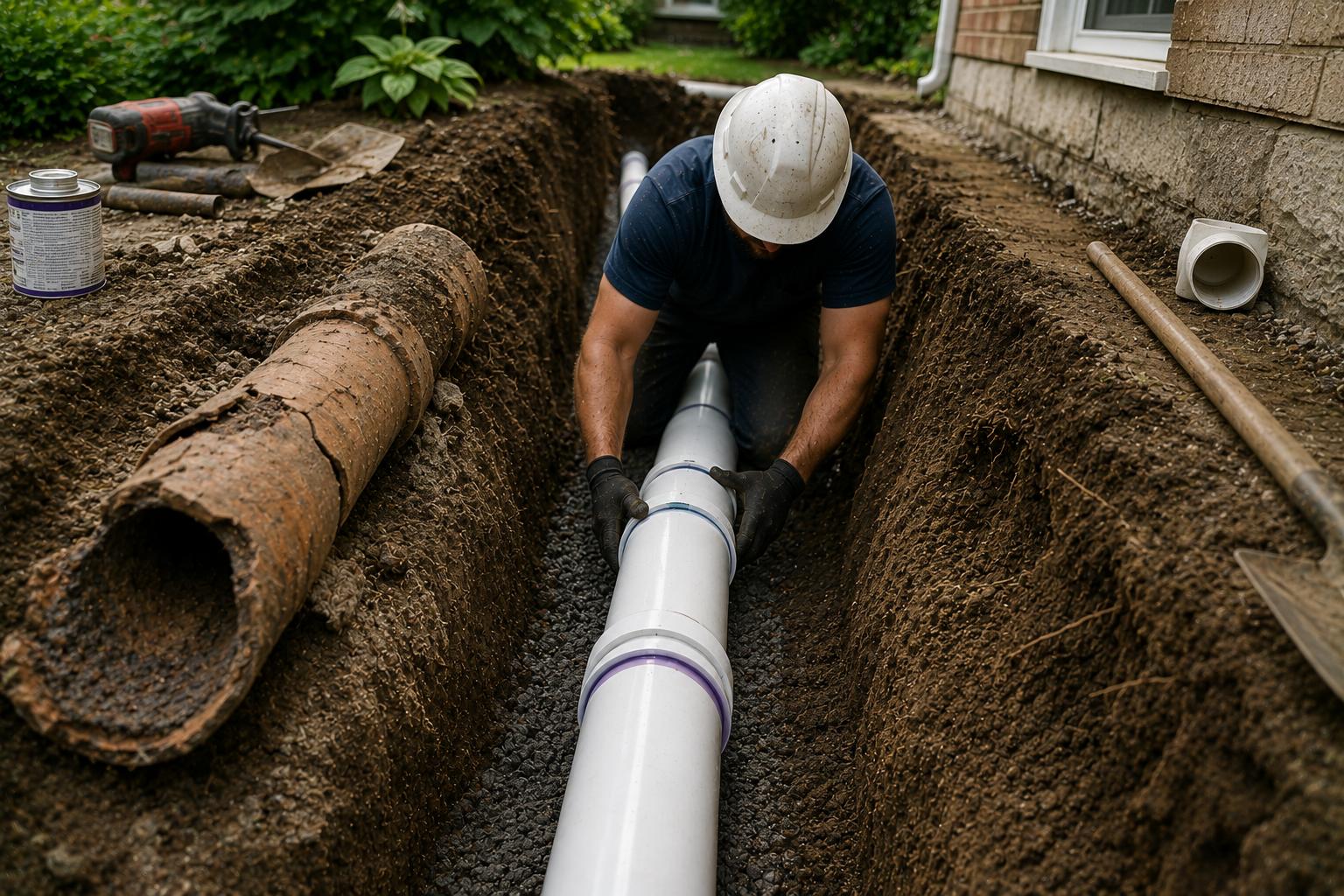
Clay sewer pipe replacement is a common consideration for older Chicago homes with aging underground sewer lines. Clay pipe can last a long time, but it is vulnerable to cracking, joint separation, root intrusion, shifting soil, and collapse as it ages. When these problems become widespread, repeated cleaning or small repairs may no longer be enough.
For homeowners, the main question is whether the clay pipe needs a localized repair, trenchless rehabilitation, partial replacement, or full replacement. The answer depends on the condition of the entire sewer line, not just the section causing the latest backup.
This guide explains why clay sewer pipes fail, when replacement makes sense, what methods may be available, and what Chicago homeowners should expect before approving work. For a broader overview of available repair and replacement methods, visit the Sewer Repair Methods hub.
Key Takeaways
- Clay sewer pipes are common in older homes and can fail from cracks, roots, joint separation, and soil movement.
- Replacement may be needed when damage is widespread or recurring.
- A sewer camera inspection is usually the best way to evaluate clay pipe condition.
- Some clay pipe problems can be handled with spot repair or pipe lining.
- Full replacement may be more practical when the line has multiple defects or repeated backups.
- Chicago properties may have added challenges involving sidewalks, driveways, alleys, basements, and mature trees.
When Should Clay Sewer Pipe Be Replaced?
Clay sewer pipe should be considered for replacement when it has multiple cracks, repeated root intrusion, separated joints, collapsed sections, severe offsets, or recurring backups that cleaning and localized repairs do not solve.
If the damage is limited to one section, a spot repair or pipe lining may be enough. If the entire line is brittle, shifted, broken, or failing in several places, replacement is usually the more reliable long-term option.
Why Clay Sewer Pipes Are Common in Chicago
Many older Chicago homes were built during periods when clay sewer pipe was commonly used for underground drainage. Clay was durable, widely available, and resistant to some forms of chemical corrosion.
However, clay pipe is installed in sections. Each section has joints, and those joints can become weak points over time. Tree roots, soil movement, settling, freeze-thaw cycles, and age can all create problems around those joints.
Clay pipe may still function well if it remains aligned and intact. Problems usually begin when cracks, gaps, or shifted sections allow roots, soil, or wastewater leakage to affect the line.
Common Problems With Clay Sewer Pipes
Clay sewer pipe usually fails because of structural or joint-related issues, not because the material simply disappears. The pipe may crack, shift, separate, or become blocked by roots.
Common clay sewer pipe problems include:
- Tree roots entering through joints or cracks
- Cracked pipe sections
- Broken or crushed sections
- Offset joints between pipe segments
- Separated pipe sections
- Soil entering the sewer line
- Standing water caused by sagging or poor slope
- Recurring backups after rodding or hydro jetting
Some of these issues can be repaired locally. Others indicate that the sewer line may need partial or full replacement.
How Clay Pipe Problems Are Diagnosed
A sewer camera inspection is typically the most useful diagnostic tool. It allows the inside of the pipe to be reviewed so the problem can be located and evaluated.
A camera inspection may show:
- Where roots are entering
- Whether joints are separated
- Whether the pipe is cracked or collapsed
- Whether standing water is present
- How many defects exist along the line
- Whether the pipe is still aligned
- Whether repair or replacement is more practical
Camera footage can help distinguish between a clog that needs cleaning and pipe damage that needs repair or replacement. Homeowners comparing temporary clearing with longer-term solutions may want to review Sewer Rodding vs Sewer Repair: What’s the Difference?.
When Clay Pipe Can Be Repaired Instead of Replaced
Clay pipe does not always need full replacement. If the damage is limited and the rest of the line remains sound, repair may be a practical option.
Repair may make sense when:
- Only one joint is separated
- There is one cracked or broken section
- Root intrusion is limited to one location
- The pipe has no major sag or belly
- The remaining pipe appears stable
- The home has not had repeated sewer failures
For isolated clay pipe damage, Spot Repair for Sewer Lines: When Is It Enough? can help homeowners understand when a targeted repair may be enough.
When Clay Pipe Replacement Makes More Sense
Replacement becomes more likely when defects appear throughout the sewer line or when the same problems keep returning after cleaning and repair.
Clay sewer pipe replacement may be appropriate when:
- Several joints are separated or offset
- Roots are entering in multiple locations
- Sections of pipe are crushed or collapsed
- The line has recurring backups after rodding
- There is widespread cracking
- Soil is entering the pipe
- The pipe has major slope or alignment issues
- Previous spot repairs have not solved the problem
Homeowners deciding between repair and replacement can compare options in Sewer Line Repair vs Replacement: Which Option Makes Sense?.
Clay Sewer Pipe Replacement Methods
Clay sewer pipe can be replaced in different ways depending on site access, pipe condition, depth, and surrounding surfaces.
Traditional Excavation
Traditional excavation involves digging down to expose the clay sewer pipe and replacing the damaged section or full line. This may be necessary when the pipe is collapsed, severely misaligned, or affected by major slope problems.
Excavation gives direct access to the pipe and allows the replacement section to be set with proper alignment and grade. It can also be more disruptive because yards, concrete, landscaping, or hardscaping may be affected.
For more detail, see Traditional Sewer Line Excavation: What Homeowners Should Expect.
Pipe Bursting
Pipe bursting is a trenchless replacement method that may be used when the existing clay pipe can serve as a path for new pipe installation. The old pipe is broken apart while new pipe is pulled into place.
This method can reduce surface disruption, but it is not appropriate for every clay sewer line. Severe alignment issues, major bellies, complicated bends, or blocked sections may prevent pipe bursting from being practical.
Homeowners considering trenchless replacement can review Pipe Bursting for Sewer Replacement Explained.
Partial Replacement
Partial replacement may be used when one section of clay pipe has failed but the rest of the sewer line remains in reasonable condition. This can be a middle ground between spot repair and full replacement.
Full Sewer Line Replacement
Full replacement may be considered when the clay pipe has widespread deterioration, multiple breaks, recurring root intrusion, or repeated failures across the line.
For a broader look at larger projects, see Full Sewer Line Replacement: What Homeowners Should Know.
Can Clay Sewer Pipe Be Lined Instead of Replaced?
In some cases, clay sewer pipe can be rehabilitated with pipe lining rather than fully replaced. Pipe lining creates a new interior surface inside the existing pipe.
Lining may be an option when the clay pipe has cracks, small gaps, or root entry points but remains structurally stable and properly aligned.
Pipe lining may not be appropriate when the clay pipe is collapsed, severely offset, crushed, or affected by major slope problems. The pipe must generally provide a usable shape and path for the liner.
For more detail, see Pipe Lining for Sewer Repair: How It Works.
Clay Pipe Replacement Options Compared
| Option | Best For | Limitations |
|---|---|---|
| Spot Repair | One isolated cracked, broken, or root-damaged section | Does not solve widespread clay pipe deterioration |
| Pipe Lining | Stable clay pipe with cracks, leaks, or root entry points | Not suitable for major collapse, severe offsets, or bellies |
| Pipe Bursting | Replacing clay pipe along an existing usable path | Requires proper access and a suitable pipe route |
| Traditional Excavation | Collapsed, sagging, severely offset, or complex pipe conditions | More surface disruption and restoration work |
| Full Replacement | Widespread failure, repeated backups, or multiple defects | Larger project scope and higher upfront cost |
Cost Factors for Clay Sewer Pipe Replacement
Clay sewer pipe replacement costs vary because the project depends on the pipe’s condition, location, depth, and replacement method. Homeowners should be cautious about relying on generic pricing without an inspection.
Important cost factors include:
- Length of pipe being replaced
- Depth of the sewer line
- Pipe location on the property
- Whether the line runs under grass, concrete, driveway, sidewalk, slab, or landscaping
- Replacement method used
- Pipe material being installed
- Access for equipment
- Permit and inspection requirements
- Need for cleanout installation
- Backfill and surface restoration
- Weather and seasonal conditions
Homeowners should ask whether estimates include restoration. Replacing pipe under a driveway or sidewalk may involve costs beyond the sewer work itself.
Chicago-Specific Considerations
Mature Trees and Root Intrusion
Many Chicago neighborhoods have mature trees. Roots often enter clay sewer lines through small cracks and joints. Cutting roots may temporarily restore flow, but roots can return if the entry point remains open.
Older Housing Stock
Older homes are more likely to have clay sewer pipe or mixed materials from past repairs. A line may include clay, cast iron, PVC, or previous replacement sections. Transitions between materials can become problem areas.
Driveways, Sidewalks, and Parkways
Clay sewer lines may run under concrete driveways, sidewalks, patios, or parkways. These surfaces can affect the replacement method and restoration scope.
For related issues, see Sewer Repair Under a Driveway: Methods and Challenges and Sewer Repair Under a Sidewalk: What Homeowners Need to Know.
Freeze-Thaw and Soil Movement
Chicago weather can contribute to soil movement over time. Settling, shifting, and freeze-thaw cycles may affect older clay pipe alignment, joints, and slope.
Permits and Inspections
Clay sewer pipe replacement may require permits, inspections, and compliance with local requirements. Homeowners should clarify who handles permitting before work begins.
What to Expect During Replacement
The exact process depends on the replacement method, but most projects include several common steps.
- Camera inspection and diagnosis
- Locating the sewer line and damaged sections
- Reviewing repair versus replacement options
- Utility marking before digging
- Permit coordination if required
- Excavation or trenchless access preparation
- Removal, replacement, lining, or bursting work
- Connection to the existing system
- Inspection and testing
- Backfill and surface restoration
Homeowners should also ask how long plumbing service may be interrupted and whether final cleanup is included.
Warning Signs Clay Sewer Pipe May Need Replacement
Replacement may need to be considered if you notice:
- Recurring sewer backups
- Roots repeatedly found during cleaning
- Slow drains throughout the home
- Gurgling toilets or drains
- Sewer odors
- Camera footage showing multiple cracks or joint failures
- Standing water inside the sewer line
- Soil or debris entering the pipe
- Prior repairs that did not solve the problem
These signs do not automatically mean the full line must be replaced, but they do suggest that a full inspection is needed.
Common Mistakes Homeowners Make
- Assuming roots are only a cleaning problem
- Rodding the same clay line repeatedly without inspection
- Choosing spot repair when the pipe is failing in multiple places
- Assuming trenchless replacement works for every clay sewer line
- Ignoring offset joints or standing water shown on camera footage
- Comparing estimates without checking restoration costs
- Assuming homeowners insurance will cover age-related pipe failure
- Delaying replacement until a partial collapse becomes an emergency
The most important mistake is focusing only on the latest blockage instead of the overall condition of the clay sewer line.
Questions to Ask Before Replacing Clay Sewer Pipe
- What did the camera inspection show?
- Is the damage isolated or widespread?
- Are roots entering at one location or several?
- Is pipe lining possible?
- Is pipe bursting possible?
- Will traditional excavation be required?
- What material will replace the clay pipe?
- Will a cleanout be installed or updated?
- Does the estimate include permits and inspections?
- Does the estimate include concrete, yard, or landscape restoration?
- How long will plumbing service be interrupted?
Frequently Asked Questions
Does clay sewer pipe always need to be replaced?
No. Clay sewer pipe may be repaired if the damage is isolated and the rest of the line remains stable. Replacement is more likely when there are multiple defects, recurring backups, or widespread deterioration.
Can clay sewer pipe be lined?
Yes, in some cases. Pipe lining may work when the clay pipe is cracked or leaking but still structurally stable and properly aligned.
Can pipe bursting replace clay sewer pipe?
Often, yes. Pipe bursting may be an option if the clay pipe path is usable and site conditions allow trenchless replacement.
Why do roots get into clay sewer pipes?
Roots often enter through joints, cracks, or small gaps in clay pipe. Once inside, they can grow and collect debris, leading to repeated blockages.
Is replacing clay pipe with PVC common?
Many replacement projects use modern approved materials such as PVC, depending on local code requirements and site conditions.
Will homeowners insurance cover clay sewer pipe replacement?
Coverage depends on the policy and the cause of damage. Many policies exclude wear and tear, root intrusion, deterioration, and age-related failure unless specific service line coverage applies.
How do I know whether clay pipe replacement is worth it?
A camera inspection, repair history, pipe condition, and comparison of repair versus replacement costs can help determine whether replacement provides better long-term value.
Conclusion
Clay sewer pipe replacement may be necessary when an older sewer line has widespread cracks, joint separation, repeated root intrusion, collapse, or recurring backups that cleaning and minor repairs do not solve. However, not every clay pipe problem requires full replacement. Some lines can be repaired, lined, or partially replaced when the damage is limited.
For Chicago homeowners, the best decision starts with inspection footage and a clear explanation of the pipe condition. Once the full line is understood, homeowners can compare spot repair, pipe lining, pipe bursting, excavation, and full replacement with a realistic sense of cost, disruption, and long-term reliability.