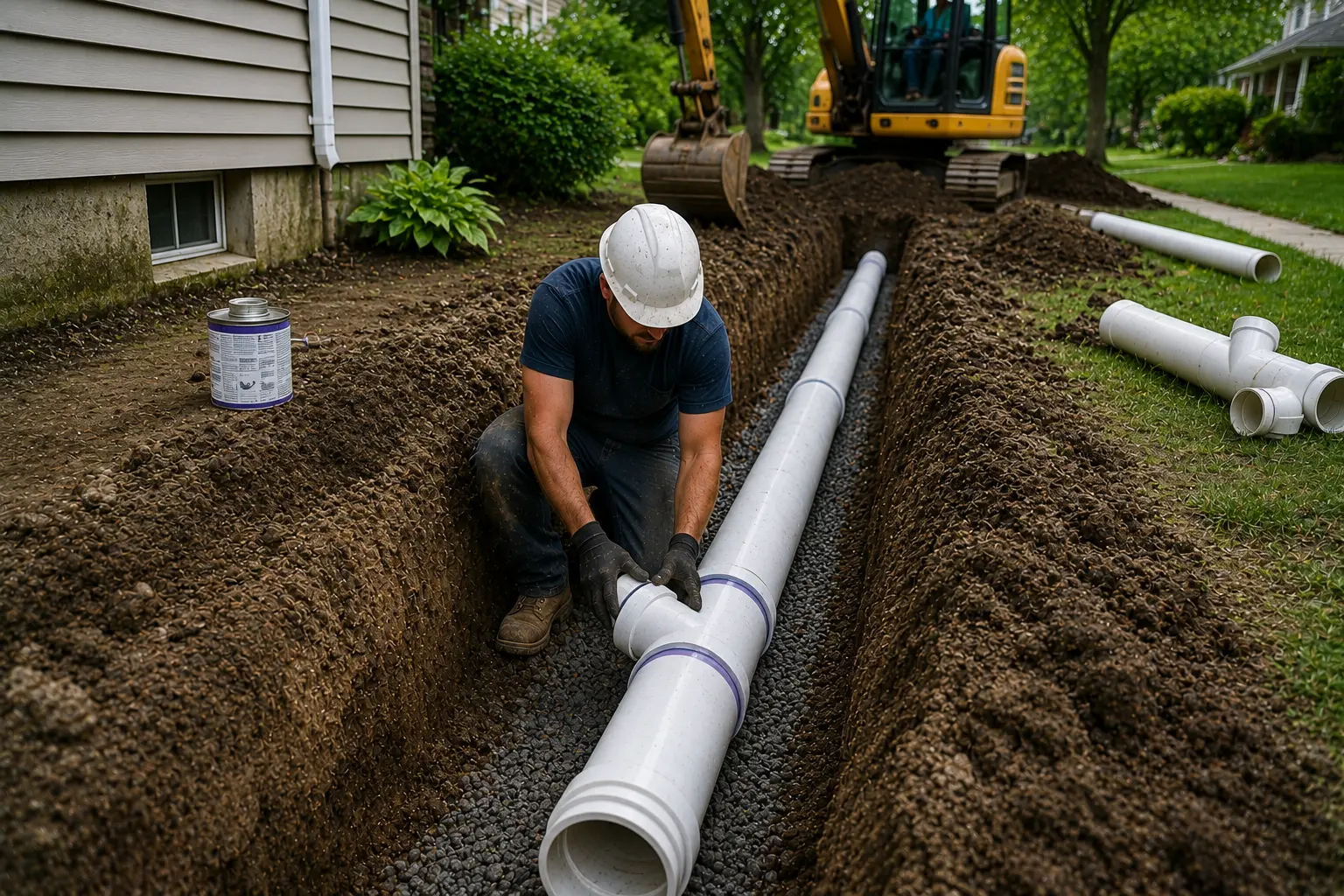
PVC sewer line replacement is a common option when an older sewer pipe needs to be replaced with a modern material. PVC is widely used in residential sewer work because it is lightweight, corrosion-resistant, smooth inside, and compatible with many repair and replacement approaches when installed properly.
For Chicago homeowners, PVC replacement often comes up when older clay or cast iron sewer lines have cracked, shifted, corroded, collapsed, or developed recurring root problems. Replacing damaged sections with PVC may improve reliability, but the benefits depend on proper installation, correct slope, approved materials, and the condition of the surrounding sewer system.
This guide explains the benefits of PVC sewer line replacement, when it makes sense, what homeowners should consider before approving work, and how PVC compares with older materials and other repair methods. For a broader overview of sewer repair approaches, visit the Sewer Repair Methods hub.
Key Takeaways
- PVC is commonly used as a modern replacement material for damaged clay, cast iron, or older sewer pipe.
- Benefits include corrosion resistance, smoother flow, easier handling, and strong compatibility with many residential sewer projects.
- PVC replacement may be used for spot repairs, partial replacements, or full sewer line replacement.
- Proper slope, bedding, connections, permits, and inspection matter as much as the pipe material itself.
- PVC does not solve every sewer issue if the underlying problem involves poor grade, soil movement, or improper installation.
- Chicago properties may require special planning when sewer lines run under driveways, sidewalks, slabs, parkways, or tight urban lots.
Why Homeowners Replace Sewer Lines With PVC
PVC is often chosen for sewer line replacement because it does not rust, has a smooth interior surface, resists many common sewer line problems, and is easier to work with than older materials. When installed correctly, it can provide a reliable replacement for damaged clay, cast iron, or failing pipe sections.
However, PVC is only as good as the installation. A new PVC sewer line still needs proper slope, solid bedding, correct connections, code-compliant materials, and careful backfill. Poor installation can lead to settling, bellies, leaks, or future blockages even when the pipe material itself is modern.
What Is PVC Sewer Pipe?
PVC, or polyvinyl chloride, is a plastic piping material commonly used in modern residential drain and sewer systems. It is lightweight, rigid, corrosion-resistant, and relatively easy to cut, connect, and install compared with many older pipe materials.
In sewer replacement projects, PVC may be used to replace older clay pipe, cast iron pipe, or failed sections of existing sewer line. Depending on the project, PVC may be installed during a localized repair, a longer partial replacement, or a full sewer line replacement.
PVC may also appear in homes that already have mixed sewer materials because previous repairs were completed at different times.
Main Benefits of PVC Sewer Line Replacement
Potential benefits of PVC sewer replacement include:
- Resistance to rust and corrosion
- Smooth interior walls that support better flow
- Reduced risk of root entry when joints are properly installed
- Lightweight handling during installation
- Compatibility with many modern sewer repair methods
- Useful for spot repairs, partial replacements, and full replacements
- Often simpler to connect to newer plumbing materials
These benefits can make PVC an attractive replacement option when an older sewer line has reached the point where repair is no longer practical.
When PVC Sewer Line Replacement Makes Sense
PVC replacement may make sense when an existing sewer line has physical damage, recurring failures, or outdated materials that are no longer reliable.
Common situations include:
- Cracked clay sewer pipe
- Broken or separated pipe sections
- Cast iron pipe with severe corrosion
- Tree roots entering through joints or cracks
- Pipe sections damaged by soil movement
- Repeated sewer backups after cleaning
- Partial collapse or crushed pipe
- Older pipe that has already required multiple repairs
Homeowners deciding whether replacement is necessary can compare the broader decision in Sewer Line Repair vs Replacement: Which Option Makes Sense?.
When PVC Replacement May Not Be the Whole Answer
Replacing old pipe with PVC can solve many sewer line problems, but it does not automatically correct every underlying condition. If the sewer line has slope, bedding, or soil movement issues, the replacement must address those problems during installation.
PVC replacement alone may not solve problems caused by:
- Poor pipe slope
- Unstable soil beneath the sewer line
- Improper backfill
- Incorrect pipe bedding
- Major pipe belly conditions that are not corrected
- Bad connections between old and new materials
- Improperly supported pipe under slabs or paved areas
The goal is not simply to install new pipe. The goal is to restore a properly aligned, well-supported sewer line that drains reliably.
PVC vs Clay Sewer Pipe
Many older Chicago homes have clay sewer pipe. Clay pipe can be durable, but it is installed in sections with joints that can separate, crack, or allow tree roots to enter.
PVC differs from clay in several important ways:
| Factor | PVC Sewer Pipe | Clay Sewer Pipe |
|---|---|---|
| Material | Modern plastic pipe | Older rigid ceramic-style pipe |
| Root Intrusion Risk | Lower when joints are properly sealed | Higher at cracked sections and older joints |
| Corrosion | Does not rust | Resistant to rust but vulnerable to cracking and joint failure |
| Installation | Lightweight and easier to handle | Heavier and sectioned |
| Common Failure Pattern | Often related to installation, settling, or damage | Cracks, roots, joint separation, offsets, collapse |
For homeowners replacing older clay systems, Clay Sewer Pipe Replacement: What to Expect provides more material-specific context.
PVC vs Cast Iron Sewer Pipe
Cast iron sewer pipe can be strong, but it may corrode, scale, and roughen inside over time. These rough interior surfaces can catch debris and contribute to recurring clogs.
PVC does not rust and generally has a smoother interior surface. This can make it a practical replacement material when cast iron has deteriorated beyond cleaning or repair.
| Factor | PVC Sewer Pipe | Cast Iron Sewer Pipe |
|---|---|---|
| Corrosion | Does not rust | Can corrode and scale over time |
| Interior Surface | Smooth | May become rough with age |
| Weight | Lightweight | Heavy |
| Repair Context | Often used for replacement sections | May require cleaning, lining, repair, or replacement when deteriorated |
| Common Concerns | Proper bedding, slope, support, and connections | Corrosion, scaling, leaks, cracking, and structural weakening |
For more on aging cast iron systems, see Cast Iron Sewer Pipe Repair Options.
Ways PVC May Be Used in Sewer Replacement
Spot Repair With PVC
If only one section of the sewer line is damaged, a short section may be excavated and replaced with PVC. This can be practical when the rest of the sewer line is still in good condition.
For isolated damage, Spot Repair for Sewer Lines: When Is It Enough? can help homeowners understand when a limited repair may be sufficient.
Partial Replacement With PVC
A longer section of old pipe may be replaced with PVC when damage is concentrated in one area but does not require a full line replacement.
Full Sewer Line Replacement With PVC
When the entire sewer line or most of the line is failing, PVC may be used as the replacement material. This may be done through traditional excavation or through certain trenchless methods when conditions allow.
For larger replacement decisions, see Full Sewer Line Replacement: What Homeowners Should Know.
Traditional Excavation vs Trenchless Replacement
PVC may be installed through different replacement methods depending on the sewer line condition and property layout.
Traditional Excavation
Traditional excavation involves digging down to expose the old pipe and installing new pipe directly. This approach may be necessary when the line is collapsed, badly sagging, severely misaligned, or when the pipe grade needs correction.
Homeowners can learn more in Traditional Sewer Line Excavation: What Homeowners Should Expect.
Trenchless Replacement
Some trenchless methods may allow a new pipe to be installed with less digging. Pipe bursting, for example, can replace an old pipe by breaking it apart and pulling new pipe into place. The replacement material and installation method must match the project requirements.
For more on trenchless options, see Trenchless Sewer Repair in Chicago Explained and Pipe Bursting for Sewer Replacement Explained.
Cost Factors for PVC Sewer Line Replacement
The material cost of PVC is only one part of a sewer replacement project. Labor, access, excavation, restoration, and inspections often have a larger impact on total cost.
Important cost factors include:
- Length of pipe being replaced
- Depth of the sewer line
- Location of the pipe on the property
- Whether excavation is required
- Whether the line runs under concrete, driveway, sidewalk, slab, or landscaping
- Soil conditions and pipe bedding requirements
- Connections to existing pipe materials
- Permit and inspection requirements
- Need for cleanout installation or replacement
- Backfill and surface restoration
Homeowners should ask whether estimates include only the pipe work or also include concrete replacement, landscaping, cleanup, permits, and inspection coordination.
Chicago-Specific Considerations
Older Homes With Mixed Pipe Materials
Chicago homes may have a mix of clay, cast iron, PVC, and previous repair sections. When PVC is connected to older pipe, the transition must be properly planned and installed to reduce the risk of leaks, offsets, or weak joints.
Driveways, Sidewalks, and Parkways
Replacing a sewer line with PVC may be straightforward in a yard but more complicated under concrete, sidewalks, driveways, parkways, patios, or garage slabs.
When replacement work involves paved areas, homeowners may want to review Sewer Repair Under a Driveway: Methods and Challenges and Sewer Repair Under a Sidewalk: What Homeowners Need to Know.
Freeze-Thaw and Soil Movement
Chicago’s freeze-thaw cycles and soil movement can affect sewer line support over time. Proper bedding, compaction, and slope are important to reduce the chance of pipe settling or belly formation.
Permit and Inspection Requirements
Sewer line replacement may require permits, inspections, and code-compliant materials. Homeowners should confirm that the replacement material and method are appropriate for the project and local requirements.
Basement and Slab Conditions
In some homes, sewer piping may run beneath basement slabs or other concrete areas. PVC replacement in these locations may require slab cutting, excavation, and restoration.
Installation Quality Matters More Than Material Alone
PVC has clear benefits, but poor installation can create future sewer problems. A properly installed PVC sewer line needs correct slope, support, bedding, and connections.
Important installation considerations include:
- Correct pipe slope for proper flow
- Stable bedding beneath the pipe
- Properly compacted backfill
- Code-compliant fittings and transitions
- Protection from settling or sagging
- Accessible cleanouts where appropriate
- Final inspection before restoration is completed
If the pipe is not supported correctly, even a new PVC line can develop low spots that hold water and waste.
The Role of Sewer Cleanouts
When a sewer line is being replaced with PVC, it may be a good time to evaluate cleanout access. A properly located cleanout can make future inspection, rodding, hydro jetting, and maintenance easier.
If the existing cleanout is missing, damaged, buried, or poorly located, replacement planning may include cleanout installation or improvement. For more detail, see Sewer Cleanout Installation: Purpose, Cost, and Benefits.
Warning Signs Replacement May Be Needed
PVC replacement may be considered when the existing sewer line is no longer reliable.
Warning signs include:
- Recurring sewer backups
- Repeated root intrusion
- Multiple cracks shown on camera inspection
- Collapsed or crushed pipe sections
- Severe cast iron corrosion
- Broken clay pipe
- Pipe bellies or standing water
- Frequent need for rodding or hydro jetting
- Previous repairs that did not solve the problem
These signs do not automatically mean full replacement is required, but they do suggest that a camera inspection and repair comparison are needed.
Common Mistakes Homeowners Make
- Assuming PVC automatically solves every sewer problem
- Ignoring slope, bedding, and soil conditions
- Choosing replacement without reviewing inspection footage
- Replacing one section without evaluating the rest of the line
- Failing to ask how old pipe will connect to new PVC
- Comparing estimates without checking restoration costs
- Overlooking cleanout access during replacement planning
- Assuming homeowners insurance will cover age-related pipe replacement
The biggest mistake is focusing only on the pipe material instead of the full sewer system. A good replacement plan considers pipe condition, location, access, installation quality, and long-term maintenance.
Questions to Ask Before Replacing a Sewer Line With PVC
- What did the camera inspection show?
- Is replacement necessary, or would repair be enough?
- Will this be a spot repair, partial replacement, or full replacement?
- What type and rating of PVC will be used?
- How will the new PVC connect to existing clay, cast iron, or other materials?
- Will the pipe slope be corrected if needed?
- What bedding and backfill process will be used?
- Are permits and inspections included?
- Will a cleanout be installed or updated?
- Does the estimate include concrete, yard, or landscape restoration?
- How long will plumbing service be interrupted?
Frequently Asked Questions
Is PVC a good material for sewer line replacement?
PVC is commonly used for sewer replacement because it is corrosion-resistant, smooth inside, lightweight, and compatible with many modern sewer repair projects when installed correctly.
Can old clay pipe be replaced with PVC?
Often, yes. Older clay pipe may be replaced with approved PVC materials depending on local requirements, project conditions, and the repair method used.
Can cast iron sewer pipe be replaced with PVC?
Yes, cast iron sewer sections may be replaced with PVC when the cast iron is corroded, damaged, or failing, provided the transition and installation are handled properly.
Does PVC prevent tree root problems?
PVC can reduce root entry risk when joints are properly installed and the pipe remains intact. However, poor connections, damage, or settling can still create future vulnerabilities.
Is PVC replacement cheaper than trenchless repair?
It depends on the project. Material cost is only one factor. Excavation, depth, access, permits, and restoration can have a larger impact on total cost.
Will homeowners insurance cover PVC sewer replacement?
Coverage depends on the policy and cause of failure. Many policies exclude deterioration, wear and tear, root intrusion, or age-related pipe failure unless special service line coverage applies.
Can PVC sewer pipe develop a belly?
Yes. Any sewer pipe can develop a low spot if it is not properly bedded, supported, or backfilled, or if surrounding soil settles over time.
Should I replace the whole sewer line with PVC or only one section?
That depends on the condition of the full sewer line. A single damaged section may only need a spot repair, while widespread deterioration may justify full replacement.
Conclusion
PVC sewer line replacement can be a practical way to modernize a damaged or failing sewer line, especially when replacing older clay or cast iron pipe. PVC offers corrosion resistance, smooth flow, and installation flexibility, but the success of the project depends on more than material choice.
For Chicago homeowners, the best decision starts with a camera inspection and a clear explanation of the existing pipe condition. From there, homeowners can compare spot repair, partial replacement, trenchless methods, traditional excavation, and full replacement to determine whether PVC is the right material and whether the proposed scope makes long-term sense.