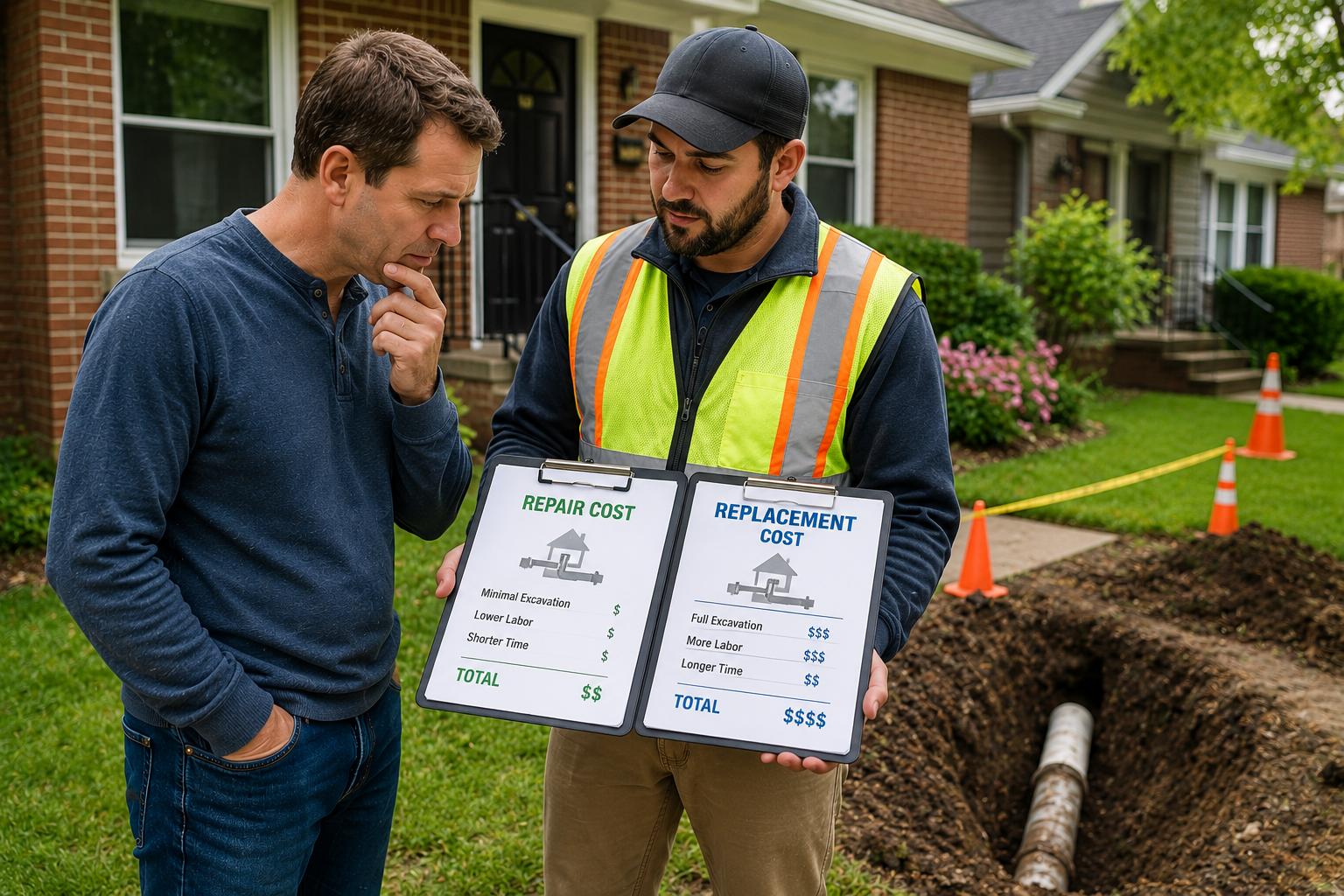
When a sewer line fails, one of the first questions Chicago homeowners face is whether repair or full replacement makes more financial sense. The answer depends on the type of damage, how much of the pipe is affected, where the pipe is located, and whether the problem is likely to come back after a smaller repair.
In general, sewer line repair makes more sense when the damage is isolated and the rest of the pipe is still in usable condition. Sewer line replacement makes more sense when the line has widespread deterioration, repeated root intrusion, collapsed sections, poor slope, or multiple recurring backups.
The cheapest option upfront is not always the least expensive option long term. A small repair can be smart if it solves the actual problem. But repeated repairs on a failing line can quickly become more frustrating and expensive than making a larger replacement decision once.
Key Takeaways
- Sewer repair is usually best for isolated damage, while replacement is more appropriate for widespread pipe failure.
- The cost difference depends on pipe depth, access, excavation, replacement length, surface restoration, and permit requirements.
- A sewer camera inspection is one of the most important tools for deciding between repair and replacement.
- Chicago homes may have older clay pipe, cast iron sections, root intrusion, tight lots, basements, sidewalks, alleys, and parkway-related access issues.
- Trenchless options may reduce digging in some situations, but they are not always suitable or cheaper.
- Homeowners should compare the long-term risk of recurring problems, not just the first estimate they receive.
Does Sewer Line Repair or Replacement Make More Sense in Chicago?
Sewer line repair usually makes more sense when the damage is limited to one section, the rest of the sewer line appears structurally sound, and the repair can solve the problem without repeated callbacks. Replacement usually makes more sense when the pipe has multiple defects, severe root intrusion, collapse, major offsets, or recurring backups after previous cleanings or repairs.
The right decision depends on the condition of the pipe, not just the price. A lower-cost repair may be the better choice if the damage is isolated. A higher-cost replacement may be more practical if the line is already failing in several places.
For a broader overview of how sewer project pricing works, see the main Chicago sewer replacement cost guide.
Main Cost Differences Between Sewer Repair and Replacement
Scope of Work
The biggest difference between repair and replacement is the size of the project. A repair may address one cracked section, one offset joint, one root entry point, or one localized failure. Replacement involves removing or rehabilitating a larger section of the sewer line, and sometimes the full private sewer lateral.
Because replacement usually involves more labor, materials, excavation, and restoration, it often costs more upfront. However, it may reduce the risk of repeated problems if the existing line is in poor overall condition.
Excavation Requirements
Excavation can heavily influence both repair and replacement costs. A small repair under concrete, deep soil, or a tight side yard can become expensive because access is difficult. A larger replacement through open yard space may be more straightforward than expected.
For many Chicago homes, the cost is shaped less by the pipe itself and more by what has to be disturbed to reach it. For a deeper breakdown of this issue, read Sewer Line Excavation Cost: What Drives the Price Higher?.
Pipe Depth
Deeper sewer lines cost more to access. More depth means more digging, more soil handling, more time, and more trench safety considerations. A deep spot repair can be costly even if only a few feet of pipe are being replaced.
When comparing repair and replacement, homeowners should ask whether the quote assumes a specific depth and what happens if the line is deeper than expected.
Surface Restoration
Restoration can change the financial comparison. A repair that requires cutting a driveway, sidewalk, patio, or basement slab may include substantial restoration costs. If that same surface will need to be opened again later for another repair, replacement may become more practical.
Ask whether the estimate includes concrete replacement, lawn repair, driveway patching, basement slab repair, backfill, compaction, and cleanup.
Permit and Inspection Requirements
Depending on the scope and location of the work, sewer repair or replacement may involve permit and inspection requirements. Larger replacement projects are more likely to involve formal coordination, but homeowners should not assume a smaller repair avoids all requirements.
A clear estimate should state who handles permits, whether permit costs are included, and whether inspections are part of the project timeline.
Repair vs Replacement Cost Comparison
| Decision Factor | Repair May Cost Less When | Replacement May Make More Sense When |
|---|---|---|
| Damage location | The issue is isolated and easy to access. | Multiple damaged sections are found along the line. |
| Pipe condition | The rest of the pipe appears stable on camera. | The pipe shows widespread cracking, separation, or deterioration. |
| Root intrusion | Roots are entering at one clear location. | Roots keep returning through multiple joints or cracks. |
| Excavation | The repair area is shallow and accessible. | Opening the same area repeatedly would be costly or disruptive. |
| Restoration | Surface damage is minimal. | Concrete, sidewalk, driveway, or slab work makes repeat repairs risky. |
| Long-term risk | The repair is likely to solve the issue for a reasonable period. | Recurring backups suggest the line is failing overall. |
Chicago-Specific Considerations
Older Clay and Cast Iron Sewer Lines
Many Chicago homes have older sewer materials, including clay pipe, cast iron sections, or a combination of materials from previous repairs. Clay pipe can crack, separate at joints, or allow root intrusion. Cast iron can corrode, scale internally, or weaken over time.
If a camera inspection shows one isolated defect, repair may be enough. If it shows repeated cracks, separated joints, poor alignment, or several older repair transitions, replacement may be the more practical long-term option.
Tree Roots and Parkway Trees
Mature trees are common across Chicago neighborhoods. Roots often enter sewer lines through existing openings such as cracks, loose joints, or separated sections. Cleaning can remove the roots temporarily, but it does not repair the opening that allowed them inside.
If roots keep returning after rodding, homeowners should ask whether the issue is one repairable entry point or a larger pipe condition problem.
Basements and Whole-House Backups
Chicago homeowners often notice sewer issues through basement floor drains, laundry tubs, lower-level toilets, or multiple fixtures backing up at once. These symptoms can point to a main line restriction, but they do not automatically prove full replacement is needed.
The pattern matters. A one-time blockage is different from recurring backups after repeated cleaning.
Tight Lots, Sidewalks, Alleys, and Parkways
Urban access can complicate repair and replacement decisions. Narrow side yards, fences, garages, sidewalks, alleys, porches, and parkway areas can make excavation more difficult. If a small repair requires major access work, the cost gap between repair and replacement may become smaller.
Weather and Urgency
Heavy rain, winter conditions, frozen ground, and saturated soil can make sewer work more complicated. If the problem becomes urgent, homeowners may have less time to compare estimates and consider alternatives. Planned work usually gives more room for thoughtful decision-making than an emergency backup.
Trenchless Repair and Replacement Options
Trenchless methods may reduce digging by using access points instead of opening the entire sewer line. Depending on the condition of the pipe, trenchless options may include lining or replacement methods designed to rehabilitate or replace the damaged section with less surface disruption.
Trenchless work can be appealing when the sewer line runs under concrete, landscaping, sidewalks, or other areas that would be expensive to restore. However, trenchless options are not always available. A collapsed pipe, major belly, severe misalignment, or improper slope may require excavation.
| Option | Potential Advantage | Potential Limitation |
|---|---|---|
| Spot repair | Targets one localized failure. | May not address aging pipe elsewhere. |
| Pipe lining | May reduce digging when the pipe is structurally suitable. | May not fix severe collapse, slope problems, or major offsets. |
| Partial replacement | Replaces a known failed section. | Leaves remaining older pipe in place. |
| Full replacement | Addresses widespread deterioration or recurring failures. | Higher upfront cost and more disruption. |
Important Homeowner Note
Trenchless should not be treated as automatically better or cheaper. It is useful only when it fits the pipe condition, access points, slope, and long-term repair goal.
Repair vs Replacement Considerations
The decision comes down to evidence, risk, and timing. A homeowner should not approve full replacement only because a sewer line clogged once. At the same time, repeated temporary fixes can become expensive if the pipe is clearly failing.
Repair May Make More Sense When
- The camera inspection shows one isolated crack, joint issue, or damaged section.
- The rest of the sewer line appears structurally sound.
- The problem has not been recurring after repeated cleanings.
- The repair area is accessible without major surface disruption.
- The homeowner wants to address a limited problem without replacing usable pipe.
Replacement May Make More Sense When
- The sewer line has several cracks, offsets, separated joints, or failing sections.
- Roots keep returning after rodding or hydro jetting.
- The line has collapsed or developed major slope problems.
- The pipe material is deteriorated throughout the inspected section.
- Backups are becoming more frequent or more severe.
- Repeated repairs are approaching the cost of a larger replacement.
When the Choice Is Not Obvious
Sometimes the best decision is not clear. A pipe may have one serious defect and several smaller warning signs. A repair may work, but replacement may reduce future risk. In these cases, homeowners should ask for the contractor’s reasoning and compare more than one written estimate.
If two estimates differ dramatically, the difference may be caused by different assumptions about excavation, restoration, pipe length, permits, or method. See why sewer replacement quotes in Chicago can vary by thousands for more context.
How to Compare Sewer Repair and Replacement Estimates
A useful estimate should explain the problem and the proposed solution. It should not simply state a price with little detail.
Before choosing repair or replacement, ask whether the estimate includes:
- The inspection findings that support the recommendation
- The exact section of pipe being repaired or replaced
- The approximate footage involved
- The assumed depth of the line
- The repair or replacement method
- The pipe material being installed
- Permit and inspection responsibilities
- Utility locating requirements
- Excavation, backfill, and compaction details
- Concrete, sidewalk, driveway, lawn, or basement slab restoration
- Cleanup and debris removal
- Conditions that could change the final cost
If the estimate does not explain these items, it may be difficult to compare it fairly against another option.
Common Mistakes and Warning Signs
Mistake: Choosing Repair Only Because It Costs Less Upfront
A smaller repair may be the right decision, but only if it solves the underlying problem. If the pipe is failing in several areas, a low upfront repair can lead to repeated costs.
Mistake: Choosing Replacement Without Inspection Evidence
Replacement may be necessary, but homeowners should understand why. A camera inspection can help confirm whether the issue is isolated, widespread, structural, or related to recurring roots.
Mistake: Ignoring Restoration Costs
Surface restoration can be a major part of the price. A repair that requires cutting concrete or opening a basement slab may not be as inexpensive as it first appears.
Mistake: Treating Rodding as a Permanent Repair
Rodding can clear a blockage, but it does not fix cracks, open joints, or collapsed pipe. If the same line keeps backing up, the pipe condition should be evaluated.
Mistake: Waiting Until the Sewer Fully Fails
Waiting can turn a planned decision into an urgent one. Emergency conditions may limit the time available to review estimates, financing, and repair alternatives. If cost is a major concern, it may help to review sewer replacement financing options for Chicago homeowners before the situation becomes urgent.
Warning Signs That May Point Toward Replacement
- Multiple drains backing up at once
- Basement floor drain backups
- Recurring clogs after repeated cleaning
- Tree roots repeatedly removed from the sewer line
- Camera inspection showing cracks, offsets, collapse, or standing water
- Sewage odors inside or outside the home
- Wet, sunken, or unusually soft areas in the yard
- Several previous spot repairs on the same sewer line
Decision Point
Repair is usually a better fit for a defined, isolated defect. Replacement becomes more reasonable when the sewer line is showing a pattern of failure rather than one limited problem.
FAQ About Sewer Line Repair vs Replacement Cost
Is sewer line repair always cheaper than replacement?
Repair is usually cheaper upfront when the problem is isolated. However, if the line has multiple defects or recurring backups, repeated repairs can become more expensive over time than a larger replacement.
How do I know if I need sewer repair or replacement?
A sewer camera inspection is usually the best starting point. It can show whether the problem is a clog, root intrusion, crack, offset joint, collapse, poor slope, or widespread deterioration. The condition of the full inspected section matters more than one symptom.
Can trenchless repair avoid excavation?
Sometimes. Trenchless methods may reduce digging if the existing pipe is suitable. They may not work for severely collapsed pipes, major bellies, bad slope problems, or severely misaligned sections.
Will homeowners insurance cover sewer repair or replacement?
Coverage depends on the policy and the cause of the damage. Many policies exclude wear and tear, age-related deterioration, and long-term root intrusion. Some homeowners may have sewer backup or service line coverage, but the details should be confirmed directly with the insurer.
What warning signs suggest replacement may be better than repair?
Repeated whole-house backups, recurring root intrusion, multiple failed sections, collapsed pipe, major offsets, standing water in the line, or several previous repairs can suggest that replacement may be more practical than another spot repair.
Why do Chicago sewer repair and replacement costs vary so much?
Costs vary because Chicago properties can differ in pipe depth, access, lot layout, pipe material, surface restoration, permit needs, and excavation difficulty. Two homes with similar symptoms may require very different work.
Should I get more than one estimate?
For major sewer work, comparing more than one detailed estimate can be useful. Make sure each estimate is based on similar inspection findings and includes the same assumptions about excavation, permits, pipe length, and restoration.
Conclusion
Sewer line repair usually makes the most sense when the damage is isolated, the pipe is otherwise stable, and the repair is likely to solve the problem. Sewer line replacement becomes more reasonable when the pipe has widespread deterioration, recurring root intrusion, collapse, poor slope, or multiple failing sections.
The best decision should be based on inspection evidence, not fear or the lowest upfront price. A sewer camera inspection, a clear written scope, and a realistic look at long-term risk can help homeowners choose between repair and replacement more confidently.
For Chicago homeowners, the real question is not simply which option costs less today. It is which option best matches the condition of the sewer line and reduces the chance of paying for the same problem again.