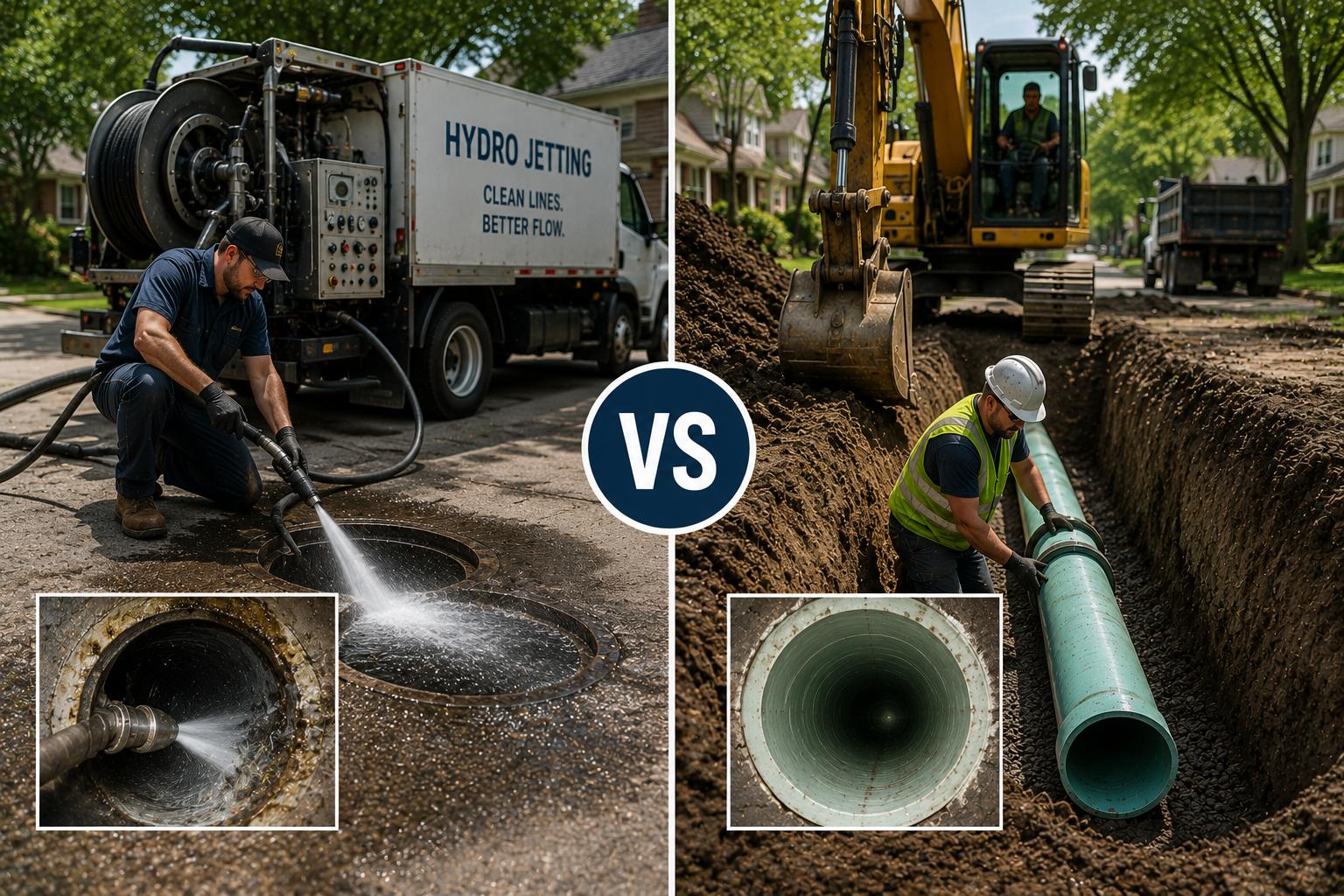
Hydro jetting and sewer line replacement solve very different sewer problems. Hydro jetting is a high-pressure cleaning method used to remove grease, sludge, roots, and debris from inside a sewer line. Sewer line replacement is a construction project that replaces a failing pipe when cleaning or minor repair is no longer enough.
For Chicago homeowners, the decision often comes down to whether the sewer line is clogged or structurally damaged. If the pipe is intact but blocked, hydro jetting may restore flow. If the pipe is cracked, collapsed, severely offset, or repeatedly failing, replacement may be the more practical long-term solution.
This article explains how hydro jetting compares with sewer replacement, when each option makes sense, what cost factors matter, and how homeowners can avoid paying for the wrong solution. For a broader overview of repair methods, visit the Sewer Repair Methods hub.
Key Takeaways
- Hydro jetting cleans the inside of a sewer line; it does not replace or rebuild damaged pipe.
- Sewer line replacement is used when the pipe itself has failed or is no longer reliable.
- A camera inspection is often the best way to determine whether the issue is a blockage or structural defect.
- Hydro jetting can be useful for grease buildup, sludge, soft blockages, and some root intrusion.
- Replacement may be needed for collapsed pipe, severe offsets, major corrosion, repeated root intrusion, or aging clay sewer lines.
- The cheapest immediate option is not always the lowest long-term cost.
Should You Choose Hydro Jetting or Sewer Replacement?
Hydro jetting makes sense when the sewer pipe is still structurally sound but clogged by grease, sludge, roots, or debris. It is a cleaning method, not a pipe repair method.
Sewer replacement makes sense when the pipe has structural problems such as collapse, major cracks, severe corrosion, repeated failures, pipe bellies, or offset joints. If a sewer line keeps clogging because the pipe itself is damaged, hydro jetting may only provide temporary relief.
What Is Hydro Jetting?
Hydro jetting uses high-pressure water to clean the inside of a sewer or drain line. The equipment sends water through a specialized nozzle that cuts through buildup and flushes debris downstream.
Hydro jetting is commonly used to remove:
- Grease buildup
- Sludge
- Soap residue
- Soft blockages
- Loose debris
- Some tree roots
- Scale or sediment, depending on pipe condition
The purpose is to restore flow by cleaning the pipe walls. It does not correct a broken, sagging, collapsed, or severely deteriorated pipe.
What Is Sewer Line Replacement?
Sewer line replacement involves removing, replacing, or bypassing a failing sewer pipe. Replacement may be done through traditional excavation or trenchless methods, depending on the pipe condition and site layout.
Replacement may involve:
- Excavating and replacing a section of pipe
- Replacing the full sewer line
- Using pipe bursting to install a new pipe
- Installing modern PVC or approved replacement materials
- Correcting slope, alignment, or structural failures
Homeowners comparing limited repairs with larger replacement projects may want to review Sewer Line Repair vs Replacement: Which Option Makes Sense?.
Hydro Jetting vs Sewer Replacement: Main Differences
| Factor | Hydro Jetting | Sewer Line Replacement |
|---|---|---|
| Purpose | Cleans the inside of the pipe | Replaces damaged or failing pipe |
| Best For | Grease, sludge, debris, and certain root blockages | Collapsed, cracked, corroded, offset, or failing pipe |
| Pipe Condition Needed | Pipe should be stable enough to handle cleaning | Used when pipe condition is poor or unreliable |
| Excavation | Usually none, if access exists | May require excavation or trenchless access points |
| Long-Term Result | Improves flow but does not rebuild the pipe | Provides new pipe or replaced sections |
| Typical Role | Maintenance or blockage removal | Structural correction or full renewal |
When Hydro Jetting Usually Makes Sense
Hydro jetting is often appropriate when the main issue is buildup inside an otherwise usable pipe. It can be especially useful when snaking or rodding has cleared a blockage but left debris behind.
Hydro jetting may be a practical option when:
- Drains are slow because of grease or sludge buildup
- The sewer line has recurring soft blockages
- Roots are present but the pipe is not severely damaged
- A camera inspection shows the pipe is mostly intact
- The line needs cleaning before pipe lining or inspection
- Backups are caused by buildup rather than collapse or pipe failure
Hydro jetting can also be part of the preparation process before certain trenchless repairs, including Pipe Lining for Sewer Repair: How It Works.
When Hydro Jetting May Not Be Enough
Hydro jetting can remove obstructions, but it cannot fix a sewer line that is physically failing. If the same blockage keeps returning, the deeper issue may be cracks, poor slope, root entry points, corrosion, or pipe separation.
Hydro jetting may not solve the problem when:
- The pipe has collapsed
- The sewer line has a major belly or sag
- Pipe joints are severely offset
- Roots are entering through multiple broken sections
- The pipe is badly corroded or structurally weak
- The line has repeated backups despite cleaning
- The pipe material has reached the end of its useful life
In these cases, cleaning may temporarily improve flow but leave the underlying failure unchanged.
When Sewer Line Replacement Makes More Sense
Replacement becomes more practical when the sewer line itself is the problem. If the pipe cannot reliably carry wastewater because of structural defects, cleaning will not provide a lasting fix.
Sewer replacement may make sense when:
- A camera inspection shows collapse or severe cracking
- The pipe has multiple root intrusion points
- There are repeated backups after cleaning
- Cast iron pipe is heavily corroded
- Clay pipe is broken, separated, or failing in multiple places
- The sewer line has serious slope or alignment problems
- Spot repairs would not address the broader condition of the pipe
For homeowners considering a larger project, Full Sewer Line Replacement: What Homeowners Should Know provides additional context.
Why Camera Inspection Matters Before Deciding
A sewer camera inspection is one of the most important steps before choosing between hydro jetting and replacement. Without seeing the inside of the line, it can be difficult to tell whether a backup is caused by a removable blockage or a failing pipe.
A camera inspection can reveal:
- Grease and sludge buildup
- Tree root intrusion
- Cracks or fractures
- Pipe collapse
- Offset joints
- Pipe bellies
- Corrosion or scaling
- Standing water inside the pipe
- Problem locations and depth estimates
In many cases, the inspection result determines whether cleaning, repair, or replacement is the most reasonable next step.
Hydro Jetting vs Sewer Rodding
Hydro jetting is sometimes confused with sewer rodding. Both are used to clear blockages, but they work differently.
Rodding uses a mechanical cable or cutting head to break through an obstruction. Hydro jetting uses water pressure to clean the pipe walls more thoroughly. Rodding may open a path through the blockage, while hydro jetting may remove more buildup from the entire interior surface.
For a closer comparison, see Sewer Rodding vs Sewer Repair: What’s the Difference?.
Cost Factors Homeowners Should Understand
Hydro jetting usually costs less than sewer replacement because it is a cleaning service rather than a construction project. However, cost should be evaluated based on whether the work solves the real problem.
Hydro jetting cost factors may include:
- Access to the sewer line
- Whether a cleanout exists
- Severity of the blockage
- Length of line being cleaned
- Whether camera inspection is included
- Amount of roots, grease, or debris present
Sewer replacement cost factors may include:
- Pipe depth
- Length of pipe being replaced
- Replacement method
- Pipe material
- Driveways, sidewalks, slabs, or landscaping in the way
- Permit and inspection requirements
- Surface restoration after the work
A lower-cost cleaning service may be reasonable when the pipe is sound. But if the pipe is failing, repeated cleaning can become expensive without solving the underlying problem.
Chicago-Specific Considerations
Older Clay Sewer Lines
Many older Chicago homes have clay sewer pipes. Clay pipe can develop cracks, root entry points, and joint separation over time. Hydro jetting may clear roots and debris, but replacement may be needed if the clay pipe is breaking down in multiple areas.
Homeowners dealing with aging clay pipe may find Clay Sewer Pipe Replacement: What to Expect helpful.
Cast Iron Corrosion
Cast iron sewer lines may develop corrosion, scale, and rough interior surfaces. Hydro jetting may remove some buildup, but it cannot reverse pipe wall deterioration.
For more material-specific context, see Cast Iron Sewer Pipe Repair Options.
Grease and Dense Urban Use
In dense urban neighborhoods, sewer lines can be affected by heavy household use, older plumbing layouts, and grease buildup. Hydro jetting may be helpful when the pipe is structurally sound but narrowed by buildup.
Concrete, Sidewalks, and Driveways
If replacement is needed, Chicago homeowners may have to consider whether the sewer line runs beneath concrete surfaces. In those situations, trenchless replacement or careful excavation planning may affect total cost and disruption.
Replacement Alternatives to Consider
Sewer replacement does not always mean one specific method. Depending on the pipe condition and property layout, homeowners may be able to compare several options.
- Spot repair: A localized repair for one damaged section.
- Pipe lining: A trenchless repair that creates a new interior pipe surface.
- Pipe bursting: A trenchless replacement method that installs a new pipe along the old route.
- Traditional excavation: Direct digging to access and replace damaged pipe.
When the problem is isolated, Spot Repair for Sewer Lines: When Is It Enough? may be worth comparing before committing to full replacement.
When replacement is needed but excavation would be highly disruptive, homeowners may want to review Pipe Bursting for Sewer Replacement Explained.
The Role of a Sewer Cleanout
A sewer cleanout provides access for inspection, rodding, hydro jetting, and some repair methods. If a home does not have a usable cleanout, clearing or inspecting the sewer line may be more difficult.
In some cases, installing a cleanout can make future maintenance and diagnosis easier. For more detail, see Sewer Cleanout Installation: Purpose, Cost, and Benefits.
Common Mistakes Homeowners Make
- Using hydro jetting repeatedly when the pipe is structurally failing
- Approving replacement before seeing camera inspection findings
- Assuming a cleared blockage means the sewer line is healthy
- Confusing cleaning services with pipe repair
- Ignoring recurring backups after rodding or jetting
- Comparing costs without considering long-term outcomes
- Failing to ask whether a cleanout is needed for future access
- Assuming insurance will cover sewer replacement without reviewing the policy
The key mistake is treating every sewer backup as a clog. Some backups are caused by blockages, but others are symptoms of a failing pipe.
Questions to Ask Before Choosing Hydro Jetting or Replacement
Before approving work, homeowners should ask questions that clarify whether the recommended solution matches the actual problem.
- Was a camera inspection performed?
- Does the pipe appear structurally sound?
- Is the issue buildup, roots, collapse, corrosion, or pipe separation?
- Will hydro jetting only clear the line or also address the cause?
- How likely is the blockage to return?
- Is a spot repair possible instead of full replacement?
- Are trenchless replacement methods an option?
- Does the estimate include inspection, permits, restoration, or cleanout work?
- How long will plumbing service be interrupted?
Frequently Asked Questions
Can hydro jetting fix a broken sewer line?
No. Hydro jetting can clean a sewer line, but it cannot repair a broken, collapsed, sagging, or severely deteriorated pipe.
Can hydro jetting remove tree roots?
Hydro jetting may remove or reduce some root intrusion, but if roots entered through cracks or open joints, the roots may return unless the pipe defect is repaired or replaced.
How do I know if I need hydro jetting or replacement?
A sewer camera inspection is usually the best way to tell. If the pipe is intact but clogged, hydro jetting may help. If the pipe is cracked, collapsed, badly offset, or deteriorated, replacement may be needed.
Is hydro jetting safe for old Chicago sewer pipes?
It depends on the condition of the pipe. Older clay or cast iron pipes should be evaluated before jetting because weakened sections may not be suitable for aggressive cleaning.
Is hydro jetting cheaper than sewer replacement?
Hydro jetting is usually less expensive upfront because it is a cleaning method. However, if the pipe is failing, repeated cleaning may become costly without solving the underlying issue.
Will homeowners insurance cover sewer line replacement?
Coverage depends on the policy and the cause of damage. Many policies exclude deterioration, age-related failure, and root intrusion unless a specific service line endorsement applies.
Can hydro jetting prevent future sewer backups?
Hydro jetting may reduce future backups caused by buildup, grease, sludge, or debris. It will not prevent backups caused by structural pipe failure, poor slope, collapse, or severe root entry points.
Conclusion
Hydro jetting and sewer line replacement are not interchangeable. Hydro jetting is a cleaning method that can restore flow when a structurally sound sewer line is blocked by grease, sludge, roots, or debris. Sewer replacement is a structural solution used when the pipe itself has failed or is no longer reliable.
For Chicago homeowners, the right choice depends on what is happening inside the pipe. A camera inspection, careful diagnosis, and realistic comparison of short-term and long-term costs can help determine whether cleaning is enough or replacement is the better investment.