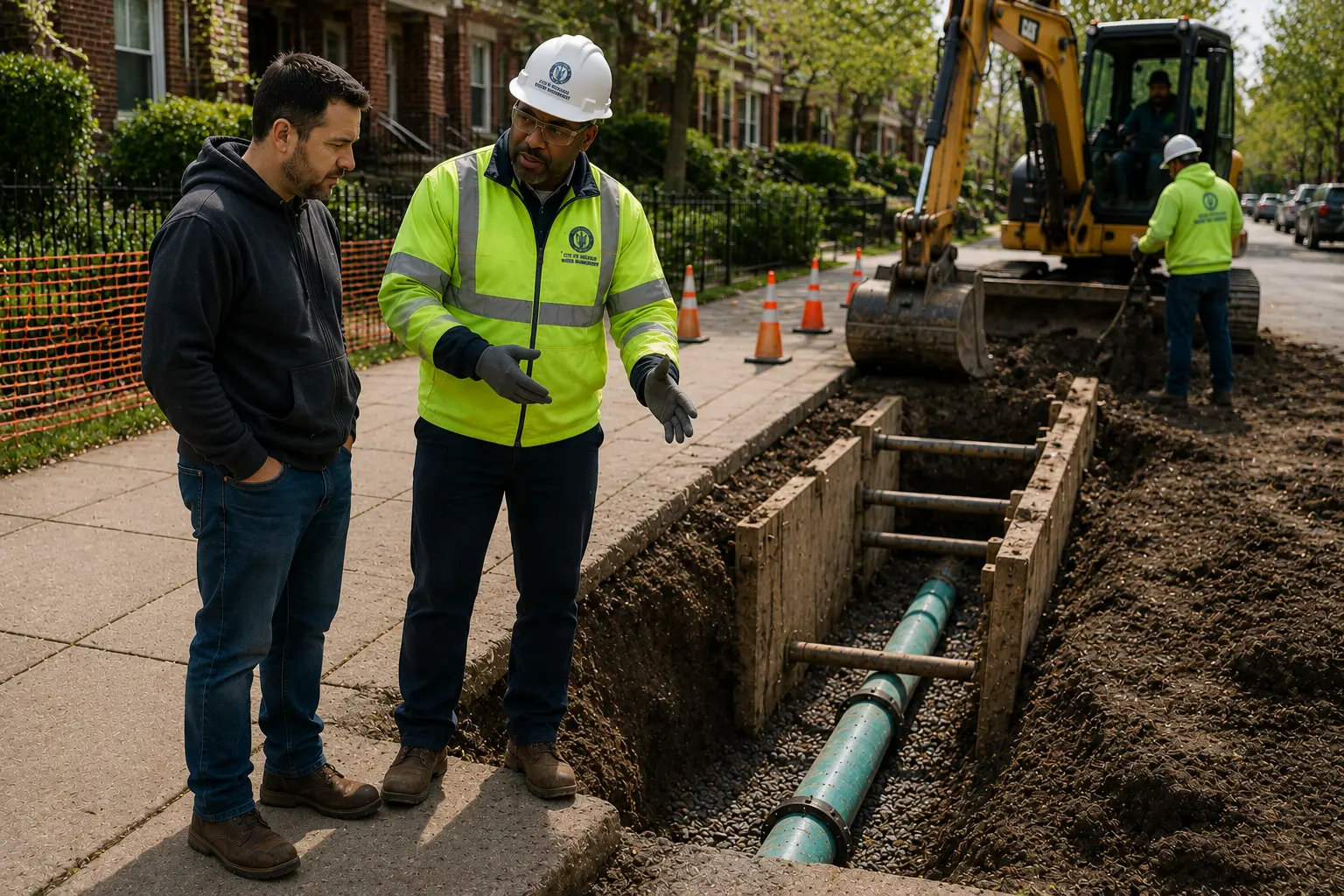
Sewer repair near a sidewalk in Chicago can be more complicated than a repair in a basement, yard, or gangway. The pipe may still be part of the private sewer line, but the location of the problem can involve public-way rules, sidewalk restoration, permits, inspections, access issues, and possible city review.
For homeowners, the most important point is that a sewer problem near the sidewalk should not be treated as a simple digging job until the defect is clearly located. The repair may be the homeowner’s responsibility, may require city permits and inspections, or may need review under Chicago-specific programs if the damaged private drain is under the public way.
Key Takeaways
- Sewer repairs near sidewalks in Chicago often involve both private sewer responsibility and public-way rules.
- The exact location of the defect determines who may be responsible and what approvals may be required.
- Permits and inspections are commonly needed for sewer excavation, replacement, or major repair near sidewalks.
- Sidewalk restoration, pedestrian access, and public safety can affect project cost and timing.
- Chicago’s Private Drain Program may apply in certain qualifying cases involving a broken private drain under the public way.
- Homeowners should ask for camera footage, line locating, permit details, and inspection documentation before approving major work.
- Skipping permit or restoration requirements can create code, resale, and liability problems later.
Why Sewer Repairs Near Sidewalks Need Extra Attention
Sewer repair near a Chicago sidewalk may require permits, inspections, licensed sewer work, and public-way coordination. The homeowner may still be responsible for the private sewer line, but work near or beneath the sidewalk can trigger additional rules because the repair affects public space, pedestrian access, and restoration requirements.
Many Chicago homes have sewer laterals that run from the house toward the street or alley. Depending on the property layout, the line may pass beneath a front yard, parkway, sidewalk, or other public-way area before connecting to the larger sewer system.
That creates a practical problem for homeowners: the pipe may serve only one private property, but the repair location may affect public infrastructure. This is why sewer work near sidewalks should be carefully documented before excavation begins.
For broader context on local sewer rules, permits, inspections, and homeowner responsibilities, see Chicago Permits, Codes & Local Rules.
Is the Homeowner Responsible for Sewer Work Near the Sidewalk?
Sometimes, yes. A sewer line can be the homeowner’s responsibility even when it runs close to or beneath a sidewalk. The key issue is whether the damaged pipe is part of the private sewer lateral or part of the public sewer system.
Homeowners are commonly responsible for the private sewer line serving their property. The city is generally responsible for public sewer mains and public sewer infrastructure. But sidewalk-area repairs can fall into a more complicated middle area because the pipe location may be near public property or under the public way.
| Location or Issue | Why Responsibility Can Be Complicated |
|---|---|
| Pipe under the front yard | Often treated as private-property sewer work. |
| Pipe near the sidewalk | May still be private but can involve public-way concerns. |
| Pipe directly under the sidewalk | May require city review, permits, sidewalk restoration, or program eligibility checks. |
| Pipe near the street connection | Responsibility depends on the exact defect and connection point. |
| City sewer main issue | Generally handled as a public infrastructure matter. |
For a deeper explanation of responsibility boundaries, review Who Is Responsible for Sewer Lines in Chicago? and City Sewer Main vs Private Sewer Line: Who Pays?.
How Contractors Determine Whether the Problem Is Near the Sidewalk
Before a homeowner approves excavation near a sidewalk, the contractor should identify the location and type of sewer defect as clearly as possible.
Common diagnostic steps include:
- Sewer rodding to attempt to clear the blockage
- Camera inspection to see the inside of the pipe
- Distance measurement from an access point or cleanout
- Electronic line locating to mark the pipe path
- Surface marking to estimate where the defect sits
- Review of whether the defect appears structural or maintenance-related
Homeowner decision point: If a contractor says the problem is “near the sidewalk,” ask whether that means on private property, under the sidewalk, under the parkway, or closer to the street. Those details can affect responsibility, permits, cost, and timing.
Permits for Sewer Repair Near Sidewalks
Sewer repair near sidewalks often requires permits because the work may involve excavation, pipe replacement, new connections, public-way impacts, or code-regulated sewer work.
Permits help ensure the repair complies with Chicago requirements and that affected public areas are restored properly. Even when a homeowner is paying for the repair, the work may still require city approval and inspection.
Permit-related questions homeowners should ask include:
- Does this repair require a sewer or plumbing permit?
- Does sidewalk-area excavation require additional approval?
- Who will obtain the permit?
- Are permit fees included in the estimate?
- Will inspections be scheduled before the work is covered?
- Who is responsible for sidewalk or parkway restoration?
Homeowners planning any major sewer project should also review Chicago Sewer Repair Permits: What Homeowners Need to Know.
Inspections and Code Compliance
When sewer work is permitted, inspections may be required before the repair can be covered or finalized. This is especially important near sidewalks because the work may involve both underground sewer code requirements and surface restoration concerns.
Inspectors may review:
- Pipe material and installation method
- Pipe slope and alignment
- Connections between old and new pipe
- Cleanout placement if included in the project
- Excavation and backfill conditions
- Compliance with the approved permit scope
- Sidewalk, parkway, or public-way restoration requirements
If required inspections are missed, the contractor may need to reopen work or provide additional documentation. That can delay completion and increase costs.
For more detail, see Sewer Repair Inspection Requirements in Chicago.
How Chicago’s Private Drain Program May Apply
Chicago’s Private Drain Program may become relevant when a qualifying private drain is broken under the public way. Since sidewalks and parkways may fall within public-way areas, homeowners should understand this program before authorizing costly excavation in that zone.
The program does not cover every clog, backup, root problem, or sewer repair. Eligibility depends on the type of defect, the property, the exact location, documentation, and city review.
When a camera inspection suggests a structural break under or beyond the sidewalk, homeowners should ask whether the issue should be reviewed before proceeding as a normal private repair.
For a full explanation, see Understanding Chicago’s Private Drain Program.
Cost Factors for Sewer Repair Near Sidewalks
Sewer repairs near sidewalks can cost more than simple private-yard repairs because access, permits, safety, and restoration may be more involved. Exact pricing varies based on depth, pipe condition, repair method, excavation area, public-way involvement, and contractor requirements.
| Cost Factor | How It Can Affect the Project |
|---|---|
| Camera inspection and locating | Helps confirm whether the defect is near, under, or beyond the sidewalk. |
| Permit requirements | Adds administrative cost and may affect timing. |
| Excavation depth | Deeper pipes usually require more labor, equipment, and safety measures. |
| Concrete removal | Sidewalk work may involve cutting, removal, and replacement of concrete. |
| Pedestrian access | Work may need to account for safe passage, barriers, or temporary access controls. |
| Pipe replacement scope | A localized repair costs less than replacing a longer section of sewer line. |
| Restoration | Sidewalk, parkway, landscaping, or surface restoration can add cost. |
| Inspection scheduling | Required inspections can affect project timing and coordination. |
When comparing contractor estimates, homeowners should check whether sidewalk restoration, permits, inspection coordination, and public-way requirements are included or excluded.
Repair Options Near Sidewalks
The best repair approach depends on the defect, pipe material, depth, accessibility, and local approval requirements.
Spot Repair
A spot repair targets a specific broken or collapsed section. This may be appropriate when the rest of the line is in acceptable condition and the defect is clearly located.
Partial Replacement
Partial replacement may be used when a longer section of pipe near the sidewalk has failed or multiple defects are present.
Full Sewer Line Replacement
If the sewer line is old, repeatedly failing, or structurally poor throughout, full replacement may be considered. Homeowners should understand permit requirements before approving this type of work. More information is available in Chicago Sewer Replacement Permit Requirements.
Trenchless Methods
Some trenchless methods may reduce surface disruption, but they are not always suitable. Pipe condition, alignment, collapse, access points, and city requirements can limit whether trenchless repair is realistic.
Practical tradeoff: A lower-cost spot repair may solve a specific break, but it may not address aging pipe nearby. A larger replacement may cost more upfront but reduce the chance of repeated sidewalk-area excavation.
Chicago-Specific Considerations
Older Sidewalk-Area Sewer Lines
Many Chicago homes have older sewer laterals made from clay or other aging materials. These pipes can crack, settle, separate, or allow roots to enter. A sidewalk-area repair may uncover additional deterioration beyond the first visible defect.
Parkways, Trees, and Roots
Tree roots can be a major factor near sidewalks and parkways. Roots may enter through cracked or separated joints, but the presence of roots does not automatically determine responsibility or program eligibility.
Public Access and Safety
Sidewalk work can affect pedestrian movement. Contractors may need to manage barriers, access, cleanup, and restoration carefully to reduce safety risks.
Multi-Unit Buildings
Two-flats and multi-unit homes may have more occupants affected by a single sewer problem. These properties may require faster temporary planning, clearer communication, and careful documentation.
Common Mistakes Homeowners Make
Approving Excavation Before the Defect Is Located
Sidewalk-area work can become expensive quickly. Homeowners should ask for camera footage, locating results, and a clear explanation of where the defect is located.
Assuming the City Pays Because the Problem Is Near the Sidewalk
A private sewer line can run near or under public areas while still raising private responsibility questions. City involvement depends on the exact facts.
Ignoring Permit Requirements
Even urgent sewer repairs may still require permits, inspections, or approved restoration.
Comparing Estimates Without Checking Scope
One estimate may include concrete restoration and permits while another does not. Homeowners should compare the full scope, not just the headline price.
Failing to Keep Documentation
Camera footage, location notes, permits, inspection approvals, photos, and invoices may matter for insurance, resale, and future disputes.
Warning Signs That a Sidewalk-Area Sewer Repair Needs Careful Review
Slow down and gather more information if:
- The blockage returns soon after rodding.
- The camera stops at a consistent point near the sidewalk.
- The contractor reports a break, collapse, or separation under the public way.
- The estimate includes sidewalk removal or concrete restoration.
- The repair may affect pedestrian access.
- The problem appears near the street connection.
- There is uncertainty over whether the city should review the issue.
These warning signs do not prove who is responsible, but they do mean the homeowner should confirm documentation, permits, and possible city involvement before moving forward.
Frequently Asked Questions
Who pays for sewer repair under a sidewalk in Chicago?
Responsibility depends on the exact location and nature of the defect. The homeowner may be responsible if the damaged pipe is part of the private sewer line, but city review or special program considerations may apply in certain public-way situations.
Do I need a permit to repair a sewer line near a sidewalk?
Often, yes. Sewer excavation, replacement, major repair, and public-way impacts may require permits and inspections. The contractor should explain what permits are needed before work begins.
Does the Private Drain Program cover sidewalk sewer problems?
It may apply only in certain qualifying cases involving a broken private drain under the public way. It does not cover every backup, clog, or root problem.
Can a contractor remove part of the sidewalk to repair my sewer?
Sidewalk removal may be part of some repairs, but public-way rules, permit requirements, safety measures, and restoration standards may apply.
Will homeowners insurance cover sidewalk-area sewer repair?
Coverage depends on the policy and cause of damage. Sewer backup coverage may help with resulting interior damage, while service line coverage may be needed for underground pipe repair. Surface restoration coverage can vary.
How can I tell if the problem is under the sidewalk?
A sewer camera inspection combined with line locating and distance measurements can help identify whether the defect is under the sidewalk, on private property, or closer to the street.
Should I call 311 for a sidewalk sewer issue?
If the issue may involve public infrastructure, public-way defects, or city review, calling 311 can help create a record. A private sewer inspection may still be needed to document the line condition.
Conclusion
Sewer repair near sidewalks in Chicago requires careful planning because the repair may involve private responsibility, public-way rules, permits, inspections, restoration, and possible city review. The homeowner’s first priority should be confirming exactly where the defect is located and what type of repair is being proposed.
Before approving major sidewalk-area work, homeowners should ask for camera evidence, line locating, permit details, inspection plans, and a clear explanation of who is responsible for restoration. That extra diligence can help prevent unnecessary costs, delays, and disputes once the repair begins.