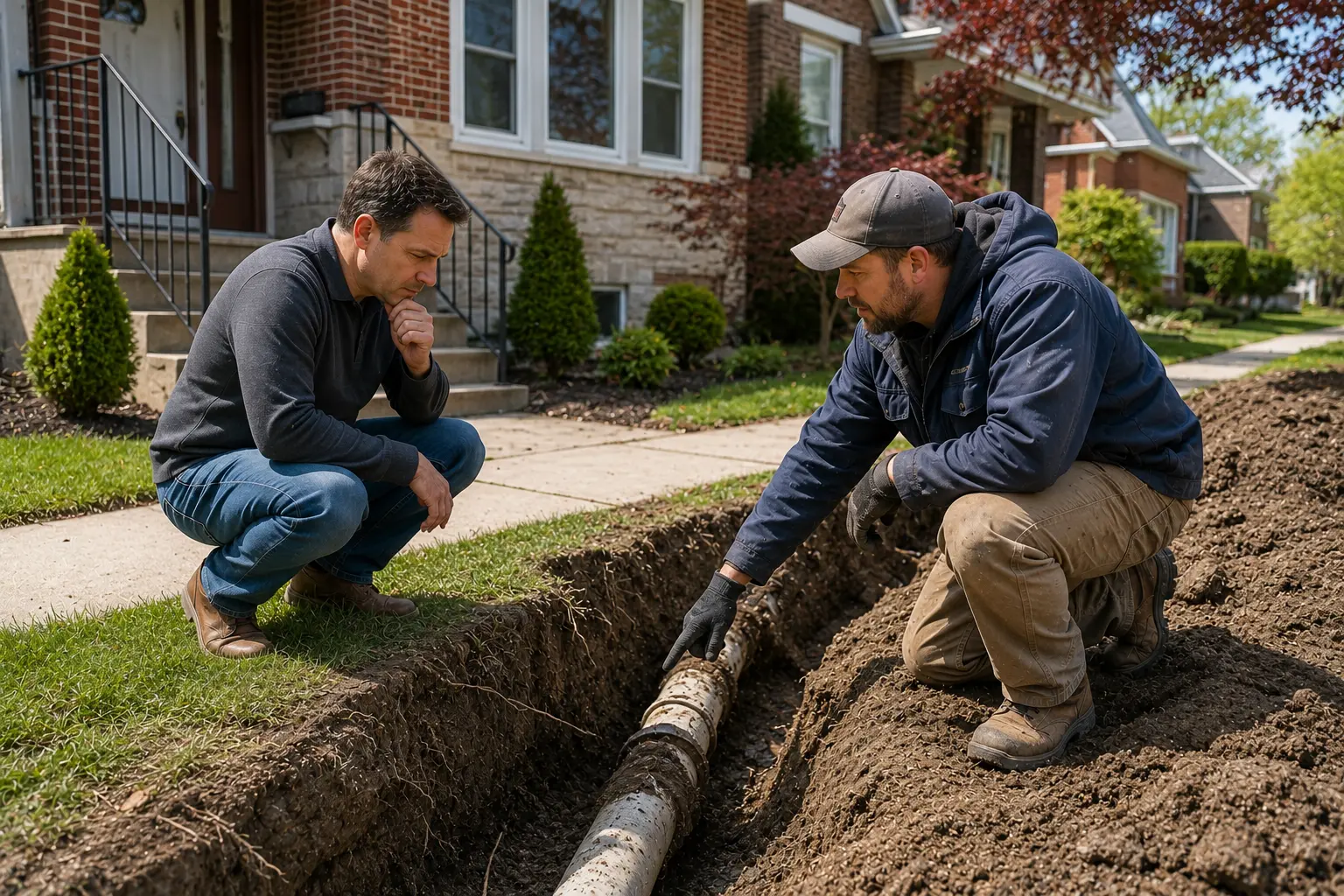
Service line coverage is one of the most important insurance add-ons for homeowners who are worried about sewer line repair or replacement costs. A standard homeowners insurance policy often excludes underground sewer line damage caused by age, deterioration, corrosion, root intrusion, or ground movement. Service line coverage is designed to help close that gap.
For many Chicago homeowners, service line coverage can be worth considering because older homes, clay sewer laterals, mature trees, tight urban lots, and expensive excavation conditions can make sewer line failures financially stressful. Whether it is worth it depends on the age of the property, the condition of the sewer line, the coverage limit, the deductible, exclusions, and what other protections the homeowner already has.
This guide explains how service line coverage works, what it may cover, what it usually excludes, and how Chicago homeowners can decide whether it belongs in their insurance plan. For more sewer insurance and financial planning topics, visit the Insurance & Financial Protection hub.
Key Takeaways
- Service line coverage is an optional homeowners insurance endorsement that may help pay for underground utility line repairs, including sewer lines.
- Standard homeowners insurance often does not cover sewer line replacement caused by deterioration, corrosion, root damage, or normal wear and tear.
- Service line coverage is different from sewer backup coverage, which usually applies to damage inside the home after sewage backs up.
- Coverage limits, deductibles, exclusions, and eligible causes of loss vary by insurer.
- Chicago homeowners with older sewer laterals, mature trees, finished basements, or limited emergency savings may find the endorsement especially useful.
- A sewer camera inspection can help homeowners understand their risk before buying coverage or filing a claim.
Is Service Line Coverage Worth It for Sewer Lines?
Service line coverage may be worth it for Chicago homeowners if the sewer line is older, the property has mature trees, excavation would be expensive, or the household could not comfortably absorb a major sewer repair bill. It is not a guarantee that every sewer problem will be covered, but it can provide valuable protection for certain underground line failures that standard homeowners insurance often excludes.
The decision should come down to policy details. Homeowners should compare the annual cost of the endorsement, the coverage limit, the deductible, covered causes of loss, exclusions, and whether sewer line replacement is clearly included.
What Is Service Line Coverage?
Service line coverage is an optional endorsement that can be added to some homeowners insurance policies. It is designed to cover certain underground utility lines that connect a home to public or shared systems.
Depending on the insurer, covered service lines may include:
- Sewer lines
- Water lines
- Natural gas lines
- Electrical lines
- Steam lines
- Drainage lines
- Communication or data lines
For sewer-related purposes, the most important question is whether the endorsement covers the private sewer lateral between the home and the municipal sewer connection.
That private section is often the homeowner’s responsibility. If it fails, the cost of locating the problem, excavating, repairing the pipe, replacing damaged sections, and restoring the property can fall on the homeowner unless an applicable insurance endorsement, warranty plan, or other protection applies.
Why Standard Homeowners Insurance Usually Is Not Enough
Many homeowners assume their regular homeowners policy will pay for sewer line replacement. In many cases, that assumption is incorrect.
Standard homeowners insurance is usually designed for sudden and accidental damage caused by covered perils. It is generally not designed to pay for aging infrastructure, gradual deterioration, corrosion, maintenance problems, or long-term root intrusion.
That means a sewer line that collapses because it is old, cracked, offset, or weakened over time may not be covered under the base policy.
For a broader explanation of that issue, read Does Homeowners Insurance Cover Sewer Line Replacement?.
What Service Line Coverage May Cover
Every policy is different, but service line endorsements may help pay for several sewer line-related expenses when a covered failure occurs.
| Potential Expense | How Service Line Coverage May Help |
|---|---|
| Excavation | May help pay to dig and access the damaged underground sewer line. |
| Pipe repair | May help cover repair of a damaged section of the sewer lateral. |
| Pipe replacement | May help cover replacement when repair is not practical, subject to limits. |
| Backfill and restoration | May help restore affected soil, pavement, landscaping, or hardscaping depending on policy terms. |
| Temporary repairs | May help pay for emergency measures needed to stabilize the situation. |
| Additional living expenses | May be included in some policies if the home becomes uninhabitable due to a covered loss. |
The endorsement’s value depends heavily on what it includes. Some policies are more generous than others, and some have important restrictions buried in the endorsement language.
What Service Line Coverage May Exclude
Service line coverage can be helpful, but it is not unlimited protection. Homeowners should read the endorsement carefully before relying on it.
Common exclusions or limitations may involve:
- Pre-existing damage
- Known defects before the policy was purchased
- Improper installation
- Defective materials
- Septic systems, if excluded
- Lines not owned by the homeowner
- Damage beyond the property boundary
- Cosmetic restoration limits
- Claims below the deductible
- Failures caused by excluded events
Some endorsements cover wear and tear more clearly than others. Others may use narrow language that limits when coverage applies. The details matter.
Homeowner tip: Do not assume the phrase “service line coverage” automatically means every sewer line problem is covered. Ask whether underground sewer laterals are included, what causes of loss are covered, and whether replacement costs are subject to a separate limit.
Service Line Coverage vs. Sewer Backup Coverage
Service line coverage and sewer backup coverage are often confused, but they protect against different financial risks.
| Coverage Type | Main Purpose | Common Sewer-Related Use |
|---|---|---|
| Service line coverage | Covers certain underground utility line failures | May help pay to repair or replace the sewer pipe itself |
| Sewer backup coverage | Covers certain damage caused by sewage entering the home | May help pay for cleanup, sanitation, damaged flooring, drywall, or belongings |
A homeowner may need both coverages to address both sides of a sewer event. Service line coverage may address the broken underground pipe, while sewer backup coverage may address contaminated materials inside the home.
For a deeper comparison, review Sewer Backup Insurance Coverage Explained and Is a Sewer Backup Endorsement Worth It?.
Chicago-Specific Considerations
Chicago homeowners should evaluate service line coverage in the context of local housing, infrastructure, weather, and property conditions.
Older Homes and Older Sewer Laterals
Many Chicago homes were built before modern plastic sewer pipe materials became common. Older clay, cast iron, and other legacy materials can crack, shift, deteriorate, or allow root intrusion over time.
Mature Trees and Root Intrusion
Tree-lined streets are part of the character of many Chicago neighborhoods, but mature trees can also increase sewer line risk. Roots may enter joints or cracks and eventually restrict flow or damage the pipe.
Coverage for roots depends on policy language, so homeowners with root concerns should also read Insurance Coverage for Tree Root Sewer Damage.
Urban Excavation Challenges
In Chicago, sewer repair may involve narrow lots, sidewalks, alleys, driveways, fencing, utility conflicts, and limited equipment access. These conditions can increase the complexity of a sewer replacement.
Finished Basements and Lower-Level Living Space
A sewer line failure can create both pipe repair costs and interior damage risk. Homes with finished basements may have more at stake if drainage problems lead to backups.
Weather and Drainage Pressure
Heavy rainfall and overwhelmed drainage systems can expose weaknesses in private sewer lines. While service line coverage does not replace flood insurance or sewer backup protection, it may help when an underground line itself fails under covered circumstances.
When Service Line Coverage May Be Worth It
Service line coverage is more likely to be worth considering when the homeowner has meaningful exposure to underground sewer repair costs.
It may be especially useful if:
- The home is older
- The sewer line material is unknown
- The property has large nearby trees
- The basement is finished or heavily used
- The homeowner has limited emergency savings
- Excavation would involve hardscaping, sidewalks, patios, or driveways
- Previous sewer inspections showed cracks, offsets, roots, or deterioration
- The endorsement has strong limits and clear sewer line language
For many homeowners, the value is not just whether a claim is likely. It is whether the cost of the endorsement is reasonable compared with the financial impact of one major sewer line failure.
When Service Line Coverage May Be Less Valuable
Service line coverage may be less useful in some situations.
It may be less valuable if:
- The sewer line was recently replaced
- The policy limit is low
- The deductible is high compared with likely repair costs
- The endorsement excludes the most likely causes of failure
- The homeowner already has overlapping coverage through another plan
- The line is not privately owned or not the homeowner’s responsibility
- The policy excludes damage discovered before the endorsement was purchased
This does not mean the endorsement is unnecessary. It means the homeowner should compare the cost, limit, and exclusions against the actual risk.
Questions to Ask Before Buying Service Line Coverage
Before adding service line coverage, homeowners should ask specific questions instead of relying on general descriptions.
- Does the endorsement cover sewer lines specifically?
- Does it cover the full private lateral from the house to the municipal connection?
- What is the coverage limit?
- What is the deductible?
- Are excavation and restoration included?
- Are tree roots covered?
- Is wear and tear covered?
- Are older pipes excluded?
- Are pre-existing issues excluded?
- Is there a waiting period?
- Does the insurer require specific contractors or approval before work begins?
These questions can prevent confusion later if a claim occurs.
How Inspections Affect the Decision
A sewer camera inspection can help homeowners understand whether service line coverage is especially important. It can reveal cracks, offsets, roots, bellies, deterioration, or partial collapses.
However, inspection timing matters. If a known defect already exists before coverage is purchased, an insurer may treat it as a pre-existing condition. That can affect whether a future claim is approved.
If a homeowner already knows the sewer line has serious damage, service line coverage may not solve the immediate problem. In that case, the homeowner may need to evaluate repair options, financing, or payment plans instead.
For homeowners already facing affordability concerns, Sewer Repair Payment Plans Explained may be helpful.
Service Line Coverage vs. Sewer Line Warranty Plans
Some homeowners compare service line coverage with sewer line warranty plans. These products may sound similar, but they are not the same.
| Option | How It Usually Works | Key Concern |
|---|---|---|
| Service line coverage | Added to a homeowners insurance policy as an endorsement | Terms depend on insurer, deductible, limits, and exclusions |
| Sewer line warranty plan | Separate service contract or warranty-style plan | May include contractor networks, caps, exclusions, and service limitations |
| Home warranty | Broader home system warranty with plumbing provisions | Underground sewer laterals may be limited or excluded |
Homeowners comparing options should read the fine print carefully. For more detail, see Sewer Line Warranty Plans: What Homeowners Should Know and Does a Home Warranty Cover Sewer Lines?.
Common Mistakes Homeowners Make
Common service line coverage mistakes include:
- Assuming standard homeowners insurance already covers sewer replacement
- Confusing sewer backup coverage with service line coverage
- Ignoring the deductible and coverage limit
- Failing to ask whether tree roots are covered
- Waiting until a sewer problem is already known before trying to add coverage
- Assuming all underground lines are covered automatically
- Not documenting sewer inspections or maintenance
Claim disputes can arise when homeowners misunderstand their policy or cannot document the cause of the damage. If a claim is denied, the reason often comes down to exclusions, pre-existing conditions, or insufficient evidence.
For related guidance, see Why Sewer Line Insurance Claims Get Denied.
How to Decide If It Makes Sense for Your Home
A practical decision starts with comparing risk and protection.
Consider these homeowner decision points:
- Age of the home: Older homes may have older underground sewer materials.
- Known sewer condition: A recent camera inspection can clarify risk.
- Property layout: Driveways, patios, alleys, and sidewalks can increase repair complexity.
- Coverage terms: A strong endorsement with clear sewer line language is more valuable than vague coverage.
- Financial cushion: Homeowners with limited emergency savings may benefit more from predictable annual protection.
- Overlapping protection: Existing warranty plans or endorsements should be compared to avoid paying twice for limited benefit.
Service line coverage is not a substitute for maintenance, but it can be part of a broader financial protection strategy.
Frequently Asked Questions
Does service line coverage include sewer lines?
It often can, but homeowners should confirm this directly in the policy endorsement. Some service line endorsements include sewer laterals, while others may use narrower language or exclusions.
Is service line coverage the same as sewer backup insurance?
No. Service line coverage generally applies to the underground pipe itself. Sewer backup coverage generally applies to damage inside the home after sewage backs up through a drain, toilet, or plumbing fixture.
Does service line coverage pay for excavation?
Many service line endorsements may include excavation as part of a covered repair, but the amount and conditions depend on the policy. Homeowners should ask whether digging, backfill, and surface restoration are included.
Will service line coverage pay for tree root damage?
It depends on the insurer and policy language. Some endorsements may cover root-related damage, while others may exclude gradual intrusion, pre-existing conditions, or maintenance-related failures.
Should I get a sewer camera inspection before buying coverage?
A camera inspection can help reveal the condition of the sewer line. However, if it identifies existing damage before coverage is purchased, that damage may be considered pre-existing and may not be covered later.
Is service line coverage useful for older Chicago homes?
It can be. Older Chicago homes may have aging sewer laterals, mature nearby trees, and higher excavation complexity. Those factors can make service line coverage worth reviewing carefully.
Does service line coverage replace the need for maintenance?
No. Homeowners still need to address clogs, recurring backups, root problems, and other warning signs. Insurance coverage may be limited if damage is linked to neglect or an unresolved maintenance issue.
Conclusion
Service line coverage can be worth it for many Chicago homeowners, especially those with older homes, mature trees, unknown sewer line materials, finished basements, or limited emergency savings. It may help cover underground sewer line repair or replacement costs that standard homeowners insurance often excludes.
The value depends on the details. Homeowners should review the endorsement carefully, confirm that sewer lines are included, compare limits and deductibles, ask about root damage and wear and tear, and understand how service line coverage differs from sewer backup insurance.
For homeowners trying to avoid major financial surprises, service line coverage is worth at least reviewing before a sewer emergency occurs.