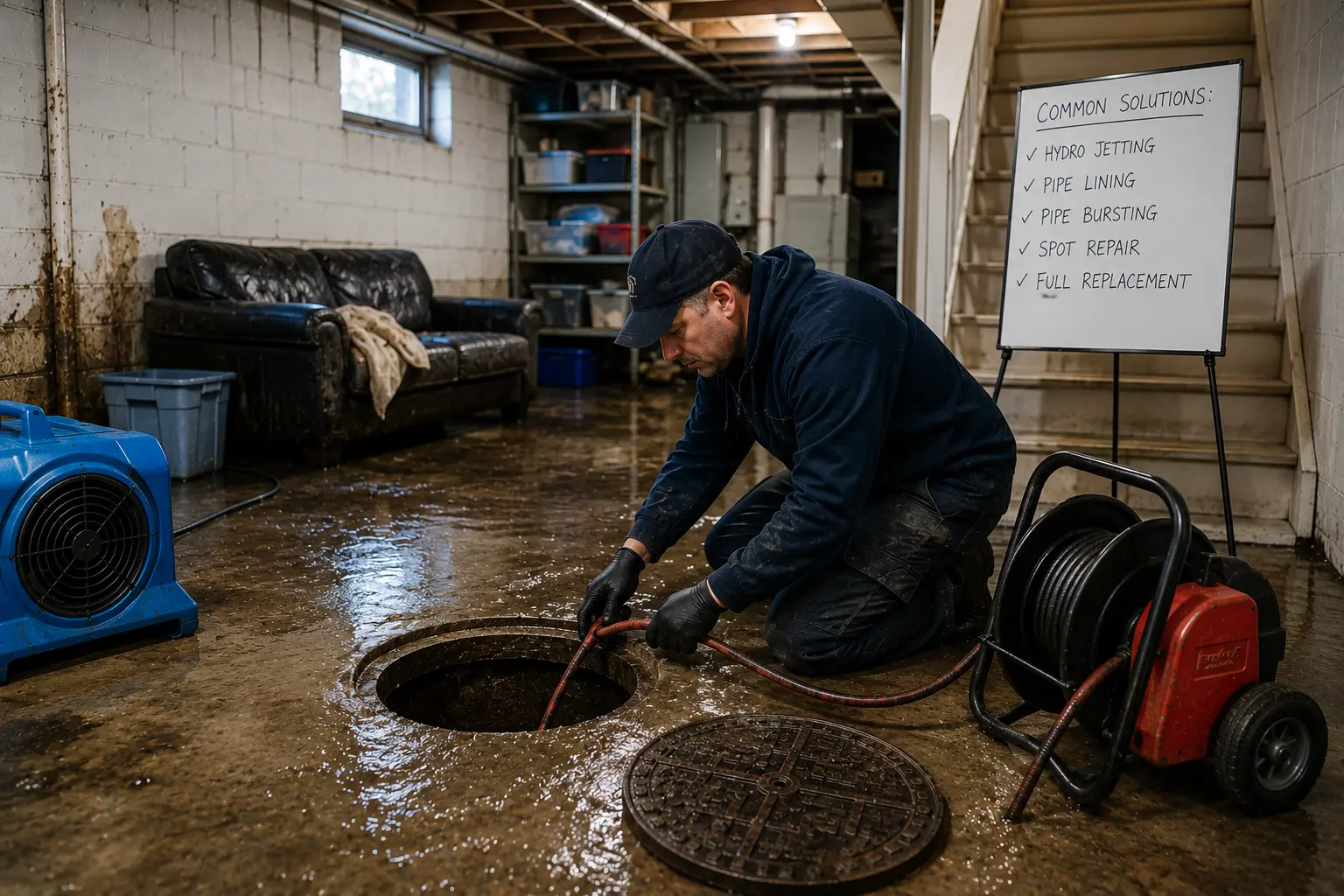
A basement sewer backup is one of the most disruptive sewer problems a Chicago homeowner can face. When wastewater comes up through a floor drain, laundry drain, utility sink, shower, or basement toilet, the issue can quickly affect flooring, drywall, stored belongings, mechanical systems, and indoor air quality.
Basement sewer backup repair usually starts with controlling the immediate backup, identifying why sewage entered the basement, and deciding whether the solution is cleaning, pipe repair, a backwater prevention device, sewer line replacement, or cleanup and restoration. The right solution depends on whether the backup was caused by a private sewer lateral problem, a main line blockage, heavy rain, a damaged pipe, or a failure in the home’s drainage setup.
For Chicago homes, basement backups deserve careful attention because older sewer lines, below-grade plumbing, combined sewer pressure, and recurring rain events can all contribute to repeated problems. A quick cleaning may help in some cases, but repeated backups often require deeper investigation.
Key Takeaways
- Basement sewer backup repair depends on the cause of the backup, not just where the water appeared.
- The first priority is stopping water use, limiting exposure, and preventing the backup from spreading.
- A sewer camera inspection can help determine whether the cause is roots, blockage, pipe damage, collapse, or another structural issue.
- Cleanup and sewer repair are separate needs; fixing the pipe does not automatically make the basement safe or dry.
- Chicago homes with older sewer laterals, basement floor drains, and heavy rain exposure may face higher backup risk.
- Backwater valves, sewer line repairs, drain cleaning, and replacement may all be possible solutions depending on the situation.
What Is the Best Repair for a Basement Sewer Backup?
The best repair for a basement sewer backup depends on the cause. A simple blockage may only require drain cleaning, while roots, cracked pipe, offset joints, or collapsed sewer lines may require repair or replacement. If backups happen during heavy rain, a backwater valve or drainage evaluation may also be considered. Homeowners should avoid choosing a repair before the sewer line has been properly inspected.
What Causes Sewage to Back Up Into a Basement?
Basements are often the first place a sewer backup appears because they contain the lowest drains in the home. When the main sewer line cannot carry wastewater away, sewage may return through the lowest available opening.
Common causes include:
- Main sewer line blockage
- Tree roots growing into the sewer lateral
- Collapsed or cracked sewer pipe
- Offset pipe joints
- Grease, wipes, or debris buildup
- Heavy rain overwhelming the sewer system
- Failed or missing backwater protection
- Improper basement plumbing connections
- Old clay or cast-iron sewer lines
If the backup is active, the first step is not selecting a permanent repair. It is stopping water use and controlling damage. Homeowners should review What to Do After a Sewer Backup for immediate safety and damage-control steps.
Common Basement Sewer Backup Repair Solutions
There is no single repair that fits every basement backup. The solution should match the cause, the condition of the sewer line, and the likelihood of the problem returning.
| Solution | When It May Help | Important Limitation |
|---|---|---|
| Drain cleaning or sewer rodding | Blockages from roots, grease, debris, or buildup | May not solve cracked, collapsed, or misaligned pipe |
| Hydro jetting | Heavy buildup or recurring restrictions | May not be appropriate for fragile or severely damaged pipe |
| Sewer camera inspection | Unknown cause, repeat backup, suspected pipe damage | Usually diagnostic, not a repair by itself |
| Spot sewer repair | Localized crack, offset, root-damaged section, or small collapse | May not help if the entire line is deteriorated |
| Backwater valve | Backups related to reverse flow from sewer surcharge | Must be properly selected, installed, and maintained |
| Temporary repair | Emergency stabilization until permanent work can be scheduled | Not a long-term substitute for needed sewer repair |
| Full sewer replacement | Severe deterioration, repeated failures, or major collapse | More disruptive and may require permits and restoration |
Drain Cleaning: When It Is Enough and When It Is Not
Drain cleaning is often the first repair attempt when a basement backup appears to be caused by a blockage. If the sewer line is obstructed by debris, grease, roots, or buildup, clearing the line may restore flow and stop the immediate backup.
Drain cleaning may be enough when:
- The backup is the first known occurrence
- The pipe appears structurally sound
- The blockage is removed completely
- Drainage returns to normal
- No serious defects are found during inspection
However, cleaning may only provide temporary relief if the sewer line has structural damage. Roots, cracks, bellies, offset joints, and collapsed sections can cause the backup to return even after the line is cleared.
If a basement drain backs up repeatedly, the issue should not be treated as a normal clog without further investigation. Recurring backups often suggest a deeper sewer line problem.
Sewer Camera Inspection After a Basement Backup
A sewer camera inspection is one of the most useful tools for understanding why a basement backup happened. It allows the condition of the sewer line to be evaluated from inside the pipe.
A camera inspection may identify:
- Tree root intrusion
- Cracked pipe walls
- Collapsed pipe sections
- Pipe bellies holding standing water
- Offset joints
- Grease or scale buildup
- Foreign objects or obstructions
- Sections where wastewater is not flowing properly
In urgent situations, an inspection can help homeowners decide whether they are dealing with a simple blockage or a more serious sewer failure. For more detail, see Emergency Sewer Camera Inspections.
Backwater Valves and Basement Backup Prevention
A backwater valve is designed to reduce the risk of sewage flowing backward into a home when sewer pressure reverses direction. This can be relevant when basement backups happen during heavy rain or sewer surcharge conditions.
A backwater valve may be considered when:
- Backups happen during storms
- The home has below-grade plumbing fixtures
- The basement contains floor drains, laundry drains, or bathrooms
- Reverse flow from the sewer system is suspected
- The private sewer line is otherwise in repairable condition
However, a backwater valve is not a universal fix. It will not repair a collapsed sewer pipe, remove roots, correct a pipe belly, or fix poor drainage slope. It also requires proper installation and maintenance.
Homeowners should treat backwater protection as one possible part of a repair strategy, not a substitute for diagnosing the sewer line.
Spot Repairs for Basement Sewer Backup Problems
If the sewer camera inspection shows one clearly damaged section, a spot repair may be recommended. This approach focuses on repairing the specific section causing the backup rather than replacing the entire sewer line.
Spot repair may make sense when:
- The damage is isolated
- The rest of the sewer line appears usable
- The problem area can be accessed reasonably
- The homeowner wants to avoid unnecessary full replacement
- The repair will likely reduce the risk of repeat backups
Spot repairs can be practical, but they depend heavily on accurate diagnosis. If the sewer line has multiple failing sections, a single repair may not prevent future problems.
Temporary Repairs During Basement Sewer Emergencies
Sometimes a basement backup happens at the worst possible time: at night, during a storm, over a weekend, or when immediate excavation is not practical. In those situations, temporary measures may be used to reduce damage or restore limited use until permanent repairs can be scheduled.
Temporary steps may include:
- Clearing enough of the blockage to restore partial flow
- Restricting water use until permanent repair
- Isolating affected basement fixtures
- Using cleanup and drying measures to reduce contamination
- Scheduling follow-up sewer repair after inspection
Temporary solutions should be treated carefully. They may help stabilize the situation, but they are not always permanent repairs. For more detail, read Temporary Sewer Line Repair Options.
When Full Sewer Line Replacement May Be Needed
Basement backups can sometimes reveal a sewer line that is beyond simple cleaning or spot repair. Replacement may be considered when the pipe is severely deteriorated or has multiple defects.
Full replacement may become more likely when:
- The sewer line has collapsed
- There are multiple damaged sections
- Roots keep returning after cleaning
- The pipe has repeated backups despite prior repairs
- The line has major sagging or standing water
- The material is old and failing throughout the run
Replacement can take longer than a simple emergency repair, especially when excavation, permits, weather, or utility conflicts are involved. Homeowners trying to understand timing can review How Quickly Can a Sewer Line Be Replaced?.
Chicago-Specific Considerations for Basement Sewer Backups
Chicago homes have several characteristics that make basement sewer backups especially important to address carefully.
Older Housing Stock
Many Chicago neighborhoods include homes with older sewer laterals. Aging pipe materials can be more vulnerable to roots, cracks, offsets, and collapse.
Basement Living and Storage Space
Basements may contain finished rooms, laundry areas, utilities, stored belongings, and sometimes living space. A sewer backup can therefore create significant cleanup and restoration needs.
Heavy Rain Events
Backups during heavy rain may involve sewer surcharge, private lateral problems, or property drainage issues. Repeated rain-related backups should be investigated rather than dismissed as unavoidable.
Urban Lot Constraints
Repair work may be complicated by narrow lots, garages, sidewalks, alleys, fences, concrete, landscaping, and limited equipment access.
Permit Requirements
Major sewer work may require permits, especially if excavation or work near public areas is involved. Homeowners can learn more from Emergency Sewer Repair Permits in Chicago.
The broader Emergency Sewer Repair hub organizes related guidance on urgent sewer issues, inspections, cleanup, costs, and repair timelines.
Cleanup After a Basement Sewer Backup
Repairing the sewer line does not automatically make the basement safe. If sewage entered the basement, cleanup and drying may be needed even after the backup stops.
Cleanup may involve:
- Removing standing wastewater
- Disinfecting hard surfaces
- Removing contaminated carpet, padding, drywall, or insulation
- Drying the basement thoroughly
- Discarding unsalvageable porous items
- Controlling odor and moisture
- Documenting damage for insurance
Porous materials that contacted sewage can be difficult to clean safely. For a deeper explanation of cleanup decisions, see Sewage Cleanup After a Sewer Backup.
Cost Factors for Basement Sewer Backup Repair
The cost of repairing a basement sewer backup depends on the cause of the backup and the amount of damage it caused. Clearing a blockage is very different from repairing a collapsed sewer lateral or restoring a contaminated finished basement.
Common cost factors include:
- Whether the backup is active or recurring
- Whether sewage entered finished basement space
- Whether a camera inspection is needed
- Depth and location of the damaged sewer line
- Whether the pipe is accessible through a cleanout
- Whether excavation is required
- Whether permits are needed
- Whether cleanup and restoration are separate expenses
- Whether work is performed after hours or on a weekend
If the backup happens outside normal business hours, pricing may be affected by urgency and scheduling. See Weekend Sewer Repair Costs Explained for more on after-hours cost considerations.
Insurance Considerations After a Basement Sewer Backup
Insurance coverage depends on the policy and the cause of the damage. Some homeowners have sewer backup or water backup coverage, while others do not. Even when coverage applies, limits and exclusions may affect what is reimbursed.
Insurance may potentially relate to:
- Cleanup and drying
- Damaged flooring or drywall
- Damaged personal property
- Temporary housing in severe cases
- Restoration of affected areas
Insurance may not automatically cover:
- The sewer line repair itself
- Damage caused by long-term deterioration
- Preventive upgrades
- Work completed without documentation
Before removing damaged materials, take photos and videos when it is safe. Documentation can be important if you plan to file an insurance claim.
Common Mistakes Homeowners Make With Basement Backups
Continuing to Use Water
Running toilets, showers, sinks, or laundry can push more wastewater into the basement if the sewer line is blocked.
Assuming It Was Only a One-Time Clog
A single backup may be caused by a temporary blockage, but repeated backups often point to a sewer line defect.
Skipping the Camera Inspection
Without inspection, it is difficult to know whether the pipe is damaged, collapsed, or likely to back up again.
Cleaning Only the Visible Water
Sewage contamination can affect porous materials and hidden areas, not just visible standing water.
Installing a Backwater Valve Without Diagnosing the Sewer Line
A backwater valve may help in some situations, but it will not fix roots, collapse, major pipe damage, or poor pipe slope.
Waiting Too Long After Repeat Backups
Recurring basement backups tend to become more disruptive and expensive if the underlying issue is left unresolved.
Warning Signs the Basement Backup Problem May Return
After a basement sewer backup, homeowners should watch for signs that the sewer problem has not been fully resolved.
- Basement floor drain smells like sewage
- Water appears around the floor drain during laundry
- Toilets gurgle when other fixtures drain
- Multiple drains slow down at once
- Backups happen during heavy rain
- The sewer line needs frequent rodding
- Sewage odors return after cleaning
- Camera inspection shows roots, cracks, standing water, or collapse
These warning signs suggest the backup may not have been an isolated event.
Frequently Asked Questions
What should I do first after sewage backs up into my basement?
Stop using water immediately. Do not flush toilets, run sinks, use laundry, or shower until the sewer line is evaluated. Keep people and pets away from the affected area and document damage if it is safe.
What is the most common repair for a basement sewer backup?
The most common first step is often clearing the sewer line, but the right repair depends on the cause. If the line is damaged, collapsed, or repeatedly blocked by roots, cleaning alone may not be enough.
Do I need a camera inspection after a basement backup?
A camera inspection is strongly worth considering if the backup affected multiple fixtures, came through a floor drain, happened more than once, or occurred without an obvious isolated cause.
Can a backwater valve stop basement sewer backups?
A backwater valve can help reduce backups caused by reverse flow from sewer surcharge, but it does not repair damaged pipe, remove roots, or fix a collapsed sewer lateral.
Will insurance cover basement sewer backup repair?
Insurance coverage depends on your policy. Sewer backup or water backup coverage may help with cleanup and damage, but the sewer line repair itself may not be covered.
Can I clean up a basement sewer backup myself?
Small, limited incidents on hard surfaces may be more manageable than large backups, but sewage should be treated as contaminated. Porous materials such as carpet, drywall, and insulation may require removal.
Why does my basement drain back up during heavy rain?
Rain-related backups may involve sewer surcharge, private lateral restrictions, foundation drainage issues, or a combination of factors. Repeated storm-related backups should be investigated.
How do I know if the sewer line needs replacement?
Replacement may be considered if inspection shows collapse, severe deterioration, multiple defects, major root intrusion, or repeated failures after prior cleaning or repair.
Conclusion
Basement sewer backup repair starts with understanding why the backup happened. A simple blockage may be resolved with cleaning, but recurring backups, root intrusion, collapsed pipe, heavy rain surcharge, or older sewer lateral defects may require more involved solutions.
For Chicago homeowners, basement backups should be taken seriously because they can affect health, property, storage, utilities, and finished living space. The best repair decision usually comes after the immediate backup is controlled, the affected area is documented and cleaned, and the sewer line is inspected well enough to identify the real cause.