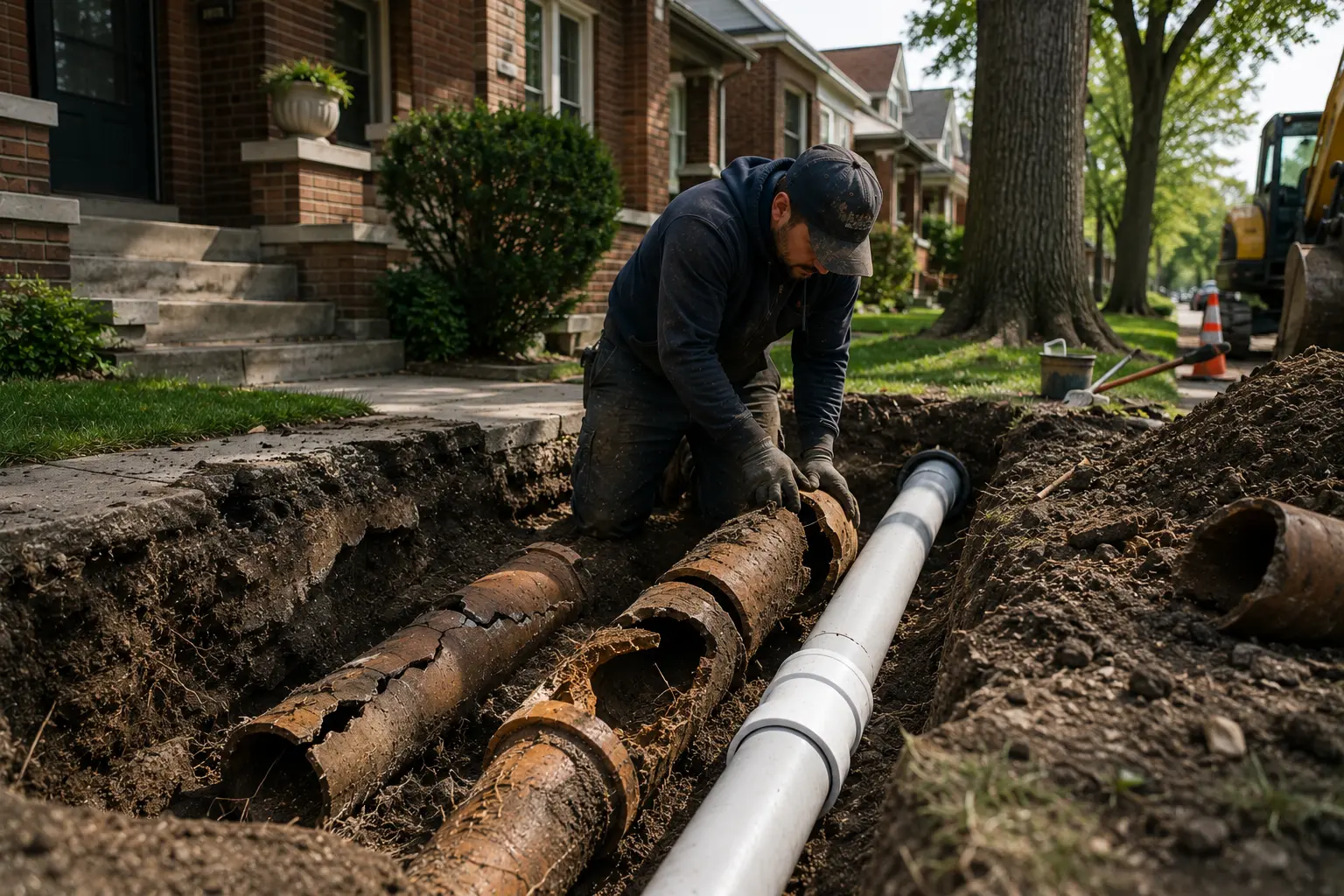
Clay sewer pipes are common in many older Chicago homes, especially properties built before modern plastic sewer materials became standard. These pipes were widely used because they were durable, available, and appropriate for the construction practices of their time. Decades later, many clay sewer lines are still in service, but age, tree roots, shifting soil, and joint separation can create serious problems for homeowners.
For Chicago homeowners, the key issue is not simply whether a sewer line is made of clay. Some clay pipes continue functioning for many years. The larger question is whether the pipe is cracked, offset, root-filled, partially collapsed, or deteriorated enough that repeated repairs are no longer practical.
This guide explains the risks of clay sewer pipes in Chicago homes, how to recognize problems, when replacement may be necessary, and what decision points homeowners should consider before committing to a repair plan. For broader property-type guidance, visit the Older Chicago Homes & Property Types resource hub.
Key Takeaways
- Clay sewer pipes are common in many older Chicago homes.
- Clay itself can last a long time, but pipe joints, cracks, and root intrusion often become the weak points.
- Recurring clogs, sewer backups, and frequent root removal may indicate a structural sewer problem.
- A sewer camera inspection is usually needed to determine whether repair or replacement makes sense.
- Replacement options may include traditional excavation or trenchless methods, depending on pipe condition and property layout.
- Homeowners should consider long-term risk, basement exposure, home sale plans, and repeated maintenance costs before deciding.
Should Chicago Homeowners Replace Clay Sewer Pipes?
Chicago homeowners do not always need to replace clay sewer pipes simply because they are old. Replacement becomes more likely when a camera inspection shows serious cracking, repeated root intrusion, separated joints, pipe collapse, or widespread deterioration. If the pipe is still structurally sound and problems are isolated, targeted repair or maintenance may be enough.
The best decision depends on the condition of the pipe, how often problems occur, where the damage is located, and how much risk the homeowner is willing to accept. In homes with finished basements, rental units, or upcoming sale plans, the threshold for addressing clay sewer problems may be lower because the consequences of failure can be more expensive.
Why Clay Sewer Pipes Are Common in Older Chicago Homes
Many Chicago homes were built during periods when vitrified clay pipe was a standard sewer material. Bungalows, greystones, two-flats, and other older property types often relied on clay sewer laterals connecting the home to the public sewer system.
Clay pipe was a practical material for its time. It resisted corrosion, handled underground conditions reasonably well, and could last for decades when properly installed. The problem is that many of these systems are now old enough that installation defects, root pressure, settlement, and normal wear can become more visible.
Clay sewer issues are part of a larger pattern seen across aging properties. For a broader look at related problems, see Common Sewer Problems in Older Chicago Homes.
How Clay Sewer Pipes Fail
Clay sewer lines usually do not fail all at once unless there is a collapse or major break. More often, problems develop gradually. Small defects allow roots, debris, and soil movement to create larger issues over time.
Cracked Pipe Sections
Clay pipe can crack because of shifting soil, freeze-thaw movement, age, heavy surface loads, or pressure from nearby tree roots. Even small cracks can allow roots and groundwater to enter the line.
Separated or Offset Joints
Clay sewer systems are made from individual pipe sections joined together. Over time, joints can separate or shift out of alignment. Once that happens, wastewater flow may be restricted, roots may enter, and debris may collect at the offset.
Root Intrusion
Root intrusion is one of the most common problems with clay sewer pipes. Roots are drawn to moisture and can enter through cracks or joints. Once inside, they expand and trap waste, grease, paper, and debris.
This is especially relevant in older neighborhoods with mature trees. Homeowners dealing with this issue may also want to read Sewer Issues in Homes Near Large Trees.
Pipe Collapse
Severely deteriorated clay pipe can eventually collapse. A collapsed section usually prevents normal flow and often requires more significant intervention than routine cleaning.
Low Spots and Bellies
If the soil under the pipe settles, a section of sewer line may sag. This creates a low spot where water and solids collect. A belly in a clay sewer line can cause repeated blockages even if the pipe is not fully broken.
Warning Signs of Clay Sewer Pipe Problems
Homeowners usually notice symptoms inside the home before they know what is happening underground. Clay pipe problems can look like ordinary drain issues at first, which is why repeated symptoms matter.
Common warning signs include:
- Frequent sewer backups
- Slow drains in multiple fixtures
- Gurgling toilets or drains
- Sewage odors near drains or in the basement
- Recurring need for sewer rodding or hydro jetting
- Backups after heavy rain or high water use
- Soft, sunken, or unusually wet areas in the yard
- Visible roots, cracks, or standing water in camera footage
Basement symptoms deserve special attention in Chicago homes because many older properties have laundry areas, storage, mechanical systems, or finished living space below grade. Related risks are discussed in Sewer Backup Problems in Chicago Basements.
How Sewer Camera Inspections Help Diagnose Clay Pipe Condition
A sewer camera inspection allows a contractor to view the interior of the line and identify the condition of the pipe. This is especially important with clay systems because symptoms alone do not show whether the problem is minor, isolated, or widespread.
A camera inspection may reveal:
- Root entry points
- Cracks or missing pipe sections
- Separated joints
- Offset pipe sections
- Standing water
- Heavy scale or debris buildup
- Collapsed pipe sections
- Improper connections from past work
For homebuyers, this can be one of the most important inspections on an older property. Sewer problems may not be visible during a standard home inspection. More guidance is available in Sewer Inspection Before Buying a Chicago Home.
Repair vs Replacement: How Homeowners Should Think About the Decision
Clay sewer pipe problems fall on a spectrum. Some are manageable with maintenance or targeted repair. Others indicate that the sewer line is nearing the end of its practical service life.
| Inspection Finding | Possible Meaning | Likely Decision Point |
|---|---|---|
| Minor root intrusion at one joint | Localized weakness | Cleaning, monitoring, or targeted repair may be considered |
| Multiple root entry points | Widespread joint or pipe deterioration | Replacement may become more practical than repeated cleaning |
| Small isolated crack | Limited structural issue | Repair may be possible depending on location |
| Several cracked sections | System-wide aging | Replacement should be evaluated |
| Offset joints | Pipe movement or settlement | Repair or replacement depends on severity |
| Collapsed section | Major structural failure | Replacement or excavation is often required |
| Standing water from a belly | Sagging pipe or settlement | Repair may require correcting slope |
When Repair May Be Enough
Repair may be reasonable when the damage is isolated, the rest of the line appears stable, and the homeowner has not experienced repeated backups. A small defect in one accessible section of pipe may not justify replacing the entire line.
When Replacement May Make More Sense
Replacement becomes more reasonable when problems are recurring, widespread, or structural. If a homeowner has paid for repeated cleaning and the same problem keeps returning, the underlying clay pipe may be the issue rather than the blockage itself.
Replacement Options for Clay Sewer Pipes
Replacement options depend on the pipe’s condition, depth, path, and accessibility. Chicago homes can present unique challenges because of narrow lots, sidewalks, mature trees, garages, gangways, and finished basements.
Traditional Excavation
Traditional excavation involves digging to expose and replace the damaged sewer line. This method may be necessary when the pipe has collapsed, lost proper slope, or shifted too far out of alignment.
Excavation can be disruptive, but it allows direct access to the pipe and may be the most appropriate option for severe structural failure.
Trenchless Replacement or Rehabilitation
Some clay sewer lines may qualify for trenchless methods. These approaches can reduce surface disruption, but they are not appropriate for every situation. A severely collapsed, heavily offset, or poorly sloped pipe may not be a good candidate.
Partial Replacement
If the damage is limited to one section, a partial replacement may address the immediate problem while leaving the rest of the line intact. This can make sense in some cases, but it also leaves older clay pipe in place.
Full Line Replacement
Full replacement may be considered when the sewer line has widespread defects. This option is more involved, but it may reduce the likelihood of repeated repairs over time.
Chicago-Specific Considerations
Clay sewer pipe decisions in Chicago are shaped by more than the pipe material itself. Property type, neighborhood layout, weather, and basement use all matter.
Older Housing Stock
Many Chicago homes were built long before modern sewer materials became common. Bungalows, greystones, and two-flats may still have original or partially original sewer lines.
Bungalow owners can review property-specific concerns in Sewer Replacement for Chicago Bungalows: What Homeowners Should Know.
Finished Basements
A clay sewer failure can be especially costly when the home has a finished basement. Flooring, drywall, furniture, and mechanical systems may all be affected by a backup. More detail is available in Sewer Repair for Homes With Finished Basements.
Multi-Unit Properties
Two-flats and small multi-family buildings may place higher demand on aging sewer lines. If multiple households depend on one sewer lateral, backups can affect tenants, rental income, and habitability.
Relevant property-type guides include Sewer Repair for Two-Flats in Chicago and Sewer Repair for Multi-Family Buildings.
Real Estate Transactions
Clay sewer pipe problems can become a major issue when buying or selling an older home. Buyers may request credits, repairs, or additional inspections if defects are discovered. Sellers may want to understand the line’s condition before listing to avoid surprises during negotiation.
Cost Factors for Clay Sewer Pipe Replacement
Exact sewer replacement pricing varies widely because underground conditions differ from property to property. Homeowners should be cautious of broad assumptions without an inspection.
Major cost factors include:
- Length of pipe being replaced
- Depth of the sewer line
- Whether excavation or trenchless methods are used
- Location of the damaged section
- Access through yard, sidewalk, gangway, alley, or basement
- Permit and inspection requirements
- Restoration of landscaping, concrete, or interior finishes
- Severity of root intrusion or collapse
- Whether the work is planned or emergency-based
Homeowner note: A lower upfront repair cost may not always be the lowest long-term cost if the remaining clay pipe is badly deteriorated. Repeated cleaning, emergency visits, and basement cleanup can change the financial picture.
Insurance Considerations
Homeowners often ask whether insurance covers clay sewer pipe replacement. The answer depends on the policy, the cause of the damage, and any sewer or service line endorsements.
Many standard homeowners policies do not cover replacement caused by ordinary wear and tear, age, or gradual deterioration. Some policies may cover certain resulting damage from a backup if the homeowner has the proper endorsement, but that does not always mean the pipe replacement itself is covered.
Homeowners should review:
- Whether sewer backup coverage is included
- Whether service line coverage is included
- Coverage limits and deductibles
- Exclusions for age, corrosion, roots, or deterioration
- Documentation requirements after a loss
Because coverage language varies, homeowners should read the policy and speak with their insurance provider before assuming a sewer repair will be reimbursed.
Common Mistakes Homeowners Make With Clay Sewer Pipes
Assuming Old Clay Pipe Must Always Be Replaced Immediately
Some clay lines remain functional. Replacement should be based on actual condition, not material alone.
Assuming Sewer Cleaning Solves a Structural Problem
Rodding or jetting can clear blockages, but it does not fix cracks, offsets, bellies, or collapsed pipe.
Ignoring Recurring Root Intrusion
If roots keep returning, the pipe likely has an entry point that cleaning alone will not eliminate.
Skipping Camera Documentation
Without inspection footage, it is difficult to compare contractor recommendations or understand the true condition of the sewer line.
Waiting Until a Backup Damages the Basement
Emergency sewer decisions are often more stressful and may provide fewer options than planned evaluation and repair.
Frequently Asked Questions
Are clay sewer pipes bad?
Clay sewer pipes are not automatically bad. Many performed well for decades. The concern is that older clay pipes can crack, separate at joints, allow root intrusion, or collapse as they age.
How do I know if my Chicago home has clay sewer pipes?
A sewer camera inspection is the most practical way to identify pipe material and condition. Some permit records or past repair invoices may also mention pipe material, but inspection footage provides more direct evidence.
Can clay sewer pipes be repaired instead of replaced?
Yes, in some cases. If the damage is isolated and the rest of the line is in acceptable condition, targeted repair may be reasonable. Widespread damage usually makes replacement more likely.
Do tree roots mean the sewer line needs replacement?
Not always. Minor root intrusion may be managed or repaired. Repeated or extensive root intrusion often suggests cracks or separated joints that may require a more permanent solution.
Will homeowners insurance pay to replace clay sewer pipes?
Insurance coverage depends on the policy. Many policies exclude age-related deterioration, but some endorsements may help with certain sewer backup or service line losses. Homeowners should verify coverage before relying on insurance.
Is trenchless replacement possible with clay pipes?
Sometimes. The existing pipe must be suitable for the selected method. Severe collapse, poor alignment, or major slope problems may require excavation instead.
Should buyers inspect clay sewer pipes before purchasing an older Chicago home?
Yes, many buyers choose to inspect the sewer line because clay pipe problems can be expensive and are usually not visible during a standard home inspection.
Conclusion
Clay sewer pipes are a common feature of older Chicago homes, but their condition can vary widely. Some remain serviceable, while others show serious signs of cracking, root intrusion, joint separation, or collapse. The most important step is understanding the actual condition of the line rather than making assumptions based on age alone.
For homeowners, a camera inspection, clear documentation, and a practical comparison of repair and replacement options can help prevent rushed decisions. Whether the home is a bungalow, greystone, two-flat, rental property, or finished-basement residence, clay sewer pipe problems should be evaluated with both immediate symptoms and long-term risk in mind.