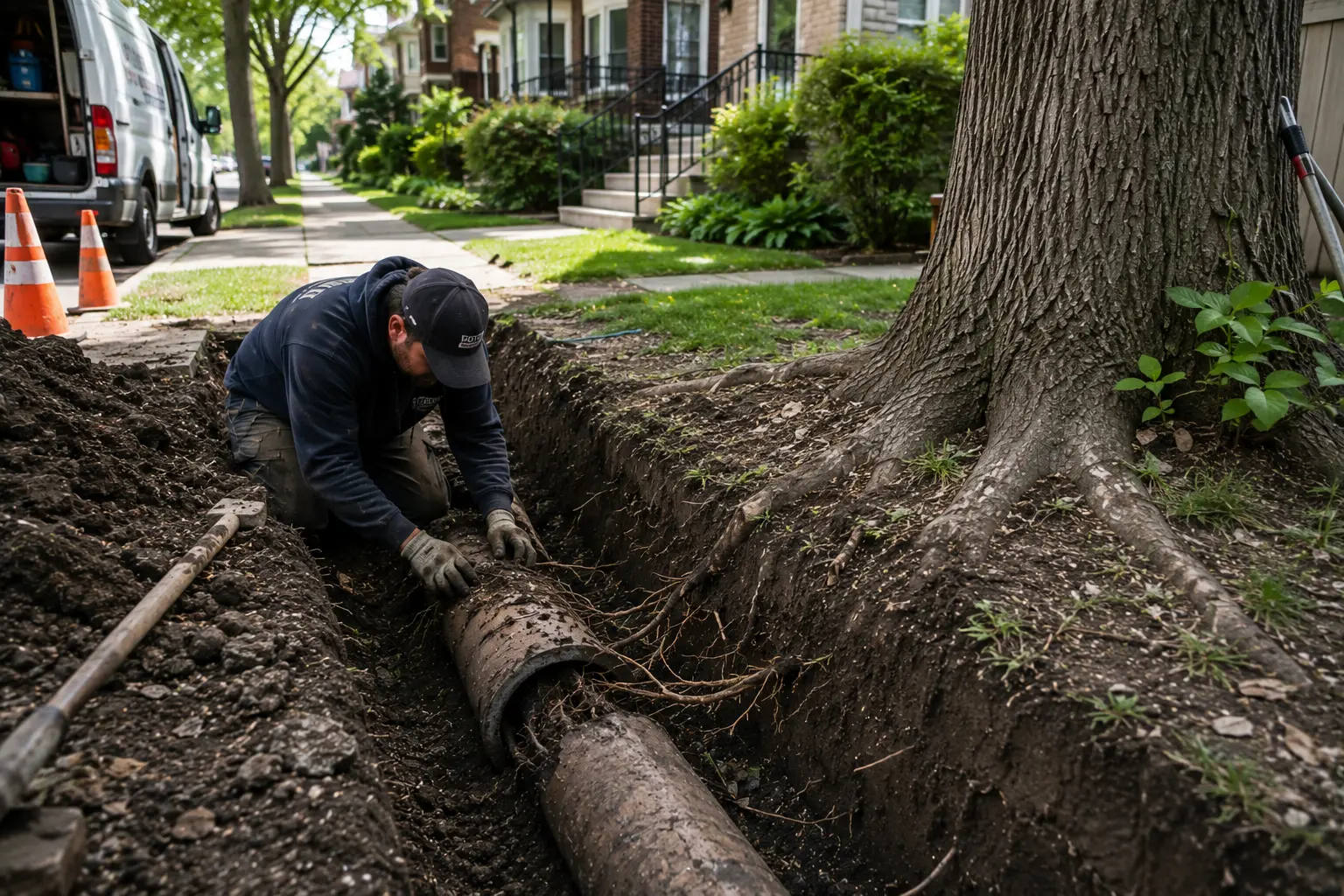
Large trees are one of the reasons many Chicago neighborhoods feel established and residential, but they can also create problems for older sewer lines. Tree roots naturally seek moisture, and aging sewer pipes can provide exactly the kind of damp opening roots are looking for.
Homes near large trees are not guaranteed to have sewer problems. The risk depends on the condition of the sewer line, pipe material, joint integrity, soil movement, tree location, and repair history. However, older Chicago homes with clay sewer pipes, cracked joints, offset sections, or recurring backups should take nearby mature trees seriously as a possible contributing factor.
The main concern is not the tree itself. The concern is whether roots have found a weakness in the sewer pipe. Once roots enter the line, they can trap waste, grease, paper, and debris, leading to slow drains, repeated clogs, basement backups, and eventually more serious pipe damage. For more older-property guidance, visit the Older Chicago Homes & Property Types resource hub.
Key Takeaways
- Large trees can contribute to sewer problems when roots enter cracks, joints, or openings in aging sewer lines.
- Older Chicago homes with clay sewer pipes are especially vulnerable to root intrusion at pipe joints.
- Recurring clogs, slow drains, gurgling fixtures, and basement backups may indicate root-related sewer trouble.
- Removing roots from the line may restore flow temporarily, but it does not repair the opening where roots entered.
- A sewer camera inspection is usually the best way to confirm whether roots, cracks, offsets, bellies, or collapse are present.
- Repair decisions should be based on pipe condition, not just the presence of trees near the property.
Can Large Trees Damage Sewer Lines?
Large trees can contribute to sewer line problems when roots enter an existing crack, loose joint, separated pipe section, or other opening. Roots usually do not need a large break to get inside. Once they reach moisture inside the sewer line, they can grow, spread, and create recurring blockages.
In older Chicago homes, this is especially common when the sewer line is made of clay pipe or has older joints that have shifted over time. If roots keep returning after sewer cleaning, the pipe likely has an entry point that should be inspected and evaluated for repair or replacement.
Why Tree Roots Are a Sewer Risk in Older Chicago Neighborhoods
Chicago has many older residential blocks with mature parkway trees, backyard trees, side-yard trees, and established landscaping. These trees may have been growing for decades, often near sewer laterals that were installed around the same era as the homes themselves.
Older sewer systems can develop weaknesses over time. Roots are opportunistic: they grow toward moisture, nutrients, and oxygen. A small opening in a sewer line can become an entry point.
Older Pipe Materials
Many older Chicago homes still have clay sewer pipe. Clay pipe can remain functional for many years, but it is made in sections with joints between each piece. Those joints can separate, crack, or shift as the ground moves.
For a closer look at this issue, see Clay Sewer Pipes in Chicago Homes: Risks and Replacement Options.
Soil Movement and Freeze-Thaw Cycles
Chicago weather can put stress on underground systems. Seasonal freeze-thaw movement, settlement, and soil changes can cause older pipes to shift. Even a small offset or gap can create an opportunity for root entry.
Long-Term Tree Growth
A young tree may not create immediate sewer concerns, but a mature tree has a much larger root system. Over time, roots may reach sewer lines that were not an issue when the tree was smaller.
How Roots Get Into Sewer Lines
Roots usually enter sewer lines through existing vulnerabilities. They are attracted to moisture escaping from the pipe or to vapor from small openings. Once roots find an entry point, they can grow inside the line and expand.
Common entry points include:
- Cracked clay pipe sections
- Separated pipe joints
- Offset joints
- Loose connections
- Old repair transitions
- Small gaps caused by settlement
- Damaged pipe near cleanouts or fittings
Important: Roots inside a sewer line usually mean the pipe has an opening. Clearing roots may restore drainage, but it does not eliminate the pipe defect that allowed roots to enter.
Warning Signs of Tree Root Sewer Problems
Root intrusion often starts gradually. At first, the sewer line may still drain, but flow becomes restricted as roots collect waste and debris. Over time, symptoms may become more frequent.
Common warning signs include:
- Recurring main sewer clogs
- Slow drains in multiple fixtures
- Gurgling toilets or drains
- Basement floor drain backups
- Backups after laundry, showers, or heavy water use
- Sewage odors in the basement or yard
- Frequent need for sewer rodding or jetting
- Roots visible in sewer camera footage
- The same blockage returning in the same section of pipe
These warning signs are especially important in older homes, where roots may be one part of a larger sewer condition. For broader symptoms, see Common Sewer Problems in Older Chicago Homes.
Why Basement Backups Are a Major Concern
When roots restrict the main sewer line, wastewater may back up into the lowest drain or fixture in the home. In many Chicago homes, that means the basement.
A basement backup may come through a floor drain, laundry drain, shower, toilet, or utility sink. If the basement is unfinished, cleanup is still serious. If the basement is finished, the damage can be much more expensive.
Homeowners dealing with lower-level risk should review Sewer Backup Problems in Chicago Basements and Sewer Repair for Homes With Finished Basements.
Finished Basement Risk
Finished basements may include flooring, drywall, trim, furniture, electronics, storage, bathrooms, laundry areas, or living space. Sewer backups can damage these materials and may require cleanup, removal, sanitizing, drying, and restoration.
How Sewer Camera Inspections Identify Root Problems
A sewer camera inspection helps confirm whether roots are present and whether the pipe has additional defects. This is important because root problems can look like ordinary clogs from inside the home.
A camera inspection may show:
- Roots entering through joints
- Fine root growth along pipe walls
- Large root masses blocking the line
- Cracked pipe sections
- Offset joints
- Standing water from a belly
- Collapsed pipe sections
- Older clay pipe or mixed pipe materials
Inspection footage can also help homeowners compare repair recommendations. If a contractor recommends major work, the homeowner should understand where the roots are entering, how severe the damage is, and whether the issue is isolated or widespread.
For buyers evaluating older homes with mature trees, sewer inspection can be especially valuable. More guidance is available in Sewer Inspection Before Buying a Chicago Home.
Cleaning, Repair, or Replacement: What Makes Sense?
The right solution depends on the condition of the pipe and how often the problem returns. Roots can sometimes be managed for a period of time, but recurring root intrusion often becomes a sign that the sewer line needs more than cleaning.
| Finding | Possible Approach | Homeowner Decision Point |
|---|---|---|
| Small roots at one joint | Cleaning, monitoring, or spot repair | Track how quickly roots return |
| Heavy roots at one defect | Spot repair may be considered | Confirm whether the rest of the line is stable |
| Roots at multiple joints | Partial or full replacement may be evaluated | Widespread entry points suggest aging pipe |
| Roots plus cracked clay pipe | Repair or replacement depends on extent | Cleaning alone may be temporary |
| Roots plus a sewer belly | Repair may need to correct slope | Debris may keep collecting in the low spot |
| Roots plus pipe collapse | Replacement or excavation usually required | Structural failure should be addressed |
When Cleaning May Be Enough
Cleaning may be reasonable when roots are minor, the pipe is otherwise stable, and backups are not recurring. However, the line should be monitored because roots can return.
When Spot Repair May Be Appropriate
A spot repair may be considered when roots enter at one known defect and the rest of the sewer line appears structurally sound.
When Replacement May Be More Practical
Replacement may be considered when roots enter at multiple points, the pipe is cracked throughout, the line has collapsed, or repeated cleaning is no longer providing reliable performance.
Should Homeowners Remove the Tree?
Removing a tree is not always the right solution. If roots entered through an old or damaged pipe, removing the tree may not fix the pipe. Other nearby trees or roots may still seek the same moisture source, and the sewer line may remain structurally compromised.
The better first question is whether the sewer line has defects. If the pipe is cracked, offset, or separated, the long-term solution may involve repairing the pipe rather than focusing only on the tree.
Practical note: Tree removal may be considered in some situations, but it should not be treated as a substitute for sewer diagnosis. A damaged sewer line can continue causing problems even after a tree is removed.
Chicago-Specific Considerations
Parkway Trees and Public Areas
Many Chicago homes have large parkway trees near sidewalks and sewer laterals. If a sewer problem is near the public way, access, permits, restoration, and responsibility questions may become more complex.
Bungalows, Greystones, and Two-Flats
Older property types are especially likely to have a combination of mature trees and aging sewer pipe. Bungalows, greystones, and two-flats may also have basements that increase the damage risk if roots cause a backup.
Related property-specific guides include Sewer Replacement for Chicago Bungalows: What Homeowners Should Know, Sewer Repair for Chicago Greystone Homes, and Sewer Repair for Two-Flats in Chicago.
Rental and Multi-Family Buildings
Root-related sewer issues can be especially disruptive in rental properties and multi-family buildings because multiple households may rely on the same sewer line. Repeated backups can affect tenant use, storage areas, laundry rooms, and lower-level units.
Older Repairs and Pipe Transitions
Some Chicago homes have sewer lines that were repaired in sections over time. Roots may enter at transitions between old and new pipe if the connection is weak, offset, or poorly sealed.
Cost Factors for Root-Related Sewer Repairs
Costs vary because root-related sewer problems range from minor maintenance to major replacement. The presence of roots alone does not determine the cost. The pipe condition and repair method matter more.
Cost factors may include:
- Severity of root intrusion
- Whether roots are isolated or widespread
- Pipe material and condition
- Length of pipe affected
- Depth of the sewer line
- Whether pipe cracks, offsets, bellies, or collapse are present
- Whether excavation is required
- Whether trenchless methods are possible
- Access through yard, sidewalk, basement, gangway, or public way
- Permit and inspection requirements
- Concrete, landscaping, sidewalk, or basement restoration
- Emergency timing versus planned repair
| Situation | Likely Cost Driver |
|---|---|
| Minor root growth | Cleaning and monitoring frequency |
| Recurring roots in one location | Targeted repair access and restoration |
| Roots throughout clay pipe | Length and condition of affected sewer line |
| Roots plus basement backup | Repair cost plus cleanup and restoration |
| Roots near sidewalk or parkway | Access, permits, concrete, and restoration |
| Roots with pipe collapse | Excavation and structural replacement |
Insurance Considerations
Insurance coverage for root-related sewer problems depends on the policy, cause of damage, and available endorsements. Homeowners should not assume that root intrusion or pipe replacement is automatically covered.
Many policies exclude gradual deterioration, age-related failure, roots, and wear and tear. Sewer backup coverage may help with certain interior damage or cleanup costs, while service line coverage may apply to certain underground pipe issues if included. These coverages are not always the same.
Homeowners should review:
- Sewer backup coverage
- Service line coverage
- Exclusions for roots, wear, age, or deterioration
- Coverage limits and deductibles
- Whether pipe replacement is covered
- Whether cleanup and restoration are covered
- Documentation requirements after a loss
Common Mistakes Homeowners Make
Assuming the Tree Is the Whole Problem
Roots usually enter through a pipe defect. The tree may be part of the problem, but the pipe condition is usually the key issue.
Relying on Repeated Cleaning Without Inspection
Repeated root removal may temporarily restore flow, but it does not show whether the pipe is cracked, offset, sagging, or collapsing.
Removing a Tree Before Understanding the Sewer Line
Tree removal can be expensive and disruptive. It may not solve the issue if the sewer pipe remains damaged.
Ignoring Basement Backup Risk
Root intrusion can eventually restrict the line enough to cause basement backups. Homes with finished basements should be especially cautious.
Assuming New Interior Plumbing Means the Sewer Line Is New
A renovated kitchen, bathroom, or basement does not necessarily mean the underground sewer line was replaced.
Waiting Until Selling the Home
Root-related sewer issues may surface during buyer inspections. Sellers may benefit from understanding the sewer condition before listing. Related guidance is available in Sewer Line Problems Before Selling a House.
Frequently Asked Questions
Can tree roots break a sewer pipe?
Roots typically enter through an existing crack, joint, or opening, then expand inside the line. Over time, root growth can worsen damage and contribute to blockages or structural failure.
How do I know if roots are in my sewer line?
Common signs include recurring clogs, slow drains, gurgling fixtures, and basement backups. A sewer camera inspection is the best way to confirm root intrusion.
Will sewer cleaning remove tree roots permanently?
No. Cleaning can remove roots from inside the line, but roots may return if the pipe opening remains. Long-term solutions usually address the entry point.
Do I need to remove a large tree to fix a sewer problem?
Not always. The sewer line should be inspected first. Repairing the pipe defect may be more important than removing the tree.
Are clay sewer pipes more vulnerable to roots?
Yes, especially at joints between pipe sections. As clay systems age, joints can separate or crack, creating entry points for roots.
Will homeowners insurance cover tree root sewer damage?
Coverage depends on the policy. Many policies exclude roots, age, wear, and deterioration. Sewer backup or service line endorsements may provide limited coverage in some situations.
Should I inspect the sewer line before buying a home near large trees?
Yes, especially if the home is older. A sewer inspection can reveal roots, clay pipe defects, offsets, bellies, and other issues that are not visible during a standard home inspection.
Conclusion
Large trees can create real sewer concerns for older Chicago homes, but the issue is usually the relationship between roots and pipe condition. Roots need an opening to enter the sewer line. Once inside, they can cause recurring clogs, slow drains, basement backups, and eventually more serious damage.
The most practical approach is to inspect the line, identify where roots are entering, and determine whether cleaning, spot repair, partial replacement, or full replacement makes sense. For homeowners, the goal is not simply to remove roots once, but to understand why they entered and how likely the problem is to return.