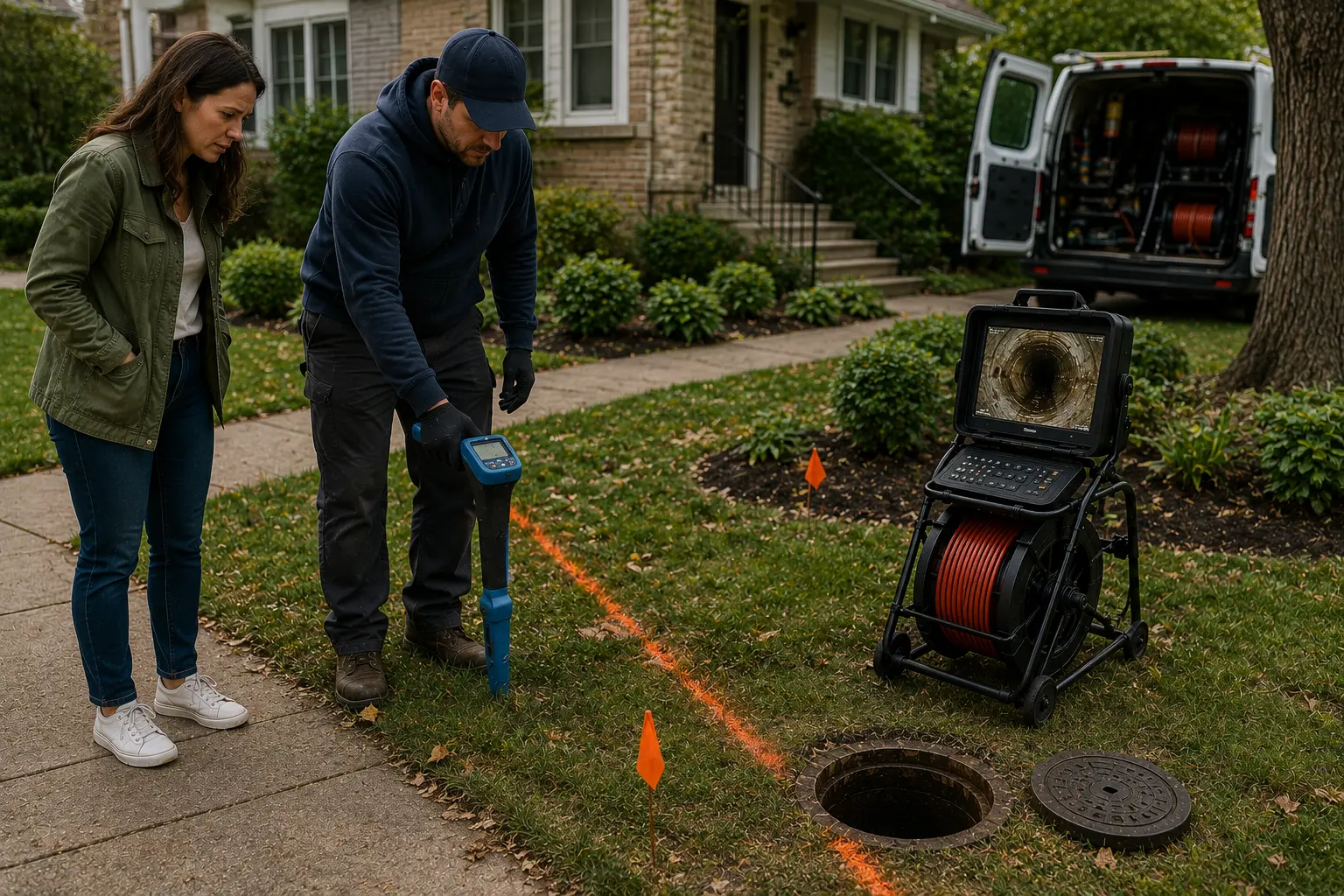
Sewer line depth and location matter more than many homeowners realize. When a sewer problem appears, the repair decision is not based only on what is wrong with the pipe. It also depends on where the pipe runs, how deep it is buried, what is above it, and how difficult it would be to access if repairs are needed.
For Chicago homeowners, this can be especially important because many properties have older sewer lines, basements, sidewalks, parkways, garages, alleys, mature trees, and tight urban lot layouts. A defect that appears simple on camera may become more complicated if it is deep underground or located beneath concrete, landscaping, or a finished space.
Understanding sewer line depth and location helps homeowners make better decisions after inspections, backups, home purchases, or repair estimates. It can also help explain why two sewer problems that look similar on video may have very different repair implications.
For more guidance on sewer inspections and diagnosis, visit the Sewer Inspections & Diagnosis hub.
Key Takeaways
- Sewer line depth refers to how far below the surface the pipe is buried.
- Sewer line location refers to the route the pipe takes from the home toward the public sewer or other connection point.
- Depth and location affect inspection findings, repair access, excavation difficulty, restoration costs, and risk.
- Camera inspections can often help estimate pipe route, defect distance, and sometimes depth when locating equipment is used.
- Chicago properties may have complicated sewer layouts due to older construction, basements, alleys, sidewalks, garages, and past repairs.
- Before approving major sewer work, homeowners should understand both the pipe condition and where the defect is located underground.
Why Sewer Line Depth and Location Matter
Sewer line depth and location matter because they influence how difficult a sewer line is to inspect, locate, access, repair, or replace. A damaged pipe section under open yard space may be relatively straightforward to reach, while a similar defect under a driveway, sidewalk, garage slab, basement floor, or parkway can involve more planning, disruption, and restoration.
A camera inspection may show the problem inside the pipe, but locating the pipe helps homeowners understand where that problem is in the real world. Both pieces of information are important before making repair decisions.
What Does Sewer Line Depth Mean?
Sewer line depth is the vertical distance between the ground surface and the sewer pipe. In practical terms, it tells homeowners how far down someone would need to dig to reach the line.
Depth can vary along the same sewer line. The pipe may begin at one depth near the home and become deeper as it slopes toward the public sewer connection. The grade of the property, basement elevation, connection point, and original construction all affect how deep the pipe is buried.
Depth matters because deeper lines typically require more careful excavation, more labor, additional safety precautions, and more restoration work after the repair is complete.
What Does Sewer Line Location Mean?
Sewer line location refers to the underground route the pipe takes. This may include where the line exits the house, how it crosses the yard or side lot, whether it runs toward the street or alley, and where it connects to the public sewer system.
Location matters because the pipe may run beneath:
- Front yards
- Backyards
- Side gangways
- Driveways
- Sidewalks
- Parkways
- Garage slabs
- Patios
- Basement floors
- Landscaping or retaining walls
If the pipe route is unknown, inspection and locating work may be needed before repair options can be evaluated. For homeowners trying to understand the pipe path, How to Find a Sewer Line Under Your Yard is a useful next step.
How Sewer Lines Are Located During an Inspection
Sewer location is often identified using a combination of visual inspection, camera distance measurements, property layout clues, and electronic locating equipment.
A sewer camera can show what is happening inside the pipe. Many camera systems also include a transmitter in the camera head. When the camera reaches a defect, a locator can be used above ground to identify the approximate surface location of the camera.
This can help determine:
- Where the sewer line runs
- Where a defect is located
- How far the camera traveled from the access point
- Whether the pipe is under soil, concrete, or a structure
- Approximate depth in some cases
For a broader explanation of camera-based diagnosis, see Sewer Camera Inspection in Chicago: What Homeowners Should Know.
How Camera Distance Measurements Work
Many sewer scope reports include distance measurements. These measurements typically show how far the camera has traveled from the access point, not necessarily the straight-line distance from the house.
For example, a report might say:
- “Root intrusion at 31 feet”
- “Standing water begins at 45 feet”
- “Offset joint at 52 feet”
- “Camera unable to pass at 68 feet”
These measurements can be useful, but they must be interpreted carefully. A 45-foot distance from a basement cleanout does not automatically tell the homeowner whether the defect is under the yard, sidewalk, parkway, or street. The camera’s starting point, direction, pipe route, and locating information all matter.
If you are reviewing an inspection document, see How to Read a Sewer Scope Report.
Why Depth Affects Sewer Repair Decisions
Depth can significantly affect how difficult a sewer repair may be. A shallow pipe is usually easier to access than a deep pipe, although surface conditions still matter. A deep pipe may require more excavation, more time, and greater attention to trench safety and restoration.
| Depth or Location Factor | Why It Matters | Homeowner Decision Impact |
|---|---|---|
| Shallow yard location | Usually easier to access than deeper or paved areas | May make targeted repair more practical |
| Deep sewer line | Requires more excavation and safety planning | May increase repair complexity |
| Under driveway or sidewalk | Concrete removal and replacement may be needed | Restoration becomes part of the decision |
| Under basement slab | Interior access and slab removal may be required | Disruption may be significant |
| Near trees | Roots may complicate access and cause recurring intrusion | Repair choice may consider long-term root risk |
| Near public connection | Responsibility and permitting questions may arise | More documentation may be needed |
Chicago-Specific Sewer Location Considerations
Chicago properties can have sewer layouts that are less predictable than homeowners expect. The age of the home, neighborhood design, lot shape, basement layout, alley access, and past repairs can all affect sewer routing.
Street Versus Alley Connections
Some sewer lines run toward the street, while others may route toward an alley or different connection point depending on the property and neighborhood infrastructure. Homeowners should not assume the line always runs straight out the front of the house.
Basement Elevation
Many Chicago homes have basements with floor drains, laundry areas, bathrooms, or utility spaces. The elevation of basement plumbing can affect where the sewer exits the home and how deep the line becomes outside.
Sidewalks, Parkways, and Public Areas
If a defect is located near or beyond the sidewalk or parkway, repair planning may involve added coordination, permits, restoration, or questions about responsibility.
Older Materials and Partial Repairs
Older Chicago homes may have clay tile, cast iron, PVC replacement sections, or mixed materials. A camera inspection may show transitions where past repairs were made, but locating the transition above ground helps clarify repair access.
Dense Urban Lots
Fences, narrow gangways, garages, patios, stairs, and neighboring structures can make access more complicated even when the defect is not very deep.
Chicago homeowner tip: Before assuming where a sewer line runs, confirm the route with inspection footage, locating equipment, available property records, and professional evaluation. Sewer lines do not always follow the path homeowners expect.
How Depth and Location Affect Cost Factors
Depth and location do not automatically determine the repair cost, but they strongly influence the work required. A camera inspection may identify the defect, while locating information helps determine how difficult that defect may be to access.
Cost-related factors may include:
- How deep the pipe is buried
- Whether the defect is under soil, concrete, or a structure
- Whether excavation equipment can access the area
- Whether hand digging is required
- Whether landscaping, fences, stairs, or hardscape must be removed
- Whether interior slab work is involved
- Whether municipal permits or inspections are required
- Whether the repair area must be restored afterward
- Whether multiple defects exist along the line
This is why homeowners should be cautious when comparing repair estimates without understanding whether each estimate is based on the same location and depth assumptions.
Why Location Matters After a Sewer Backup
After a sewer backup, homeowners often want to know whether the problem is isolated or likely to happen again. A camera inspection can identify the cause, but locating the defect helps determine what action is practical.
For example:
- Roots at a single accessible location may support a targeted repair discussion.
- A belly beneath a driveway may involve more restoration than expected.
- A collapsed section near the public connection may require additional coordination.
- Multiple defects along the line may change the conversation from spot repair to broader replacement planning.
If the inspection follows a backup, read Sewer Inspection After a Sewer Backup.
Why Location Matters Before Buying a House
During a home purchase, sewer line depth and location can affect negotiation and risk. A buyer may be more comfortable with a documented issue if the defect is isolated and accessible. The same defect may be more concerning if it is deep, under finished space, or beneath major hardscape.
Buyers should look for sewer scope reports that identify:
- Whether the full line was inspected
- Where the defect was found
- Whether the defect was located above ground
- Whether the line runs under costly restoration areas
- Whether additional estimates are needed before closing
For buyer-specific guidance, see Sewer Inspection Before Buying a House.
When Sewer Line Locating Services Are Useful
Sewer line locating services are useful when the route of the pipe is unknown, repair planning is being discussed, excavation is being considered, or an inspection report identifies a problem but does not clearly show where it is located.
Locating may be especially helpful when:
- There are no reliable property records
- The sewer line route is unclear
- The camera found a defect at a specific distance
- The line may run under concrete or a structure
- Major landscaping or construction is planned
- Repair estimates need to be compared accurately
- A contractor needs to mark the defect before excavation
For more detail, see Sewer Line Locating Services: What to Expect.
Related Testing and Alternatives
A camera inspection and line locating are common tools, but they may not answer every sewer-related question. Depending on the issue, additional diagnostic methods may be appropriate.
Smoke Testing
Smoke testing may be used to identify certain leaks, venting issues, improper connections, or pathways where sewer gas or smoke escapes. It does not replace a camera inspection but may help in specific diagnostic situations. Learn more in Sewer Line Smoke Testing Explained.
Dye Testing
Dye testing may be used to trace water movement, confirm connections, or investigate certain drainage questions. It is more focused on flow paths than pipe condition.
Camera Inspection
Camera inspection remains the primary tool for visually assessing the interior of the sewer line. For a deeper look at what the camera can show, see What Does a Sewer Camera Inspection Show?.
Common Mistakes Homeowners Make
Assuming the Sewer Line Runs in a Straight Line
Sewer lines often take practical routes based on the original construction, grade, and connection point. They may not run exactly where homeowners expect.
Focusing Only on the Camera Finding
A defect on video matters, but where it is located can affect the repair decision just as much as the defect itself.
Ignoring Depth
Depth affects excavation difficulty, safety planning, labor, and restoration. A deep pipe can make even a localized defect more complicated.
Comparing Estimates Without Location Details
Two estimates may not be comparable if one is based on a located defect and the other is based on a general assumption.
Not Asking Whether Locating Was Performed
A report may list distance measurements without identifying the surface location. Homeowners should ask whether the defect was actually located above ground.
Trusting a Vague Inspection
If the inspection does not explain the route, distance, access point, limitations, or location of defects, it may not provide enough information for major decisions. Review Signs a Sewer Inspection Was Done Poorly for warning signs.
Frequently Asked Questions
How deep are sewer lines in Chicago?
Sewer line depth varies by property, basement elevation, grade, pipe route, and connection point. Some sections may be relatively shallow while others become deeper as the pipe slopes away from the home. A camera inspection with locating equipment can help estimate depth at specific points.
Can a sewer camera tell where the pipe is located?
Often, yes. Many camera systems can be paired with locating equipment that detects the camera head from above ground. This can help identify the approximate route and location of defects.
Is the sewer line always in the front yard?
No. Some lines run toward the street, while others may route toward an alley or another connection point. Older properties and past repairs can make routing less predictable.
Why does sewer depth affect repair cost?
Deeper lines generally require more excavation, labor, safety planning, and restoration. Surface conditions also matter, especially if the line is under concrete, structures, or finished areas.
Can I find my sewer line without digging?
Often, yes. Sewer camera locating, property records, cleanout locations, and professional locating equipment can help identify the route without exploratory digging.
What if the inspection report gives a distance but not a location?
A distance measurement is helpful, but it may not be enough for repair planning. The starting point, direction, pipe route, and above-ground locating information are needed to understand where the defect actually is.
Does homeowners insurance cover sewer locating?
Coverage depends on the policy, cause of loss, endorsements, and claim circumstances. Some policies may cover diagnostic costs related to a covered event, while others may not.
Should I locate the sewer line before landscaping or construction?
Yes, it is often wise to understand the sewer route before major landscaping, driveway work, additions, patios, garages, or other projects that could affect access to the pipe later.
Conclusion
Sewer line depth and location are essential pieces of the sewer diagnosis process. A camera inspection may reveal what is wrong inside the pipe, but locating the pipe helps explain where that problem sits beneath the property and how difficult it may be to access.
For Chicago homeowners, this information is especially useful because sewer lines may run beneath basements, sidewalks, parkways, gangways, driveways, patios, garages, or older landscaping. Older materials and partial repair histories can add another layer of complexity.
Before approving major sewer work, homeowners should understand the pipe condition, the defect location, the depth, the access challenges, and the likely restoration needs. Those details make repair decisions clearer and help prevent surprises once work begins.