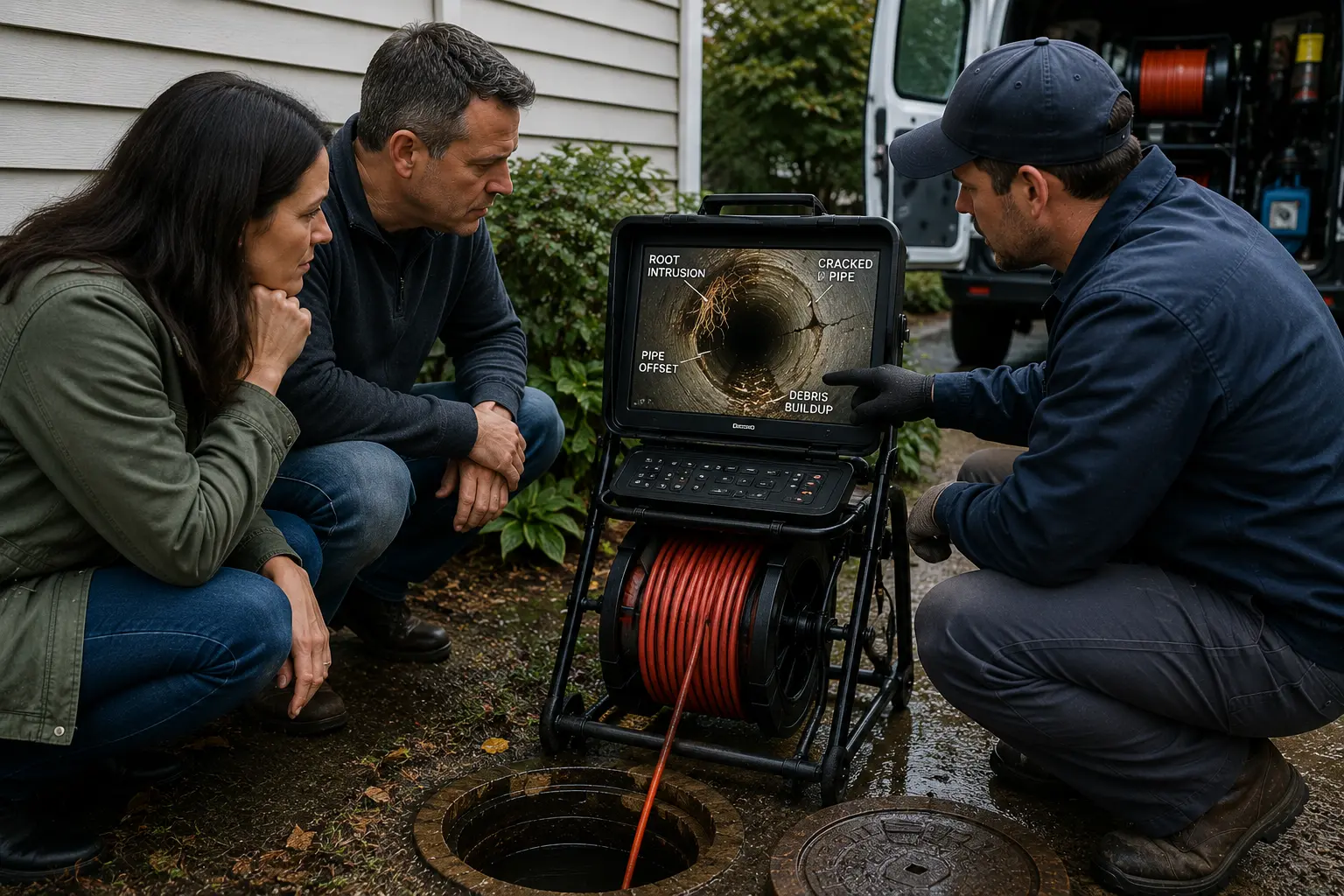
A sewer camera inspection gives homeowners a direct look inside the underground sewer line. Instead of guessing why drains are slow, why backups happen, or whether an older pipe is still in good condition, the inspection uses video footage to show what is actually happening inside the pipe.
For Chicago homeowners, this can be especially valuable. Many homes have older clay or cast iron sewer lines, mature nearby trees, basements with lower-level fixtures, and sewer systems that may have been repaired in sections over many decades. A camera inspection can help identify hidden problems before they become more disruptive or expensive.
The main thing a sewer camera inspection shows is the interior condition of the sewer pipe. It can reveal blockages, root intrusion, cracks, offsets, bellies, corrosion, collapsed sections, pipe material changes, and other defects that are not visible from inside the home.
For more homeowner-focused sewer diagnostic resources, visit the Sewer Inspections & Diagnosis hub.
Key Takeaways
- A sewer camera inspection shows the inside of the sewer line using video footage.
- It can reveal roots, cracks, clogs, offsets, pipe bellies, corrosion, collapse risks, and previous repairs.
- The inspection helps homeowners understand whether a sewer issue is temporary, recurring, or structural.
- Camera footage is useful after backups, before buying a home, before approving repairs, or when drain problems keep returning.
- A sewer camera inspection has limits; it may not show every outside condition around the pipe, and visibility can be reduced by standing water or heavy debris.
- The value of the inspection depends on clear footage, proper documentation, and accurate interpretation.
What Can You See During a Sewer Camera Inspection?
A sewer camera inspection can show the condition of the inside walls of the sewer pipe, including root intrusion, cracks, broken sections, blockages, grease buildup, sagging pipe sections, offsets between pipe joints, corrosion, collapsed areas, and prior repairs. It can also help estimate where a defect is located if the equipment includes distance tracking or electronic locating.
It does not automatically repair the problem, and it does not always show everything happening outside the pipe. However, it provides visual evidence that can help homeowners make better decisions about cleaning, repair, replacement, or further testing.
How a Sewer Camera Inspection Works
A sewer camera inspection uses a waterproof camera attached to a flexible cable. The camera is inserted through a cleanout, floor drain, roof vent, or another access point, depending on the property and the available plumbing layout.
As the camera moves through the line, it sends live video to a monitor. The operator watches for defects, obstructions, standing water, material changes, and signs of pipe failure. In many cases, the footage can be recorded and shared with the homeowner.
For a broader explanation of the process, see Sewer Camera Inspection in Chicago: What Homeowners Should Know.
Common Problems a Sewer Camera Inspection Can Show
The most useful part of a camera inspection is that it can separate surface-level symptoms from the actual underground condition. A toilet backup, slow drain, or basement floor drain issue may have several possible causes. The camera helps narrow the problem.
| What the Camera Shows | What It May Mean | Why It Matters |
|---|---|---|
| Tree roots | Roots have entered through joints, cracks, or openings. | Roots can cause recurring clogs and may indicate pipe damage. |
| Grease or sludge buildup | Waste, grease, soap residue, or debris is narrowing the pipe. | Cleaning may help, but buildup can return if flow problems remain. |
| Cracks or fractures | The pipe wall is damaged or weakened. | Cracks can allow roots, soil, and water to enter the line. |
| Offset joints | Two pipe sections are misaligned. | Offsets can catch debris and restrict wastewater flow. |
| Pipe belly | A low section of pipe is holding water. | Standing water can cause recurring clogs and backups. |
| Collapsed section | The pipe has partially or fully failed. | Collapse often requires significant repair planning. |
| Corrosion | Metal pipe is deteriorating from the inside. | Corrosion can reduce pipe strength and flow capacity. |
| Prior repairs | The camera shows patches, transitions, or replacement sections. | Past repair quality can affect future risk and repair decisions. |
Tree Root Intrusion
Tree roots are one of the most common findings in older sewer lines. Roots enter through small cracks, loose joints, separated pipe sections, or weakened areas where moisture is available.
On camera, root intrusion may appear as thin strands, thick root masses, or dense obstructions inside the pipe. In mild cases, roots may only partially restrict flow. In more serious cases, roots can trap paper and waste until the line backs up.
For Chicago homeowners, root intrusion is especially relevant in older neighborhoods with mature trees and clay sewer lines. Cutting roots may restore flow temporarily, but the camera footage can help determine whether the pipe itself has a defect that allows roots to return.
Cracked, Broken, or Collapsed Pipe
A camera inspection can show visible cracks, missing pipe sections, broken clay tiles, fractured joints, or areas where the pipe has lost its shape. These findings are more serious than simple buildup because they may indicate structural failure.
Signs of pipe damage may include:
- Visible fractures along the pipe wall
- Open gaps at joints
- Soil or debris entering the line
- Sections where the pipe is no longer round
- Water flowing from unexpected openings
- Camera obstruction caused by a collapsed area
A damaged pipe does not always mean the entire sewer line must be replaced. The location, severity, pipe material, and condition of the remaining line all affect the next step.
Offset Joints and Pipe Misalignment
An offset joint occurs when two pipe sections no longer line up properly. This can happen because of ground movement, aging materials, poor installation, settlement, or previous repairs.
On camera, an offset may appear as a step, ledge, or uneven transition between two pipe sections. Waste and toilet paper can catch on that edge, creating repeated blockages.
Small offsets may be monitored or cleaned periodically, while larger offsets may require repair if they significantly restrict flow or indicate ongoing movement.
Pipe Bellies and Standing Water
A sewer line should generally slope so wastewater flows away from the home. A pipe belly is a low section where the pipe has sagged and water collects instead of draining completely.
On camera, a belly often appears as standing water that partially or fully covers the lens. Sometimes the operator can push through the water and see the pipe beyond it. Other times, the standing water may limit visibility.
Pipe bellies matter because solids can settle in the low section and create recurring clogs. The severity depends on how much water is holding, how long the affected section is, and whether the problem has caused backups.
Blockages, Grease, Wipes, and Debris
A sewer camera inspection can show material inside the pipe that should not be there. This may include grease buildup, wipes, paper, sludge, foreign objects, roots, or construction debris.
The camera can help determine whether the issue is likely a maintenance problem or the result of a deeper defect. For example, debris caught at the same location may suggest an offset joint or damaged pipe section rather than a random clog.
After a backup, this distinction becomes important. Learn more in Sewer Inspection After a Sewer Backup.
Pipe Material and Past Repairs
A camera inspection may also show the type of pipe material inside the sewer line. In Chicago homes, this can be useful because older properties may have a mix of materials from different eras of repair.
The camera may reveal:
- Clay tile pipe
- Cast iron pipe
- PVC replacement sections
- Transition couplings
- Spot repairs
- Older patchwork
- Changes in pipe diameter or alignment
This information can help homeowners understand whether the line appears original, partially repaired, or significantly updated. Buyers evaluating older properties may also want to review Sewer Inspection Before Buying a House.
Can a Sewer Camera Show the Exact Location of a Problem?
A camera inspection can often help estimate where a problem is located, but the level of accuracy depends on the equipment and inspection method.
Many camera systems include distance counters that estimate how far the camera has traveled from the access point. Some systems also include a transmitter that can be located from above ground. This helps identify the approximate location and depth of the defect.
This information can be important when comparing repair options because a defect under open yard space may be very different from a defect under a driveway, sidewalk, garage slab, or finished basement area.
For more detail, see Sewer Line Depth and Location Explained and Sewer Line Locating Services: What to Expect.
What a Sewer Camera Inspection May Not Show
Sewer cameras are powerful diagnostic tools, but they have limitations. Homeowners should understand what the inspection can and cannot prove.
- It may not show soil conditions outside the pipe.
- It may not confirm every leak unless the defect is visible from inside.
- Standing water may block visibility.
- Heavy debris or roots may prevent the camera from passing.
- It may not fully explain municipal sewer conditions beyond the private line.
- It may not show sewer gas pathways outside the inspected pipe.
- It cannot determine repair cost by itself without considering access, depth, and restoration needs.
Homeowner note: A camera inspection is best understood as visual evidence of the pipe interior. It is not a complete engineering study of every underground condition around the sewer line.
Chicago-Specific Considerations
In Chicago, sewer camera inspection findings often need to be interpreted with the age and layout of the property in mind.
Older Clay Pipe
Clay sewer pipe is common in many older areas. It can last a long time, but joints may separate and roots may enter. The camera can show whether the pipe is intact, cracked, offset, or heavily invaded by roots.
Basement Fixtures
Homes with basement floor drains, laundry areas, or lower-level bathrooms may experience backups sooner because wastewater often appears first at the lowest fixture.
Urban Access Issues
In some Chicago properties, sewer lines pass beneath sidewalks, gangways, patios, garages, alleys, or driveways. Locating the defect can be as important as identifying the defect itself.
Mixed Repair History
Older homes may have had multiple partial repairs. A camera inspection can reveal where old and new pipe sections meet and whether those transitions are contributing to problems.
Owners of older properties should also read Sewer Inspections for Older Chicago Homes.
How Inspection Findings Affect Repair Decisions
The same camera finding can lead to different decisions depending on severity, location, and the homeowner’s goals. A small amount of buildup may call for maintenance. A collapsed section may require urgent repair. A partially root-filled clay line may fall somewhere in between.
| Finding | Possible Next Step | Decision Factor |
|---|---|---|
| Light buildup | Cleaning and monitoring | Whether symptoms return |
| Minor roots | Cleaning, monitoring, or further evaluation | Whether roots are recurring or worsening |
| Offset joint | Monitor or repair | How much it restricts flow |
| Pipe belly | Further evaluation or repair planning | Length and depth of standing water |
| Cracked pipe | Repair estimate or replacement discussion | Severity and location of cracking |
| Collapsed section | Repair planning | Access, depth, and urgency |
Homeowners should avoid making decisions based only on a single phrase such as “bad pipe” or “roots.” The video footage, location, severity, and written findings matter.
Cost Factors Connected to Camera Findings
A camera inspection may identify the problem, but the repair cost depends on site-specific factors. A defect that looks severe on video may be relatively accessible, while a smaller defect may be expensive to reach if it is deep or under hardscape.
Important cost factors include:
- How deep the sewer line is buried
- Where the defect is located
- Whether excavation is needed
- Whether the line runs under concrete, landscaping, or structures
- Whether the issue is isolated or widespread
- Pipe material and diameter
- Permit, inspection, and restoration requirements
- Whether temporary cleaning can manage the issue
This is why camera footage is usually only the first step. Repair planning often requires combining the footage with locating, access review, and contractor evaluation.
Warning Signs the Camera Inspection Was Not Useful Enough
A sewer camera inspection should leave the homeowner with clearer information, not more confusion. If the inspection is vague or poorly documented, it may be difficult to make a confident decision.
Warning signs include:
- No video footage was provided.
- The inspector did not explain what was visible.
- The report does not identify how far the camera traveled.
- Defects are mentioned without approximate locations.
- The camera could not pass, but the limitation was not clearly documented.
- Repair recommendations are made without showing supporting footage.
- The inspection does not clarify whether the full line was viewed.
For more guidance, see Signs a Sewer Inspection Was Done Poorly.
Frequently Asked Questions
Can a sewer camera inspection show tree roots?
Yes. Tree roots are usually visible inside the pipe when the camera reaches the affected area. The footage may show thin root strands, larger root masses, or roots combined with debris and waste.
Can a sewer camera inspection show a broken pipe?
Yes, if the break is visible from inside the pipe and the camera can reach it. The inspection may show cracks, missing pipe sections, collapsed areas, or soil entering the line.
Can a sewer camera inspection show the exact repair cost?
No. The camera can show the pipe condition, but repair cost depends on depth, location, access, pipe material, restoration needs, permits, and the extent of the problem.
Can a sewer camera inspection find a sewer smell?
Sometimes it can identify pipe defects or blockages that may contribute to odors, but sewer smells may also involve traps, vents, floor drains, or other plumbing conditions. Additional testing may be needed.
What if the sewer camera cannot get through the line?
If the camera cannot pass, the line may be blocked by roots, debris, a collapse, or heavy buildup. The limitation should be documented, and further cleaning or evaluation may be needed.
Does a sewer camera inspection show leaks?
It may show visible cracks, separations, or openings where leakage is likely, but it does not always prove the full extent of leakage outside the pipe. Some leak concerns may require additional diagnostic testing.
Should I be present during the sewer camera inspection?
Being present can be helpful because you can ask questions and see the footage in real time. If you cannot attend, request video, photos, and a written explanation.
Will insurance use sewer camera footage?
Insurance companies may request documentation when a sewer backup or service line claim is involved. Coverage depends on the policy, cause of loss, endorsements, exclusions, and claim circumstances.
Conclusion
A sewer camera inspection shows the inside condition of the sewer line. It can reveal roots, cracks, clogs, offsets, bellies, corrosion, collapsed sections, previous repairs, and other problems that cannot be seen from the surface.
For Chicago homeowners, this information can be especially useful because older sewer materials, mature trees, basements, and mixed repair histories are common. The inspection does not solve the problem by itself, but it provides visual evidence that can guide maintenance, repair planning, purchase decisions, insurance documentation, and long-term risk management.
The most useful inspection is one that provides clear footage, explains the findings, identifies limitations, and helps the homeowner understand what decision needs to be made next.