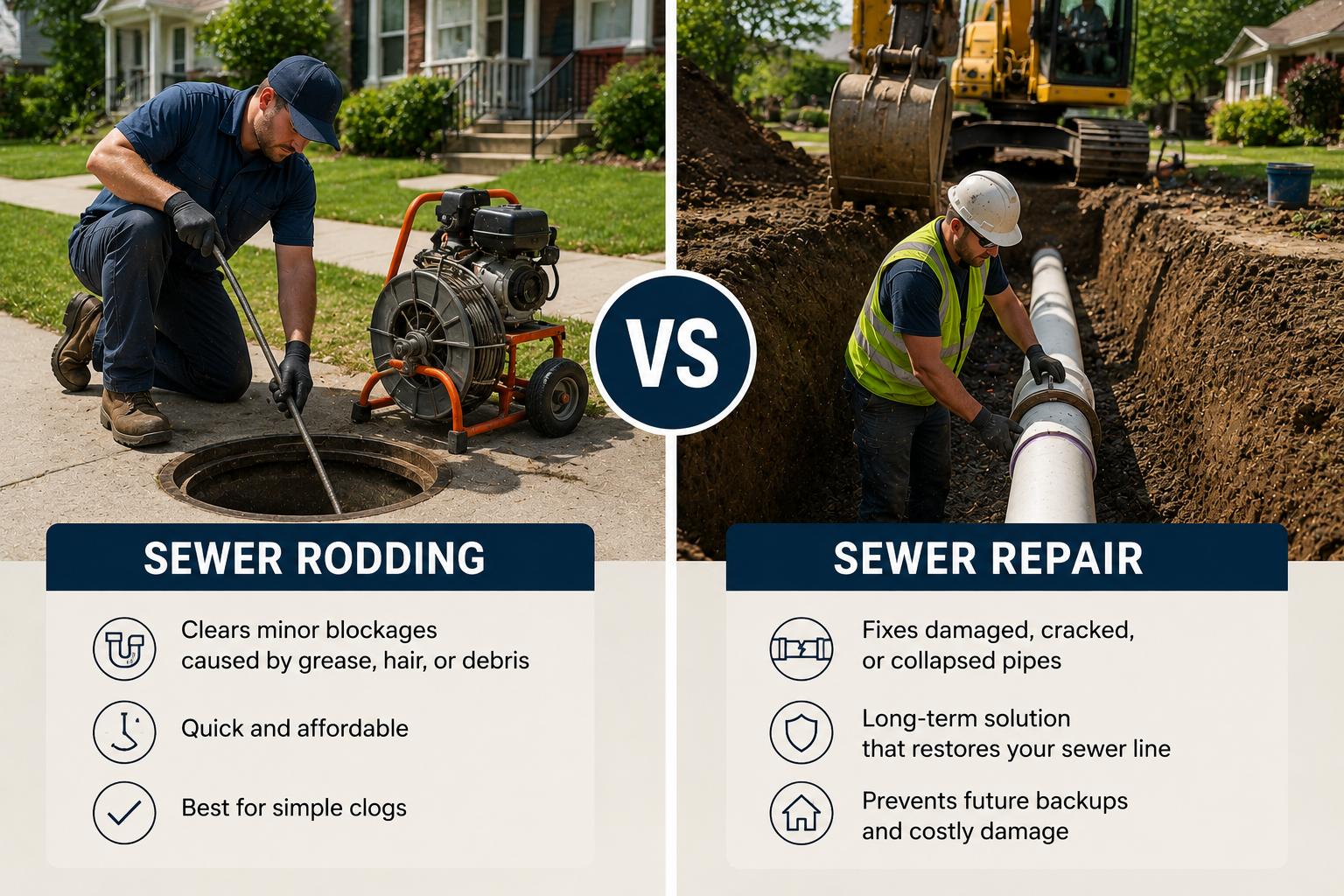
Sewer rodding and sewer repair are often discussed together, but they are not the same thing. Sewer rodding is a cleaning method used to clear blockages inside a drain or sewer line. Sewer repair addresses physical damage to the pipe itself, such as cracks, breaks, root entry points, offset joints, corrosion, or collapse.
For Chicago homeowners, the difference matters because a backed-up sewer line may feel like one problem, but the cause can vary widely. A clog may be solved with rodding. A damaged or failing pipe may require repair or replacement. Choosing the wrong approach can lead to repeated backups, unnecessary costs, and delayed repairs.
This article explains how sewer rodding compares with sewer repair, when each option makes sense, what warning signs to watch for, and how homeowners can make a more informed decision. For a broader look at available methods, visit the Sewer Repair Methods hub.
Key Takeaways
- Sewer rodding clears blockages but does not repair damaged pipe.
- Sewer repair fixes structural problems such as cracks, broken sections, root intrusion points, or offset joints.
- Rodding may be enough when the sewer line is blocked but otherwise intact.
- Repair may be needed when backups keep returning or a camera inspection shows pipe damage.
- Older Chicago sewer lines made from clay or cast iron may need more than repeated cleaning.
- A sewer camera inspection is often the best way to tell whether the problem is a clog or a failing pipe.
The Main Difference Between Rodding and Repair
Sewer rodding is a maintenance or clearing service. It uses a mechanical cable, rod, or cutting head to break through blockages and restore flow. It can help with clogs, roots, grease, paper buildup, and debris, but it does not rebuild or replace the sewer pipe.
Sewer repair is needed when the pipe itself is damaged. If the sewer line is cracked, collapsed, severely corroded, offset, sagging, or repeatedly invaded by roots, rodding may only create temporary relief. The underlying pipe defect may still need to be repaired or replaced.
What Is Sewer Rodding?
Sewer rodding is a mechanical cleaning process used to open a clogged sewer or drain line. A flexible cable or sectional rod is fed into the pipe through a cleanout, drain opening, or other access point. A cutting head or attachment may be used to break up obstructions and restore flow.
Rodding is commonly used for:
- Tree roots inside the pipe
- Grease buildup
- Paper or hygiene product blockages
- Sludge and soft debris
- Localized clogs
- Recurring slow drains caused by buildup
Rodding can be useful when the problem is inside the pipe but the pipe itself remains in workable condition. It is not designed to seal cracks, correct slope issues, fix broken pipe, or replace deteriorated materials.
What Is Sewer Repair?
Sewer repair addresses physical defects in the sewer line. Unlike rodding, which clears the path through the pipe, repair work is intended to correct a damaged section or restore the pipe’s ability to function properly.
Sewer repair may involve:
- Spot repair for one damaged section
- Pipe lining inside the existing pipe
- Excavation to replace a broken section
- Joint repair
- Replacement of deteriorated clay or cast iron pipe
- Trenchless methods when the pipe qualifies
For homeowners comparing repair options, Sewer Line Repair vs Replacement: Which Option Makes Sense? provides a useful decision framework.
Sewer Rodding vs Sewer Repair: Side-by-Side Comparison
| Factor | Sewer Rodding | Sewer Repair |
|---|---|---|
| Primary Purpose | Clears a blockage | Fixes pipe damage |
| Best For | Clogs, roots, grease, debris, soft buildup | Cracks, breaks, collapse, corrosion, offsets, failed pipe sections |
| Pipe Condition Needed | Pipe should be stable enough for mechanical cleaning | Used when pipe condition is compromised |
| Long-Term Result | Restores flow temporarily or as maintenance | Addresses the damaged area or failing pipe |
| Excavation Needed | Usually no excavation if access exists | May require excavation or trenchless access points |
| Typical Decision Tool | Symptoms and blockage response | Camera inspection and pipe condition |
When Sewer Rodding May Be Enough
Rodding may be a reasonable first step when the issue appears to be a clog rather than a structural failure. This is especially true if the sewer line has not had repeated problems and there are no signs of pipe collapse or major deterioration.
Sewer rodding may be enough when:
- A clog is isolated and clears fully after rodding
- The sewer line has not been backing up repeatedly
- A camera inspection shows no major pipe damage
- The blockage is caused by debris, grease, or soft buildup
- Roots are minor and have not damaged the pipe structure
- The pipe drains normally after cleaning
Rodding can also help diagnose the problem. If the same line clogs again shortly after service, that may indicate a deeper issue inside the pipe.
When Sewer Repair May Be Needed Instead
Sewer repair becomes more likely when the same problem keeps returning or when inspection shows physical pipe damage. In these cases, rodding may clear the line but fail to address why the blockage keeps forming.
Repair may be needed when:
- Backups return soon after rodding
- Roots repeatedly enter the same section
- A camera inspection shows cracks or broken pipe
- The line has a belly or sag that holds waste and water
- Pipe joints are offset or separated
- Cast iron is heavily corroded
- Clay pipe is cracked, shifted, or deteriorating
- Rodding equipment cannot pass through the line properly
If only one area is damaged, Spot Repair for Sewer Lines: When Is It Enough? may help homeowners understand when a localized fix is practical.
Why Repeated Rodding Can Become a Warning Sign
There is nothing unusual about occasional sewer cleaning, especially in older homes. However, repeated rodding should raise questions. If the sewer line requires frequent clearing, the problem may not be the clog itself. The clog may be a symptom of pipe failure.
Common underlying causes include:
- Tree roots entering through cracks or open joints
- A pipe belly that allows waste to collect
- Rough cast iron interiors that trap debris
- Broken clay pipe sections
- Offset joints that catch paper and solids
- Partial collapse reducing the pipe opening
In these situations, rodding may temporarily open the line, but the same conditions remain. A camera inspection after cleaning can help reveal whether repair is needed.
Sewer Rodding vs Hydro Jetting
Sewer rodding and hydro jetting are both cleaning methods, but they work differently. Rodding uses a mechanical cable or cutting head to break through an obstruction. Hydro jetting uses high-pressure water to clean the interior walls of the pipe more thoroughly.
Rodding may be useful for opening a clogged line quickly. Hydro jetting may be more effective for flushing grease, sludge, and buildup from the pipe walls when the pipe is strong enough to handle the process.
For a deeper comparison between cleaning and replacement decisions, see Hydro Jetting vs Sewer Line Replacement.
How a Camera Inspection Changes the Decision
A sewer camera inspection can help determine whether rodding solved the problem or only exposed a larger issue. Camera footage can show the inside of the pipe and reveal defects that are impossible to confirm from symptoms alone.
A camera inspection may identify:
- Root intrusion points
- Cracks or fractures
- Open joints
- Offset pipe sections
- Collapsed pipe
- Standing water caused by a belly
- Corrosion or scale buildup
- Pipe material and overall condition
In many cases, the best time to inspect the sewer line is after the blockage has been cleared. Once the pipe is open, the camera can travel farther and provide a clearer view.
Repair Options After Rodding Reveals Damage
If rodding clears the line but inspection shows damage, the next step depends on the type and extent of the defect.
Spot Repair
A spot repair may be enough when one short section is damaged and the rest of the sewer line is in reasonable condition.
Pipe Lining
Pipe lining may be considered when the pipe is cracked or leaking but still structurally stable enough to support a liner. More details are available in Pipe Lining for Sewer Repair: How It Works.
Pipe Bursting
Pipe bursting may be used when replacement is needed but full trench excavation may be avoidable. It replaces the old pipe along its existing route.
Traditional Excavation
Excavation may be necessary when the pipe is collapsed, severely sagging, badly offset, or physically inaccessible for trenchless methods. Homeowners can compare expectations in Traditional Sewer Line Excavation: What Homeowners Should Expect.
Chicago-Specific Considerations
Older Clay Sewer Lines
Many Chicago homes still have clay sewer lines. Clay pipe can crack, shift, separate at joints, and allow roots to enter. Rodding may remove the roots temporarily, but if the pipe has open joints or fractures, roots can return.
For homeowners dealing with older clay systems, Clay Sewer Pipe Replacement: What to Expect explains when replacement may become necessary.
Cast Iron Pipe Conditions
Cast iron sewer lines may develop corrosion, scale, and rough interior surfaces. These conditions can catch debris and contribute to repeated clogs. Rodding may clear the blockage, but it cannot restore a deteriorating pipe wall.
Additional material-specific guidance is available in Cast Iron Sewer Pipe Repair Options.
Tree Roots and Mature Neighborhoods
Chicago’s older neighborhoods often include mature trees and aging underground infrastructure. Roots can enter through tiny openings in sewer lines and expand over time. Repeated root cutting may delay the problem, but it does not seal the entry point.
Cleanout Access
A properly located sewer cleanout can make rodding, inspection, and future maintenance easier. Without a usable cleanout, access may be more difficult and costs may increase.
Homeowners can learn more in Sewer Cleanout Installation: Purpose, Cost, and Benefits.
Cost Factors Homeowners Should Understand
Sewer rodding usually costs less than repair because it is a cleaning service. However, the lower upfront cost only helps if the pipe does not have a deeper structural problem.
Rodding cost factors may include:
- Access to the sewer line
- Whether a cleanout exists
- Severity of the blockage
- Length of line being cleared
- Whether roots or heavy buildup are present
- Whether camera inspection is included
- Emergency timing or after-hours service
Sewer repair cost factors may include:
- Pipe depth
- Location of the damaged section
- Type of repair method
- Pipe material
- Amount of excavation required
- Permits and inspections
- Driveway, sidewalk, slab, or landscaping restoration
The key is comparing the cost of repeated rodding against the cost of fixing the underlying issue. A single rodding service may be sensible. Frequent rodding for the same sewer line usually deserves a closer look.
Common Mistakes Homeowners Make
- Assuming every sewer backup is just a clog
- Using repeated rodding instead of investigating recurring problems
- Skipping a camera inspection after a serious blockage
- Confusing sewer cleaning with sewer repair
- Ignoring roots that keep returning
- Approving repair work without understanding the pipe defect
- Comparing costs without considering long-term reliability
- Assuming homeowners insurance will automatically cover repairs
The biggest mistake is treating rodding as a permanent solution when the sewer line has a structural defect. Rodding can be useful, but it should not be used as a substitute for repair when the pipe itself is failing.
Questions to Ask Before Deciding
Before choosing between rodding and repair, homeowners should ask questions that clarify the actual condition of the line.
- Is this likely a blockage or a pipe defect?
- Has this same line backed up before?
- Was a sewer camera inspection performed?
- Did the camera show roots, cracks, bellies, offsets, or collapse?
- Will rodding address the cause or only clear the symptom?
- Is hydro jetting appropriate after rodding?
- Is a spot repair possible?
- Would pipe lining or pipe bursting be an option?
- Does the home have a usable sewer cleanout?
- What would make replacement more practical than continued cleaning?
Frequently Asked Questions
Is sewer rodding the same as sewer repair?
No. Sewer rodding clears blockages inside the pipe. Sewer repair fixes physical damage to the pipe itself.
Can rodding fix tree root intrusion?
Rodding can cut or break through roots inside the line, but it does not seal the crack or joint where roots entered. If roots keep returning, repair may be needed.
How often is sewer rodding normal?
Occasional cleaning may be normal for some older sewer lines. Frequent rodding for the same problem is a warning sign that the pipe may have an underlying defect.
Should I get a camera inspection before sewer repair?
Yes. A camera inspection helps identify the location and type of damage so homeowners can compare repair options more accurately.
Is hydro jetting better than rodding?
It depends on the blockage and pipe condition. Hydro jetting can clean pipe walls more thoroughly, while rodding can be effective for breaking through certain obstructions. Older or damaged pipes should be evaluated before aggressive cleaning.
Will homeowners insurance cover sewer repair?
Coverage depends on the policy and the cause of the damage. Many policies exclude wear and tear, root intrusion, deterioration, and underground service line failures unless specific coverage has been added.
When should I stop rodding and consider repair?
Repair should be considered when backups keep returning, roots repeatedly enter the line, camera footage shows cracks or offsets, or the pipe is deteriorating enough that cleaning only provides temporary relief.
Conclusion
Sewer rodding and sewer repair serve different purposes. Rodding is useful for clearing blockages and restoring flow, but it does not correct structural pipe damage. Sewer repair is needed when the pipe itself is cracked, broken, offset, collapsed, corroded, or repeatedly failing.
For Chicago homeowners, the best decision usually starts with the pattern of the problem and the condition of the pipe. A one-time clog may only need rodding. Recurring backups, repeated root intrusion, or inspection-confirmed pipe defects often point toward repair or replacement. Understanding that difference can help homeowners avoid temporary fixes when a more durable solution is needed.