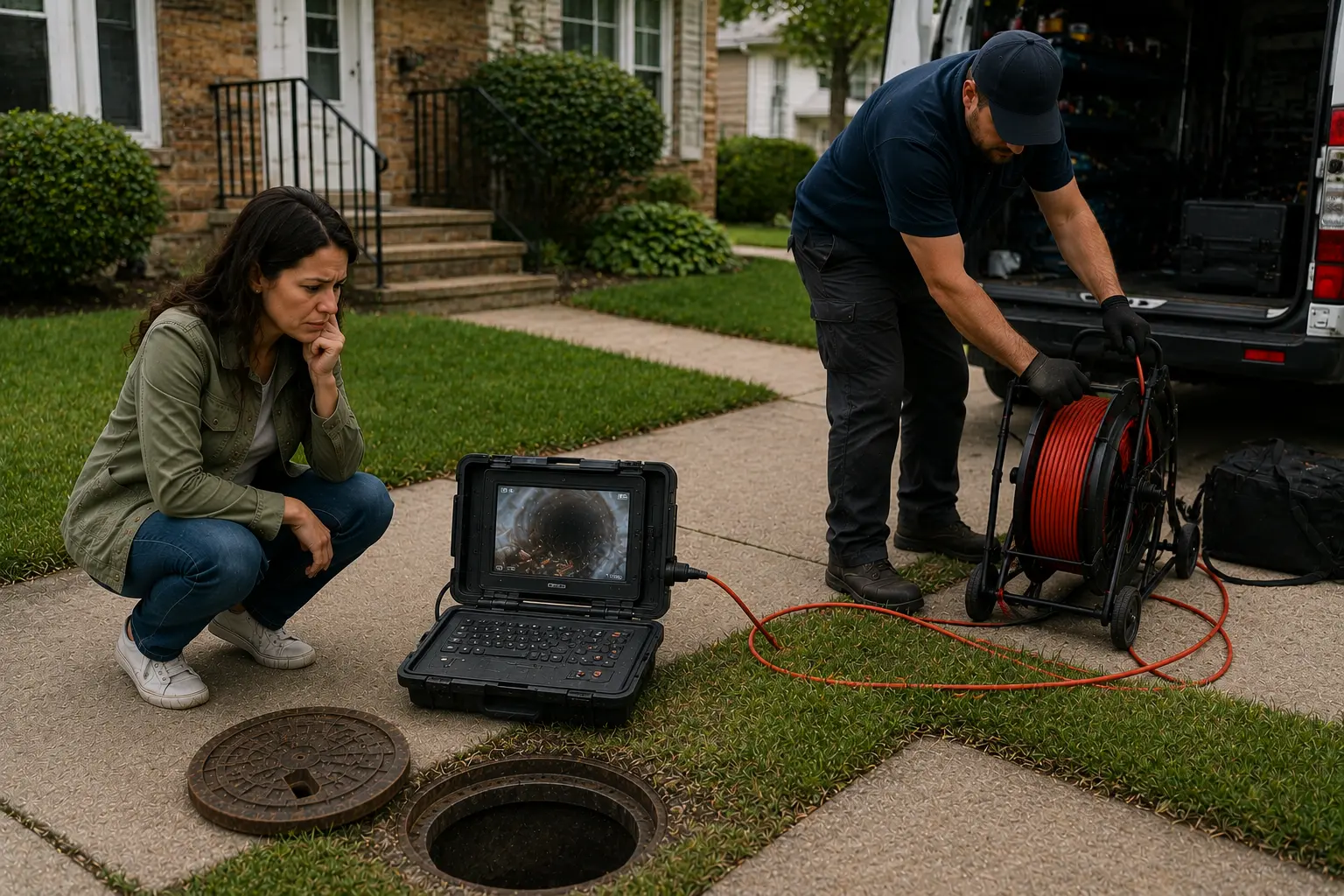
A sewer inspection should make an underground problem clearer, not more confusing. When the inspection is done well, homeowners should understand what part of the sewer line was inspected, what the camera showed, where defects were found, and what questions remain. When it is done poorly, the result may be vague, incomplete, rushed, or unsupported by evidence.
This matters because sewer inspection findings often influence expensive decisions. A homeowner may be deciding whether to approve a repair, negotiate during a home purchase, investigate a sewer backup, or determine whether an older Chicago sewer line needs closer monitoring. If the inspection is unreliable, the decision that follows may also be unreliable.
For Chicago homeowners, inspection quality is especially important because many homes have older clay or cast iron sewer lines, mature tree roots, basements, narrow lots, sidewalks, parkways, alleys, and previous repairs that can make sewer diagnosis more complex. A poor inspection can miss important defects or make a manageable issue sound worse than it is.
For more homeowner-focused resources on sewer diagnosis, visit the Sewer Inspections & Diagnosis hub.
Key Takeaways
- A poor sewer inspection may be incomplete, vague, undocumented, or unsupported by clear video evidence.
- Homeowners should receive enough information to understand what was inspected, what was found, and what limitations existed.
- Warning signs include no video, unclear defect locations, no distance measurements, no explanation of pipe condition, or rushed repair recommendations.
- A camera inspection should identify major visible issues such as roots, cracks, offsets, bellies, blockages, corrosion, or collapse when accessible.
- Chicago homes often require careful inspection because older pipes, basements, tree roots, and mixed repair histories can complicate diagnosis.
- If an inspection seems unreliable, homeowners may need clarification, a second opinion, or a more complete sewer scope.
How Can You Tell If a Sewer Inspection Was Poorly Done?
A sewer inspection may have been done poorly if the inspector did not provide video footage, did not explain what part of the line was inspected, failed to document defect locations, made repair recommendations without clear evidence, or could not explain the difference between minor maintenance issues and serious structural defects.
A good inspection should leave the homeowner with a clearer understanding of the sewer line’s condition. If the report only says “bad sewer line,” “roots present,” or “replacement recommended” without showing why, the inspection may not be detailed enough to support a major repair decision.
Why Sewer Inspection Quality Matters
A sewer camera inspection is often used when the stakes are high. Homeowners may order one before buying a home, after a sewer backup, when drains keep clogging, or before approving expensive sewer work.
In those situations, the inspection should answer practical questions:
- Was the full line inspected?
- Where did the camera enter the system?
- How far did the camera travel?
- What pipe material was visible?
- Were roots, cracks, offsets, bellies, corrosion, or collapse visible?
- Where were the defects located?
- Was standing water or debris limiting visibility?
- Was the recommendation supported by the footage?
If the inspection does not answer these questions, the homeowner may not have enough information to make a confident decision. For more background on what a sewer camera inspection should show, see What Does a Sewer Camera Inspection Show?.
Sign 1: No Video Footage Was Provided
One of the clearest warning signs of a poor sewer inspection is the absence of video footage. A sewer scope is a visual inspection. If the homeowner cannot review the footage, it becomes difficult to verify what was found.
A written summary can be helpful, but it should not be the only evidence when significant defects or repair recommendations are involved. Video allows homeowners to compare opinions, document conditions, and understand whether the recommendation matches the actual pipe condition.
Homeowner rule: If a sewer inspection leads to a major repair recommendation, ask for the video or images that support the finding.
Sign 2: The Report Does Not Say Where the Camera Entered
The access point matters. A camera inserted from a basement cleanout may show a different portion of the line than a camera inserted from an exterior cleanout, floor drain, or another access point.
A useful report should identify where the inspection began. Without that information, distance measurements and defect locations become much harder to interpret.
For example, “roots at 40 feet” is not very useful if the homeowner does not know whether the measurement started at a basement cleanout, an outside cleanout, or another point in the system.
Sign 3: The Inspection Does Not Explain How Far the Camera Went
A sewer inspection may be incomplete if the camera did not travel through the full accessible line. That may happen because of roots, heavy debris, standing water, a collapsed section, a sharp bend, or lack of access.
An incomplete inspection is not automatically a bad inspection. Sometimes the pipe condition truly prevents the camera from passing. The problem is when the limitation is not clearly explained.
| Inspection Detail | Why It Matters | Warning Sign |
|---|---|---|
| Camera access point | Shows where the inspection began | Report does not identify the starting point |
| Total distance inspected | Shows how much of the line was viewed | No distance or footage length is listed |
| Camera stopping point | Identifies whether the line was fully inspected | Camera stops but no reason is documented |
| Defect distance | Helps locate the problem | Defects described without measurements |
| Inspection limitations | Explains visibility problems | Standing water, debris, or blockage is ignored |
If you are trying to interpret a report, review How to Read a Sewer Scope Report.
Sign 4: Defects Are Described Too Vaguely
A report that says “line is bad” or “pipe needs work” is not specific enough. Homeowners need to know what was actually observed.
Useful descriptions may include:
- Root intrusion at a specific distance
- Offset joint restricting flow
- Standing water suggesting a possible belly
- Cracked clay pipe
- Corroded cast iron section
- Collapsed area preventing camera passage
- Heavy buildup or obstruction
- Material transition at a prior repair
Vague language can lead to confusion, especially when repair decisions are expensive. Specific findings help separate maintenance issues from structural problems.
Sign 5: Repair Recommendations Are Not Supported by Evidence
A sewer inspection may identify serious problems, but the recommendation should match the evidence. If a report recommends full replacement without showing widespread damage, homeowners should ask follow-up questions.
Good recommendations are usually tied to:
- Visible pipe condition
- Defect severity
- Location of the issue
- Whether the problem is isolated or repeated
- Whether the pipe is structurally compromised
- Whether cleaning, monitoring, spot repair, or replacement is being considered
A major repair recommendation may be reasonable in some cases, but it should not be based on vague statements alone.
Sign 6: The Inspection Ignores Location and Depth
Knowing what is wrong inside the pipe is only part of the diagnosis. Homeowners also need to understand where the problem is located underground.
A defect under open yard space may have different repair implications than the same defect under a driveway, sidewalk, parkway, garage slab, basement floor, or mature tree. If location and depth are not discussed, the inspection may not provide enough information for repair planning.
For more context, see Sewer Line Depth and Location Explained.
Sign 7: The Inspector Cannot Explain What You Are Seeing
Homeowners are not expected to be sewer experts. A good inspection should include a clear explanation of the footage in practical terms.
The inspector should be able to explain:
- What pipe material is visible
- Whether the line appears clear or restricted
- What defect is being shown
- Why the defect matters
- Whether the issue appears minor, moderate, or serious
- What information is still uncertain
If the explanation is rushed, dismissive, confusing, or overly technical without homeowner context, the inspection may not be serving its purpose.
Sign 8: The Camera Footage Is Unclear or Poorly Performed
Some inspections are difficult because of standing water, debris, roots, or pipe conditions. However, the report should clearly document visibility problems.
Warning signs in the footage may include:
- The camera moves too quickly to see defects clearly
- The lens is dirty for much of the inspection
- The camera is submerged without explaining standing water
- The video does not show the full path clearly
- Important areas are passed without explanation
- There is no commentary, marking, or written summary
- The footage ends abruptly with no explanation
Unclear footage may still contain useful information, but homeowners should understand its limits before making decisions.
Chicago-Specific Reasons Poor Inspections Are Risky
Poor sewer inspections can cause problems anywhere, but Chicago properties often involve conditions that make accurate diagnosis especially important.
Older Clay and Cast Iron Lines
Many older homes have sewer lines that may contain cracks, separated joints, corrosion, or root intrusion. These issues need to be described clearly, not reduced to vague comments about “old pipe.”
Tree Root Intrusion
Root intrusion is common in older, tree-lined neighborhoods. A report should identify whether roots appear minor, severe, isolated, or recurring throughout the line.
Basement Backup Risk
Many Chicago homes have basement floor drains, laundry areas, and lower-level fixtures. A poorly inspected sewer line may leave homeowners unaware of backup risk until damage occurs.
Urban Access Challenges
Sidewalks, parkways, alleys, driveways, patios, garages, and narrow gangways can make repair planning more complicated. Location details matter.
Mixed Repair Histories
Older homes may have partial repairs, material transitions, and undocumented sewer work. A thorough inspection should note visible transitions or suspicious repair points.
Owners of older homes may also want to review Sewer Inspections for Older Chicago Homes.
How a Poor Inspection Can Affect Home Purchase Decisions
During a home purchase, a poor sewer inspection can create two opposite problems. It may miss a serious issue, leaving the buyer with unexpected repair costs after closing. Or it may exaggerate a manageable issue, creating unnecessary fear or conflict during negotiations.
Buyers should be especially careful if:
- The inspection was rushed during a short contingency window
- No video was provided
- The report recommends repair but does not show clear evidence
- The camera did not inspect the full line
- Defect location was not marked
- The seller provides an old inspection with limited documentation
For buyer-specific guidance, see Sewer Inspection Before Buying a House.
How a Poor Inspection Can Affect Backup Decisions
After a sewer backup, a poor inspection may fail to identify whether the problem was temporary or likely to recur. This can leave homeowners unsure whether cleaning was enough or whether repairs should be considered.
A useful post-backup inspection should identify:
- Whether roots, debris, or buildup caused the blockage
- Whether the line was fully cleared before inspection
- Whether structural damage is visible
- Whether standing water remains in the line
- Whether the same issue is likely to happen again
- Whether the report provides documentation for insurance or repair planning
For more on this situation, read Sewer Inspection After a Sewer Backup.
What a Good Sewer Inspection Should Include
A good sewer inspection should be practical, documented, and clear enough for a homeowner to understand the next step.
At minimum, a useful inspection should include:
- Clear video footage when possible
- Identification of the access point
- Total distance inspected
- Pipe material observations
- Specific defect descriptions
- Distance to major defects
- Notes about standing water, debris, or limited visibility
- Explanation of whether the full line was inspected
- Photos or screenshots of major findings when available
- Repair or follow-up recommendations tied to evidence
If a defect needs to be physically marked, Sewer Line Locating Services: What to Expect explains how locating fits into the process.
Questions to Ask If You Doubt the Inspection
If something about the inspection seems incomplete or unclear, ask direct questions before making a major decision.
- Can I see the full video footage?
- Where did the camera enter the sewer line?
- How far did the camera travel?
- Was the entire line inspected?
- Why did the camera stop?
- What pipe material is visible?
- Where exactly is the defect?
- Was the defect located above ground?
- Is the issue structural or maintenance-related?
- What evidence supports the repair recommendation?
- Could cleaning or monitoring be reasonable?
- Should a second inspection be considered?
Common Mistakes Homeowners Make
Accepting a Verbal Opinion Without Documentation
A verbal explanation may be helpful, but major decisions should be supported by footage, photos, measurements, or a written summary.
Assuming Every Inspection Is Complete
Some inspections are partial because the camera cannot pass. That limitation should be clearly documented.
Ignoring Report Limitations
Standing water, debris, blocked access, or unclear footage can reduce confidence in the findings.
Confusing a Clog With a Structural Failure
A blockage may be caused by roots or buildup, but the underlying pipe condition determines whether repair is needed.
Approving Repairs Based on Fear
Sewer issues can be stressful, but repair decisions should be based on evidence, not pressure or vague warnings.
Not Getting Clarification During a Real Estate Timeline
Buyers should ask questions quickly when inspection findings affect negotiations or contingency deadlines.
Frequently Asked Questions
What is the biggest warning sign of a poor sewer inspection?
The biggest warning sign is a major repair recommendation without clear video, photos, distance measurements, or a specific explanation of the defect. Homeowners should be able to understand what evidence supports the recommendation.
Should a sewer inspection always include video?
Video is strongly preferred because sewer inspection is a visual process. If no video is provided, homeowners may have difficulty verifying findings or getting a second opinion.
What if the camera could not inspect the full line?
That does not automatically mean the inspection was poor, but the limitation should be clearly documented. The report should explain where the camera stopped and why.
Can a poor inspection miss tree roots?
Yes. If the camera does not reach the affected area, moves too quickly, has poor visibility, or lacks clear documentation, root intrusion may be missed or understated.
Can a sewer inspection make a problem sound worse than it is?
Yes. Vague language, lack of severity detail, or unsupported recommendations can make manageable issues seem like immediate emergencies. Clear footage and explanation help prevent overreaction.
Should I get a second opinion after a bad sewer inspection?
A second opinion may be wise if the inspection is unclear, incomplete, unsupported by footage, or tied to an expensive repair recommendation.
Does homeowners insurance rely on sewer inspection reports?
Insurance companies may consider inspection documentation when reviewing sewer backup or service line claims, depending on the policy and claim circumstances. Clear documentation is usually more useful than vague notes.
How do I know if a sewer scope report is reliable?
A reliable report should identify the access point, distance inspected, visible pipe condition, defects, limitations, and recommendations supported by video or images.
Conclusion
A sewer inspection should give homeowners useful evidence, not just vague conclusions. If the inspection lacks video, clear defect descriptions, distance measurements, location information, or explanation of limitations, it may not be reliable enough to support a major decision.
For Chicago homeowners, inspection quality matters because sewer lines may be older, deeper, root-invaded, partially repaired, or located beneath difficult access areas. A poor inspection can lead to missed problems, unnecessary repairs, weak negotiations, or confusion after a sewer backup.
The best inspections are clear, documented, and practical. They show what was inspected, what was found, where it was found, what could not be confirmed, and what decision the homeowner should consider next.