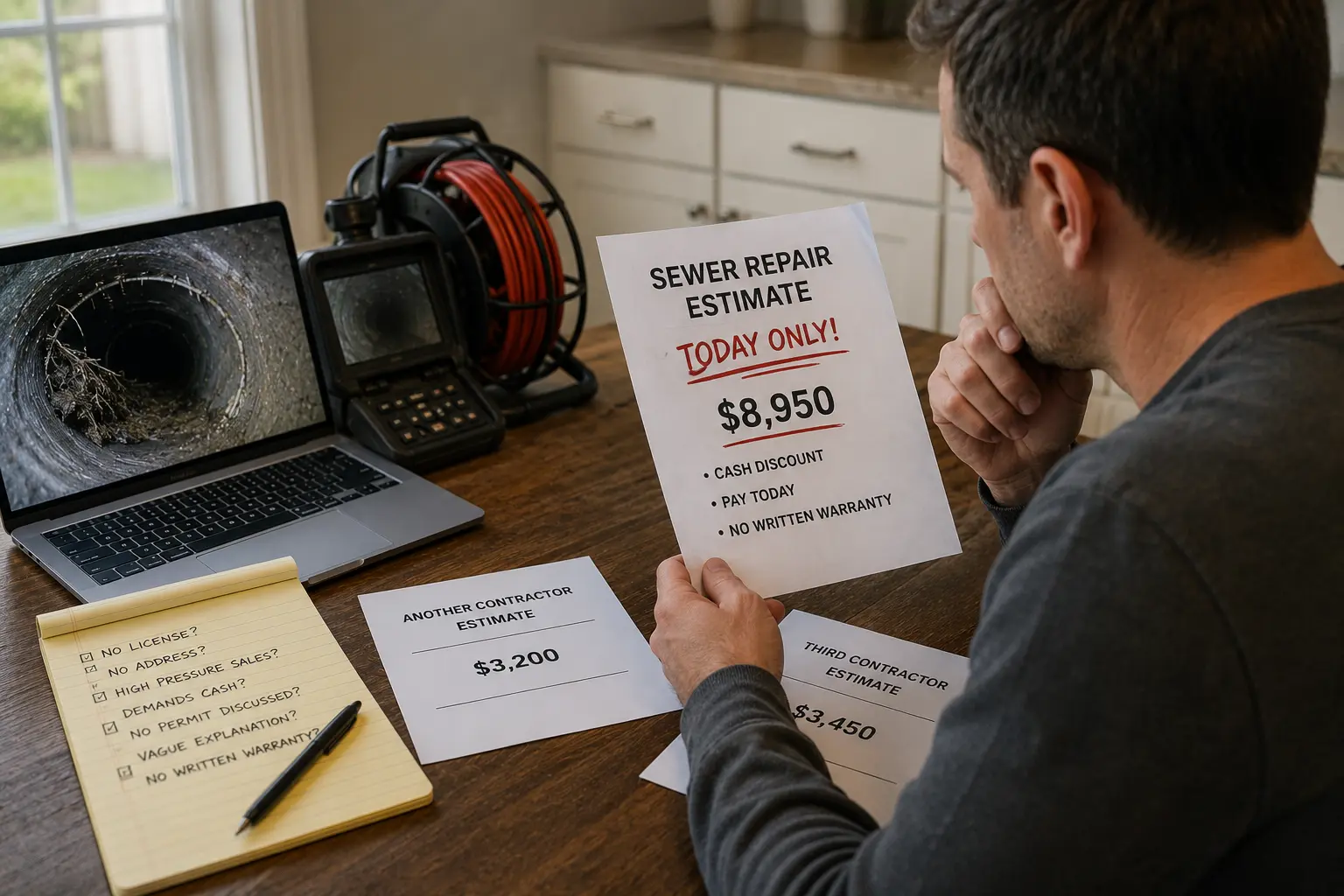
Sewer repair scams often happen when homeowners are under pressure. A basement backup, sewage odor, slow drains throughout the house, or a contractor warning that the sewer line may fail can make it difficult to slow down and evaluate the situation carefully. Scammers and questionable contractors know this, which is why sewer repair can be an area where high-pressure tactics, vague estimates, and unnecessary replacement recommendations appear.
For Chicago homeowners, the risk can be even higher because sewer work may involve older pipes, tree root intrusion, basements, alleys, sidewalks, parkways, excavation, permits, and restoration costs. When the work is complicated, it becomes easier for a dishonest or poorly qualified contractor to hide missing details behind technical language.
This guide explains how to avoid common sewer repair scams, what warning signs to watch for, how to verify a contractor, and what should be in writing before you approve major sewer work. For more help evaluating contractors and estimates, visit the Contractor Selection & Quotes hub.
Key Takeaways
- Be cautious of contractors who pressure you to sign immediately or pay a large amount upfront.
- Major sewer repair recommendations should be supported by clear evidence, such as camera inspection findings when available.
- Never rely on a vague verbal quote for expensive sewer work.
- Ask for proof of licensing, insurance, written scope, permit responsibilities, and warranty terms.
- Compare multiple estimates when possible, especially for sewer line replacement.
- Watch for estimates that exclude permits, inspections, cleanup, restoration, or warranty coverage.
- Chicago homeowners should pay close attention to local access issues, public property, older pipe materials, and permit requirements.
How Can Homeowners Avoid Sewer Repair Scams?
Homeowners can avoid sewer repair scams by slowing down the decision, asking to see inspection evidence, getting a detailed written estimate, verifying licensing and insurance, comparing multiple quotes when possible, confirming permit and restoration responsibilities, avoiding large upfront payments, and refusing to sign under pressure. Any major sewer repair should be clearly explained, documented, and tied to the actual condition of the pipe.
Why Sewer Repair Is Vulnerable to Scams
Sewer problems can feel urgent and intimidating. Most homeowners cannot see the damaged pipe, may not understand sewer camera footage, and may worry about serious property damage if they delay repairs. That creates an opening for dishonest contractors to exaggerate the problem or rush the homeowner into signing.
Common pressure points include:
- Fear of another sewage backup
- Concerns about basement damage
- Uncertainty about underground pipe conditions
- Confusion over repair methods
- Limited time to compare contractors
- Difficulty understanding what a quote includes
A legitimate contractor should help reduce confusion, not increase pressure. They should explain the problem clearly, show evidence when available, and provide written details before asking for a major commitment.
Scam Warning Sign #1: Pressure to Sign Immediately
High-pressure sales tactics are one of the clearest warning signs. A contractor may claim the price is only available today, that the line will collapse immediately, or that you do not have time to get another opinion.
Be cautious of phrases such as:
- “You need to sign right now.”
- “This price disappears after today.”
- “No other company can do this in time.”
- “If you wait, your whole house could flood.”
- “We already have the crew nearby, so you must decide now.”
Some sewer emergencies do require fast action, especially if sewage is actively backing up into the home. Even then, a contractor should distinguish between immediate stabilization and long-term replacement decisions.
For a broader list of warning signs, see Red Flags to Watch for in Sewer Repair Contractors.
Scam Warning Sign #2: No Camera Footage or Inspection Evidence
If a contractor recommends expensive sewer repair or replacement, ask what evidence supports that recommendation. In many cases, a sewer camera inspection can help show the condition of the pipe.
Ask to see:
- The camera footage
- Still images of the damaged section
- The location of the problem
- The distance from the access point
- Whether the issue is isolated or widespread
- An explanation of why the proposed repair is necessary
A camera inspection does not answer every question, but it can help homeowners avoid approving work based only on fear or vague claims. If a contractor refuses to show footage or explain the findings, slow down.
Before relying on a contractor’s recommendation, review Should You Get a Sewer Camera Inspection Before Hiring a Contractor?.
Scam Warning Sign #3: Vague Verbal Quotes
A verbal quote may be acceptable for a simple service call, but it is not enough for major sewer repair or replacement. Expensive sewer work should be documented in writing.
A vague quote may hide important missing costs, such as:
- Permits
- Inspections
- Excavation
- Pipe materials
- Cleanouts
- Debris removal
- Backfill
- Concrete repair
- Landscaping restoration
- Warranty coverage
A complete quote should identify the diagnosis, repair method, scope, materials, permit responsibilities, restoration obligations, payment terms, and exclusions. For a detailed breakdown, see What Should Be Included in a Sewer Repair Quote?.
Scam Warning Sign #4: Large Upfront Payment Demands
Some contractors may reasonably request a deposit before scheduling work or ordering materials. However, demanding full payment upfront, especially in cash, is a major warning sign.
Before paying anything, ask:
- What does the deposit cover?
- Is the payment schedule written into the contract?
- When is final payment due?
- Is payment tied to milestones or inspection approval?
- What happens if the project is delayed?
- What happens if unexpected problems are found?
Homeowners should avoid paying the full cost before work is completed. A clear payment schedule protects both the homeowner and the contractor.
Scam Warning Sign #5: No Proof of Licensing or Insurance
Sewer repair can involve excavation, heavy equipment, underground utilities, property damage risk, and worker safety concerns. A contractor who cannot provide documentation may not be qualified for the project.
Ask for proof of:
- Business licensing where applicable
- Relevant plumbing or sewer qualifications
- General liability insurance
- Workers’ compensation coverage
- Experience with similar sewer projects
Do not rely on a verbal statement that the contractor is “covered.” Ask for documentation before signing.
If you are unsure whether you need a plumber, sewer contractor, or company that does both, read Licensed Plumber vs Sewer Contractor: What’s the Difference?.
Scam Warning Sign #6: Full Replacement Recommended Without Alternatives
Full sewer line replacement may be necessary in some cases, but it should not be recommended automatically for every sewer issue. A contractor should explain why replacement is required and whether other options are realistic.
Possible alternatives may include:
- Drain cleaning
- Root removal
- Spot repair
- Pipe lining
- Pipe bursting
- Partial replacement
Some alternatives may not be appropriate depending on the pipe’s condition. The important point is that the contractor should explain why. If the discussion jumps immediately to the most expensive option without evidence, consider getting another opinion.
Use Questions to Ask Before Sewer Line Replacement to guide that conversation.
Scam Warning Sign #7: Missing Permit and Inspection Details
Many sewer repair and replacement projects require permits or inspections. If a contractor avoids the topic, the quote may be incomplete.
Ask:
- Are permits required?
- Who obtains them?
- Are permit fees included?
- Who schedules inspections?
- Will work pause for inspection approval?
- Are public areas involved?
Skipping required permits can create problems later, including compliance issues, failed inspections, or complications when selling the home.
Scam Warning Sign #8: Unusually Low Quotes
A low quote is not automatically a scam. Some contractors may recommend a smaller repair, have lower overhead, or complete the work efficiently. However, a quote that is dramatically lower than others should be reviewed carefully.
| Possible Missing Item | Why It Matters |
|---|---|
| Permits | Permit fees and inspection coordination can affect the real project cost. |
| Restoration | Concrete, pavement, lawn, or landscaping repair may be excluded. |
| Debris Removal | Old pipe, soil, and construction debris may need hauling. |
| Warranty | A lower quote may come with limited or unclear warranty protection. |
| Pipe Length | One quote may cover less pipe than another. |
| Change Orders | Unexpected add-ons may raise the final price after work begins. |
Compare quotes line by line before deciding. For more detail, read How to Compare Sewer Replacement Quotes.
Scam Warning Sign #9: Weak or Verbal Warranty Promises
Warranty language should be written, specific, and understandable. Be cautious if a contractor relies only on phrases like “we stand behind our work” without explaining what is actually covered.
Ask whether the warranty covers:
- Labor
- Materials
- Workmanship
- Settling or backfill issues
- Recurring backups
- Root intrusion
- Only the repaired section
- Transferability if you sell the home
Also ask what is excluded. Many warranty disputes happen because homeowners and contractors had different assumptions about coverage.
Scam Warning Sign #10: The Contractor Avoids Written Change Orders
Unexpected conditions can appear during sewer work. That does not automatically mean the contractor is dishonest. However, additional charges should be documented and approved before the extra work is performed whenever possible.
Ask how the contractor handles:
- Additional damaged pipe
- Unexpected utility conflicts
- Soil or groundwater issues
- Extra excavation
- Permit changes
- Additional restoration
A written change order process helps prevent disputes about what was approved and how much it costs.
Chicago-Specific Sewer Scam Risks
Chicago homeowners should be especially careful because local sewer projects can involve several conditions that affect cost and complexity.
Older Pipe Materials
Many homes have older clay, cast iron, or deteriorated sewer materials. A contractor should explain whether the pipe has isolated damage or broader failure.
Tree Root Intrusion
Roots are common in older neighborhoods. A contractor should explain whether roots are the main problem or whether they entered through cracked or separated pipe joints.
Basement Backups
Basement sewage backups can create urgency. Be careful of contractors who use that urgency to push immediate full replacement without documentation.
Alleys, Sidewalks, and Parkways
Sewer lines may run through areas that involve access challenges or public property. Quotes should explain restoration responsibilities and permit requirements.
Seasonal and Weather Conditions
Cold weather, heavy rain, and saturated soil can affect excavation and restoration. A contractor should set realistic expectations rather than promising impossible timelines.
How to Protect Yourself Before Signing
Before approving sewer repair, confirm these items in writing:
- The diagnosis and reason for the repair
- Camera inspection findings, if available
- The exact repair method
- The pipe section being repaired or replaced
- Materials being used
- Permits and inspections
- Cleanup and debris removal
- Concrete, pavement, lawn, or landscaping restoration
- Warranty terms and exclusions
- Payment schedule
- Change order process
- Contractor insurance documentation
If these details are missing, ask for a revised estimate before signing. The Sewer Repair Estimate Checklist can help you review the proposal more carefully.
Common Mistakes Homeowners Make
Sewer repair scams often succeed because homeowners are trying to solve an urgent problem quickly. Avoid these common mistakes:
- Approving major work without seeing evidence
- Signing under pressure
- Accepting a verbal quote
- Failing to verify insurance
- Assuming permits are included
- Choosing the lowest price without reviewing exclusions
- Paying too much upfront
- Ignoring unclear warranty language
- Not asking about restoration
- Skipping a second opinion for expensive replacement work
If a project is expensive and not immediately dangerous, taking time to compare estimates can be one of the best protections.
What to Do If You Suspect a Sewer Repair Scam
If something feels wrong, do not let pressure force an immediate decision. Pause the process and gather more information.
Consider these steps:
- Ask for all details in writing
- Request camera footage or inspection findings
- Verify licensing and insurance
- Compare at least one additional estimate
- Review the contract before paying
- Ask what work is urgent and what can wait
- Keep copies of quotes, messages, invoices, and photos
- Contact your insurer if property damage or a possible claim is involved
If the contractor becomes aggressive when you ask reasonable questions, that is a warning sign by itself.
Frequently Asked Questions
What is the most common sewer repair scam?
One common problem is pressuring homeowners into expensive sewer replacement without clearly showing evidence that replacement is necessary. Vague quotes, fear-based urgency, and refusal to explain inspection findings are major warning signs.
Should I trust a contractor who says I need immediate sewer replacement?
Sometimes immediate action is necessary, especially during active sewage backups or confirmed pipe collapse. However, the contractor should still explain the evidence, show inspection findings when available, and provide written details before major work begins.
Is it suspicious if a contractor asks for a deposit?
Not always. Deposits can be normal for scheduled work or materials. It becomes concerning when the contractor demands full payment upfront, cash-only payment, or a large deposit without a detailed written contract.
Can a sewer camera inspection prevent scams?
It can help. Camera footage gives homeowners visible evidence of the problem and makes it easier to ask questions or compare estimates. However, the footage should be explained clearly and not used as a pressure tactic.
How do I know if a sewer repair quote is legitimate?
A legitimate quote should be written, detailed, and specific. It should include diagnosis, scope, repair method, materials, permits, cleanup, restoration, warranty, payment terms, exclusions, and possible change orders.
Should I get multiple estimates for sewer replacement?
For major sewer replacement, multiple estimates are usually helpful unless the situation is an immediate emergency. Comparing proposals can reveal differences in scope, price, repair method, and warranty coverage.
Can homeowners insurance protect me from sewer repair scams?
Insurance may help with certain covered losses, but it does not replace careful contractor selection. Homeowners should still verify credentials, review estimates, understand exclusions, and document the project.
Conclusion
Avoiding sewer repair scams starts with slowing down long enough to verify the problem, review the estimate, and confirm the contractor’s qualifications. The best contractors should be willing to explain the diagnosis, show inspection evidence, discuss alternatives, provide written details, and answer questions without pressure.
For Chicago homeowners, the stakes can be high because sewer work may involve older pipes, basements, excavation, permits, sidewalks, parkways, and costly restoration. A clear written quote, documented findings, reasonable payment terms, and written warranty protection can help reduce the risk of being misled.
If a contractor relies on fear, urgency, vague promises, or incomplete paperwork, it is reasonable to pause, ask more questions, and seek another opinion before approving major sewer repair work.