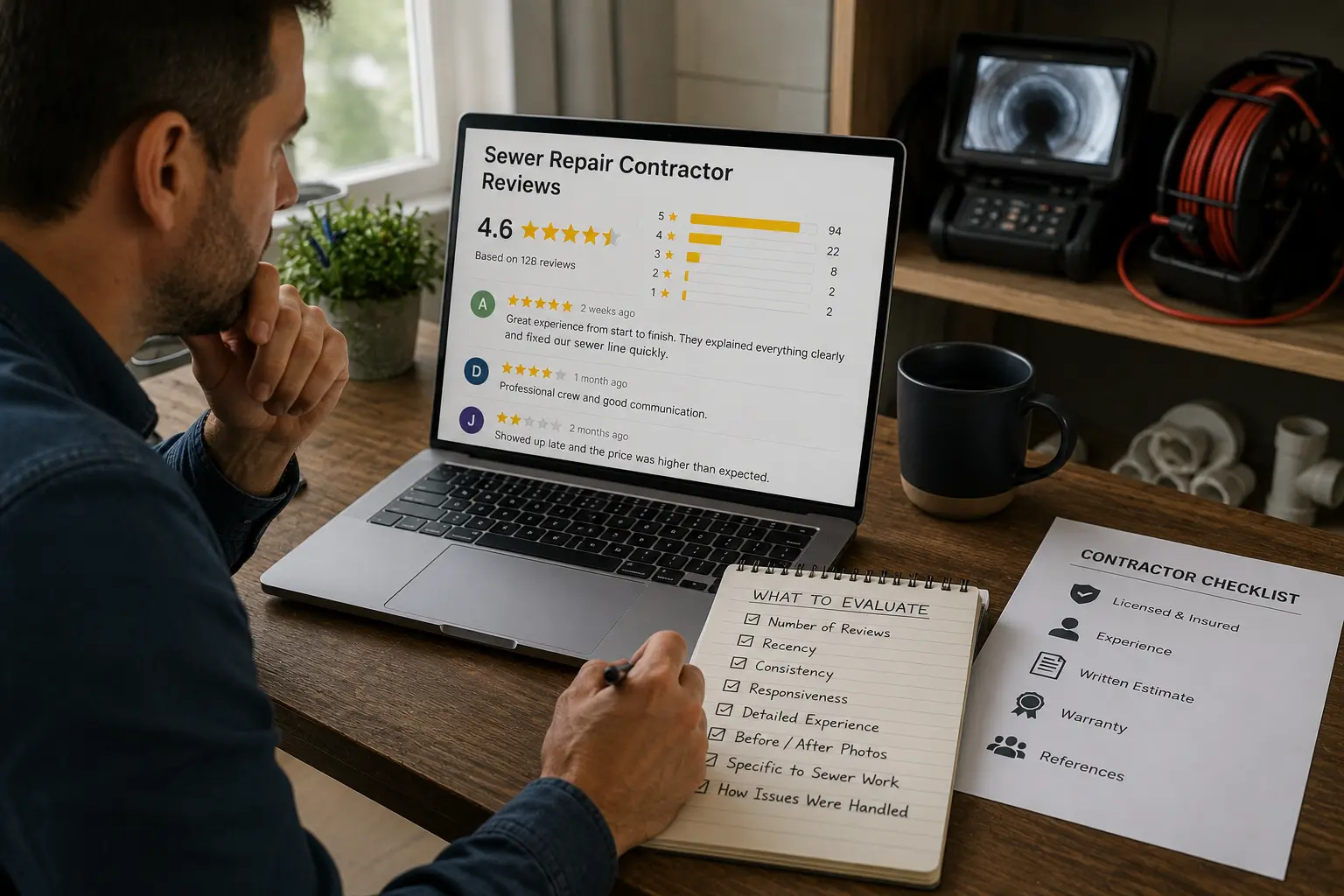
Online reviews can be helpful when choosing a sewer contractor, but they can also be misleading if homeowners rely only on star ratings. Sewer repair is different from many household services because the work can be expensive, disruptive, technical, and highly dependent on property conditions. A contractor with a strong overall rating may still be a poor fit for a complex sewer replacement, while one negative review may not tell the full story.
For Chicago homeowners, reviews should be read with a practical eye. Older sewer lines, basement backups, tree root intrusion, alleys, sidewalks, parkways, and permitting issues can all affect how a project goes. The most useful reviews are the ones that explain what problem the homeowner had, how the contractor diagnosed it, what work was performed, how communication went, and whether the issue was resolved after the job.
This guide explains how to evaluate sewer contractor reviews, what patterns to look for, which review details matter most, and how to combine reviews with estimates, inspections, and contractor qualifications. For more help with hiring decisions, visit the Contractor Selection & Quotes hub.
Key Takeaways
- Star ratings are only a starting point; the details inside the reviews matter more.
- Look for reviews that describe similar sewer problems, such as backups, roots, excavation, or replacement.
- Repeated complaints about pricing, cleanup, delays, pressure tactics, or warranty issues should be taken seriously.
- Positive reviews are most useful when they mention clear communication, accurate diagnosis, written estimates, and clean work.
- Chicago sewer projects may involve older pipes, tight access, public property, and permitting concerns, so local experience matters.
- Use reviews alongside licensing, insurance, camera inspection findings, and written estimates before hiring.
- Be cautious if reviews seem unusually generic, repetitive, or disconnected from actual sewer work.
How Should You Evaluate Sewer Contractor Reviews?
Evaluate sewer contractor reviews by looking beyond the overall rating. Focus on reviews that describe the type of sewer problem, the contractor’s diagnosis, communication, estimate clarity, repair method, cleanup, permit handling, warranty support, and how the company handled problems. Repeated patterns are more important than one glowing review or one angry complaint.
Start With the Type of Work Mentioned
Not every plumbing review is relevant to sewer repair. A company may have excellent reviews for water heaters, fixture repairs, or simple drain cleaning, but that does not necessarily prove they are the best choice for sewer excavation or replacement.
When reading reviews, look for projects similar to yours:
- Main sewer line backups
- Sewer camera inspections
- Tree root intrusion
- Collapsed or cracked sewer pipes
- Spot repairs
- Trenchless sewer repair
- Traditional excavation
- Full or partial sewer replacement
- Basement sewer backups
- Permit or inspection coordination
If most reviews only mention minor plumbing jobs, you may need more information before trusting the company with a major sewer project. For help understanding whether you need a sewer specialist or a general plumbing contractor, read Licensed Plumber vs Sewer Contractor: What’s the Difference?.
Look for Specific Details, Not Generic Praise
The most useful reviews are specific. They explain what happened, what the contractor did, and how the homeowner felt about the process.
A helpful review might mention:
- The sewer problem the homeowner experienced
- Whether a camera inspection was performed
- How clearly the contractor explained the findings
- Whether the estimate matched the final work
- How long the repair took
- Whether the property was cleaned up afterward
- Whether the problem stayed fixed
Generic reviews such as “great service” or “best company ever” are not useless, but they carry less weight than reviews with project-specific details.
Useful review details usually answer this question: Did the contractor solve a sewer problem similar to yours in a professional, clearly explained, and well-documented way?
Pay Attention to Communication Patterns
Sewer repair projects often involve scheduling, inspections, excavation, utility concerns, property access, and possible change orders. Communication matters before, during, and after the work.
Positive review signs include comments about:
- Explaining the diagnosis clearly
- Answering homeowner questions
- Showing camera footage
- Providing updates during the job
- Arriving when scheduled
- Explaining delays
- Following up after completion
Negative patterns may include repeated complaints about missed appointments, vague answers, surprise charges, unreturned calls, or confusion about who was responsible for the job.
Poor communication in reviews is especially important if you are considering a large sewer replacement. Before signing, use the questions in Questions to Ask Before Sewer Line Replacement to test how clearly the contractor explains the project.
Review Comments About Diagnosis and Camera Inspections
A sewer contractor should be able to explain why a repair is needed. Reviews that mention clear diagnosis, camera footage, or inspection findings are especially useful.
Look for review language such as:
- “They showed me the camera footage.”
- “They explained where the roots were entering.”
- “They marked the damaged section.”
- “They showed why replacement was necessary.”
- “They gave us options instead of pushing one solution.”
Be more cautious if reviews mention that the contractor recommended expensive work without showing evidence, explaining the problem, or discussing alternatives.
If camera inspections are part of your decision, review Should You Get a Sewer Camera Inspection Before Hiring a Contractor? before relying on any contractor recommendation.
Compare Reviews Against the Estimate
Reviews are useful, but they should not replace a written estimate. A company may have strong reviews and still provide a vague quote. Homeowners should use reviews to decide who deserves consideration, then use written proposals to make the final decision.
When reviews praise a company, check whether the contractor’s estimate also includes:
- Diagnosis
- Repair method
- Pipe length or repair area
- Materials
- Permits
- Inspections
- Excavation details
- Cleanup
- Restoration
- Warranty terms
- Payment schedule
If the estimate is incomplete, ask for clarification even if the reviews are positive. The Sewer Repair Estimate Checklist can help you review what should be included.
Watch for Repeated Complaints
One negative review does not automatically mean a contractor should be avoided. Every service business can have occasional unhappy customers, complicated projects, or misunderstandings. Repeated patterns matter much more.
| Review Pattern | Why It Matters | What to Ask Before Hiring |
|---|---|---|
| Surprise charges | May indicate vague estimates or poor change order practices | What could increase the final price? |
| Poor cleanup | Restoration and debris removal may not be clearly included | What condition will the property be left in? |
| Pressure tactics | May indicate sales-driven recommendations | Can I review the quote before deciding? |
| Warranty complaints | May indicate unclear coverage or weak follow-up | What warranty is in writing? |
| Missed appointments | May indicate scheduling or communication problems | Who is my project contact? |
| Unclear diagnosis | May indicate weak documentation | Can I see the inspection findings? |
If you see several reviews describing the same issue, treat that pattern as more meaningful than the company’s average rating.
Understand How to Read Negative Reviews
Negative reviews should be read carefully, not automatically accepted or dismissed.
Ask yourself:
- Does the review describe a specific sewer project?
- Does the complaint involve communication, price, quality, or cleanup?
- Did the company respond professionally?
- Does the complaint appear repeatedly in other reviews?
- Was the issue caused by hidden conditions or unclear expectations?
- Does the review mention permits, inspections, or warranty problems?
A professional response from the contractor does not erase the complaint, but it can show whether the company takes concerns seriously. A defensive, dismissive, or hostile response may be a warning sign.
Be Careful With Perfect Ratings
A perfect rating may be genuine, especially for a newer or smaller company, but homeowners should still read the details. The goal is not to find a company with no complaints. The goal is to find a contractor with a strong record of solving similar sewer problems responsibly.
Be cautious if many positive reviews sound nearly identical, lack project details, or appear within a short time period without much substance.
More trustworthy positive reviews often mention:
- The specific sewer issue
- The name or role of the technician or project lead
- How the estimate was explained
- What repair method was used
- Whether the work area was restored
- How follow-up was handled
Chicago-Specific Review Clues
Reviews from Chicago-area homeowners can be especially helpful when they mention local project conditions. Sewer work in Chicago is often shaped by property age, access, weather, and municipal requirements.
Older Homes and Pipe Materials
Look for reviews that mention older clay, cast iron, or deteriorated sewer lines. Experience with older pipe systems can be important when evaluating repair options.
Basement Backups
Many Chicago homes have basements, and sewer backups can cause significant damage. Reviews that describe how the contractor handled basement-related sewer problems may be useful.
Alleys, Sidewalks, and Parkways
Chicago sewer work may involve tight access, alleys, sidewalks, parkways, or public areas. Reviews that mention careful excavation, cleanup, or restoration can help show how the contractor manages disruption.
Permits and Inspections
Reviews that mention permit handling, inspection coordination, or compliance can be particularly valuable for larger sewer repair or replacement jobs.
Weather and Scheduling
Chicago weather can complicate excavation, concrete work, and restoration. Reviews that discuss realistic scheduling and communication during delays can be useful.
Use Reviews to Build a Shortlist, Not Make the Final Decision
Reviews are best used to create a shortlist of contractors worth contacting. They should not be the only factor in the final hiring decision.
After reviewing ratings and comments, homeowners should still confirm:
- Licensing and insurance
- Experience with similar sewer problems
- Inspection findings
- Written estimate details
- Repair method and alternatives
- Permit responsibilities
- Restoration obligations
- Warranty terms
- Payment schedule
For a complete hiring framework, see How to Choose a Sewer Repair Contractor in Chicago.
How Reviews Can Help You Compare Quotes
Reviews may help explain differences between quotes. For example, a contractor with many reviews praising cleanup, careful excavation, and communication may include more restoration or project management in the estimate. Another contractor may offer a lower price but exclude certain items.
Use reviews to help evaluate:
- Whether the contractor communicates clearly
- Whether final costs tend to match estimates
- Whether customers mention surprise charges
- Whether the company follows through after payment
- Whether problems are resolved professionally
- Whether work areas are cleaned and restored
Then compare that information against the written proposal. If you are reviewing multiple bids, How to Compare Sewer Replacement Quotes explains how to compare scope, method, warranty, and exclusions.
Common Mistakes and Warning Signs
Avoid these review-reading mistakes:
- Choosing based only on the highest star rating
- Ignoring whether reviews mention sewer work specifically
- Overlooking repeated complaints
- Trusting generic reviews without project details
- Ignoring how the company responds to problems
- Assuming many reviews guarantee quality
- Letting one angry review outweigh a consistent pattern of good work
- Failing to compare reviews with the written estimate
- Ignoring warranty and follow-up complaints
If reviews suggest pressure tactics, unclear pricing, or poor follow-up, read Red Flags to Watch for in Sewer Repair Contractors before hiring.
Questions to Ask After Reading Reviews
Once you have reviewed a contractor’s online reputation, ask questions that confirm whether the company is a good fit for your project.
- Do you regularly handle this type of sewer problem?
- Can you show inspection findings before recommending repair?
- Will the quote explain exactly what is included?
- Are permits and inspections included?
- What restoration is included after excavation?
- How do you handle unexpected conditions?
- Who will be my point of contact during the project?
- What warranty applies, and is it written?
- Can you explain any common complaints I saw in reviews?
The way a contractor answers these questions can be just as important as the reviews themselves.
Frequently Asked Questions
Are online reviews reliable for choosing a sewer contractor?
They can be useful, but they should not be the only factor. Reviews are best used alongside licensing, insurance, inspection findings, written estimates, warranties, and contractor experience.
How many reviews should a sewer contractor have?
There is no perfect number. A large review history can be helpful, but the quality and relevance of the reviews matter more than the total count. Look for reviews about sewer work similar to your problem.
Should I avoid a sewer contractor with negative reviews?
Not automatically. One or two negative reviews may not be enough to disqualify a contractor. Repeated complaints about the same issue are more concerning, especially if they involve pricing, quality, cleanup, or warranty support.
What review details matter most for sewer repair?
The most useful reviews mention diagnosis, camera inspections, written estimates, repair method, communication, cleanup, final cost, warranty support, and whether the sewer problem was resolved.
Can fake reviews be a problem?
Yes. Reviews that are extremely generic, repetitive, or lack project details may be less useful. Homeowners should look for specific descriptions of real sewer problems and how the contractor handled them.
Should reviews mention permits or inspections?
For major sewer repair or replacement, reviews that mention permits, inspections, or municipal requirements can be helpful. These details suggest the reviewer had a larger project rather than a simple service call.
Can homeowners insurance reviews help me choose a contractor?
Reviews mentioning insurance claims may be useful if you are dealing with a covered loss, but insurance handling should not be the only factor. You still need a qualified contractor with a clear scope, proper documentation, and written warranty terms.
Conclusion
Sewer contractor reviews can be valuable, but they need to be read carefully. The best reviews are specific, project-related, and focused on diagnosis, communication, estimate clarity, cleanup, repair quality, and follow-up support.
For Chicago homeowners, reviews should also be considered in light of local sewer conditions, including older pipes, basements, tree roots, tight access, sidewalks, alleys, and permitting requirements. A strong review profile can help you build a shortlist, but the final decision should still depend on qualifications, inspection evidence, written estimates, warranty terms, and how clearly the contractor answers your questions.
The goal is not simply to find the highest-rated contractor. The goal is to find a sewer professional whose reviews, documentation, and project approach match the repair your home actually needs.