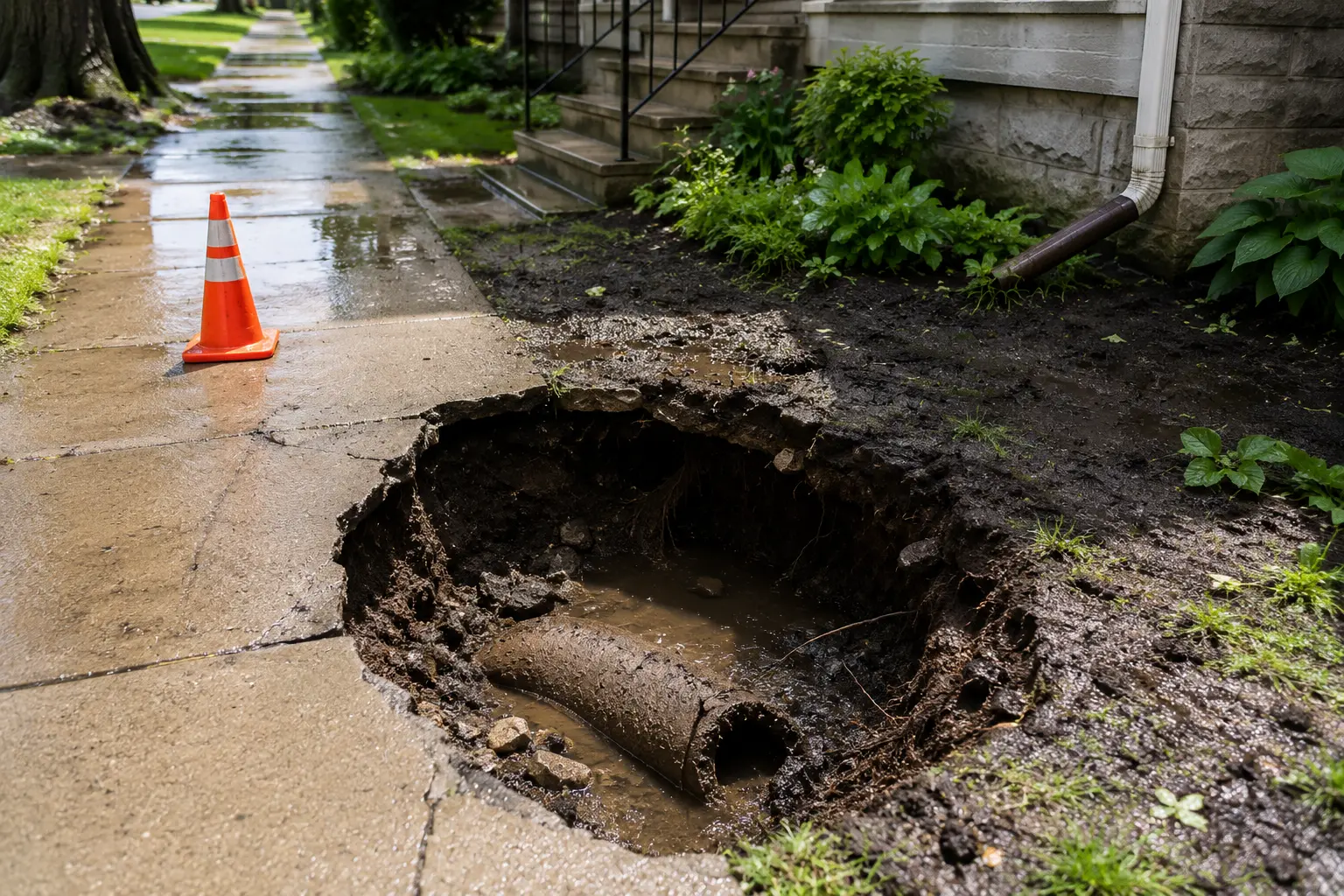
A collapsed sewer line is one of the more serious sewer problems a homeowner can face. Warning signs may include repeated sewer backups, multiple slow drains, toilets that will not flush properly, gurgling drains, sewage odors, water pooling in the yard, sunken soil, and camera inspection footage showing that part of the pipe has caved in or become blocked.
A collapse is different from a routine clog. A clog may be removable with cleaning. A collapsed sewer line means the pipe itself has failed or is physically obstructing wastewater flow. In many cases, cleaning alone cannot restore reliable drainage because the pipe no longer has a clear, stable opening.
For Chicago homeowners, recognizing the warning signs matters because many properties have older sewer laterals, clay pipe sections, basements, mature trees, and compact lots where a sewer failure can quickly lead to basement backups, property damage, difficult excavation, and urgent repair decisions.
Key Takeaways
- A collapsed sewer line means part of the pipe has failed, caved in, crushed, or become structurally blocked.
- Common warning signs include repeated backups, multiple slow drains, gurgling fixtures, sewage odors, and water rising from basement drains.
- Yard pooling, sinkholes, soft soil, or sewage smells outside can suggest underground pipe failure.
- A sewer camera inspection is usually needed to confirm whether the line is collapsed or severely restricted.
- Drain cleaning may not solve a collapse because the pipe itself may be damaged or blocked.
- Older Chicago homes with clay sewer pipe, root intrusion, soil movement, or previous repairs may be more vulnerable.
- A collapsed line often requires repair or replacement, especially if wastewater cannot leave the home reliably.
How to Recognize a Possible Sewer Line Collapse
A sewer line may be collapsed if wastewater repeatedly backs up into the home, several drains stop working at once, toilets gurgle or fail to flush, sewage smells appear near basement drains, or the yard develops wet, sunken, or foul-smelling areas along the sewer route.
The most reliable confirmation usually comes from a sewer camera inspection. If the camera cannot pass through a section, shows crushed pipe, heavy deformation, severe blockage, or a missing pipe opening, the issue may be a collapse rather than an ordinary clog.
What Is a Collapsed Sewer Line?
A collapsed sewer line occurs when part of the pipe loses its structural shape or becomes blocked because the pipe wall has failed. The pipe may cave in, crush, separate, shift, or fill with soil and debris. Once that happens, wastewater cannot move through the line normally.
In some cases, the collapse is complete and drainage stops almost entirely. In other cases, the collapse is partial. A partial collapse can still allow some water to pass, which may make the problem harder to recognize at first. The homeowner may see recurring clogs, slow drains, or periodic backups before the line fails more severely.
A collapse can happen because of old pipe materials, soil movement, root damage, heavy loads, poor installation, corrosion, cracking, or long-term deterioration. In older Chicago homes, clay pipe sections and shifting joints can be especially relevant.
Major Warning Signs of a Collapsed Sewer Line
Repeated Sewer Backups
Repeated backups are one of the strongest warning signs of a serious main line problem. If wastewater backs up into a basement floor drain, lower-level shower, toilet, tub, or laundry drain, the sewer line may be severely restricted.
One backup can happen because of a clog. Repeated backups after cleaning are more concerning. If the pipe has collapsed, the same area may continue trapping waste or blocking flow no matter how often the line is cleared.
Basement backups are especially important in Chicago homes because basements often contain the lowest drain openings in the house. For more context, see Sewer Backup in Basement: Causes and Warning Signs.
Multiple Drains Slow Down at the Same Time
A single slow drain usually points to a local clog. Multiple slow drains throughout the house may indicate a restriction in the main sewer line. Toilets, tubs, showers, laundry drains, and basement floor drains may all begin draining poorly because wastewater cannot move past the collapsed area.
This whole-house pattern is more serious than one slow sink. If the symptoms affect several fixtures, the issue may be downstream of the home’s branch drains. The article What Slow Drains Throughout the House Can Mean explains how to tell when slow drainage may involve the main line.
Toilets Gurgle, Bubble, or Struggle to Flush
Gurgling toilets and drains can happen when air is trapped or forced backward through the plumbing system. A collapsed or partially collapsed sewer line can disrupt normal airflow and wastewater movement, creating bubbling sounds in toilets, tubs, showers, or basement floor drains.
Gurgling alone does not prove the sewer line has collapsed. But when it appears with slow drains, repeated backups, or sewage odors, it becomes a more serious warning sign.
Sewage Odors Inside the Home
A collapsed sewer line can cause sewage odors if wastewater sits in the line, backs up into lower drains, or leaks into surrounding soil. The smell may be strongest in basements, utility rooms, laundry areas, crawl spaces, or near floor drains.
Sewer odor can also come from less severe causes, such as dry traps or toilet seals. The concern rises when odor appears with drainage problems. If smell is the main symptom, Why Your House Smells Like Sewage can help homeowners compare possible causes.
Water or Wastewater Rising From Basement Drains
Water rising from a basement floor drain is a major warning sign. It can mean the main line is blocked enough that wastewater is reversing direction and coming back into the home.
If the sewer line has collapsed, normal household water use may trigger the problem. Laundry, showers, toilet flushing, or multiple fixtures running at once may send more water into the system than the damaged line can handle.
Recurring Sewer Clogs After Cleaning
If the sewer line is cleaned and clogs return quickly, the issue may be structural. A collapsed section can catch waste, paper, grease, and debris. Cleaning may temporarily create a path through the blockage, but the pipe may continue failing or obstructing flow.
Recurring clogs may also be caused by roots, bellies, or offset joints. The related guide Why Do Sewer Lines Keep Clogging? explains how repeated blockages can point to larger pipe defects.
Wet, Sunken, or Foul-Smelling Areas Outside
A collapsed sewer line may leak wastewater into the ground or cause soil to shift around the damaged area. Outside warning signs may include soggy soil, sunken spots, unpleasant odors, unusually green grass, or water pooling along the sewer route.
In Chicago, these signs may show up in small yards, gangways, parkways, or near sidewalks. On properties with a lot of concrete, exterior clues may be harder to notice. If water pooling is one of the symptoms, homeowners may want to review Water Pooling in the Yard: Could It Be a Sewer Problem?.
What Causes a Sewer Line to Collapse?
Aging Clay Sewer Pipe
Older clay sewer pipes can crack, shift, and separate over time. Once the pipe loses support or develops structural weakness, it may become vulnerable to collapse. Clay pipe joints can also create entry points for roots and soil.
Not every clay pipe is failing, but older clay lines with repeated root intrusion, cracks, offsets, or standing water should be evaluated carefully. Homeowners can learn more in Cracked Clay Sewer Pipes: Causes and Risks.
Tree Root Intrusion
Roots usually enter through an existing crack, joint, or gap. Once inside, they can expand, trap waste, and increase pressure inside the line. Over time, roots can worsen existing damage and contribute to structural failure.
Root intrusion does not always mean collapse, but roots combined with old pipe materials, offsets, or cracks can increase the risk of severe restriction or failure.
Soil Movement or Washout
Sewer pipes need stable support. If soil shifts, settles, erodes, or washes away, a pipe may sag, separate, or collapse. Soil movement can be influenced by water leaks, old repairs, nearby excavation, drainage issues, or long-term settling.
A pipe that loses support may first develop a belly or offset joint before failing more severely.
Offset Joints and Pipe Separation
When pipe sections shift out of alignment, waste can catch at the joint and roots may enter through the gap. Over time, the joint may worsen, and soil may enter the pipe. If enough support is lost, collapse can become more likely.
Heavy Loads Above the Sewer Line
Driveways, garages, heavy equipment, concrete slabs, or other loads above a weakened sewer pipe can contribute to damage. A properly installed and supported line is designed to handle normal conditions, but an old or already weakened pipe may be more vulnerable.
Poor Previous Repairs
A previous repair that did not restore proper slope, support, bedding, or alignment can create future problems. Transitions between pipe materials can also become weak points if they were not installed correctly or if the surrounding soil later settled.
How a Collapsed Sewer Line Is Diagnosed
Symptoms can suggest a collapsed line, but a camera inspection is usually needed to confirm the condition. The camera can show whether the pipe is open, partially blocked, crushed, separated, filled with debris, or impossible to pass.
A camera inspection may show:
- A crushed or deformed pipe section
- A complete blockage where the camera cannot pass
- Soil, rock, or debris inside the pipe
- A missing or broken pipe wall
- Severe offset joints
- Heavy roots combined with structural damage
- Standing water before the obstruction
- Evidence of prior repairs or material transitions
Homeowners should ask where the suspected collapse is located, how deep the line is, whether the damage is isolated, and whether the rest of the sewer line appears usable.
Practical Homeowner Tip
If a contractor says the line is collapsed, ask what the camera showed and whether the camera could pass the damaged section. A clear recommendation should explain the location, severity, pipe material, and whether repair or replacement is being recommended.
How Serious Is a Collapsed Sewer Line?
A collapsed sewer line is usually more serious than a routine blockage because the pipe itself is damaged. The level of urgency depends on whether wastewater can still leave the home and whether sewage is already backing up.
| Condition | What It May Mean | Typical Concern |
|---|---|---|
| Partial collapse with some flow | Wastewater can pass, but the line is restricted. | Recurring clogs and increasing backup risk. |
| Complete collapse | The sewer path is blocked or severely crushed. | Drainage may stop and backups may occur quickly. |
| Collapse near the house | Wastewater may back up into lower fixtures sooner. | Higher risk of basement damage. |
| Collapse under concrete or public way | Access may be more difficult. | Repair complexity and restoration may increase. |
| Collapse with roots | Pipe damage and root intrusion are both present. | Cleaning alone is unlikely to be reliable. |
| Collapse with soil entering pipe | The pipe wall may be open to surrounding ground. | Potential for worsening blockage and soil movement. |
Chicago-Specific Considerations
Older Sewer Laterals
Many Chicago homes have older sewer laterals that may include clay pipe, cast iron, or sections from past repairs. Age alone does not prove collapse, but older materials can be more vulnerable when combined with roots, cracks, offsets, and soil movement.
Basements Increase the Consequences
Because many Chicago homes have basements, a collapsed sewer line can quickly become a property-damage issue. Wastewater may enter through floor drains, laundry drains, basement toilets, or lower-level showers.
Finished basements raise the stakes because sewage can damage flooring, drywall, trim, furniture, storage, and mechanical areas.
Parkways, Sidewalks, Alleys, and Tight Lots
The location of the collapse affects the repair plan. A damaged section under a yard may be less complicated than one under a basement floor, driveway, sidewalk, parkway, alley, or street. Chicago properties often have tight side access, older concrete, and public-way considerations that can affect timing and restoration.
Storms Can Expose Weak Sewer Lines
Heavy rain may reveal a sewer line that was already compromised. If the line is partially collapsed, added water volume or pressure may make backups more likely. Storm timing should be documented, but homeowners should still investigate the condition of the private sewer lateral.
Repair, Replacement, or Cleaning: What Are the Options?
The right solution depends on whether the line is truly collapsed, where the damage is located, and whether the rest of the pipe is stable. A collapse usually requires more than routine cleaning, but not every case requires replacing the entire sewer line.
Cleaning May Help Temporarily When
- The collapse is partial and debris is contributing to the blockage.
- The line needs immediate flow restored before further diagnosis.
- The pipe is not fully crushed or blocked.
- The homeowner understands cleaning does not repair the collapsed section.
Targeted Repair May Be Possible When
- The collapse is limited to one section.
- The rest of the pipe appears stable.
- The damaged area can be accessed reasonably.
- The repair can restore proper flow and pipe support.
- There are no widespread defects throughout the line.
Replacement May Be Considered When
- The line is fully collapsed.
- Several sections are cracked, shifted, or deteriorated.
- Roots and structural damage are widespread.
- Multiple repairs would be needed.
- The sewer lateral has a long history of backups and failures.
- The damaged section cannot be reliably repaired in isolation.
If a collapse is part of a broader pattern of sewer failure, Signs Your Sewer Line May Need Replacement can help homeowners understand when replacement becomes more likely.
Cost Factors and Homeowner Decision Points
The cost of addressing a collapsed sewer line depends on the location, depth, severity, pipe material, access, restoration, and whether the work is a spot repair or a larger replacement. Homeowners should avoid relying on exact pricing before inspection because the scope can change significantly based on what the camera and site conditions show.
Important cost factors include:
- Depth of the sewer line: Deeper lines usually require more labor, excavation, safety planning, and equipment.
- Location of the collapse: Work under a yard is different from work under a basement floor, sidewalk, driveway, alley, or street.
- Length of damaged pipe: A short collapsed section may be handled differently than widespread deterioration.
- Pipe material: Clay, cast iron, PVC, and mixed materials can affect repair methods.
- Access constraints: Fences, garages, narrow gangways, landscaping, and concrete can complicate the work.
- Restoration needs: Concrete, flooring, landscaping, parkway areas, and cleanup may affect total project cost.
- Emergency timing: Active backups can reduce time to compare quotes and options.
- Insurance coverage: Coverage depends on the policy, endorsements, cause of damage, and whether there is related backup damage.
Homeowners should ask whether the quote includes diagnosis, excavation, pipe replacement or repair, permits, inspections, backfill, surface restoration, cleanup, and any exclusions. Comparing scope is just as important as comparing price.
When a Collapsed Sewer Line Becomes an Emergency
A collapsed sewer line can become an emergency when wastewater cannot leave the home or sewage is actively backing up. The urgency depends on whether the home can still safely use plumbing and whether contaminated water is entering living areas.
Emergency warning signs include:
- Sewage backing up into the basement
- Several drains refusing to drain
- Toilets backing up or not flushing
- Water rising from floor drains
- Strong sewage odors with drainage failure
- The camera cannot pass through the line
- Visible sinkholes or unsafe soil movement
- Wastewater reaching finished space, utilities, or stored belongings
If the symptoms suggest immediate damage or loss of plumbing use, homeowners can compare the situation with When Does a Sewer Problem Become an Emergency?.
Common Mistakes Homeowners Make
Assuming It Is Just Another Clog
A collapsed sewer line may look like a clog at first because the symptoms can overlap. If the same line keeps backing up or cleaning does not hold, the pipe condition needs to be checked.
Relying on Cleaning After a Collapse Is Confirmed
Cleaning may clear debris, but it cannot rebuild a crushed or caved-in pipe. If inspection confirms collapse, homeowners should understand that cleaning is usually temporary at best.
Approving Major Work Without Seeing the Evidence
A collapse should be explained clearly. Homeowners should ask what the camera showed, where the damage is, whether the collapse is partial or complete, and what alternatives exist.
Ignoring Exterior Warning Signs
Wet soil, sinking ground, sewage odors outside, or pooling near the sewer route can signal underground failure. These signs may matter even if indoor fixtures still drain somewhat.
Waiting Until the Basement Floods
If a collapsed line is suspected, waiting can increase the risk of sewage damage, emergency work, and limited repair options.
Comparing Quotes Without Understanding Restoration
Sewer work may disturb concrete, flooring, landscaping, sidewalks, yards, or parkways. Restoration should be clarified before comparing quotes.
FAQ
What are the first signs of a collapsed sewer line?
Early signs may include recurring sewer clogs, slow drains throughout the house, gurgling toilets or drains, sewage odors, and basement drain activity. More serious signs include repeated backups, water rising from floor drains, and camera footage showing pipe failure.
Can a collapsed sewer line still drain a little?
Yes. A partial collapse may allow some water to pass while still causing slow drains, recurring clogs, and backups during heavier use. This can make the problem seem intermittent before it becomes more severe.
How is a collapsed sewer line confirmed?
A sewer camera inspection is commonly used. The camera may show crushed pipe, soil in the line, severe deformation, a blocked section, or an area the camera cannot pass. Additional locating may be used to identify where the damaged section sits underground.
Can a collapsed sewer line be cleaned out?
Sometimes debris can be cleared temporarily if the collapse is partial. However, cleaning does not repair the structural failure. If the pipe has caved in or is crushed, repair or replacement is usually needed for a reliable fix.
Does a collapsed sewer line always require full replacement?
Not always. If the collapse is limited to one section and the rest of the pipe is stable, targeted repair may be possible. Full replacement becomes more likely when the pipe has multiple failing sections, widespread deterioration, or repeated structural problems.
Can tree roots cause a sewer line to collapse?
Roots usually enter through cracks, joints, or weak points. Over time, root growth can worsen existing damage, trap waste, and contribute to pipe failure. Roots may be one factor in a collapse, especially in older clay sewer lines.
Will homeowners insurance cover a collapsed sewer line?
Coverage depends on the policy, endorsements, cause of collapse, and whether there is related sewer backup damage. Many policies treat wear and tear, settling, roots, and deterioration differently from sudden covered events. Service line coverage and sewer backup coverage may also have separate limits.
Is a collapsed sewer line dangerous?
It can be. The main risks include sewage backup, contaminated water exposure, property damage, soil movement, and loss of plumbing use. If wastewater is entering the home or the ground is sinking, the issue should be treated as urgent.
Conclusion
The warning signs of a collapsed sewer line include repeated backups, multiple slow drains, gurgling toilets, sewage odors, water rising from basement drains, recurring clogs after cleaning, and wet or sunken areas outside. A collapse is more serious than a typical clog because the pipe itself may be crushed, broken, or blocked by structural failure.
For Chicago homeowners, the stakes can be high because older sewer laterals, clay pipe, basements, mature trees, tight lots, sidewalks, and restoration needs can all affect the repair decision. The most important step is to confirm the problem with inspection and understand whether the collapse is partial, complete, isolated, or part of broader sewer line deterioration.
Once a collapse is confirmed, homeowners should compare repair and replacement options based on pipe condition, location, depth, access, urgency, and restoration requirements. Acting before the next backup can help reduce property damage and give homeowners more control over the decision.