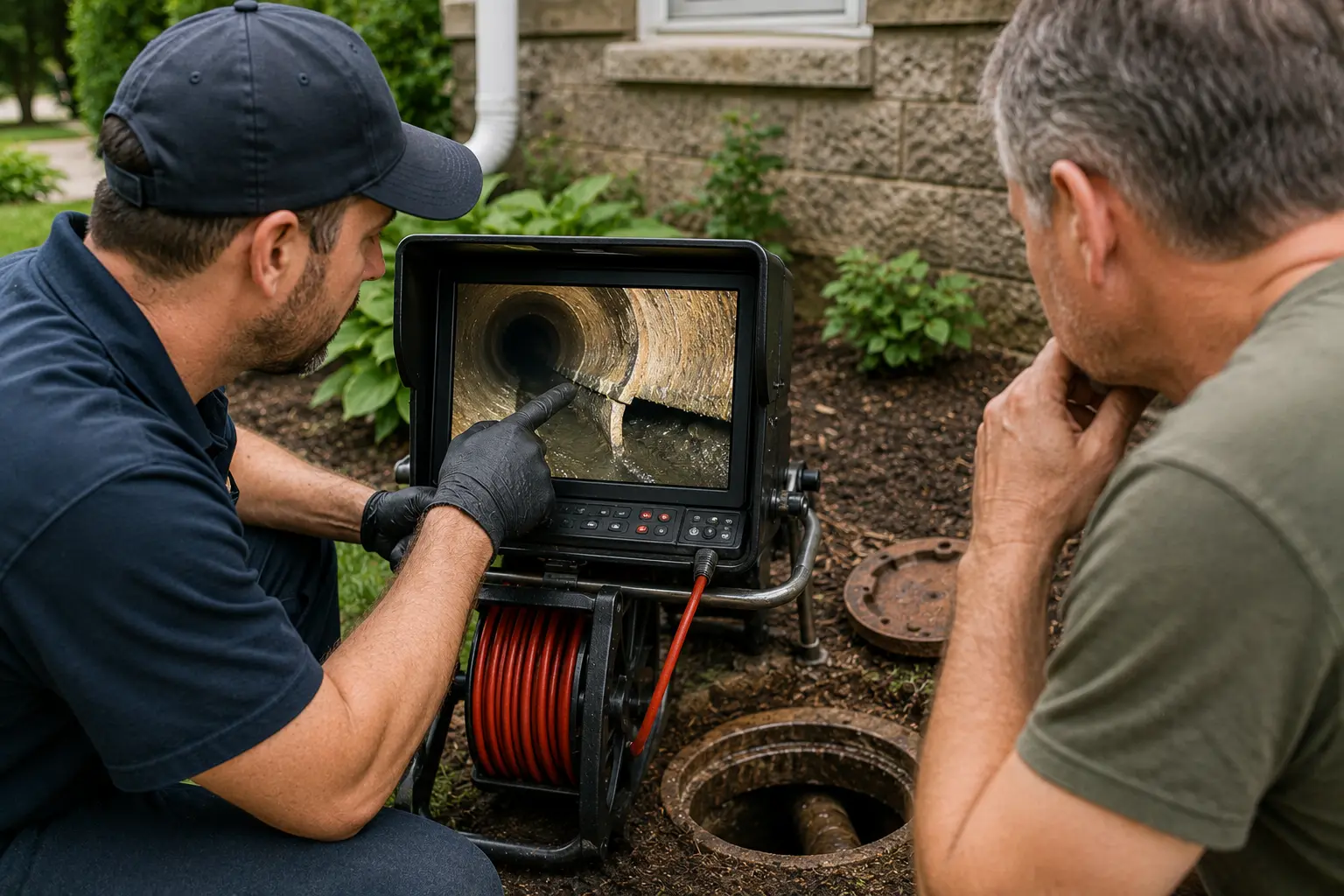
An offset sewer pipe joint is a place where two sections of sewer pipe no longer line up correctly. Instead of forming a smooth path for wastewater, one pipe section has shifted higher, lower, or sideways from the next section. That misalignment can catch waste, slow drainage, allow tree roots into the line, and contribute to recurring clogs or backups.
For Chicago homeowners, offset sewer joints are especially relevant in older sewer laterals, clay pipe systems, and properties where soil settlement, mature tree roots, previous repairs, or underground movement have affected the pipe over time. An offset joint may be a small inspection finding, or it may be the reason a sewer line keeps clogging after repeated cleaning.
An offset joint does not always mean the entire sewer line must be replaced. The seriousness depends on how far the pipe sections have shifted, whether roots or soil are entering, whether wastewater is backing up, and whether the rest of the sewer line is stable.
Key Takeaways
- An offset sewer pipe joint means two pipe sections have shifted out of alignment.
- Offset joints can catch waste, slow drainage, allow root intrusion, and create recurring sewer clogs.
- Common signs include frequent clogs, slow drains throughout the house, gurgling fixtures, sewage odors, and basement backups.
- Older Chicago homes with clay sewer laterals may be more vulnerable because clay pipes are installed in sections with joints.
- A sewer camera inspection is usually needed to confirm the location and severity of the offset.
- Cleaning may restore flow temporarily, but it does not realign the pipe joint.
- Repair decisions depend on the offset’s severity, depth, location, symptoms, and whether other pipe defects are present.
What an Offset Sewer Joint Means
An offset sewer pipe joint means the pipe has shifted out of alignment at a connection point. Wastewater may still pass through, but solids, paper, grease, wipes, and roots can catch on the uneven edge. Over time, that can lead to repeated clogs, slow drains, sewer odors, and backups.
A small offset may be monitored if the line drains well and there are no repeated symptoms. A severe offset, especially one with roots, standing water, soil entry, or repeated backups, may require repair or replacement of the affected section.
How Offset Sewer Pipe Joints Happen
Soil Settlement
Sewer pipes depend on stable soil support. When soil settles, washes out, freezes and thaws, or shifts over time, one pipe section may drop or move away from another. This can create a lip or gap at the joint.
In older Chicago neighborhoods, soil movement can happen gradually over many years. A sewer line may work normally for a long time before the joint shifts enough to create noticeable symptoms.
Older Clay Pipe Sections
Clay sewer lines are built from separate pipe sections. Each connection is a joint. If the joints loosen, shift, or lose support, the pipe sections may become offset.
This is one reason older clay sewer systems can develop recurring issues. The pipe itself may not be fully collapsed, but the joints may no longer create a smooth drainage path. If clay pipe damage is also present, homeowners may want to review Cracked Clay Sewer Pipes: Causes and Risks.
Tree Root Pressure
Tree roots do not usually enter a sewer line through a perfectly sealed pipe. They enter through cracks, gaps, loose joints, or offsets. Once roots reach an offset joint, they can grow inside the pipe and make the blockage worse.
Root growth can also worsen the joint over time by expanding inside the opening and catching more debris. If roots are found at an offset, the issue is not only the roots. The pipe alignment and entry point also matter.
Poor Previous Repairs
A previous sewer repair can create or contribute to an offset if the new section was not aligned properly, if different materials were joined poorly, or if soil support was not restored correctly. Transitions between old clay pipe and newer pipe materials can be important inspection points.
Pipe Movement From Heavy Loads or Nearby Work
Driveways, garages, patios, sidewalks, utility work, excavation, or heavy equipment can affect the ground around a sewer line. A properly supported sewer line should be stable, but an older or weakened line may shift when conditions around it change.
Signs an Offset Sewer Joint May Be Causing Problems
Frequent Sewer Clogs
An offset joint can create a ledge inside the pipe where waste catches. Toilet paper, grease, wipes, sludge, and debris may collect at the misaligned section. The line may clear after service, then clog again because the obstruction point remains.
If the same sewer line keeps clogging, the issue may be more than ordinary buildup. The article Why Do Sewer Lines Keep Clogging? explains how repeated clogs can point to pipe defects such as roots, bellies, offsets, and cracks.
Slow Drains Throughout the House
When an offset joint restricts the main sewer line, multiple fixtures may drain slowly. Toilets, tubs, showers, laundry drains, and basement floor drains may all be affected because wastewater is meeting resistance after it leaves the home.
This whole-house pattern is more concerning than one slow sink. If several drains are slow at the same time, the main sewer line should be considered. For related guidance, see What Slow Drains Throughout the House Can Mean.
Gurgling Toilets or Drains
As wastewater moves past an offset, air may be pushed or pulled through the drainage system in unusual ways. This can cause toilets, tubs, showers, or basement drains to gurgle.
Gurgling alone does not prove an offset joint exists. But gurgling with recurring clogs, slow drains, sewer odors, or basement drain activity can indicate a larger sewer restriction.
Tree Roots Keep Returning
Roots can enter through the gap at an offset joint. Cleaning may remove the roots temporarily, but the opening remains. If roots return after repeated cleaning, the pipe joint may still be allowing entry.
Homeowners dealing with recurring roots can learn more from Tree Roots in Sewer Lines: Signs and Solutions.
Sewage Odors
An offset joint can trap waste or allow sewer gas to escape if the pipe is separated enough. Odors may appear near basement drains, utility rooms, lower-level bathrooms, or outside near the sewer route.
Sewer smells can have many causes, including dry traps and fixture issues. The concern increases when odor appears with slow drainage or repeated clogs.
Basement Sewer Backups
If waste builds up at the offset joint, wastewater may eventually back up into the home. In many Chicago homes, that means water or sewage may appear at basement floor drains, laundry drains, basement toilets, or lower-level showers.
A basement backup should be treated as a serious warning sign, especially if it has happened more than once. The guide Sewer Backup in Basement: Causes and Warning Signs explains why lower-level backups often point to main line problems.
How a Sewer Camera Inspection Identifies an Offset Joint
A sewer camera inspection is usually the clearest way to identify an offset pipe joint. The camera may show a visible ledge, gap, step, separation, or shift where two pipe sections meet. In some cases, the camera may bump against the offset or struggle to pass through the joint.
A useful inspection should help answer:
- Where is the offset located?
- How severe is the misalignment?
- Can the camera pass through the joint?
- Are roots entering at the offset?
- Is soil entering the line?
- Is waste collecting at the joint?
- Is there standing water near the offset?
- Are there cracks, bellies, or collapse nearby?
- What surface is above the damaged section?
Practical Homeowner Tip
If an inspection shows an offset joint, ask whether it is only a visible alignment issue or whether it is actively causing clogs, roots, standing water, or backups. The severity and symptoms matter more than the label alone.
How Serious Is an Offset Sewer Pipe Joint?
Offset joints can range from minor to serious. A slight offset in a line that drains well may not require immediate major work. A large offset that catches waste, admits roots, or blocks the camera is more concerning.
| Inspection Finding | What It May Mean | Typical Concern |
|---|---|---|
| Small visible offset | Pipe sections are slightly misaligned. | May be monitored if drainage is normal. |
| Offset with debris buildup | Waste is catching at the joint. | Recurring clogs may continue. |
| Offset with roots | The joint is allowing root entry. | Cleaning may not provide lasting relief. |
| Offset with standing water | The pipe may also have slope or belly issues. | Slow drainage and repeated blockages are more likely. |
| Offset the camera cannot pass | The misalignment may be severe. | Repair or replacement may be more likely. |
| Offset with cracked or collapsed pipe | Multiple structural defects are present. | Higher risk of failure and backups. |
Chicago-Specific Considerations
Older Clay Sewer Laterals
Many Chicago homes have older sewer laterals that may include clay pipe sections. Because clay lines are made of individual segments, joints are a natural weak point as the line ages. When soil shifts or support changes, those joints may become offset.
Basement Drainage Risk
Chicago basements can make offset joint problems more disruptive. If the offset restricts the main sewer line, wastewater may back up through the lowest drains in the home. Finished basements, laundry areas, storage spaces, and utility rooms can all be affected.
Mature Trees and Root Entry
Tree-lined streets and parkways are common in many Chicago neighborhoods. Roots can enter through offset joints, especially where older pipe sections have shifted apart. If root intrusion and an offset appear together, cleaning alone may not be a long-term fix.
Concrete, Parkways, and Tight Access
The location of the offset matters. A joint beneath open yard space may be easier to access than one beneath a basement floor, sidewalk, driveway, alley, or parkway. Restoration work can affect the total project scope.
Previous Repairs and Material Transitions
Some sewer laterals include a mix of old and newer materials. Offsets can occur near transitions if materials were not aligned, supported, or connected properly. During inspection, homeowners should ask whether the offset is at an old joint, a repair connection, or a material transition.
Can an Offset Sewer Joint Be Cleaned?
An offset sewer joint can often be cleaned if waste, roots, or debris are caught at the misaligned section. Cleaning may restore flow temporarily, especially if the pipe still has enough open space for wastewater to pass.
The limitation is that cleaning does not realign the pipe. If the offset creates a ledge or gap, waste may continue catching there. If roots are entering, they may return. If the offset is severe, the line may keep clogging until the physical defect is repaired.
Cleaning may be reasonable when:
- The offset is minor.
- The line clears fully.
- There are no repeated backups.
- The camera can pass through the joint.
- No significant roots, soil, or collapse are present.
Cleaning is less likely to be enough when the offset is severe, catches debris repeatedly, allows roots in, or appears with other defects.
Repair, Replacement, or Monitoring: How the Decision Is Made
The right response depends on the severity of the offset and the homeowner’s history of sewer symptoms. A minor inspection finding may not need immediate excavation. A severe offset causing repeated basement backups is a different situation.
Monitoring May Be Reasonable When
- The offset is small.
- There are no recurring clogs.
- The line drains normally.
- No roots or soil are entering.
- The camera inspection shows the rest of the pipe is stable.
Cleaning May Be a Temporary Solution When
- Waste is caught at the offset.
- The line can be cleared safely.
- The homeowner needs immediate flow restored.
- Further inspection or repair planning is needed.
Targeted Repair May Be Needed When
- The offset is isolated to one joint or section.
- Roots are entering through that joint.
- The joint repeatedly catches debris.
- The rest of the sewer line is in usable condition.
- The affected section can be accessed and realigned or replaced.
Replacement May Be Considered When
- There are multiple offset joints.
- The line also has widespread cracks, roots, or collapse.
- Several sections are deteriorated.
- Backups continue after cleaning.
- Multiple spot repairs would be needed to solve the full problem.
If the offset is part of a larger failure pattern, Signs Your Sewer Line May Need Replacement can help homeowners understand when replacement becomes more likely.
Cost Factors and Tradeoffs
The cost of addressing an offset sewer pipe joint depends on whether the issue is monitored, cleaned, repaired, or replaced. The same inspection term can lead to different costs depending on location, severity, depth, access, and symptoms.
Important cost factors include:
- Severity of the offset: A small lip is different from a major separation that blocks the line.
- Location of the joint: Damage under open soil is different from damage under a basement floor, sidewalk, driveway, alley, or parkway.
- Depth of the pipe: Deeper sewer lines are usually more complex to access.
- Pipe material: Clay, cast iron, PVC, and mixed materials can affect repair options.
- Root or soil intrusion: Roots or soil entering through the offset can increase urgency.
- Related defects: Bellies, cracks, and collapse may change the scope.
- Restoration needs: Concrete, flooring, landscaping, and public-way restoration may affect total cost.
- Emergency timing: A backup may require faster decisions with less time to compare options.
- Insurance coverage: Coverage depends on the policy, endorsements, cause of damage, and whether there is related backup damage.
The main tradeoff is temporary flow versus long-term reliability. Cleaning may be the lowest-disruption option, but if the offset keeps catching waste or allowing roots in, a physical repair may become more practical.
When an Offset Joint Becomes an Emergency
An offset joint is not always an emergency. It becomes urgent when it blocks the line enough to cause active backups, prevents normal drainage, or contributes to sewage entering the home.
Emergency warning signs include:
- Sewage backing up through a basement floor drain
- Multiple fixtures refusing to drain
- Water rising in tubs, showers, or toilets
- Strong sewer odors with slow drainage
- Repeated clogs shortly after cleaning
- The camera cannot pass through the offset
- Evidence of collapse, soil entry, or severe pipe separation
If the issue has reached this point, homeowners may want to compare symptoms with When Does a Sewer Problem Become an Emergency?.
Common Mistakes Homeowners Make
Thinking Cleaning Fixes the Offset
Cleaning can remove waste or roots caught at the joint, but it does not realign the pipe. If the offset remains, clogs may return.
Ignoring Root Entry
Roots entering through an offset joint are a sign that the pipe has an opening. Root cutting may help temporarily, but the entry point remains unless the defect is addressed.
Assuming Every Offset Requires Full Replacement
Not every offset joint requires replacing the entire sewer line. Some can be monitored or repaired in one section, depending on severity and symptoms.
Ignoring Related Pipe Defects
Offsets often appear with other issues, such as cracked clay pipe, sewer line bellies, roots, or partial collapse. The full inspection should guide the decision.
Waiting Until the Basement Backs Up Again
If an offset has already caused backups, waiting can increase cleanup costs and reduce time for comparing repair options.
Comparing Quotes Without Comparing Scope
A quote for cleaning is not the same as a quote for excavation and repair. Homeowners should compare the location, repair length, restoration, permits, and exclusions.
FAQ
What does an offset sewer pipe joint mean?
It means two sections of sewer pipe no longer line up smoothly. One section has shifted, creating a ledge, gap, or separation where waste can catch and roots or soil may enter.
Can an offset joint cause sewer backups?
Yes. If waste collects at the offset or roots enter through the gap, the line can become restricted enough to cause backups. In many Chicago homes, the backup may appear first in the basement.
Can an offset sewer joint be cleaned?
It can often be cleaned temporarily if waste or roots are caught at the joint. However, cleaning does not fix the misalignment. If the offset keeps catching debris, repair may be needed.
Does an offset joint always require replacement?
No. A minor offset with no symptoms may be monitored. A severe offset causing repeated clogs, roots, soil entry, or backups may require targeted repair or replacement of the affected section.
How is an offset sewer joint found?
A sewer camera inspection can show where pipe sections have shifted. The camera may reveal a ledge, gap, separation, root entry point, or an area where the camera has difficulty passing.
Are offset joints common in older Chicago sewer lines?
They can be, especially in older clay sewer laterals made of separate pipe sections. Soil movement, root pressure, aging joints, and previous repairs can all contribute to misalignment.
Can an offset joint cause sewer smells?
Yes, especially if waste collects at the joint, sewer gas escapes through separation, or the offset contributes to backups. However, sewer smells can also come from traps, toilet seals, or venting issues, so diagnosis matters.
Will homeowners insurance cover an offset sewer pipe joint?
Coverage depends on the policy, endorsements, cause of damage, and whether there is related backup damage. Wear and tear, settling, roots, and gradual deterioration may be treated differently from sudden covered events.
Conclusion
An offset sewer pipe joint is a misaligned connection between two sections of pipe. It may seem like a small defect, but it can catch waste, allow roots into the line, slow drainage, create sewer odors, and contribute to repeated basement backups.
For Chicago homeowners, offset joints are especially important because older clay sewer laterals, mature trees, soil movement, basements, and tight access conditions can make recurring sewer problems more disruptive. Cleaning may restore flow temporarily, but it does not correct the pipe alignment.
The best decision depends on the inspection findings, symptom history, location, severity, and whether other defects are present. Homeowners should ask clear questions, compare repair scopes carefully, and decide whether monitoring, cleaning, targeted repair, or replacement is the most practical path forward.