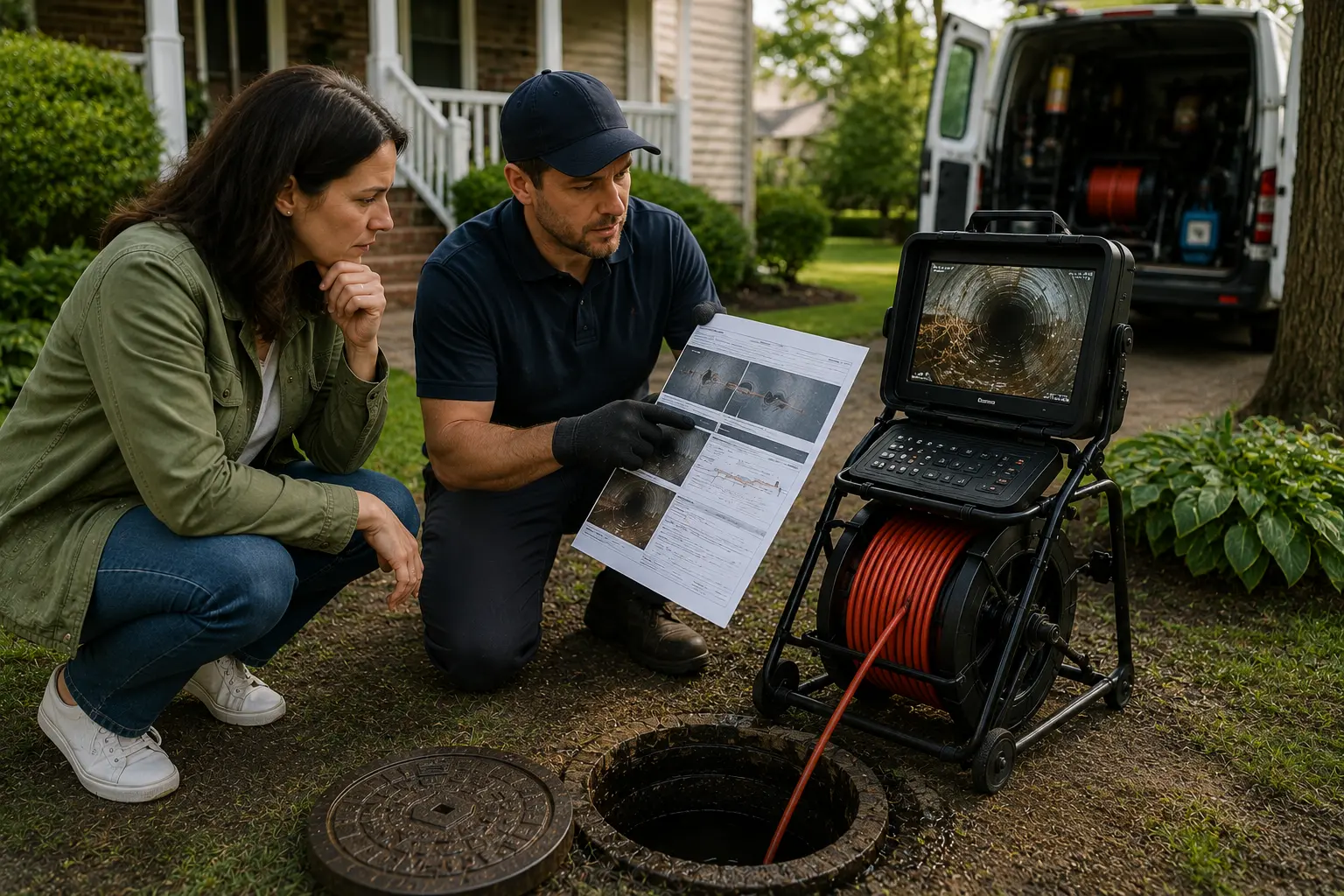
A sewer scope report can feel confusing at first. Homeowners may receive a video link, a few still images, distance measurements, pipe material notes, and repair recommendations without knowing which findings are minor and which ones could become expensive problems.
The purpose of a sewer scope report is to document what the camera inspection found inside the sewer line. It may identify roots, cracks, offsets, bellies, buildup, corrosion, prior repairs, collapsed sections, or areas the camera could not fully inspect. For Chicago homeowners, these details matter because many homes have older clay or cast iron lines, mature nearby trees, basement fixtures, and sewer systems that may have been partially repaired over time.
Reading the report carefully can help you understand the severity of the problem, ask better questions, compare contractor opinions, document conditions for insurance or real estate purposes, and avoid making repair decisions based on vague language alone.
For more homeowner-focused sewer diagnostic guidance, visit the Sewer Inspections & Diagnosis hub.
Key Takeaways
- A sewer scope report summarizes what a camera inspection found inside the sewer line.
- The most important details are pipe condition, defect type, defect location, severity, visibility limits, and whether the full line was inspected.
- Common findings include roots, cracks, offsets, pipe bellies, buildup, corrosion, collapsed areas, and previous repairs.
- Distance measurements and locating information help determine where a problem may be underground.
- A report should include video or photo evidence whenever possible.
- Homeowners should be cautious with vague reports that recommend major repairs without showing clear supporting evidence.
How Should You Read a Sewer Scope Report?
To read a sewer scope report, start by confirming what part of the sewer line was inspected, where the camera entered, how far it traveled, and whether the footage clearly shows the reported defects. Then review each finding by type, severity, distance from the access point, and whether it affects flow or pipe structure.
The most important question is not simply whether the report says the sewer line has a problem. The better question is whether the report clearly shows where the problem is, how serious it appears, and what decision the homeowner needs to make next.
What a Sewer Scope Report Usually Includes
Sewer scope reports vary by provider, but useful reports usually include a combination of written notes, images, video footage, and measurements. Some reports are detailed and easy to interpret. Others may be brief, informal, or difficult to follow.
A helpful report should identify:
- The inspection date
- The property address
- The access point used
- The direction the camera traveled
- The total distance inspected
- Pipe material, if visible
- Major defects or obstructions
- Approximate distance to each defect
- Whether the full line was inspected
- Any limitations, such as standing water or blockage
- Recommended next steps
- Photos or video footage supporting the findings
If you need a broader explanation of the inspection process itself, see Sewer Camera Inspection in Chicago: What Homeowners Should Know.
Start With the Scope of the Inspection
Before interpreting any defect, confirm what was actually inspected. A sewer scope report is only useful within the limits of what the camera was able to see.
Look for answers to these questions:
- Where did the camera enter the sewer line?
- Was the inspection performed from a basement cleanout, exterior cleanout, floor drain, roof vent, or another access point?
- Did the camera travel toward the public sewer connection?
- How far did the camera go?
- Was the entire line inspected?
- Did anything prevent the camera from continuing?
Important homeowner point: A partial sewer scope is not the same as a full inspection. If the camera could not pass a blockage, root mass, or collapsed section, the unseen portion of the line may still contain additional problems.
Understand Common Sewer Scope Terms
Many reports use short labels or plumbing terms that may not be obvious to homeowners. Understanding the wording can help you separate routine observations from major concerns.
| Report Term | What It Usually Means | Why It Matters |
|---|---|---|
| Root intrusion | Tree roots are entering the pipe through cracks, joints, or openings. | Roots can cause recurring clogs and may indicate pipe damage. |
| Offset joint | Two pipe sections are misaligned. | Waste can catch on the offset and create repeated blockages. |
| Belly | A low section of pipe is holding water. | Solids may settle in the standing water and cause backups. |
| Crack or fracture | The pipe wall is damaged. | Cracks can worsen and allow roots, soil, or water into the line. |
| Corrosion | Metal pipe is deteriorating from the inside. | Corrosion may reduce pipe strength and flow capacity. |
| Scale or buildup | Material is accumulating on the pipe walls. | Buildup can restrict flow and may require cleaning. |
| Collapse | The pipe has partially or fully failed. | Collapse is usually a serious structural finding. |
| Standing water | Water remains in part of the line during inspection. | May indicate a belly, poor slope, blockage, or limited visibility. |
For more detail on what the footage may reveal, review What Does a Sewer Camera Inspection Show?.
Pay Attention to Defect Severity
A report may identify a problem, but the severity matters. Not every root strand or minor pipe imperfection requires the same response.
Minor Findings
Minor findings may include light buildup, isolated small roots, older pipe with no obvious restriction, or a minor imperfection that does not appear to affect flow. These may call for monitoring or maintenance rather than immediate repair.
Moderate Findings
Moderate findings may include recurring root intrusion, a noticeable offset, standing water in a section of pipe, or cracks that appear stable but concerning. These findings often require follow-up questions, cleaning history, and possibly repair estimates.
Major Findings
Major findings may include severe root blockage, broken pipe, collapse, significant pipe belly, soil visible inside the line, or a camera that cannot pass. These findings can affect repair urgency, home purchase negotiations, insurance documentation, and long-term planning.
Review Distance Measurements Carefully
Many sewer scope reports include distance measurements, often listed in feet from the access point. These measurements help identify where a defect appears along the line.
For example, a report may say:
- “Roots at 22 feet”
- “Offset joint at 38 feet”
- “Standing water from 44 to 51 feet”
- “Camera unable to pass at 63 feet”
These numbers matter because they can help determine whether the problem is under the basement slab, yard, sidewalk, driveway, parkway, or near the public sewer connection. However, distance measurements alone are not always enough. The camera’s starting point and direction must also be clear.
For more context, see Sewer Line Depth and Location Explained.
Look for Location and Depth Information
Some sewer inspections include electronic locating. This means the camera head can be detected from above ground, helping identify where a defect is located and sometimes how deep it is.
This can be important because repair difficulty depends heavily on access. A damaged section under open yard space may be simpler to reach than a defect under a garage slab, sidewalk, driveway, patio, or finished basement.
A strong report may include:
- Defect distance from the access point
- Approximate surface location
- Estimated depth
- Notes about nearby structures or hardscape
- Whether locating was performed or not
If locating information is missing and repairs are being discussed, you may want to learn more about Sewer Line Locating Services: What to Expect.
Confirm Whether the Video Supports the Recommendation
A sewer scope report should connect the recommendation to the evidence. If the report recommends major repair or replacement, the footage should clearly show why.
Review whether the report explains:
- What defect was found
- Where it was found
- How severe it appears
- Whether the defect affects flow
- Whether the pipe is structurally damaged
- Whether the issue is isolated or repeated throughout the line
- Whether less invasive maintenance could be considered first
Practical rule: Be cautious when a report jumps from vague findings to expensive recommendations without clear footage, measurements, or explanation.
Chicago-Specific Report Details to Notice
Chicago sewer scope reports often need to be read with local housing conditions in mind. The same finding may carry different significance depending on the age of the property, location of the defect, and whether the line serves basement fixtures.
Clay Tile Pipe
Clay pipe is common in older Chicago homes. Reports may note separated joints, root intrusion, cracks, or offsets. These findings should be evaluated based on severity and recurrence.
Cast Iron Pipe
Cast iron may show corrosion, scaling, rough interior surfaces, or restricted flow. Surface appearance alone does not always determine urgency, but corrosion should be taken seriously if it affects function or structure.
Basement Backup Risk
When a home has a basement floor drain, laundry area, or lower-level bathroom, sewer defects can carry additional risk because backups often appear at the lowest fixtures first.
Mixed Materials and Past Repairs
Older homes may have sections of clay, cast iron, PVC, or other replacement materials. Transitions between materials should be reviewed carefully because poor connections can create future problem points.
Owners of older homes may also want to read Sewer Inspections for Older Chicago Homes.
How to Use a Sewer Scope Report When Buying a House
During a real estate purchase, the sewer scope report can become part of the buyer’s due diligence. It may help determine whether to proceed, negotiate repairs, request a credit, obtain estimates, or ask for further evaluation.
Buyers should focus on:
- Whether the line was fully inspected
- Whether major defects were clearly documented
- Whether the issue is isolated or widespread
- Whether the seller has repair records
- Whether estimates are needed before the inspection period ends
- Whether the risk fits the purchase price and buyer’s budget
For more specific buyer guidance, see Sewer Inspection Before Buying a House.
How to Use a Sewer Scope Report After a Backup
After a sewer backup, the report can help determine whether the event was caused by a temporary obstruction or a recurring structural problem.
Important report details include:
- Whether the line was cleaned before inspection
- Whether roots or debris caused the blockage
- Whether standing water remains after clearing
- Whether a collapse or major defect is visible
- Whether the same issue is likely to recur
- Whether the report provides useful insurance documentation
For next steps after an actual backup, read Sewer Inspection After a Sewer Backup.
Cost and Repair Decision Factors
A sewer scope report may identify a defect, but it does not automatically determine the final repair cost. Repair decisions depend on both the pipe condition and the site conditions around the pipe.
Cost and decision factors include:
- Depth of the sewer line
- Location of the defect
- Length of affected pipe
- Pipe material
- Whether the issue is isolated or widespread
- Whether excavation is required
- Whether the defect is under concrete, landscaping, or a structure
- Permit and restoration requirements
- Whether cleaning or monitoring is a reasonable alternative
- Whether the issue has caused repeated backups
A good report helps define the problem. A repair estimate then considers access, method, labor, restoration, and risk.
Common Mistakes When Reading a Sewer Scope Report
Focusing Only on the Final Recommendation
The recommendation matters, but the supporting evidence matters more. Homeowners should review the video, photos, distances, and limitations before accepting the conclusion.
Ignoring Inspection Limits
If the camera could not inspect the full line, that limitation should be treated as important. The uninspected portion may still contain problems.
Assuming Every Finding Requires Immediate Replacement
Some findings can be monitored or managed with cleaning. Others require repair. Severity and recurrence are key.
Overlooking Location
A defect’s location can affect repair difficulty as much as the defect itself. A problem under a driveway or basement slab may be more complex than one in an accessible yard.
Not Asking for the Video
A written summary alone may not be enough. Video helps homeowners compare opinions and understand what was actually seen.
Trusting a Poorly Documented Report
If the report is vague, incomplete, or unsupported, it may not be reliable enough for major decisions. Learn more in Signs a Sewer Inspection Was Done Poorly.
Questions to Ask After Receiving the Report
If the report is unclear, homeowners should ask direct questions before making decisions.
- Was the full sewer line inspected?
- Where did the camera start?
- How far did the camera travel?
- What pipe material was visible?
- Where exactly is the main defect?
- Was the defect electronically located?
- How severe is the issue?
- Is the problem structural or maintenance-related?
- Could cleaning resolve the issue temporarily?
- Is repair urgent, or can the condition be monitored?
- What evidence supports the recommendation?
Frequently Asked Questions
What is the most important part of a sewer scope report?
The most important part is the documented evidence: clear video or photos, defect descriptions, distance measurements, inspection limits, and an explanation of how the findings affect the sewer line’s function or structure.
What does “roots in the line” mean?
It means tree roots are visible inside the sewer pipe. Roots usually enter through cracks, joints, or separations. The severity depends on how much of the pipe is blocked and whether the underlying pipe is damaged.
What does “standing water” mean in a sewer scope report?
Standing water means water is sitting in part of the sewer line instead of draining away. This may indicate a sagging pipe section, improper slope, blockage, or other flow problem.
Does a sewer scope report prove the line needs replacement?
Not always. Some findings justify cleaning, monitoring, or targeted repair. Replacement decisions depend on severity, pipe condition, age, location, repair history, and whether defects are isolated or widespread.
Should I get a second opinion after a bad sewer scope report?
A second opinion can be useful when the report recommends expensive work, the footage is unclear, the line was only partially inspected, or the findings and recommendation do not seem to match.
Can a sewer scope report help with insurance?
It may help document the pipe condition after a backup or suspected service line issue. Whether insurance covers inspection, cleanup, or repairs depends on the specific policy, endorsements, exclusions, and claim circumstances.
What if the report says the camera could not pass?
That is an important finding. It may indicate a severe blockage, root mass, collapse, or heavy buildup. The report should document where the camera stopped and what was visible at that point.
How do I know if a sewer scope report is reliable?
A reliable report should include clear footage, specific defect descriptions, distance measurements, inspection limits, and recommendations that match the evidence shown. Vague conclusions without documentation should be questioned.
Conclusion
Reading a sewer scope report is about more than scanning for the words “roots,” “crack,” or “repair recommended.” Homeowners should look at what part of the line was inspected, what the camera actually showed, where the defects are located, how severe they appear, and whether the recommendation is supported by clear evidence.
For Chicago homeowners, careful report review is especially important because older sewer materials, mature trees, basement fixtures, mixed repair histories, and urban access issues can all affect the seriousness of the findings.
A good sewer scope report helps turn a hidden underground issue into a clearer decision. It should help homeowners understand the condition of the pipe, the risk of future problems, and the next practical step.