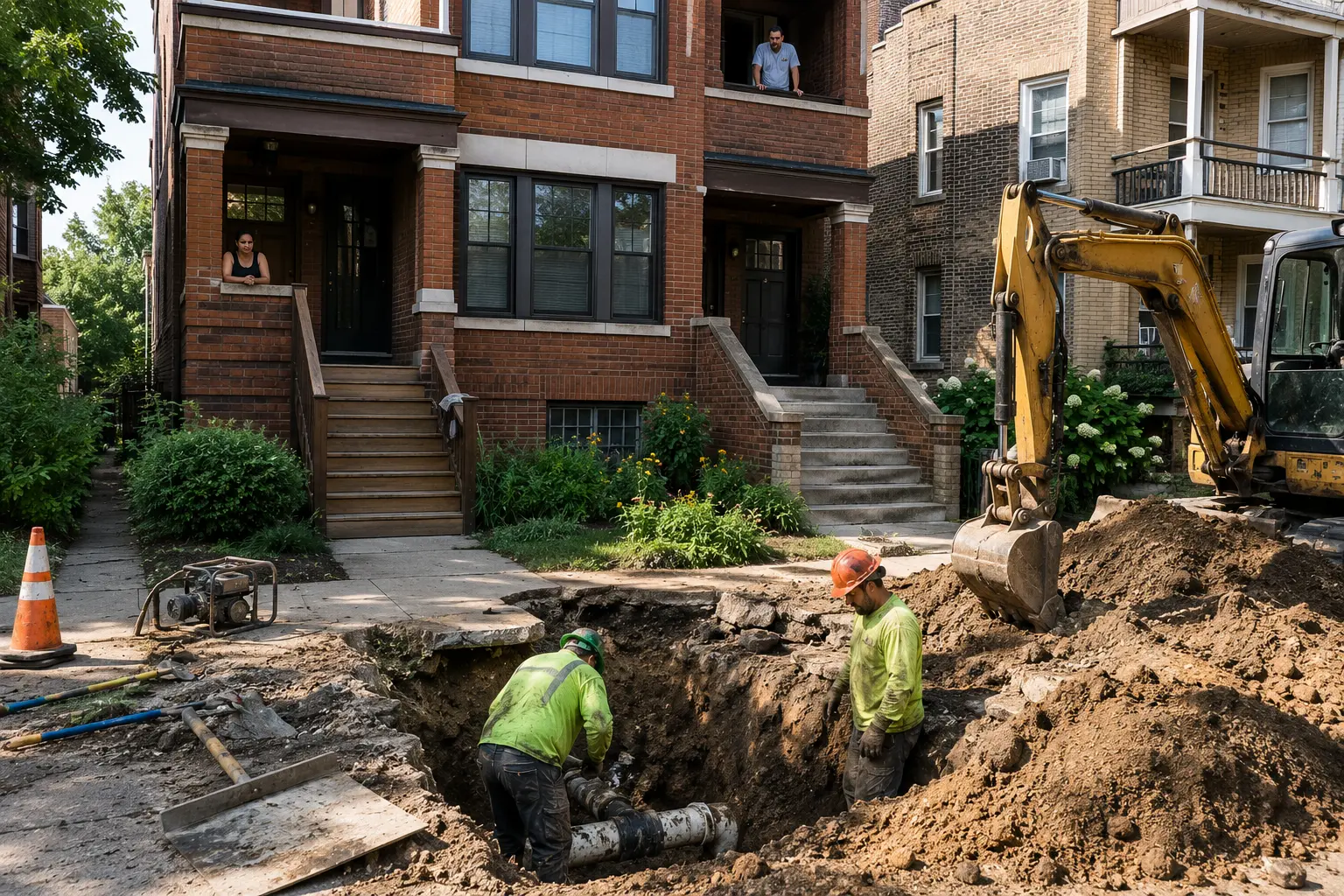
Sewer repair for two-flats and multi-unit homes in Chicago can be more complicated than sewer work for a single-family property. One sewer problem may affect multiple households, tenants, owners, or units, and the repair may involve shared drainage, access issues, permits, inspections, city rules, insurance questions, and responsibility disputes.
The most important point is that multi-unit sewer problems should be documented carefully before major work begins. The owner or association may need to determine whether the problem is in a private sewer lateral, shared building drain, public sewer main, easement area, or public-way location. That determination affects who pays, what permits are needed, how quickly repairs must be coordinated, and what records should be kept.
Key Takeaways
- Sewer repairs in two-flats and multi-unit homes can affect multiple occupants at the same time.
- Shared drains, common sewer lines, and older Chicago building layouts can make diagnosis more complicated.
- Responsibility may depend on ownership structure, property records, lease terms, condo documents, and the location of the defect.
- Permits and inspections are commonly required for major sewer repairs, replacements, excavation, or code-regulated work.
- Licensed professionals are especially important when several units depend on the same sewer system.
- Insurance coverage can vary depending on whether damage affects common areas, individual units, tenants, or the sewer line itself.
- Documentation matters for owners, tenants, associations, insurers, contractors, and future buyers.
Why Sewer Repairs Are Different in Two-Flats and Multi-Unit Homes
Sewer repair in a Chicago two-flat or multi-unit home is often more complex because one sewer line may serve multiple units, occupants, or ownership interests. A backup in one basement, bathroom, or floor drain may involve a shared drain line, private sewer lateral, building-wide plumbing issue, public sewer concern, or repair area that requires permits and inspections.
In a single-family home, the decision path is usually more direct: diagnose the private line, determine responsibility, and repair the problem if necessary. In a two-flat, three-flat, small apartment building, condo building, or mixed-use property, several additional questions may arise.
Who authorizes the work? Who pays? Are tenants affected? Is the problem limited to one unit or shared by the whole building? Does the repair require access through a rented space, common area, sidewalk, alley, or neighboring property?
For broader context on Chicago sewer rules, permits, inspections, and responsibility issues, see Chicago Permits, Codes & Local Rules.
Common Sewer Problems in Chicago Multi-Unit Buildings
Two-flats and multi-unit properties can experience the same sewer problems as single-family homes, but the consequences are often larger because more people rely on the system.
| Problem | Why It Matters in Multi-Unit Homes |
|---|---|
| Basement sewer backup | May affect storage, laundry areas, garden units, mechanical rooms, or tenant spaces. |
| Recurring main line clogs | More occupants can mean higher wastewater use and faster recurrence if the underlying issue is not fixed. |
| Tree roots in private lateral | Can affect all units served by the same sewer line. |
| Collapsed or cracked sewer pipe | May require excavation, permits, inspections, and temporary service disruption. |
| Shared drain configuration | Can make it harder to identify which unit, branch, or common line is involved. |
| Public sewer or storm-related backup | May affect multiple properties or lower-level units during heavy rain. |
Because symptoms can appear in one unit while the cause affects the whole building, diagnosis should focus on the drainage system as a whole rather than only the most visible backup location.
Who Is Responsible for Sewer Repair in a Two-Flat or Multi-Unit Property?
Responsibility depends on the property structure and the location of the defect. A building owned by one person is different from a condo building, a shared ownership arrangement, or a property with multiple legal interests.
Common responsibility factors include:
- Whether the building has one owner or multiple owners
- Whether the sewer line is private, shared, or public
- Whether the defect is inside the building or underground outside
- Whether the affected area is a common element
- Whether condo or association documents apply
- Whether tenant damage or habitability issues are involved
- Whether the defect is under private property, public way, or an easement
For the basic homeowner-versus-city responsibility framework, review Who Is Responsible for Sewer Lines in Chicago? and City Sewer Main vs Private Sewer Line: Who Pays?.
Shared Sewer Lines and Common Drainage
Some multi-unit properties have shared sewer lines or common drainage components. In those cases, one defect may affect multiple units or owners.
Shared sewer situations can raise practical questions:
- Is the problem in a unit branch line or the building main?
- Does the sewer line serve one building or multiple buildings?
- Does an association or owner group need to approve repairs?
- Who pays for diagnosis?
- Who pays for repair and restoration?
- Are tenants entitled to temporary accommodations or rent adjustments?
- Who keeps final documentation?
Practical owner note: If a sewer problem affects more than one unit, avoid treating it as an isolated tenant complaint until the shared drainage system has been evaluated.
Permits for Sewer Repair in Multi-Unit Homes
Major sewer repairs in two-flats and multi-unit homes often require permits, especially when the work involves excavation, pipe replacement, new connections, structural sewer repairs, or public-way impacts.
Permit questions are especially important in multi-unit properties because documentation may be needed by owners, associations, insurers, tenants, lenders, or future buyers.
Before work begins, ask:
- Does this sewer repair require a permit?
- Who will obtain the permit?
- Is the permit being pulled for the correct property and scope?
- Are multiple units or common areas listed correctly?
- Will inspections be required before backfill or completion?
- Will final permit approval documentation be provided?
For more detail, see Chicago Sewer Repair Permits: What Homeowners Need to Know and Chicago Sewer Replacement Permit Requirements.
Inspection Requirements and Code Concerns
Inspections help confirm that permitted sewer work meets applicable code requirements before the work is covered or finalized. In multi-unit homes, inspection issues can be especially important because several households may depend on the same drainage system.
Inspectors may review:
- Pipe material and size
- Slope and alignment
- Connections between old and new pipe
- Cleanout access
- Excavation and bedding
- Backfill and restoration
- Public-way impacts
- Compliance with the permitted scope of work
If required inspections are missed, the contractor may need to reopen the work area or complete corrective steps. That can create additional disruption for occupants.
Homeowners and property managers can learn more in Sewer Repair Inspection Requirements in Chicago.
Licensed Plumber and Contractor Requirements
Because multi-unit sewer repairs can affect health, sanitation, tenant use, and building-wide drainage, qualified contractor selection is especially important. Major sewer work should be handled by professionals who understand Chicago permitting, inspection, and code requirements.
Before hiring a contractor, ask:
- Are you licensed for this type of sewer work in Chicago?
- Have you handled sewer repairs for two-flats or multi-unit buildings?
- Will you provide camera footage and line locating results?
- Will you handle permits and inspections?
- How will access and service disruption be managed?
- Will tenants or occupants need to avoid water use during work?
- What restoration is included?
For more guidance, see Licensed Plumber Requirements for Sewer Work in Chicago.
Chicago-Specific Considerations for Two-Flats and Multi-Unit Homes
Older Building Stock
Many Chicago two-flats and small multi-unit buildings were built with older drainage layouts and aging sewer materials. Repairs may uncover clay pipe, cast iron, prior patches, unusual connections, or limited cleanout access.
Garden Units and Basement Apartments
Lower-level units are often most vulnerable to backups. If a garden unit, basement apartment, laundry area, or mechanical room floods, cleanup and habitability concerns may become urgent.
Public Way and Alley Access
Chicago buildings often drain toward a street or rear alley. Sewer repairs near public areas may require extra planning, permits, access coordination, and restoration.
Related location-specific guidance is available in Sewer Repair Near Streets and Alleys in Chicago.
Private Drain Program Questions
If a qualifying private drain defect is under the public way, Chicago’s Private Drain Program may become relevant. However, eligibility is not automatic and may depend on property type, location, and city review.
For more detail, see Understanding Chicago’s Private Drain Program.
Easements and Shared Access
Some buildings may have sewer lines that cross shared yards, gangways, neighboring property, or easement areas. These situations can affect access rights, restoration, and payment responsibility.
For related planning issues, see Understanding Sewer Line Easements in Chicago.
Cost Factors for Multi-Unit Sewer Repair
Sewer repair for two-flats and multi-unit homes may cost more than a simple single-family repair because access, coordination, occupancy, permits, and restoration can be more involved. Exact pricing varies based on the defect, pipe depth, repair method, location, and documentation needed.
| Cost Factor | Why It Matters |
|---|---|
| Number of affected units | More occupants can increase urgency, communication needs, and temporary service concerns. |
| Camera inspection and locating | Helps identify whether the issue is in a unit branch, common line, private lateral, or public-way area. |
| Pipe depth and access | Deep or hard-to-reach lines require more labor, equipment, and safety planning. |
| Permits and inspections | May add cost and affect scheduling. |
| Public-way work | Streets, alleys, sidewalks, or parkways may require additional restoration and coordination. |
| Tenant disruption | Water-use restrictions, cleanup, or habitability concerns may create additional costs. |
| Surface restoration | Concrete, asphalt, landscaping, common areas, or interior finishes may need repair. |
| Ownership structure | Associations, multiple owners, or shared lines can delay approval and payment decisions. |
Insurance Issues for Two-Flats and Multi-Unit Sewer Problems
Insurance can be more complicated in multi-unit buildings because damage may involve the building owner, tenants, condo owners, common areas, personal property, and underground service lines.
Coverage depends on the policy type, endorsements, exclusions, cause of loss, and whether the claim involves cleanup, interior damage, liability, or pipe repair.
Insurance questions to review:
- Does the policy include sewer backup or water backup coverage?
- Is there service line coverage for underground pipe repair?
- Are tenant belongings covered by tenant renters insurance instead?
- Are common areas treated differently from individual units?
- Are code upgrades or permit costs covered?
- Are there exclusions for wear, roots, deterioration, or maintenance issues?
- What documentation does the insurer require?
Owners should document the backup, cleanup, repair diagnosis, contractor findings, and communication with occupants as early as possible.
Managing Tenants and Occupants During Sewer Repairs
Sewer repairs in occupied buildings require clear communication. Even a short repair can affect toilet use, laundry, showers, basement access, parking, or alley access.
Owners and property managers should consider:
- How long sewer service may be limited
- Which units are affected
- Whether tenants should avoid flushing or running water
- Whether cleanup is needed in living areas
- Whether temporary access restrictions affect parking or storage
- How emergency contact updates will be shared
- What documentation should be provided after completion
Clear communication can reduce conflict and help occupants understand the repair timeline.
Common Mistakes Owners Make
Treating a Building-Wide Backup as a Single-Unit Issue
A backup visible in one unit may be caused by a shared drain or main sewer issue affecting the whole property.
Approving Work Without Understanding Responsibility
Owners should confirm whether the issue is private, shared, public, or easement-related before authorizing major excavation.
Skipping Permit and Inspection Questions
Major sewer repairs often require permits and inspections. Documentation matters more when multiple occupants or owners are involved.
Failing to Communicate With Tenants
Unclear communication can lead to water use during repairs, complaints, missed access windows, or preventable damage.
Not Preserving Camera Footage and Repair Records
Multi-unit properties should keep organized records for future repairs, insurance issues, resale, and tenant disputes.
Warning Signs That a Multi-Unit Sewer Problem Needs Careful Review
Owners should slow down and gather documentation when:
- More than one unit is backing up or draining slowly.
- The lowest unit repeatedly floods during heavy rain.
- Rodding provides only temporary relief.
- Camera footage shows a defect near a street, alley, sidewalk, or public way.
- The sewer line appears to serve multiple units or buildings.
- The repair requires access through a tenant space or neighboring property.
- The building has a condo association, shared ownership, or easement issue.
- The contractor recommends excavation without clear locating results.
These warning signs do not determine responsibility by themselves, but they do mean the owner should document the issue before making expensive decisions.
Frequently Asked Questions
Who pays for sewer repair in a Chicago two-flat?
If one owner owns the building, the owner is often responsible for private sewer repairs. If there are multiple owners, shared lines, or association documents, payment responsibility may depend on property records and ownership structure.
Is a sewer backup in one unit always that tenant’s fault?
No. A backup in one unit may be caused by a shared building drain, private sewer lateral, public sewer issue, or blocked main line. Diagnosis is needed before assigning responsibility.
Do multi-unit sewer repairs require permits?
Major repairs, excavation, replacement, new connections, and public-way work often require permits and inspections. Minor maintenance may not, depending on the scope.
Can tenants use water during sewer repair?
Sometimes water use must be limited during active sewer work. The contractor should explain when occupants should avoid flushing toilets, running laundry, or using drains.
Does insurance cover sewer backups in multi-unit buildings?
Coverage depends on the policy. Sewer backup coverage, service line coverage, landlord policies, condo master policies, and renters insurance may all be relevant depending on the damage.
What if the sewer line serves multiple buildings?
Shared sewer service can create responsibility and access questions. Property records, easements, surveys, and contractor findings may be needed before repair costs can be divided.
Should a two-flat owner call 311 for a sewer backup?
Calling 311 can be useful if public infrastructure, heavy rain, street flooding, multiple nearby properties, or public-way defects may be involved. A private sewer inspection may still be needed.
Can Chicago’s Private Drain Program apply to multi-unit buildings?
Possibly in limited circumstances, but eligibility is not automatic and may depend on property type, unit count, defect location, documentation, and city review.
Conclusion
Sewer repair for two-flats and multi-unit homes in Chicago requires careful planning because one problem can affect multiple occupants, owners, units, and responsibilities. The repair may involve private sewer lines, shared drains, public-way areas, easements, permits, inspections, insurance coverage, and tenant communication.
The best approach is to document the issue early, locate the defect accurately, confirm who is responsible, hire qualified professionals, verify permit and inspection requirements, and keep final records. That process helps reduce confusion, protect the property, and avoid costly disputes when several people depend on the same sewer system.