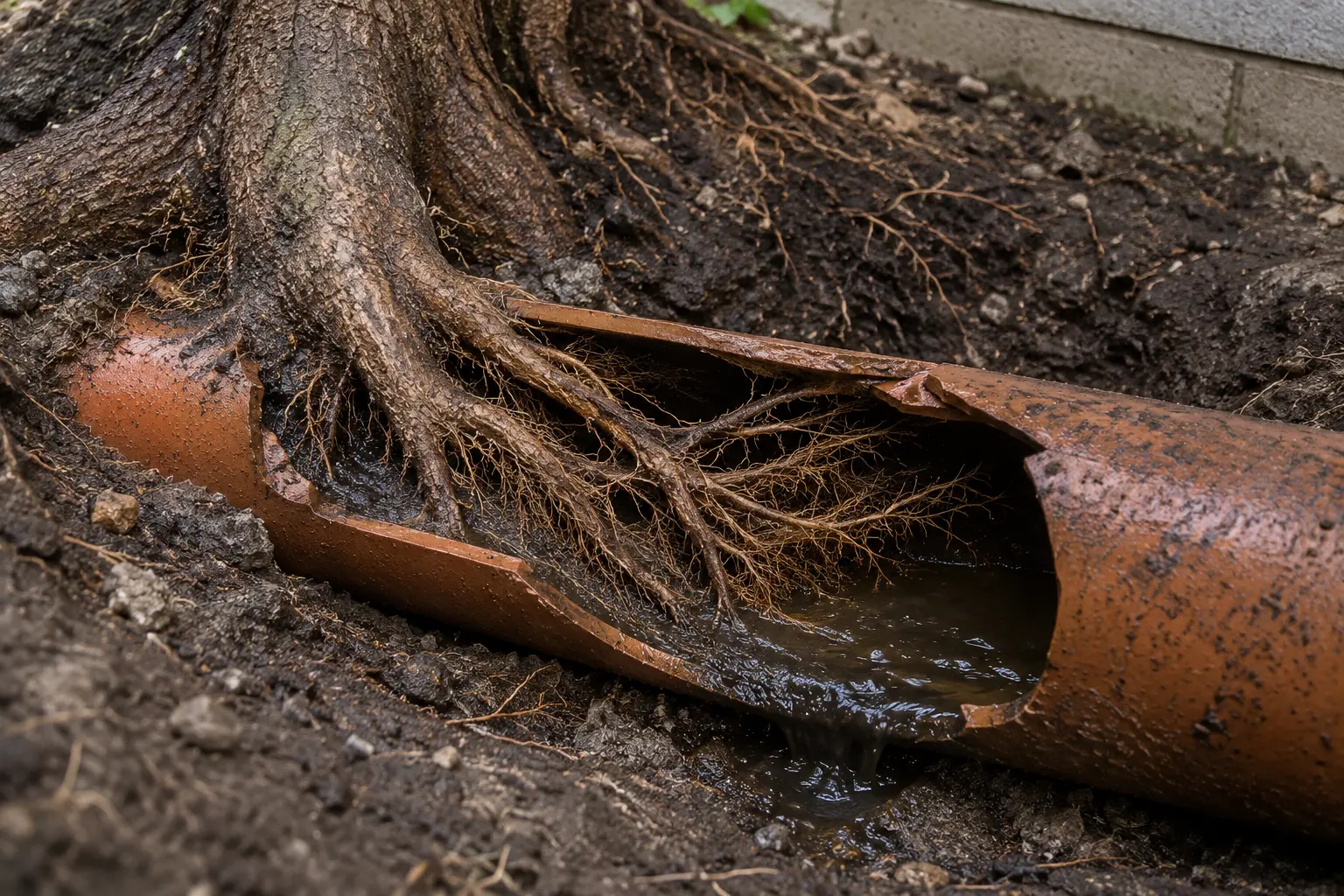
Tree roots in sewer lines can cause slow drains, recurring clogs, gurgling toilets, sewage odors, basement backups, and repeated main line cleaning needs. Roots usually enter through cracks, loose joints, offset pipe sections, or deteriorated sewer pipe, then grow inside the line where they trap waste and restrict flow.
For Chicago homeowners, root intrusion is a common concern because many neighborhoods have mature trees, older sewer laterals, clay pipe sections, and compact lots where the sewer line may run near tree roots, parkways, sidewalks, or older underground utilities. Root problems may start slowly, but they can eventually lead to backups, pipe damage, and difficult repair decisions.
Tree roots do not always mean the entire sewer line needs replacement. Some root problems can be managed with cleaning or targeted repair. However, if roots keep returning, affect multiple pipe joints, or appear with cracked clay pipe, offset joints, a sewer line belly, or a collapsed section, the problem may be more structural than routine maintenance.
Key Takeaways
- Tree roots enter sewer lines through cracks, gaps, loose joints, offsets, or weakened pipe sections.
- Common signs include frequent sewer clogs, slow drains throughout the house, gurgling drains, sewer odors, and basement backups.
- Root cutting may restore flow temporarily, but it does not fix the opening where roots entered.
- Older Chicago homes with clay sewer pipes and mature nearby trees may be more vulnerable to root intrusion.
- A sewer camera inspection can show where roots are entering and whether the pipe is otherwise stable.
- Solutions may include cleaning, root cutting, hydro jetting, targeted repair, pipe lining, partial replacement, or full replacement depending on pipe condition.
- Repeated root problems should be treated as a warning sign, not just a routine clog.
What Tree Roots in a Sewer Line Usually Mean
Tree roots in a sewer line usually mean the pipe has an opening that allowed roots to enter. That opening may be a crack, separated joint, offset pipe connection, deteriorated clay section, or damaged area. Once roots enter, they can catch toilet paper, grease, wipes, and debris until wastewater slows or backs up.
If roots are found once and the pipe is otherwise intact, cleaning or targeted repair may be enough. If roots keep returning after service, appear in several sections, or are connected to cracked, offset, bellied, or collapsed pipe, the sewer line may need more than temporary cleaning.
How Tree Roots Get Into Sewer Lines
Roots Follow Moisture
Tree roots naturally grow toward moisture and nutrients. A sewer line can become attractive to roots if a small crack, loose joint, or leak allows moisture to escape into the surrounding soil. Roots do not need a large opening to start entering the pipe.
Once inside, roots can continue growing because the sewer line provides water and organic material. Over time, the root mass can become thick enough to restrict flow and catch waste.
Older Pipe Joints Are Vulnerable
Many older sewer systems use pipe sections connected by joints. If those joints loosen, shift, or separate, roots can enter through the gap. This is especially common in older clay pipe systems, where individual sections may move over time.
Root intrusion at a joint may begin as a small maintenance issue. If the joint continues to shift or deteriorate, the root problem may return even after the line is cleaned.
Cracked Clay Pipe Can Let Roots In
Clay sewer pipe can last a long time, but it can crack, separate, or shift as it ages. Roots may exploit those openings. In Chicago, older properties with mature trees and clay sewer laterals may be more likely to experience this kind of problem.
If a camera inspection shows root intrusion through cracked clay sections, homeowners may also want to review Cracked Clay Sewer Pipes: Causes and Risks.
Offset Pipe Sections Can Create Root Entry Points
An offset sewer pipe joint happens when two pipe sections no longer line up smoothly. Roots can enter through the gap, while waste can catch on the offset edge. This creates both a structural issue and a clogging issue.
Root intrusion and offset joints often reinforce each other. The offset catches waste, roots catch more waste, and the line becomes increasingly vulnerable to repeated clogs.
Signs You May Have Tree Roots in the Sewer Line
Frequent Sewer Clogs
Recurring clogs are one of the most common signs of root intrusion. A line may clear after rodding or cleaning, only to clog again weeks or months later. That pattern suggests something inside the pipe is repeatedly catching waste.
If the sewer line keeps clogging, the issue may not be what was flushed recently. It may be roots, pipe damage, a belly, or an offset joint. The related guide Why Do Sewer Lines Keep Clogging? explains how repeated clogs can point to a deeper issue.
Slow Drains Throughout the House
Roots can narrow the sewer line gradually. At first, homeowners may notice that tubs, showers, toilets, laundry drains, or basement floor drains take longer to empty. The problem may become more noticeable when several fixtures are used at the same time.
Slow drainage throughout the home is more concerning than one slow sink. It often means the restriction is farther downstream in the main drain or sewer lateral. For more context, see What Slow Drains Throughout the House Can Mean.
Gurgling Toilets or Drains
As roots restrict the pipe, wastewater and air may not move smoothly. This can cause toilets, tubs, showers, or basement drains to gurgle. Gurgling may happen when the washing machine drains, a toilet flushes, or a bathtub empties.
Gurgling alone does not prove roots are involved, but gurgling with repeated clogs or slow drains should be taken seriously.
Sewage Odors
Roots can trap waste inside the pipe, contributing to sewer odors near drains or in the basement. If roots are connected to cracks or pipe separation, sewer gas or wastewater may also escape where it should not.
Because sewage smells can come from several sources, odor should be evaluated along with the full pattern of symptoms. The article Why Your House Smells Like Sewage explains how to think through odor sources.
Basement Sewer Backups
If roots restrict the main sewer line enough, wastewater may back up into the basement through a floor drain, shower, toilet, or laundry drain. This is one of the most serious warning signs because it can cause contamination and property damage.
Chicago basements are especially vulnerable because they often contain the lowest drain openings in the home. If roots contribute to a blockage, the basement may be where the problem becomes visible first.
Recurring Problems Near Trees or Parkway Areas
If backups or clogs seem to recur in a home with mature trees nearby, roots may be worth considering. Roots from trees on private property, parkways, or neighboring areas can all create problems when the sewer line has vulnerable openings.
The presence of trees does not prove the cause, but it increases the importance of camera inspection when symptoms keep returning.
How Serious Are Tree Roots in a Sewer Line?
Tree roots can range from a manageable maintenance issue to a sign of structural sewer line failure. The seriousness depends on how much root growth is present, where roots entered, and what condition the pipe is in.
| Inspection Finding | What It May Mean | Possible Next Step |
|---|---|---|
| Small roots at one joint | One entry point may be allowing roots into the line. | Cleaning, monitoring, or targeted repair may be considered. |
| Heavy root mass | Roots are significantly restricting flow. | Cleaning plus camera inspection to assess pipe damage. |
| Roots at multiple joints | The pipe may have several vulnerable sections. | Repair or replacement may become more likely. |
| Roots through cracked clay pipe | The pipe wall may be structurally damaged. | Targeted repair, lining, or replacement depending on severity. |
| Roots with offset joints | The pipe has shifted and is catching waste. | Structural repair may be needed if cleaning does not hold. |
| Roots with a collapsed section | The line may be failing beyond routine maintenance. | Replacement or excavation may be necessary. |
Chicago-Specific Considerations
Mature Trees and Older Neighborhoods
Many Chicago neighborhoods have mature parkway trees, older homes, and sewer laterals that may have been in place for decades. Roots become more of a concern when older pipe materials develop cracks, weak joints, or separation.
A large tree near the sewer route does not automatically mean the tree is the problem. Roots need an entry point. The real question is whether the sewer line has openings that allow roots inside.
Clay Sewer Pipes
Older clay sewer pipes are especially relevant because they are made of sections joined together. As soil shifts or joints deteriorate, roots can enter through small gaps. Clay can also crack, creating additional entry points.
If roots are found in a clay line, homeowners should ask whether the pipe is otherwise stable or whether the camera shows cracking, offsets, or separation.
Basements and Low Drain Openings
Chicago homes commonly have basement floor drains, laundry drains, utility sinks, and lower-level bathrooms. If roots create a main line restriction, wastewater may appear in the basement before homeowners notice problems elsewhere.
The related article Sewer Backup in Basement: Causes and Warning Signs explains why basement backups can be a major warning sign.
Parkways, Sidewalks, and Access
Root problems may occur under private yards, gangways, sidewalks, parkways, or near the city connection. Access can affect repair complexity. If excavation is needed, restoration may involve concrete, landscaping, soil, or public-way considerations.
Seasonal Patterns
Some homeowners notice root-related symptoms more during certain times of year, but root intrusion can cause problems at any time once roots are inside the pipe. The most useful pattern is not the season alone, but whether clogs keep returning after the line is cleaned.
How Tree Roots Are Diagnosed
Drain Cleaning May Reveal the Pattern
If a sewer line is cleaned and roots are removed, that can confirm roots are part of the blockage. However, cleaning alone does not show the full pipe condition. It may not reveal whether roots entered through one joint or several damaged sections.
Sewer Camera Inspection Shows the Entry Point
A camera inspection is usually the most useful diagnostic step after a root problem is suspected. It can show where roots are entering, how severe the intrusion is, whether the pipe is cracked or offset, and whether water is standing in the line.
Homeowners should ask for a plain-language explanation of the footage. The most important questions are:
- Where are the roots entering?
- Is there one root entry point or several?
- Is the pipe cracked, offset, bellied, or collapsed?
- Does the line drain fully after cleaning?
- Is the pipe material clay, cast iron, PVC, or mixed?
- Is repair possible, or is replacement being recommended?
Practical Homeowner Tip
Roots are not just a clogging problem. They are often a pipe-entry problem. The best diagnosis should explain both the blockage and the opening that allowed roots into the sewer line.
Solutions for Tree Roots in Sewer Lines
Mechanical Root Cutting
Mechanical cutting can remove roots from inside the sewer line and restore flow. This may be appropriate when the immediate goal is to clear a blockage and get the line draining again.
The limitation is that root cutting does not repair the crack, gap, or joint where roots entered. If the opening remains, roots may grow back.
Hydro Jetting
Hydro jetting uses high-pressure water to clear roots, sludge, grease, and debris from the line. It may be useful when the pipe is strong enough to handle the process and when buildup is part of the problem.
Hydro jetting may not be appropriate for every old or damaged pipe. If the line is fragile, cracked, or partially collapsed, inspection should guide whether jetting is safe or useful.
Chemical Root Treatments
Some root treatments are designed to slow root regrowth inside the pipe. These treatments may help in certain maintenance situations, but they do not repair structural openings. Homeowners should be cautious about relying on chemical treatment alone if roots are entering through major pipe damage.
Targeted Sewer Repair
If roots are entering through one damaged joint or one cracked section, a targeted repair may be enough. This can address the entry point without replacing the entire sewer line.
Targeted repair is most practical when the rest of the line is in good condition and the damage is limited.
Pipe Lining
In some situations, lining may create a new interior surface inside the existing pipe. This may help seal certain cracks or joints if the host pipe is suitable. However, lining is not always appropriate for collapsed pipes, severe offsets, major bellies, or lines that cannot be cleaned and prepared properly.
Partial or Full Replacement
Replacement may be considered when roots have entered multiple sections, the pipe is badly cracked, several joints have shifted, or the line has collapsed. Replacement is a larger decision, but it may be more practical when the sewer line is failing structurally.
If roots are one of several warning signs, Signs Your Sewer Line May Need Replacement can help homeowners understand when replacement becomes more likely.
Cost Factors and Tradeoffs
The cost of dealing with tree roots depends on whether the issue is treated as maintenance, repair, or replacement. A one-time cleaning is different from repairing a damaged pipe section, and a targeted repair is different from replacing a long sewer run.
Important cost factors include:
- Severity of root growth: Light roots may be easier to clear than a dense mass that repeatedly blocks the line.
- Number of entry points: One root entry point is different from roots entering throughout the line.
- Pipe condition: Roots in an otherwise stable pipe may be handled differently than roots in cracked or collapsed pipe.
- Pipe material: Clay, cast iron, PVC, and mixed-material lines can affect repair options.
- Pipe depth: Deeper sewer lines can make excavation and repair more complex.
- Location: Roots under a yard may be simpler to address than roots under concrete, a basement floor, sidewalk, or parkway.
- Restoration: Concrete, landscaping, flooring, and public-way restoration can affect total cost.
- Urgency: A root problem that has already caused a basement backup may require faster action.
The tradeoff is between temporary relief and long-term reliability. Cleaning may be less expensive upfront, but if the same root problem keeps causing backups, homeowners may spend repeatedly without solving the pipe defect.
When Root Problems Become an Emergency
Tree roots are often a developing problem, but they can become urgent when they block the line enough to cause sewage to back up into the home. Warning signs include wastewater rising from a basement floor drain, several drains refusing to drain, strong sewer odors, or toilets backing up during normal use.
Root intrusion becomes more urgent when:
- Sewage is actively backing up into the basement.
- Multiple fixtures are affected at the same time.
- Drain cleaning does not restore normal flow.
- The camera cannot pass through the line.
- There is evidence of collapse or severe pipe damage.
- Finished basement areas or utilities are at risk.
Homeowners unsure about urgency can review When Does a Sewer Problem Become an Emergency?.
Common Mistakes Homeowners Make
Assuming Root Cutting Fixes the Sewer Line
Root cutting can clear the pipe, but it does not fix the opening where roots entered. If the pipe defect remains, the roots may return.
Waiting for the Next Backup
If a sewer line has a known root problem, waiting until the next backup can increase cleanup costs and reduce time for comparing repair options.
Ignoring the Pipe Condition
Roots are only part of the story. Homeowners should ask whether the pipe is cracked, offset, bellied, or collapsed. The pipe condition usually determines whether maintenance is enough.
Using Chemicals Without Diagnosis
Chemical root treatments may not solve structural problems. If the line has repeated backups or multiple root entry points, diagnosis is more important than guessing.
Removing a Tree Without Confirming the Sewer Issue
Tree removal does not automatically fix roots already inside a sewer line, and roots may not be from the tree the homeowner suspects. The sewer line condition should be confirmed before making major landscape decisions.
Comparing Quotes Without Comparing Scope
One quote may cover cleaning only. Another may include camera inspection. Another may include excavation, pipe repair, or restoration. Homeowners should compare what is actually included.
FAQ
How do I know if tree roots are in my sewer line?
Common signs include frequent sewer clogs, slow drains throughout the house, gurgling toilets, sewage odors, and basement backups. A sewer camera inspection is usually the clearest way to confirm roots and identify where they are entering.
Can tree roots break a sewer pipe?
Roots usually enter through an existing opening, such as a crack, loose joint, or offset section. Once inside, they can expand and worsen the problem by trapping waste, increasing pressure, and contributing to further pipe damage.
Does finding roots mean the sewer line must be replaced?
Not always. If roots are limited to one entry point and the pipe is otherwise stable, cleaning or targeted repair may be enough. Replacement becomes more likely when roots enter through multiple damaged sections or the pipe is cracked, collapsed, or badly deteriorated.
Will roots come back after the sewer line is cleaned?
They can. Cleaning removes roots from inside the pipe, but it does not seal the opening where they entered. If the crack, joint, or offset remains, roots may grow back over time.
Are Chicago homes more likely to have root problems?
Many Chicago homes have conditions that can make root intrusion more likely, including older sewer laterals, clay pipe sections, mature trees, and shifting pipe joints. The risk depends on the pipe condition and whether roots have an entry point.
Can tree roots cause a basement sewer backup?
Yes. If roots restrict the main sewer line enough, wastewater may back up into the lowest drains in the home. In many Chicago homes, that means basement floor drains, laundry drains, lower-level showers, or basement toilets.
Will homeowners insurance cover tree roots in a sewer line?
Coverage depends on the policy, endorsements, and cause of damage. Many policies treat wear and tear, deterioration, and maintenance issues differently from sudden covered damage. Sewer backup coverage and service line coverage may also have separate rules and limits.
Should I remove a tree if roots are in my sewer line?
Not automatically. The priority is to identify where roots are entering and whether the pipe can be repaired. Removing a tree may not fix roots already inside the line or repair the pipe defect that allowed entry.
Conclusion
Tree roots in sewer lines are a common cause of recurring clogs, slow drains, gurgling toilets, sewage odors, and basement backups. Roots usually enter through a defect in the pipe, such as a crack, loose joint, offset, or deteriorated clay section. That means the real issue is often both the root blockage and the pipe opening that allowed it.
For Chicago homeowners, root intrusion is especially important because older sewer laterals, mature trees, clay pipe, basements, and tight access conditions can make repeated sewer problems more disruptive. A single cleaning may restore flow, but recurring root problems should be evaluated with the long-term condition of the sewer line in mind.
The best next step is usually to confirm the location and severity of the roots, understand the pipe condition, and compare maintenance, repair, lining, or replacement options based on evidence. That approach helps homeowners avoid both unnecessary major work and repeated short-term fixes that do not address the actual cause.